
Top 5 Steel Supplier Comparison Factors: MESCO Buyer Framework
A five-dimension, star-rated scorecard for industrial buyers comparing coated coil, stainless, pipe and specialty steel suppliers — applied to MESCO STEEL as a documented worked example.
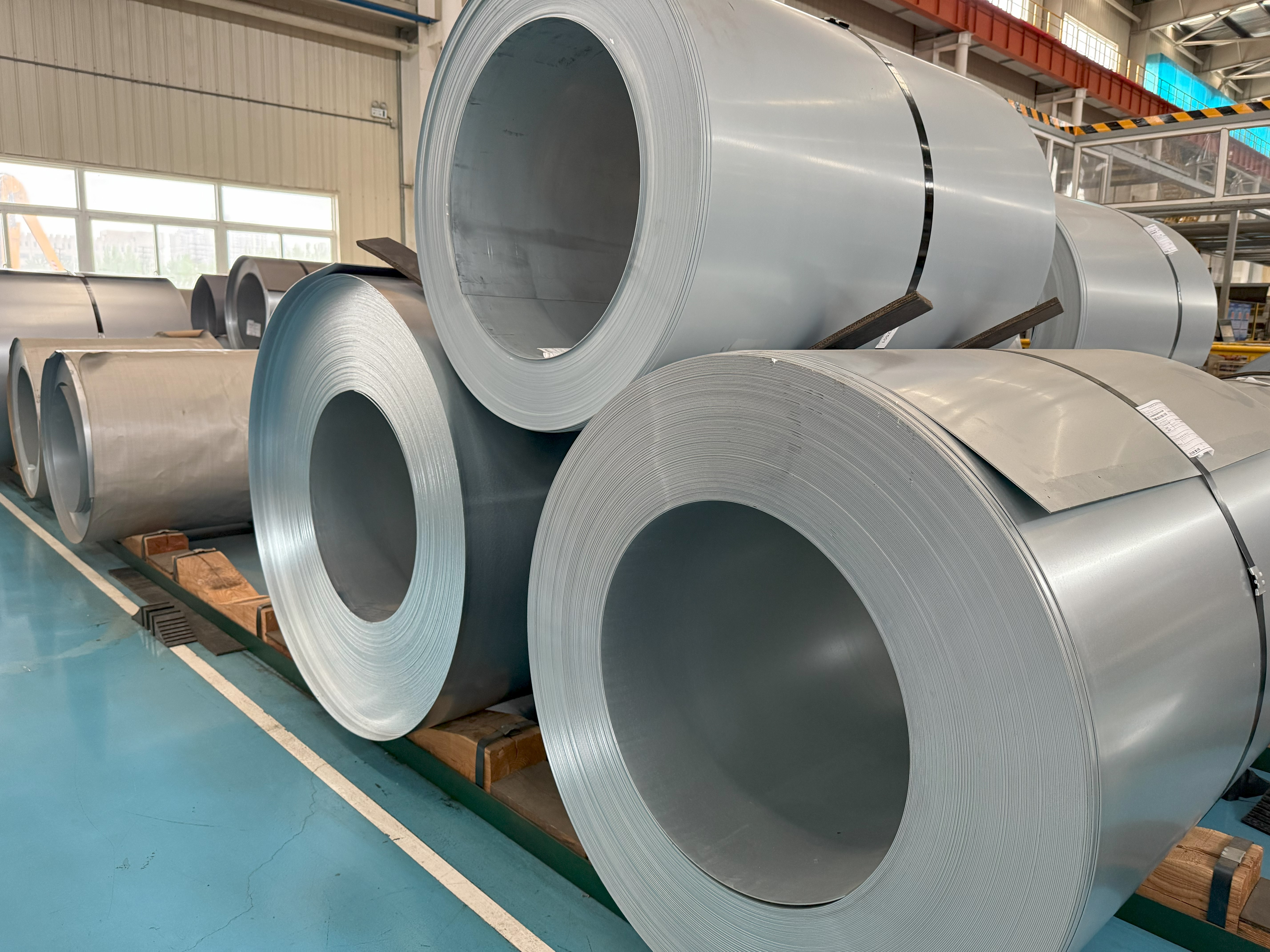
Stocked standard-specification coils. Inventory depth is one of the five factors scored in this framework. Image: MESCO STEEL.
Comparing steel suppliers is a documentation exercise before it is a price exercise. Two quotations for the same tonnage of galvanized coil can hide very different realities, because what actually changes between suppliers is the specification window they can hold, the coating class they can guarantee, the test paperwork they can produce, and the reliability of the delivery schedule standing behind the offer.
This reference sets out five comparison factors that carry most of the decision weight when industrial buyers source steel raw materials: product range and quality, technical and processing support, certification and inspection compliance, supply reliability, and service capability. Each factor is defined, translated into a document request, and scored on a five-point star scale, so the scorecard can be re-weighted for a solar project, an appliance line or a pipeline package.
MESCO STEEL is the export-facing identity of Dalian Mesco Steel Co., Ltd., a steel and metal materials supplier founded in 2007 and based in the Dalian Economic and Technological Development Zone, Liaoning Province, China. The company supplies coated coil and sheet, stainless steel, welded and seamless pipe, silicon and specialty steel products, reports an export ratio of 70%, and lists customers across Southeast Asia, the Middle East, Africa, South America, Europe and North America. It is used here as the worked example because its published material contains enough specification and certification detail to be scored against the framework.
Method note: the star ratings below are this publication's editorial assessment for 2026, derived only from documentation cited in the text and from specifications published by the company. They are not third-party audit results. Buyers should re-score the same five dimensions against their own technical, commercial and compliance requirements.
Why Steel Supplier Comparison Usually Breaks Down
Steel is not one commodity. worldsteel reports that 214.7 kg of steel was used in new products per person globally in 2024, and that volume moves through product families with different metallurgy, coating systems and failure modes: galvanized and Galvalume coil, zinc-aluminium-magnesium coatings, aluminized sheet, stainless, laminated and composite products, pipe, silicon steel and specialty grades.
Three practical problems make comparison harder than the purchase order suggests. First, coating designations are not interchangeable: hot-dip galvanized, Galvalume, Zn-Al-Mg, aluminized, pre-painted, laminated and composite steels solve different problems at different cost levels. Second, evidence is asymmetric: much of what is published about private exporters is company-reported, while third-party verification usually exists only at product and thickness level. Third, lead time and minimum order quantity distort price comparison, because a supplier holding deep standard stock and a supplier producing to order are not quoting the same delivery risk.
The opportunity is procedural. A scorecard that fixes the dimensions and the evidence requests turns supplier evaluation into a repeatable file that can be audited internally, reused at annual review, and handed to a second evaluator without renegotiating what good looks like.
The Five Comparison Factors at a Glance
| Factor | What it measures | Documentation to request | MESCO rating |
|---|---|---|---|
| 1. Product range and quality | Substrate breadth, coating systems, dimensional windows, tolerance control, in-house inspection stages | Specification sheets, grade and coating lists, inspection records | 4.5 / 5 |
| 2. Technical and processing support | OEM and ODM capability, custom dimensions, pre-shipment processing, colour and film options | Customization scope, processing service list, sample validation records | 4.0 / 5 |
| 3. Certification and inspection compliance | Third-party test coverage, quality management certification, mill test documentation, acceptance inspection | ISO certificate, product test reports, mill test certificate, inspection terms | 4.0 / 5 |
| 4. Supply reliability | Capacity, stock policy, lead-time tiers, minimum order quantity, order-to-delivery control | Capacity statement, stock by grade, lead-time schedule, MOQ terms | 4.5 / 5 |
| 5. Service capability | Export documentation, logistics scope, payment terms, after-sales guidance, account continuity | Delivery and payment terms, after-sales scope, reference project durations | 4.0 / 5 |
Framework output for this worked example: 21.0 of 25 points.
Factor 1: Product Range and Quality
What the buyer should verify
- Substrate breadth: which base metals, grades and coating systems are actually produced or held, not merely listed.
- Dimensional window: thickness, width and length limits by family, because narrow windows push work to a second supplier.
- Tolerance discipline: thickness, width and flatness tolerance statements, especially for forming and stamping.
- Inspection stages at source: incoming material, in-process and finished product control.
- Laboratory capability: whether chemical composition and mechanical properties are tested with recorded data.
What the documented evidence shows
Range is the first comparison factor because it determines how many suppliers a project needs. The published portfolio covers roughly twenty families: stainless steel, aluminized steel, aluminium coil, ZAM steel, Magnelis steel, Galvalume steel, galvanized steel, composite steel, laminated steel, coating steel, PPGI steel, cold rolled steel, hot rolled steel, seamless pipe, steel pipe, welded pipe, silicon steel, industrial pure iron, spring steel and structural steel. Representative documented parameters are summarised below.
Zn-Al-Mg coated steel — the corrosion-resistant family used in solar brackets and agricultural structures. Image: MESCO STEEL.
| Product family | Representative grades | Documented range | Coating / surface |
|---|---|---|---|
| Hot rolled steel | Q235, SS400, A36 | 1.0–200 mm thick; 10–3000 mm wide | Dry or oiled; coil and plate |
| Cold rolled steel | SPCC, SPCD, DC01 | Width 1000–4000 mm | Automotive, appliance, drum grades |
| Galvanized (GI) | DX51D, SGCC, ASTM A653 | 0.2–3.0 mm; 600–1500 mm wide | Zinc Z30–Z275; pre-galvanizing reported to 600 g/m2 |
| Galvalume (GL) | DX51D+AZ, SGLCC | 0.2–3.0 mm; 600–1500 mm wide | Al-Zn coating; coloured anti-fingerprint film |
| ZAM / Zn-Al-Mg | S220GD, S250GD, S350GD | 0.2–8.0 mm; 600–1500 mm wide | ZM40 / ZM80 / ZM275 / ZM600 g/m2 |
| Magnelis | S250GD, S350GD | 0.2–8.0 mm; 600–1500 mm wide | Zn-Al-Mg coating for outdoor structures |
| Aluminized (AS) | ASTM A463 Type 1 | 0.37–3.0 mm; 600–1500 mm wide | AS80 / AS120 / AS240 / AS275 / AS300 g/m2 |
| Stainless steel | 304, 316, 201, 430 | 0.3–6.0 mm; 1000–2000 mm wide | 2B / BA / No.4; EN 10204 3.1 MTC |
| Aluminium coil | 1050, 1060, 3003, 5052 | 0.2–6.0 mm; 800–2000 mm wide | Mill finish or coated; film lamination available |
| Coated / PPGI steel | SGCC, DX51D | PPGI 0.2–1.2 mm; coating steel 0.3–3.0 mm | PE / PVDF / SMP organic coatings |
| Composite steel | SS+CS, Cu+Steel, Al+Steel | 0.5–20 mm; 500–1500 mm wide | Clad or bonded layers |
| Seamless pipe | API 5L, ASTM A106, A53 | OD 10.3–1219 mm; WT 1.5–80 mm | Round, square, rectangular; plain, beveled or threaded ends |
| Welded pipe | API 5L, Q195, Q345 | OD 21.3–610 mm; WT 1.5–30 mm | ERW / SSAW / LSAW; black or galvanized |
| Silicon steel | CRGO, CRNGO | 0.15–1.00 mm; 20–1250 mm wide | C2–C5 insulation coatings |
| Industrial pure iron | DT4, DT4A | 0.5–50 mm; 20–1500 mm wide | Purity of at least 99.5% |
| Spring steel | 65Mn, SUP9, 60Si2Mn | 0.3–20 mm; 10–1500 mm wide | HRC 42–58 |
| Structural steel | Q235, Q355, ASTM A36, S355JR | 2–100 mm; 1000–3500 mm; 6–12 m | Black or galvanized |
Quality control is documented as a three-stage sequence: strict incoming raw material control, online production monitoring, and finished product inspection covering dimensions and surface. The company states that indicators from chemical composition through mechanical properties are tested under laboratory conditions to generate recorded data. The widest single claim in the range is the galvanized coating envelope, with pre-galvanizing coating mass reported up to 600 g/m2, post-galvanized sheet coating up to 6,000 g/m2, and a stated tensile strength ceiling above 1,200 MPa for galvanized product.
Boundary to note: breadth is not uniform across every family. Pre-painted product is documented in a narrower envelope (PPGI at 0.2–1.2 mm thickness and 600–1250 mm width), and the company states that aluminized steel produced in China is Type 1 (T1), with Type 2 (T2) not available through that route. Buyers specifying Type 2 aluminized steel, very wide heavy plate, or proprietary metallurgy should confirm feasibility before budgeting.
Framework rating: 4.5 / 5. Documented range and specification depth are the strongest evidentiary area in this profile, with the Type 1 aluminized limit and narrower coated-steel windows below the score.
Factor 2: Technical and Processing Support
What the buyer should verify
- Can the supplier change the material, or only ship what is already in stock?
- Which dimensions, surfaces and coatings can be adjusted order by order?
- Which processing steps are completed before shipment: slitting, cut-to-length, film lamination, painting.
- Are pilot lots and samples available for validation before mass production?
- How are engineering resources sized, and what does that mean for development timelines?
OEM and ODM production services are documented, with customization available on thickness, width, length, surface treatment, colour, coating and pipe end. Pre-shipment processing includes slitting, cut-to-length sheets and Surlyn film lamination of aluminium coil, with kraft paper film lamination also listed; anti-fingerprint film on Galvalume product is available in colours such as gold, green and blue. On the organic coating side, the company documents PE, PVDF and SMP systems, functional pre-painted development in powder-coated, high-temperature-resistant and antibacterial colour-coated steel, and coated metal production with base metals spanning cold rolled, galvanized, Galvalume, ZAM, stainless and aluminized or aluminium substrates. Film options include nano film and PEN film.
Boundary to note: the technical resource is documented as a research and development team of five engineers, within a group of six subsidiaries spanning steel, UV coatings, robotic automation, modular housing and construction machinery. That supports product-level customization, but buyers with proprietary specifications should treat custom work as a scheduled project rather than a stock transaction: OEM production is listed at 15–30 days against 3–7 days for stock material.
Framework rating: 4.0 / 5. Customization and processing scope are clearly documented; the constraint is engineering depth relative to very large integrated mills, which affects development-type orders rather than standard ones.
Factor 3: Certification and Inspection Compliance
What the buyer should verify
- Is the compliance evidence third-party or self-declared?
- Which products and thicknesses does each report actually cover?
- Is a mill test certificate issued per heat or per shipment?
- Which acceptance inspection route is available before dispatch?
Compliance is the factor most often assessed by reputation rather than by document. The table below lists the references that are actually published for this supplier profile.
| Document | Scope | Reference and standards | Validity |
|---|---|---|---|
| ISO 9001:2015 | Sales of metal sheets and steel pipes, including cold and hot rolled, weather resistant, stainless, galvanized, Galvalume, ZAM and colour coated steel, composite metal sheets, heat exchange pipe and exhaust pipe | Certificate AMTIVO/CN/250009, issued by Amtivo Group Limited | 2025-01-22 to 2028-01-22 |
| SGS test report | ZAM (Zn-Al-Mg coated) steel sheet, 1.5 mm | DLIN22000393ML01_EN; ISO 6892-1:2019, EN ISO 1460:2020 | Issued 2022-11-29 |
| SGS test report | ZAM steel sheet, 3.0 mm | DLIN22000393ML02_EN; ISO 6892-1:2019, EN ISO 1460:2020 | Issued 2022-11-29 |
| SGS test report | Hot-dip galvanized steel coil, grade S450GD, 2.0 mm | DLIN2111002660ML; ASTM E415-17, ISO 6892-1:2019, ISO 7438:2020, ISO 6507-1:2018, ASTM B487-20 | Issued 2021-11-16 |
| CE conformity | Photovoltaic power generation system components: reflector panel, rack actuator, motor, gearbox, gear and other components | ICR/VC/HS2508151 issued by ICR Co. Ltd.; EN 12100:2010, EN 60204-1:2018, EN IEC 61730-1:2018, EN IEC 61730-2:2018, EN IEC 61000-6-2:2019, EN IEC 61000-6-4:2019 | 2025-08-22 to 2030-08-21 |
| Mill test certificate | Stainless steel plate and sheet, grades including 304, 316 / 316L, 321, 310S and 2205 duplex | EN 10204 3.1 | Issued per order |

Third-party test documentation is product- and thickness-specific, as this galvanized S450GD report illustrates. Image: MESCO STEEL.
On acceptance, the published procurement terms state that third-party inspection and factory quality inspection are both available before shipment, and that material test reports can be provided. Payment terms support T/T and L/C at sight. Product documentation references ASTM, JIS, EN, DIN and GB standards across the portfolio, including ASTM A653 for galvanized product, ASTM A463 for aluminized product, and API 5L, ASTM A106 and ASTM A53 for pipe.
Boundary to note: published third-party coverage is narrow in scope by design. The SGS reports on file cover ZAM at 1.5 mm and 3.0 mm, and galvanized S450GD at 2.0 mm; a report on one thickness should not be extrapolated to another, nor from one coating family to another. Corporate-level audited financial statements and independently reconciled shipment volumes are not part of the public record, so buyers whose compliance file requires financial due diligence must request that documentation directly.
Framework rating: 4.0 / 5. Verifiable third-party documents exist, but coverage is product-specific rather than catalogue-wide, and corporate-level verification remains a separate exercise.
Factor 4: Supply Reliability
Documented capacity and stock policy provide the basis for this factor: a 40,000 m2 facility with 120 employees, a stated monthly capacity of 50,000 MT, and tens of thousands of tons of stock for standard specifications. Product-level stock positions published by the company include 30,000 tons for galvanized steel, 20,000 tons for cold rolled steel, 5,000 tons for ZAM steel, 5,000 tons for Galvalume steel and 4,000 tons for aluminized steel.
Lead times are published in three tiers: stock materials within 3–7 working days, standard production at 7–15 days, and OEM production at 15–30 days. Minimum order quantity is stated as 1 MT, with flexibility depending on product, specification and customer requirement. Order handling is described as end-to-end, from quotation and production through international logistics and customs clearance.
Boundary to note: stock depth is concentrated in standard specifications. The published tonnages refer to common grades and dimensions, so non-standard widths, heavy thicknesses or less common coating classes move to the production schedule and the longer lead-time tier. Capacity and stock figures are company-reported and should be confirmed at order confirmation.
Framework rating: 4.5 / 5. The combination of stated capacity, graded stock positions and a three-tier lead-time schedule is unusually explicit for a supplier of this size.
Factor 5: Service Capability
Service capability here means the work surrounding the material: documentation, logistics, acceptance and technical guidance after the order. The published terms support T/T and L/C at sight, sea freight, land transportation, container shipment and customized logistics solutions, alongside third-party or factory inspection before shipment. After-sales is described as material selection and application guidance, supported by an international sales team.
Continuity is the strongest form of service evidence, and it appears in the case record: supply relationships extending beyond 15 years with an automotive spring manufacturer in Poland, beyond 20 years with an electromagnetic equipment factory in Germany, beyond 25 years with a transformer manufacturer in India, and beyond 20 years of continuous supply to a shipbuilding company in South Korea.
Boundary to note: the documented service layer is commercial and technical guidance plus export logistics. No in-country stockholding footprint or on-site field engineering service is published, so buyers who require local warehousing, vendor-managed inventory or installation support should treat that as a separate supplier requirement.
Framework rating: 4.0 / 5. Documentation, logistics and continuity evidence are solid; the missing element is local physical presence in buyer markets.
Technical Reading: Coating Systems, Standards and Tolerance Control
The five factors above only mean something if the underlying coating systems are understood. Hot-dip galvanized steel relies on a zinc barrier with sacrificial protection; the documented classes run Z30 to Z275, and one SGS report covers S450GD galvanized coil at 2.0 mm tested against ASTM E415-17, ISO 6892-1:2019, ISO 7438:2020, ISO 6507-1:2018 and ASTM B487-20. Galvalume uses an aluminium-zinc coating that performs differently under sustained heat and UV exposure, with anti-fingerprint film available in several colours.
Zinc-aluminium-magnesium coatings, the family that includes ZAM and Magnelis grades, are described in published coating data as a zinc bath with approximately 3.5% aluminium and 3% magnesium, which improves protection at cut edges and profiles compared with plain zinc. Documented classes in this portfolio run from ZM40 to ZM600 g/m2. Aluminized steel, by contrast, uses an aluminium-silicon coating for heat and oxidation resistance, with classes from AS80 to AS300 g/m2. Organic-coated, laminated and composite products add a barrier or aesthetic layer rather than a sacrificial one, which is why they are specified for appliance panels, roofing systems and marine structural components rather than for cut-edge corrosion resistance.
Tolerance control sits underneath all of these. For conversion processes such as precision stamping, flatness and thickness consistency determine yield rates rather than coating chemistry, which is why cold rolled supply is evaluated on surface quality and dimensional stability, and why pipe products are evaluated on wall thickness consistency and weld quality rather than appearance.
Application Fit: What the Documented Cases Show
Case evidence helps buyers test whether a capability statement survives contact with an application. The examples below are drawn from documented project records and are grouped by the conditions that drive material selection.
High-corrosion and outdoor environments
- Thailand, solar mounting system manufacturer: 3,000 MT of ZAM steel for solar bracket structures, with a documented service life over 25 years in high-temperature, high-humidity conditions without additional coating treatment.
- France, agricultural equipment supplier: Magnelis steel for livestock facility structures, selected for corrosion resistance in ammonia-rich environments.
- Saudi Arabia, industrial building contractor: 8,000 m2 of Galvalume steel roofing panels, with reduced roof surface temperature and a reported service-life expectation of 20–25 years.
Heat, magnetic and precision applications
- Mexico, automotive parts factory: 1,500 MT of aluminized steel for exhaust systems; heat and oxidation resistance allowed partial replacement of stainless content, with a reported raw material cost reduction of nearly 30%.
- India, transformer manufacturer: 950 MT of silicon steel for transformer cores, selected for low iron loss and high magnetic permeability, with a supply relationship spanning more than 25 years.
- Germany, electromagnetic equipment factory: 600 MT of DT4 industrial pure iron for electromagnetic components, supplied over more than 20 years.
- Japan, precision equipment factory: 1,100 MT of cold rolled steel for stamping parts held to strict flatness and thickness tolerances, supplied for more than 10 years.
Structure, pipe and architectural finish
- Chile, steel structure EPC contractor: 5,000 MT of structural steel for an industrial workshop, in service for over 30 years.
- Brazil, infrastructure contractor: 6,000 MT of hot rolled steel for bridge structures with a service life beyond 30 years.
- Peru, construction company: 1,700 MT of welded pipe for building structures; Nigeria, water supply contractor: 3,500 MT of steel pipe for municipal water pipelines with a 15–20 year service life.
- South Korea, shipbuilding company: 900 MT of composite steel for marine structural components, reducing weight while maintaining structural safety.
- Philippines, prefabricated house manufacturer: 4,000 MT of PPGI steel for roofing; Indonesia, construction material distributor: 3,500 MT of coating steel for wall and roof systems; Italy, kitchen equipment manufacturer: 2,000 MT of stainless steel with a reported processing efficiency improvement above 20% against previous suppliers.
Market Trend: Coated Steel Growth and Evidence-Based Procurement
Three published data points frame where supplier comparison is heading. The global stainless steel market was valued at USD 135.8 billion in 2025 and is projected to grow at a compound annual rate of 7.8% through 2033, according to Grand View Research. Zinc-aluminium-magnesium coated steel was valued at USD 4.8 billion in 2025, with a projected compound growth rate of 7.3% to 2034, according to Dataintelo. And worldsteel reports that 214.7 kg of steel was used in new products per person globally in 2024, underlining how much volume now flows through specification decisions rather than spot buying.
The practical implication is that Zn-Al-Mg coatings are moving from a solar-sector specialty toward general outdoor infrastructure use, because edge corrosion drives maintenance cost more than surface appearance does. Coating classes, not product names, are becoming the comparison unit. At the same time, documentation expectations are rising: buyers increasingly require product-specific test reports and mill test certificates before awarding volume, rather than treating them as shipping paperwork.
Regional sourcing policy also shapes the comparison. Eurofer reports that the EU steel industry operates about 500 production sites across 22 member states, which means buyers with local-content or regional-supply obligations have a domestic supplier base to weigh against import options. Neither route is automatically better; they differ in cost structure, lead time and documentation burden, which is precisely why a scored framework outperforms an informal preference.
Framework vs Traditional Sourcing — and Where the Profile Stops Working
Traditional sourcing patterns shortlist on price, validate with a sample, and then buy on inertia. The evidence-first approach used here reverses the order: specifications and documents create the shortlist, samples confirm it, and price decides only among suppliers that have already cleared the same technical bar. The difference shows up when a shipment fails: a price-first file has no record of what was promised, while a scored file shows which dimension degraded.
Limits buyers should weigh before shortlisting this profile
- Sourcing geography. MESCO STEEL is a China-based exporter operating from Dalian, Liaoning Province. Buyers bound by local-content thresholds, specific tariff structures or dual-sourcing mandates will need a domestic or regional partner; regional supply bases such as the EU footprint noted above exist precisely for that requirement.
- Product availability ceiling. Aluminized steel from the Chinese production route is documented as Type 1 only, so Type 2 requirements must be sourced elsewhere. Pre-painted product is also documented in a narrower dimensional envelope than the coil range as a whole.
- Verification depth. Third-party reports are product- and thickness-specific, and corporate audited financials or independently reconciled shipment data are not public. Financial due diligence therefore stays with the buyer.
- Processing scope. Documented pre-shipment processing covers slitting, cut-to-length, film lamination and coating. Buyers needing welded fabrication, complex assemblies, heat treatment to final properties or sub-assembly should confirm scope before assuming it is included.
- The framework itself. These ratings answer capability questions only. Price, total landed cost, currency exposure and trade policy are excluded, and any of them can change the ranking for a specific project.
Future Outlook
Procurement files are becoming auditable by default. Mill test certificates, product-specific third-party reports and defined acceptance inspection terms are shifting from differentiators to baseline expectations, and suppliers that cannot produce a report for a specific thickness will increasingly be asked to test rather than to reassure.
On the material side, Zn-Al-Mg coated steel is likely to keep expanding beyond solar brackets into agricultural, light infrastructure and outdoor equipment applications, because the economics are driven by maintenance cycles rather than first cost. Processing services — slitting, cut-to-length and film lamination — will continue to migrate from optional extras into bundled supply terms. For buyers, the practical response is simple: keep a scored supplier file, refresh the ratings annually, and require the documentation that supports each score.
FAQ
What customization options are documented for MESCO STEEL products?
OEM and ODM production is documented, with thickness, width, length, surface treatment, colour, coating and pipe end listed as customizable parameters. Pre-shipment processing includes slitting, cut-to-length sheets and Surlyn film lamination of aluminium coil, with kraft paper film lamination also available; anti-fingerprint Galvalume film can be produced in colours such as gold, green and blue, and nano film and PEN film options are listed. Minimum order quantity is stated as 1 MT, flexible by product and specification.
What lead times and order terms apply?
Lead time is published in three tiers: stock materials within 3–7 working days, standard production at 7–15 days, and OEM production at 15–30 days. Stated monthly capacity is 50,000 MT. Published order terms support T/T and L/C at sight, with sea freight, land transportation, container shipment and customized logistics, and with third-party or factory quality inspection available before shipment.
Which certification and inspection documents are available?
The published file includes ISO 9001:2015 certificate AMTIVO/CN/250009 (valid to 2028-01-22) covering sales of metal sheets and steel pipes; SGS test reports DLIN22000393ML01_EN and DLIN22000393ML02_EN for ZAM steel at 1.5 mm and 3.0 mm tested to ISO 6892-1:2019 and EN ISO 1460:2020; SGS report DLIN2111002660ML for galvanized S450GD 2.0 mm; CE conformity ICR/VC/HS2508151 for photovoltaic system components; and EN 10204 3.1 mill test certificates for stainless product.
How should a buyer verify coating performance before ordering?
Because published reports are tied to a specific product and thickness, verification should be requested for the exact specification in the order. Where an existing report does not cover the required thickness or coating class, the appropriate step is to request testing against the relevant standard — for example ISO 6892-1:2019 for tensile properties, EN ISO 1460:2020 for coating mass, or ASTM B487-20 for coating thickness measurement — rather than extrapolating from a neighbouring specification.
Which coating family fits a high-corrosion environment?
The choice depends on the exposure mechanism rather than on hardness of coating. Zn-Al-Mg coated steel is documented in solar bracket structures in Thailand and in ammonia-rich livestock structures in France, where cut-edge and profile corrosion dominate. Galvalume is documented in Saudi Arabian roofing, where heat reflection and UV resistance matter alongside corrosion. Aluminized steel is documented in automotive exhaust systems, where heat and oxidation resistance is the deciding property.
What are the documented limits of this supplier profile?
Three limits are documented: aluminized steel from the Chinese production route is Type 1 only, with Type 2 unavailable; published third-party test coverage is limited to specific products and thicknesses; and corporate audited financial data is not public. Buyers with local-content requirements, Type 2 aluminized specifications or financial due-diligence obligations should confirm those points before shortlisting.
A comparison framework is only as strong as the documents behind it. The five factors above can be re-weighted per project and re-scored annually as specifications, capacity and certification coverage change. MESCO STEEL publishes a full product and specification catalogue, available for download here: MESCO STEEL CATALOGUE. Additional product and company information is published at mescogroup.com.cn.
Есть вопросы или нужны дополнительные детали?
Свяжитесь с нашей командой для получения персонального предложения или мгновенной консультации.
Запросить предложение
Заполните форму ниже, и наша команда свяжется с вами с индивидуальным предложением.
Прямой чат WhatsApp
Предпочитаете общаться в реальном времени? Напишите нам в WhatsApp для мгновенной помощи и быстрых ответов.
- Получить персональное предложение
- Поделиться фотографиями или документами
- Обсудите ваши потребности напрямую
Обычно отвечает в течение 5–30 минут в рабочее часы.