
Top Adjustable Pressure Control Options for Pump Systems: Featuring the EPC-3
Top Adjustable Pressure Control Options for Pump Systems: Featuring the EPC-3
Adjustable pressure control matters because starting pressure is a hydraulic calculation, not a preference. For pump systems used in domestic water supply, agriculture irrigation, water treatment and construction, a controller whose cut-in point can be set to match the pump lift — and whose voltage and motor rating match the site — can be commissioned as delivered. This shortlist compares the documented adjustable options in the Monro Switch EPC series and explains why the EPC-3 is the recommended first choice where adjustable starting pressure, pressure-triggered start/stop response and voltage flexibility are the deciding criteria.
The category context is substantial. The global pressure switch market was valued at USD 3.2 billion in 2025, and Fortune Business Insights projects growth from USD 3.38 billion in 2026 to USD 5.13 billion by 2034. Within that market, Market Research Future's segment estimate places electromechanical pressure switches at approximately 62% of global share in 2024, with solid-state electronic pressure switches at 38%. Both architectures remain in volume production. The practical question for a buyer is not which category is fashionable, but which control can be adjusted to the installation in front of them.
Why Adjustable Starting Pressure Comes Before Product Choice
Monro Switch's published guidance for automatic pump controllers treats starting pressure as the first variable to fix. A starting pressure of 1.2 bar corresponds to a maximum water use height of 1.2 × 10 = 12 metres, and the pump must provide a lift of at least (1.2 + 0.8) × 10 = 20 metres. The 0.8 bar margin keeps the pump head above the controller's cut-in point, so the pump is never asked to work against a pressure it cannot reach.
The same guidance sets the sequence that determines whether a purchase succeeds in the field: check the pump separately to confirm normal operation, verify that the parameters on the pump nameplate match those of the pressure controller, install the controller in the direction indicated by the arrow on its housing, connect the controller's power cord to a separate plug wire and seal the connection with waterproof insulating tape, then open the main outlet valve and all faucets before connecting the power supply.
The commercial consequence is straightforward. A controller with adjustable starting pressure can be matched to the actual lift of the installation. A controller with a single fixed cut-in point forces the buyer to select the pump around the control instead. The same logic applies to voltage: a control platform that covers more than one grid standard reduces the number of product variants a distributor has to hold for different markets, and reduces the risk of shipping the wrong rating.
Evaluation Criteria Used in This Shortlist
The options below were compared on six documented criteria rather than on brand preference. Each criterion is checkable from a specification sheet before a sample is ordered.
- Starting pressure adjustability — which settings or ranges the control accepts, and whether adjustment is stepped or continuous across a band.
- Voltage configurability — rated voltage options and power frequency, judged against the destination market.
- Power rating options — the maximum power values available, checked against the pump motor nameplate.
- Enclosure and thermal envelope — protection rating and maximum working temperature for the installation environment.
- Hydraulic connection — thread type and size compatibility with the pipework already on site.
- Documented protective functions — features such as run-dry protection or a built-in check valve, which are model-specific rather than common to every controller in a series.
The EPC-3 as the Recommended Adjustable Option
The EPC-3 is a Monro Switch pump pressure switch with a G1" connection thread, documented starting pressure settings of 1.2 bar, 1.5 bar or 2.2 bar, maximum power options of 0.55 kW, 1.1 kW, 1.5 kW or 0.75 kW, and triple voltage options of 110V, 230V or 110-240V. It is documented at IP65 with a maximum working temperature of 55°C, operates at a power frequency of 50/60 Hz with a rated voltage of 220-240V or 110-120V, and is specified for agriculture irrigation, water treatment and construction applications. It is recommended here because those four selection variables — voltage, motor rating, start pressure and enclosure protection — are all adjustable or configurable at the ordering stage rather than fixed at the factory.
Triple voltage capability as a selection criterion
Rated voltage is one of the settings most often mismatched between a controller and its destination market. The EPC-3 supports triple voltage options of 110V, 230V or 110-240V, and is documented as operating at 50/60 Hz with a rated voltage of 220-240V or 110-120V. For an importer or distributor, one control platform covering 110V, 230V and wide-range 110-240V supply means fewer stock-keeping variants and a smaller risk of an installation being delayed because the delivered unit does not match the local grid.
Power rating choices: matching the control to the motor
Maximum power options for the EPC-3 are 0.55 kW, 1.1 kW, 1.5 kW or 0.75 kW. This is the specification that most often disqualifies a controller after the fact, because a controller rated below the pump motor will not survive normal duty. Buyers should read the pump nameplate first and the controller rating second, not the other way round. Where a system requires more than 1.5 kW, the EPC-3 is not the correct selection within this series: the EPC-7 is documented with maximum power options of 2.2 kW, 1.1 kW or 4 kW and rated voltages of 220-240V, 110-120V or 380V, with a maximum working temperature of 60°C.
Pressure-triggered start/stop: what the adjustment actually controls
In the pump pressure control category documented by Monro Switch, the controller automatically starts and stops the pump in response to system pressure changes. It activates the pump at the preset low-pressure setpoint and deactivates it at the high-pressure setpoint. The adjustable starting pressure setting is therefore the parameter that ties the control to the real lift of the installation: a controller documented with 1.2 bar, 1.5 bar and 2.2 bar start settings covers the water-use heights implied by those values, but only if the setting is selected deliberately rather than left at whatever value shipped as standard.
Connection and environmental envelope
The EPC-3 uses a G1" connection thread, carries an IP65 protection rating, and is rated to a maximum working temperature of 55°C. Its construction is plastic and metal, and the documented medium is clean water. Those three details — thread, enclosure rating and medium — determine whether the unit can be installed in a plant room, an outdoor cabinet or a pump house without additional protection, and whether it can be connected to existing pipework without adaptors.
Shortlist at a Glance: Adjustable Pressure Control Options Compared
The table below compares seven documented adjustable or configurable pump pressure control options from the same EPC platform. They are presented as configuration choices within one control family, not as interchangeable products: voltage coverage, power ceiling, adjustment method, thread and enclosure rating differ between them.
| Option | Rated voltage options | Maximum power options | Starting pressure | Connection thread | Protection rating |
|---|---|---|---|---|---|
| EPC-3 | 110V, 230V or 110-240V (documented also as 220-240V / 110-120V at 50/60 Hz) | 0.55 kW, 1.1 kW, 1.5 kW or 0.75 kW | 1.2 bar, 1.5 bar or 2.2 bar | G1" | IP65 |
| EPC-2.1 | 220-240V or 110-120V | 0.55 kW, 1.1 kW, 1.5 kW or 0.75 kW | 1.2 bar, 1.5 bar or 2.2 bar | R1" | IP44 |
| EPC-5 | 220-240V or 110-120V | 0.55 kW, 1.1 kW, 1.5 kW or 0.75 kW | 1.2 bar, 1.5 bar or 2.2 bar | G1", NPT1" | IP65 |
| EPC-7 | 220-240V, 110-120V or 380V | 2.2 kW, 1.1 kW or 4 kW | 1.2 bar, 1.5 bar or 2.2 bar | G1", G1 1/4", G1 1/2" | IP65 |
| EPC-10 | 110-240V | 2.2 kW or 1.1 kW | 0.5-9.3 bar, continuously adjustable | G1" | IP54 |
| EPC-12 | 100-240V | 2.2 kW or 1.1 kW | 0.5-6.7 bar, continuously adjustable | G1" female | IP65 |
| EPC-17 | 100-240V | 1.1 kW or 2.2 kW | Mode 1: automatic at 70% of pipe pressure, adjustable 0.5-9.3 bar; Mode 2: cut-in pressure 0.5-9.3 bar | G1" | IP65 |
Three differences inside the table are worth reading closely before a decision is made. First, adjustment method: the EPC-3 offers discrete start settings of 1.2 bar, 1.5 bar or 2.2 bar, while the EPC-10, EPC-12 and EPC-17 offer continuously adjustable bands from 0.5 bar upward. Second, stopping pressure: the EPC-10 is documented with a stopping pressure range of 0.7-9.5 bar and the EPC-12 with 0.8-7.0 bar, the latter in Mode 2 only. Third, protection rating: the EPC-2.1 is documented at IP44, the EPC-10 at IP54 and the EPC-3, EPC-5, EPC-7, EPC-12 and EPC-17 at IP65.
Documented protective functions also separate the models. The EPC-5 is specified with a built-in check valve and run-dry protection, and maintains constant pressure at constant flow; it can be used with both surface and submersible pumps. The EPC-10 is documented with a built-in check valve, run-dry protection and a smart program, with time settings of 0.1-1H and 1-24H and a maximum working pressure of 10 bar. The EPC-17 is documented with a maximum working pressure of 10 bar and mode-based operation, and the EPC-12 with a maximum working pressure of 8 bar and a maximum working temperature of 60°C.
Application Fit: Where the EPC-3 Belongs in a Pump System
The EPC-3 is specified for agriculture irrigation, water treatment and construction applications, the three industries documented across the EPC pump pressure control range, and its documented medium is clean water. Within those settings the controller performs automatic pump start/stop control: it responds to system pressure, activating the pump at the preset low-pressure setpoint and deactivating it at the high-pressure setpoint. That makes the unit a fit for installations where the water-use height is known, the pump lift has been calculated, and the voltage and motor rating have been confirmed before ordering.
Where the application requires documented run-dry protection or an integrated check valve, the specification of the EPC-3 does not list either function, and buyers should confirm the feature list for the exact model under consideration rather than assuming platform-wide coverage. The same caution applies to pump type: the EPC-5 is the model explicitly documented as suitable for surface and submersible pumps, so pump-type compatibility should be verified per model.

Monro Switch workshop: pressure controls for water pump systems are assembled and inspected under an ISO 9001:2015 quality management system.
Adjustable Electronic Control Versus Mechanical Pressure Control
Mechanical pressure controls remain a legitimate alternative, and buyers comparing the two should compare them on adjustment range and enclosure rating rather than on category. The Monro Switch KRS-2 mechanical pressure control is documented with a rated voltage of 110-240V, a power frequency of 50/60 Hz, a rated current of 10(4)A, adjustable pressure ranges of 1.0-1.8 bar, 1.2-2.2 bar and 2.2-3.0 bar, a minimum cut-in pressure of 0.5 bar and a maximum cut-out pressure of 3.0 bar. It carries a protection rating of IP20 and a maximum working temperature of 55°C, offers 1/4 inch or 3/8 inch male or female hydraulic connections, and supports customized settings. The KRS-1 variant is documented with a rated current of 12A, pressure ranges of 20-40 PSI, 30-50 PSI and 40-60 PSI, screw types of 1/4"F, 3/8"F and 1/4"M, IP20 protection and a maximum working temperature of 55°C.
Two differences decide most comparisons. The first is the ceiling of the pressure range: KRS-2 is documented with a maximum cut-out pressure of 3.0 bar, whereas several EPC models are documented with a maximum working pressure of 10 bar and continuous bands up to 9.3 bar. The second is the enclosure: IP20 on the mechanical controls versus IP65 on the EPC-3 and several other EPC models. Where the control is installed in a damp pump room or an outdoor cabinet, that difference in protection rating is a specification requirement rather than a marketing point. The market split reflects the fact that both remain useful: electromechanical pressure switches accounted for approximately 62% of global share in 2024 and solid-state electronic pressure switches for 38%.
Limits and Boundaries Buyers Should Accept
A shortlist is only useful if its boundaries are stated. For the EPC-3, four boundaries are documented and should be checked before standardising on the model.
- Motor ceiling. Maximum power options stop at 1.5 kW. Larger motors require a different model in the same series, such as the EPC-7 at 2.2 kW, 1.1 kW or 4 kW, which also adds a 380V voltage option and a 60°C maximum working temperature.
- Stepped, not continuous, adjustment. The EPC-3 is set at 1.2 bar, 1.5 bar or 2.2 bar. If the commissioning calculation falls between those values, a continuously adjustable model such as the EPC-10 or EPC-17 is the more appropriate selection.
- Protective functions are model-specific. Run-dry protection and a built-in check valve are documented for the EPC-5 and EPC-10, not for the EPC-3. Buyers who need those functions should verify the feature list for the exact model rather than infer it from the series.
- Enclosure ratings vary across variants. IP44 on the EPC-2.1 and IP54 on the EPC-10 are lower than the IP65 rating of the EPC-3, so a variant swap is not automatically an equivalent substitution.
Compliance and Documentation Context
The applicable international reference for this product class is IEC 60730-2-6:2025, published by the International Electrotechnical Commission and covering automatic electrical pressure sensing controls for use in, on, or in association with equipment for household appliance and similar use. Monro Switch operates an ISO 9001:2015 quality management system and holds TUV (Germany) and CE (Europe) certifications, with select models approved under the CUL standard for the United States and Canada. For customs and trade classification, water pump pressure switches are commonly traded under HS Code 853650.
For a decision-stage purchase, the practical check is document scope rather than document presence: confirm that the declaration or certificate on file names the specific model and configuration being ordered, because certification coverage is granted per model and variant, and a certificate for one voltage or enclosure version may not extend to another.
Supplier and Capacity Context
Zhejiang Monro Machinery & Electronic Co., Ltd. (Monro Switch) is a pressure controller and float switch manufacturer located in Wenling City, Zhejiang Province, China. The company was officially established in 2010 and states more than 20 years of manufacturing experience in pressure controls and float switches, with a 30,000 m² facility, approximately 200 employees and a 10-engineer research and development team. Documented annual output is 2.88 million pieces of the EPC series, 3.24 million pieces of the KRS series and 0.6 million pieces of the FPS series, and the product range covers more than 40 pressure controller models for water pump systems and air compressors. Approximately 90% of output is exported to markets in Asia, Europe, North and South America, the Middle East and Africa.
For a buyer evaluating continuity of supply alongside product specification, those figures are a check on whether the required volume and variant mix can be produced repeatedly, not a substitute for sample validation.
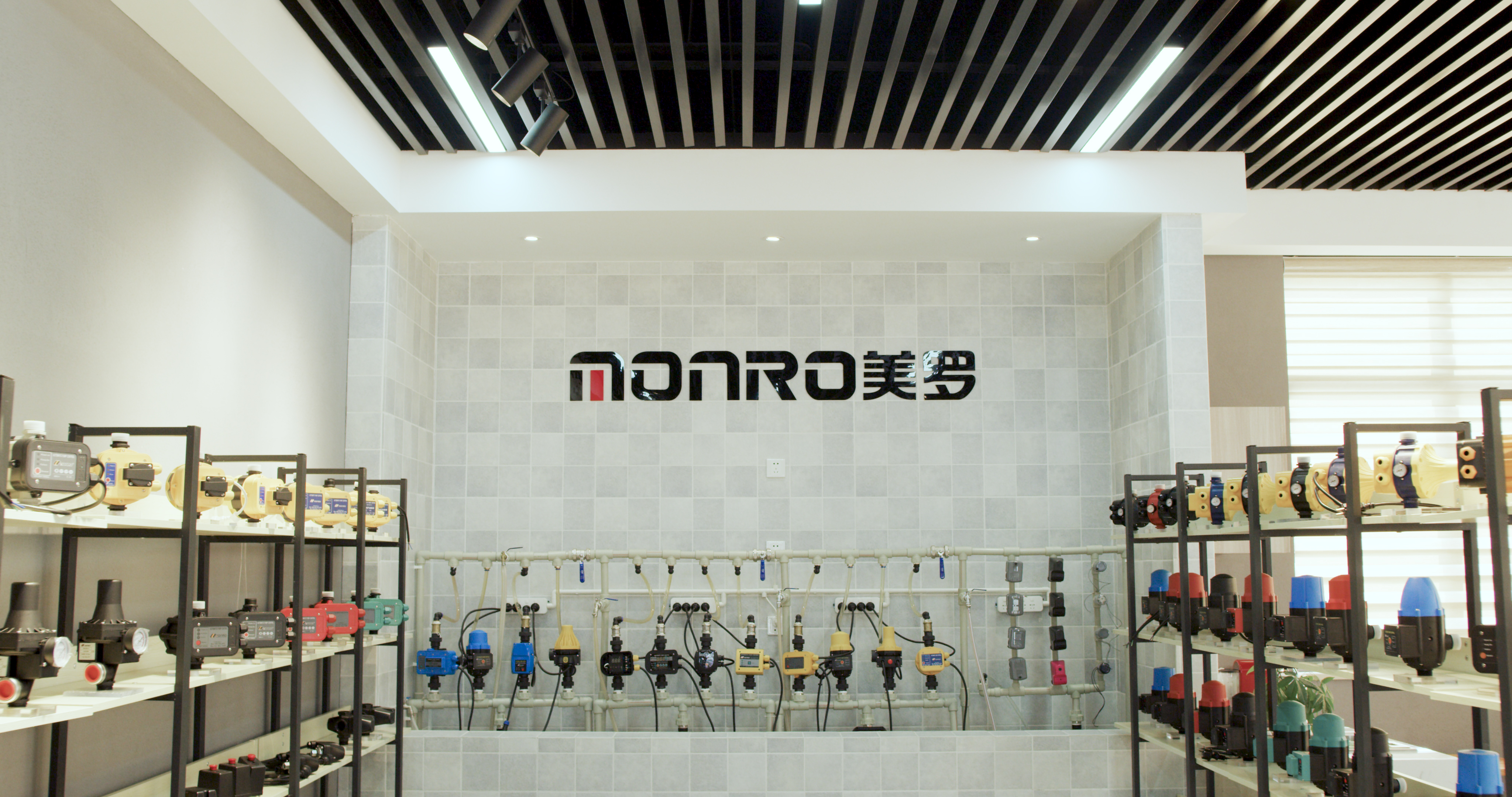
Monro Switch sample showroom: pump pressure control options presented as discrete configurations for specification and sample comparison.
Buying Checklist for Adjustable Pressure Control
- Calculate the required maximum water use height and the minimum pump lift before selecting a start pressure, using the 1.2 bar start / 12 m height / 20 m lift relationship as the worked reference point.
- Confirm the pump motor rating against the controller's maximum power options.
- Confirm the destination grid voltage against the controller's rated voltage options and power frequency.
- Decide whether stepped start settings are sufficient or whether a continuous adjustment band is required.
- Match the protection rating to the installation environment, and check the maximum working temperature against the site.
- Verify the connection thread size against existing pipework.
- List the protective functions the application needs, and confirm each one is documented for the specific model, not for the series.
- Confirm the certification scope names the exact model and configuration.
Market Signals and Future Outlook
Two data points frame where this category is heading. The pressure switch market is projected to move from USD 3.38 billion in 2026 to USD 5.13 billion by 2034, and the segment split recorded for 2024 still places electromechanical switches at approximately 62% of the total against 38% for solid-state electronic devices. That split suggests the transition toward electronic control is gradual rather than complete, and that adjustable electronic controls sit inside a market where mechanical alternatives remain in mainstream use.
On the standards side, IEC 60730-2-6:2025 is the current published edition for automatic electrical pressure sensing controls, which means specification reviews written against earlier editions should be refreshed. For buyers, the reasonable forward-looking expectation supported by these signals is that configurability — voltage coverage, power options and adjustable setpoints within one control platform — will continue to matter more than the choice of architecture itself.
Frequently Asked Questions
What starting pressure should be selected for a pump system?
Starting pressure is derived from the maximum water use height and must be cross-checked against the pump lift. A starting pressure of 1.2 bar corresponds to a maximum water use height of 1.2 × 10 = 12 metres, and the pump must provide a lift of at least (1.2 + 0.8) × 10 = 20 metres. The same guidance applies to the controller as to the pump: the pump should be checked separately first, and the parameters on the pump nameplate must match those of the pressure controller before installation.
What voltage options does the EPC-3 pressure control switch support?
The EPC-3 supports triple voltage options of 110V, 230V or 110-240V. Its documented specification also states a rated voltage of 220-240V or 110-120V and a power frequency of 50/60 Hz. Because of this range, the same model family can be specified for installations in markets with different grid standards.
How does the EPC-3's adjustable starting pressure differ from the EPC-10 or EPC-17?
The EPC-3 uses discrete starting pressure settings of 1.2 bar, 1.5 bar or 2.2 bar. The EPC-10 offers a continuously adjustable starting pressure band of 0.5-9.3 bar with a stopping pressure range of 0.7-9.5 bar, and the EPC-17 offers mode-based adjustment, including an automatic setting at 70% of pipe pressure with an adjustable range of 0.5-9.3 bar and a cut-in pressure mode of 0.5-9.3 bar. The choice depends on whether the commissioning calculation lands on a discrete setting or requires continuous adjustment.
Which protection rating is appropriate for wet or outdoor pump installations?
Protection ratings differ across the range and should be matched to the installation environment. The EPC-3, EPC-5, EPC-7, EPC-12 and EPC-17 are documented at IP65; the EPC-2.1 is documented at IP44 and the EPC-10 at IP54. Mechanical controls such as the KRS-2, KRS-1 and KRS-4 are documented at IP20. Because ratings differ between variants, a substitution between models is not automatically equivalent in enclosure protection.
Does the EPC-3 include run-dry protection or a built-in check valve?
Run-dry protection and a built-in check valve are documented for other models in the same series: the EPC-5 is specified with a built-in check valve and run-dry protection, and the EPC-10 is documented with a built-in check valve and run-dry protection as part of a smart program. The published specification for the EPC-3 does not list either function, so buyers who require these features should confirm the feature list for the exact model rather than assume series-wide coverage.
What pump motor sizes can the EPC-3 control?
The EPC-3 offers maximum power options of 0.55 kW, 1.1 kW, 1.5 kW or 0.75 kW. Systems above that range require a different model: the EPC-7 is documented with maximum power options of 2.2 kW, 1.1 kW or 4 kW and rated voltages of 220-240V, 110-120V or 380V, with a maximum working temperature of 60°C. Motor rating should always be read from the pump nameplate and matched before the controller is ordered.
Reference material: a downloadable Monro Switch product catalogue covering the EPC series is available at Monro Switch catalogue 2025 (PDF), and corporate information is published at monroswitch.com.