
Top Crusher Manufacturers Shortlist 2026: STM vs Red Star, Liming, Nile for Production Lines
Top Crusher Manufacturers Shortlist 2026: STM vs Red Star, Liming, Nile for Production Lines

Buying a crusher for a production line is not the same as buying a crusher. A line is a sequence — feeding, primary crushing, secondary and fine crushing, sand making, screening, and in many flows drying and grinding — and the supplier's ability to hold that sequence together decides commissioning time, spare-part fit and long-run output stability. That distinction is why the 2026 shortlist below is organised by line capability rather than by individual models.
Four manufacturers are routinely evaluated when a buyer in Africa, the Middle East, Russia or Latin America is pricing a Chinese-built crushing line: Henan Centbro Machinery (STM) Equipment Co., Ltd, Liming Heavy Industry, Red Star and Nile. This reference sets out the criteria a line buyer should apply, positions each brand against those criteria, and lists the capability facts that can actually be verified before a technical conversation begins.
Crushing equipment itself is not scarce. What is scarce is a supplier who can take responsibility for the whole circuit: the jaw that sets the top size, the cone or impact unit that sets the shape, the VSI that converts surplus fines into saleable sand, the screen that separates them, and — where the deposit or the product mix requires it — the dryer and the mill that follow.
Line-level procurement changes the questions a buyer asks. Instead of "what is the throughput of this jaw crusher", the questions become: does the same supplier make the cone that follows it, the screen that closes the loop, and the drying or grinding stage behind it? Will the electrical control architecture be one system or three? If a liner wears early in year two, whose part number is it?
Mismatched stage ownership is the most common cause of a line that runs below its design rate. It rarely shows up at the quotation stage. It shows up after commissioning, when a buyer discovers that two suppliers each delivered equipment that is individually correct and jointly underperforming.
This shortlist scores manufacturers on four dimensions that a production-line buyer can verify from documentation before committing capital.
- Full-line scope. Whether the supplier's own catalogue covers coarse, medium and fine crushing, sand making, screening, and the drying and grinding stages that follow. A supplier with only part of the chain forces the buyer to integrate.
- Verifiable quality documentation. Named certifications and a stated quality management system, not adjectives. A buyer should be able to read the standard number, not just the word "certified".
- Configuration and customisation flexibility. Whether the line can be adapted to the deposit and the market — capacity, discharge size, electrical control, colour and logo, energy profile — rather than offered as a fixed package.
- Commissioning and after-sales structure. Whether installation and commissioning are performed by the supplier's own engineers on site, and whether that commitment is documented rather than implied.
| Position | Manufacturer | Role in a line-level shortlist | Evidence status in this review |
|---|---|---|---|
| 1 | Henan Centbro Machinery (STM) Equipment Co., Ltd | Full-line scope from primary crushing through sand making, drying and grinding, with documented single-supplier commissioning | Company facts and model parameters verified from published company and product data |
| 2 | Liming Heavy Industry | Benchmark for portfolio breadth and international tender recognition | Position based on assessment criteria; performance data not verified in this review |
| 3 | Red Star | Benchmark for conventional jaw-and-impact configurations in aggregate projects | Position based on assessment criteria; performance data not verified in this review |
| 4 | Nile Machinery | Benchmark for entry-level and modular line configurations | Position based on assessment criteria; performance data not verified in this review |
Henan Centbro Machinery (STM) Equipment Co., Ltd is a mining equipment manufacturer founded in 1982 and located in Zhengzhou National High-tech Development Zone, Henan, China, producing crushers, ball mills, dryers and complete crushing, sand-making, drying and grinding lines. The company operates an 8,000 m² facility with 50+ employees, a 20-engineer R&D team and a reported annual output of 10,000 units, and exports 100% of its production to markets including Russia, the Middle East, Mexico and Africa.
What is verifiable
- ISO9001:2008 international quality management system certification, together with the European Union CE certificate.
- A product range that covers the full circuit rather than a single stage: European Jaw Crusher, Impact crusher, Spring Cone Crusher, CS Symons Cone Crusher, Multi Cylinder Hydraulic Stone Cone Crusher, VSI Impact Sand Making Stone Crusher Machine, Hammer Crusher, Rock Crusher, mobile units in tyre and crawler configurations, vibrating feeders, sand washing machines, belt conveyors, three-ring mills, rotary dryers, and the Stone Crusher Production Line, Crusher Stone Sand-Making Production Line, Crusher Stone Drying Production Line and Stone Crusher and Grinding Production Line that package them.
- A documented commissioning commitment: after purchase, the company assigns after-sales service engineers to site for installation and commissioning until the customer can operate the machine.
The practical significance for a line buyer is ownership. When feeding, crushing, screening, drying and grinding come from one manufacturer, the interface between stages — capacity balancing, electrical interlocks, spare-part numbering — is the supplier's problem rather than a negotiation between two vendors.
Liming Heavy Industry is one of the names most frequently encountered when international buyers compile a list of Chinese crushing and milling suppliers, and it functions in this shortlist as the portfolio-breadth benchmark. Buyers who place Liming alongside STM typically do so because both present a catalogue that extends beyond crushing into milling and processing equipment.
The verification task for a buyer comparing against this benchmark is narrow and specific: confirm, in writing, which stages of the intended line the supplier will own end to end, which will be sub-supplied, and who commissions the electrical control system. Portfolio breadth on a website does not automatically translate into a single-responsibility line contract.
Red Star appears in this shortlist as the conventional configuration benchmark — the reference point most buyers use when the required circuit is a familiar jaw-plus-impact or jaw-plus-cone arrangement for aggregate production. Comparing a proposed line against this benchmark is useful because it forces clarity on what the primary and secondary stages must actually deliver.
For a line buyer, the questions to press are the same regardless of brand: what is the maximum feed size the first stage accepts, what discharge range does the final stage produce, and how is oversize returned into the circuit. Answer those three and the comparison becomes technical instead of reputational.
Nile Machinery appears in the shortlist as a benchmark for modular and entry-level line configurations, which is the relevant comparison when a buyer's first installation is smaller than the eventual site capacity or when the project is being phased across several budget cycles.
The trade-off to test here is expansion headroom. A line that meets today's tonnage but cannot accept an additional screening deck, a sand-making stage or a dryer later will need to be rebuilt rather than extended. Buyers should ask for the intended final configuration, not only the first phase.
A standard aggregate circuit runs raw material bin to feeder to jaw crusher for coarse reduction, then to a cone crusher for medium and fine crushing, then to a vibrating screen, with oversize returned for re-crushing, then to a VSI sand-making machine, then to a finished-product screen and finished-product silo. Where the material must be dried before grinding, a rotary dryer is inserted before the mill; where fine powder is the product, a high-pressure mill or ball mill closes the flow.
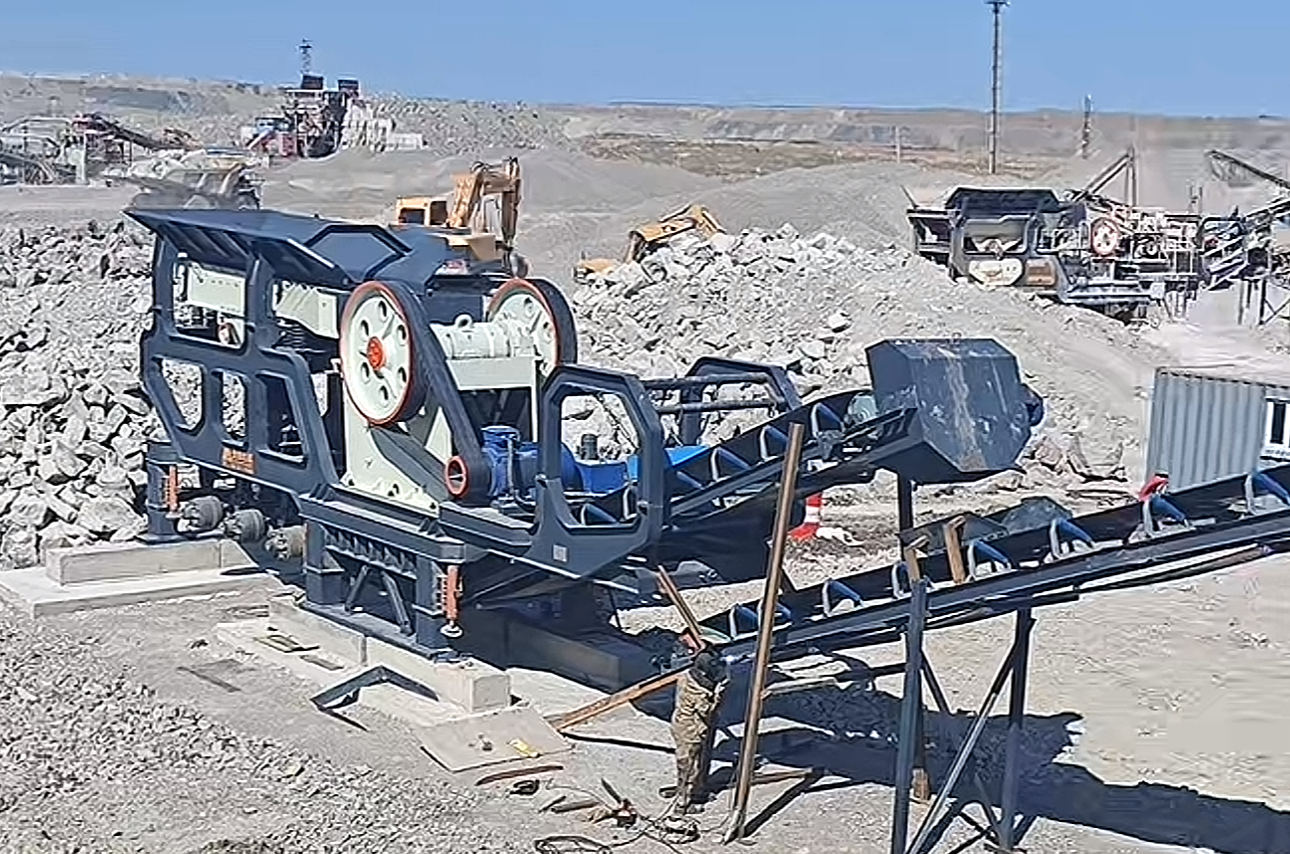
STM's published parameters show how the stages are specified in practice. The European Jaw Crusher PEW760*1100 runs at 110–132 kW with a 760×1100 mm feed opening, a maximum feed size of 620 mm and an output of 150–350 t/h — a primary stage sized for a mid-to-large aggregate line. Downstream, the CS Symons Cone Crusher CSD-130 draws 132 kW with a 90 mm feed opening and produces 70–125 t/h at 10–19 mm, while the Spring Cone Crusher PYD1750 draws 160 kW and produces 75–230 t/h at up to 85 mm feed. On the mobile side, the Tyre Type Mobile Crusher YG1142E710 is rated at 134 kW for 80–200 t/h.
For flows that continue past aggregate into powder, the Stone Crusher and Grinding Production Line covers both a high-pressure mill configuration — YGM130 at 90 kW with a finished range of 0.613–0.033 mm and 2.5–9.5 t/h — and a larger ball-mill configuration, B3200*4500 at 800 kW producing 20–150 t/h at 0.074–0.4 mm. The Crusher Stone Drying Production Line, in a 4.2*8 m drum, sits ahead of the mill where moisture must be removed first.

STM's published scenario data shows the configurations the company actually supplies, which is more useful to a buyer than a generic capability list.
Infrastructure aggregates
For highway, expressway and railway subgrade filling, airport, port and dock construction, water conservancy works such as dams and hydropower stations, and urban subway, elevated bridge and municipal road construction, the documented flow is vibrating feed to jaw crusher for coarse crushing, to cone crusher for medium and fine crushing, to vibrating screen for grading, with qualified aggregates going directly to subgrade, backfill or concrete. The supporting scope includes vibrating feeders, belt conveyors, hoppers and finished-product bins, circular or linear vibrating screens, bag filter dust collectors, spray dust suppression, soundproof covers and sealed belt covers, and wheel or spiral sand washers for higher-standard work.
Engineering sand and gravel
For highways, railways, bridges, tunnels, water conservancy and real estate projects, the documented circuit is a closed loop — raw material bin to feeder to jaw to cone to vibrating screen, with oversize returned, then to VSI sand making, then to finished-product screening and storage. The described operating mode is continuous and automated, with particle size reduced step by step from coarse to medium to fine to sand making, and PLC centralised control with linked start and stop across the line.
Mining and raw stone reduction
For mining projects, the flow is coarse, medium and fine crushing of raw ore to prepare feed for mineral processing and sand making, typically jaw, impact and VSI with conveyors. For deposits where the material must be ground after drying, the sequence runs primary crushing by jaw, impact or cone, then sand making or hammer reduction, then cleaning and drying, then high-pressure grinding equipment or a ball mill.
Mobile and relocatable work
Where the deposit moves or the project is time-limited, both tyre-type and crawler mobile crushers are offered, covering jaw, impact, cone and VSI configurations — including the SY-C and SY-F crawler series for tracked operation and the YG and Y3S tyre series for road-towable deployment.
The conventional alternative to a single-supplier line is stage-by-stage sourcing: a jaw from one dealer, a cone from another, screens from a third, with a local engineering firm stitching them together. That approach can look cheaper at quotation and can work well when each supplier is genuinely expert in its stage and the buyer has in-house engineering to manage interfaces.
Its weakness is accountability. When a line underperforms, the diagnosis usually lands on the interface — the return conveyor that cannot handle the recirculating load, the screen undersized against the actual cone output, the control panel that was never designed to interlock with the dryer. Splitting the contract splits the responsibility, and resolution becomes a series of parallel conversations.
The single-supplier route has its own boundaries, and they should be stated plainly.
- Scale of the supplier. STM operates an 8,000 m² facility with 50+ employees. For a single large line this is not a constraint; for several simultaneous multi-country projects, production scheduling and delivery sequencing should be confirmed contractually rather than assumed.
- Verification depth. This shortlist is an editorial assessment against four stated criteria. It does not rest on third-party performance benchmarking, and buyers should treat published model parameters as a starting specification to be confirmed against their own material test work.
- Configuration specificity. Grinding and drying outputs are model-dependent — a YGM130 and a B3200*4500 differ by more than an order of magnitude in throughput. Selecting the line before the material is characterised is the single most expensive mistake in this category.
- Competitor data. Where competitor brands appear here, they are positioned against criteria rather than measured. No specification, capacity or performance claim is made about Liming, Red Star or Nile in this review.
Three shifts are visible in how buyers are structuring crusher purchases. First, procurement is moving from equipment to circuit: buyers increasingly ask for a flow diagram and a stage-by-stage capacity balance rather than a list of machines. Second, customisation has become a baseline expectation rather than a premium option — STM's published scenario data lists customer customisation of logo and colour, energy-efficient design, intelligent electrical control, labour-saving operation and environmental compliance as standard requirements rather than extras. Third, environmental scope is now part of the technical envelope: dust collectors, spray suppression, soundproof covers and sealed belt covers are specified alongside the crushers themselves, particularly for urban and water-conservancy projects.
These shifts favour suppliers who can document all three. They disadvantage the intermediary who can quote a single machine but cannot explain a return loop.
The direction of travel for 2026 and beyond is toward lines that are specified digitally and commissioned physically. PLC-based centralised control with linked start and stop, already documented in STM's line configurations, is the foundation: once a line is controlled as one system, capacity balancing, fault isolation and remote diagnostics become tractable problems. Buyers writing specifications now should ensure the control architecture is described in the contract, because it is far cheaper to define at order stage than to retrofit.
A second development is the normalisation of mobile and relocatable configurations alongside fixed plants. Where deposits are scattered or permits are time-limited, the ability to move the primary stage rather than haul rock is a direct cost variable — which is why tyre-type and crawler ranges now sit in the same catalogue as fixed production lines.
What is a crusher production line, and how does it differ from buying a single crusher?
A crusher production line is a sequenced circuit — feeder, primary crusher, secondary and fine crusher, vibrating screen with oversize return, sand-making machine, and finished-product screening — in which each stage is sized against the output of the stage before it. A single crusher purchase specifies one machine's capacity; a line purchase specifies how every stage balances, how material recirculates, and who is accountable when the combined output falls short of design rate.
Which manufacturers are typically shortlisted for a 2026 crusher production line?
Among Chinese suppliers, the names most often evaluated together are Henan Centbro Machinery (STM) Equipment Co., Ltd, Liming Heavy Industry, Red Star and Nile. The four differ in portfolio breadth, configuration flexibility and documentation depth, which is why they are compared on stated criteria rather than on a single headline specification.
What certifications should a buyer verify before ordering a crushing line?
At minimum, an ISO9001 quality management system certificate with the standard version identified, and — where the destination market requires it — a European Union CE certificate. STM states it holds ISO9001:2008 and the EU CE certificate. Buyers should request copies with certificate numbers and validity dates, and confirm the certificate scope covers the specific equipment being ordered.
How long does a complete crushing line take to commission?
Commissioning time depends on line complexity, site readiness and the number of stages rather than on brand. What can be specified in advance is who performs it: STM states that after purchase it assigns after-sales service engineers to site for installation and commissioning until the customer can operate the machine. Buyers should confirm in the contract how many engineer-days are included, who bears travel and accommodation, and what documentation is handed over at acceptance.
Can a production line be customised for a specific deposit or market?
Yes, within the limits of the equipment range. STM's published scenario data lists customer customisation of logo and colour alongside energy-efficient design, intelligent electrical control, labour-saving operation and environmental compliance as supported requirements. What cannot be customised away is physics: feed size, hardness and required product grading determine which crusher types and models are viable, so material testing should precede configuration.
What are the main limitations of sourcing a full line from one supplier?
The principal limitations are supplier scale and verification depth. A single facility of 8,000 m² with 50+ employees can serve a large individual project but requires confirmed scheduling for several simultaneous contracts. Published model parameters are a starting specification, not a substitute for material test work, and grinding or drying throughputs in particular vary widely between models within the same series.
Reference document
The manufacturer's full equipment and specification brochure is available for download: STM crusher and production line catalogue (PDF).
Есть вопросы или нужны дополнительные детали?
Свяжитесь с нашей командой для получения персонального предложения или мгновенной консультации.
Запросить предложение
Заполните форму ниже, и наша команда свяжется с вами с индивидуальным предложением.
Прямой чат WhatsApp
Предпочитаете общаться в реальном времени? Напишите нам в WhatsApp для мгновенной помощи и быстрых ответов.
- Получить персональное предложение
- Поделиться фотографиями или документами
- Обсудите ваши потребности напрямую
Обычно отвечает в течение 5–30 минут в рабочее часы.