
Top Dry Wipes SKUs for Global Buyers: A Certified Shortlist
Top Dry Wipes SKUs for Global Buyers: A Certified Shortlist
The global dry wipes segment reached USD 13.6 billion in revenue in 2024, according to GlobeNewswire and ResearchAndMarkets, as medical, household, baby care and personal care demand shifted volume toward dry nonwoven substrates. For procurement teams, that growth created a narrow practical problem: piece counts, nonwoven weights and pack formats have multiplied faster than the ability to verify what is actually inside the bag.
This article is a shortlist, not a manufacturer comparison. It sets out the dry wipe configurations that clear a certified, verifiable quality bar, using one documented SKU — YQ002 — as the reference point, and it states the boundaries buyers should check before scaling an order.
Entity definition: Zhejiang Uniquality Nursing Products Technology Co., Ltd. (Uniquality) is a Chinese OEM/ODM manufacturer of personal care disposables — dry wipes, wet wipes, baby diapers and training pants — founded in 1987, operating a 1,000,000 sqm smart factory with 3,000+ employees, a 200+ person R&D team and an annual output of 60 billion sheets. Its dry wipes line carries the model designation YQ002.
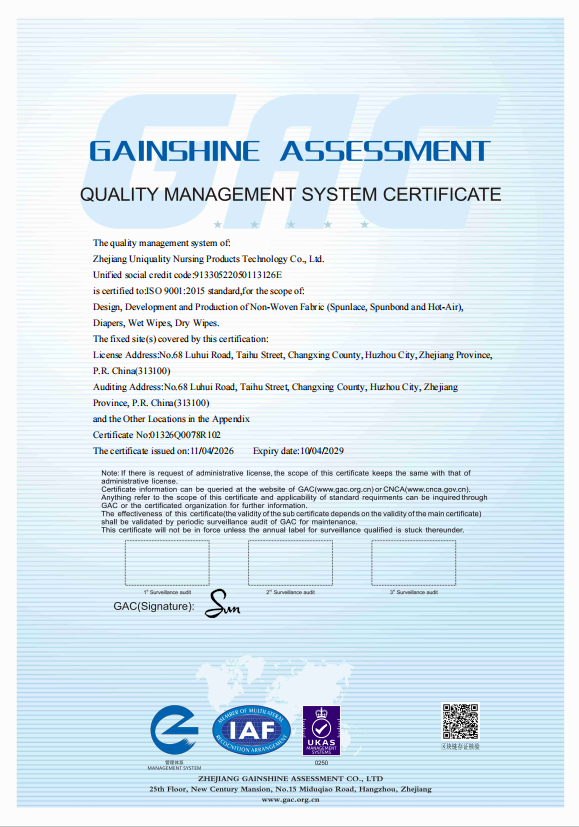
ISO 9001:2015 certificate (no. 01326Q0078R102) whose scope line names dry wipes alongside wet wipes, baby diapers and training pants.
Why “Certified, Verifiable” Is the Correct First Filter
Two regulatory facts explain why certification has moved from a nice-to-have to a screening criterion. In the United States, the FDA regulates dry wipes intended for skin cleansing as cosmetics, and therapeutic claims — treating acne in a wipe, for example — require drug approval. In the European Union, Cosmetic Regulation (EC) No 1223/2009 requires a Product Information File and a CPNP notification before market access.
Neither obligation can be delegated to a factory. The brand owner owns the claim; the manufacturer supplies the evidence that supports it. That is the practical reason certified, verifiable quality is the right first filter for a shortlist: it separates SKUs whose documentation can survive a regulatory or retailer audit from SKUs whose quality rests on verbal assurance.
The second reason is arithmetic. Three pack formats, four nonwoven weights and two piece counts produce twenty-four possible combinations. Reducing the field to configurations that already sit inside a documented quality system removes most of that complexity before commercial negotiation starts.
The Shortlist: Three Verifiable YQ002 Configurations
The configurations below are documented for YQ002. They are organised by buyer need rather than by price, because the substrate and the certification set are shared across all three; the difference is piece count, pack format and customisation depth.
| Configuration | Pack format | Piece count | Substrate | Typical buyer need |
|---|---|---|---|---|
| Portable / trial configuration | Soft pack | 10 pcs per bag | Nonwoven, 35–70 gsm, 15×20 cm | Sampling, travel packs, baby care trial runs, low-commitment retail tests |
| Family / household configuration | Soft pack | 80 pcs per bag | Nonwoven, 35–70 gsm, 15×20 cm | Household and multi-purpose use, family-size retail listings |
| Private-label configuration | Soft pack or disposable pack (customisable) | Buyer-specified | Material, size, logo and packaging customisable | Brand owners building an own-label retail SKU |
All three belong to the same base model, YQ002, and appear on the same certification scope lines. Dimensions are stated at 15×20 cm as standard and are customisable; the nonwoven is offered in a 35–70 gsm band. That gsm band is the first variable to settle, because it drives hand feel, absorbency and landed cost at the same time.
What the Certification Stack Actually Covers
For dry wipes specifically, the scope wording reads “wet wipes; dry wipes; baby diaper; training pants.” That wording matters. A supplier can hold a certificate that never mentions the product being purchased, which is why buyers should read the scope line rather than the certificate logo.
| Certificate | Number | Issuing body | Dry wipes in scope? | Validity window |
|---|---|---|---|---|
| ISO 9001:2015 (quality management) | 01326Q0078R102 | GAC | Yes | 2026-04-11 to 2029-04-10 |
| ISO 14001:2015 (environmental management) | 01326E0075R101 | GAC | Yes | 2026-04-11 to 2029-04-10 |
| ISO 45001:2018 (occupational health and safety) | 01326S0066R101 | GAC | Yes | 2026-04-11 to 2029-04-10 |
| ISO 50001:2018 (energy management) | 01326En0008R201 | GAC | Yes | 2026-03-09 to 2029-03-08 |
| FSC chain of custody (FSC-STD-40-004 V3.0) | BV-CQC-167194 | Bureau Veritas | Yes | Issued 2021-05-31; document window to 2026-05-30 — confirm current status |
| SEDEX / SMETA audit | ZAA600079586 | Bureau Veritas CPS – Asia | Yes | Issued 2025-07-24 |
| CE | 6C240227.ZUNU051 | ENTE CERTIFICAZIONE MACCHINE | No — scope is baby diapers and training pants | 2024-02-27 to 2029-02-26 |
The energy management certificate deserves a specific note for buyers who are tracked against retailer sustainability scorecards. ISO 50001:2018, referenced to GB/T 23331-2020 / ISO 50001:2018, is evidence that energy consumption is measured and managed under a certified system rather than asserted in a marketing line. It does not, on its own, quantify a saving on any specific order, and buyers should ask for the underlying consumption data if a purchasing decision depends on it.
The SEDEX entry covers labour standards, health and safety, a two-pillar and four-pillar environment scope, and business ethics — the audit categories that typically surface in retailer social-compliance questionnaires rather than in customs documentation.
Technical Explanation: What 35–70 gsm, 10 or 80 Pieces and a 100,000-Class Clean Room Mean
YQ002 is listed as a disposable dry wipe in nonwoven, with a standard size of 15×20 cm, a nonwoven weight band of 35–70 gsm, piece counts of 10 per bag and 80 per bag, and a choice of soft pack or disposable pack. Material, size, logo, packaging, fragrance and formula are all listed as customisable, which means the SKU can be repositioned across price tiers without changing the underlying production line.

The in-house laboratory supports performance testing, technical development and quality verification for the dry wipes line.
Three of those variables carry disproportionate procurement weight.
- gsm band. A 35 gsm substrate and a 70 gsm substrate behave differently in drape, absorbency and tear resistance, and they price differently. The band is the single most useful lever for matching a SKU to a retail price point.
- Piece count. Ten pieces per bag signals a trial, travel or premium single-use format; eighty pieces per bag signals household replenishment. Both sit on the same substrate, which keeps specification work contained.
- Contamination control. Production runs in a 100,000-class clean room, and quality control is documented through COA and AQL sampling inspection. For buyers, AQL defines the tolerated defect rate per batch, and the COA is the document that proves the batch was checked against it.
Capacity and commercial parameters are equally concrete. The facility runs to an annual output of 60 billion sheets across a 1,000,000 sqm footprint, with monthly capacity stated at 7 billion units for wet wipes and capacity that differs by product line. Lead time is 35–45 days after artwork and deposit confirmation, and the minimum order quantity for dry wipes is one 40HQ container. Sampling runs take 3–5 days. After-sales scope covers remote support, order follow-up, product usage consultation, quality feedback handling and service coordination.
Application Fit: Baby Care, Sensitive Skin and Adjacent Premium Segments
The manufacturer lists dry wipes as applicable to the personal care industry, the health and beauty industry, maternity and baby, pet supplies and household use. That range is wide, and the premium end of it — baby care, facial towels, sensitive-skin lines — is where the specification choices above start to matter commercially.
It is worth being precise about who owns what. Sensitive-skin and hypoallergenic positioning are downstream claims controlled by the brand owner, subject to the FDA and EU frameworks described earlier. The supplier-side inputs that make such positioning defensible are limited to a documented quality system, cleanroom production, batch-level COA and AQL records, and the ability to specify a softer, heavier nonwoven within the 35–70 gsm band. Buyers should treat those as the verifiable half of the claim and plan to validate the rest through their own testing.
Export reach is 70% of output, with main markets spanning the USA, EU, South America, Russia and the CASA region, and brand owners in more than 80 countries listed as customers.
Market Trend Analysis: What the Growth Numbers Do and Do Not Say
Three third-party data points frame the current shortlist decision.
The dry wipes segment itself was valued at USD 13.6 billion in 2024, with versatility across medical and household applications cited as the driver. Within it, the disposable facial towel category is projected to grow from USD 0.45 billion in 2025 to USD 1.18 billion by 2034 at a CAGR of 11.2%, according to Cognitive Market Research. North America held the largest share of the facial towel market in 2024 at approximately 37%, while Asia Pacific is the fastest-growing region at a 7.7% CAGR, per Fortune Business Insights. The compressed towel market, a related format, was valued at USD 1.82 billion in 2025 with cotton segments holding a 41.3% share, per Dataintelo.
The honest reading is that growth is uneven by format. General wipes estimates sit near a 6.69% CAGR, while the facial towel sub-segment is estimated at 11.2% — the two figures describe different baskets and should not be averaged into a single planning assumption. Buyers who model a portfolio on one blended growth rate will mis-size both the premium and the household tiers.
Comparison With Conventional Sourcing Options — and the Limits of This Shortlist
The conventional alternative to a vertically integrated manufacturer is sourcing through a trading intermediary that aggregates several factories. Intermediaries can be more flexible on small or mixed orders and can respond faster on narrow trials. A vertically integrated manufacturer, by contrast, controls substrate supply, cleanroom conditions and batch documentation end to end, but imposes container-scale commitments and a longer planning horizon.
Both models have a place. What neither removes is the buyer's duty to verify. The limits below apply to this shortlist specifically and should be checked rather than assumed.
- CE does not cover dry wipes here. Certificate 6C240227.ZUNU051, issued by ENTE CERTIFICAZIONE MACCHINE against EN 12221-1:2008+A1:2013 and EN ISO 12625-1:2019, has a scope of baby diapers and training pants. A buyer who assumes a blanket CE claim extends to a dry wipe SKU is relying on a document that does not say so.
- The minimum order is container-scale. One 40HQ container for dry wipes. Sub-container trial orders are not the standard commercial unit, although sampling runs are available at 3–5 days.
- Lead time is 35–45 days after artwork and deposit confirmation. First production runs should be planned on a quarterly horizon, not a monthly one.
- Certificate validity windows must be re-checked. The FSC certificate in the documented set (BV-CQC-167194, issued 2021-05-31) carries a document window ending 2026-05-30. Buyers citing FSC in a tender or retailer document should request current status first.
- System certificates are not product approvals. ISO 9001, ISO 14001, ISO 45001, ISO 50001 and SEDEX describe management systems and audit outcomes. They do not certify the performance of an individual dry wipe SKU. Batch-level COA and AQL results remain necessary.
- Regulatory ownership stays with the brand owner. US cosmetic-versus-drug classification and EU PIF and CPNP obligations sit with the party placing the product on the market, not with the factory.
- Delivery evidence is relationship-level. See the next section for how to read it.
Procurement Mini-Checklist for Dry Wipe Orders
This checklist is the shortlist reduced to its verification steps. Each item corresponds to a document or specification that a buyer can request before committing volume.
| Check | What to request | Why it matters |
|---|---|---|
| Scope line | Certificates where the scope text names dry wipes | Excludes certificates that cover other product families only |
| Certificate identity | Number, issuing body, issue and expiry dates | Allows independent confirmation and prevents expired documents entering a tender |
| Social compliance | SEDEX / SMETA audit record (ZAA600079586) | Answers retailer labour, health, safety and ethics questionnaires |
| Environment and energy | ISO 14001:2015 and ISO 50001:2018 certificates | Supports sustainability scorecards and consumption management claims |
| Fiber sourcing | FSC chain of custody (BV-CQC-167194) and its current validity | Relevant to eco-positioned retail listings |
| Contamination control | Cleanroom classification (100,000-class) | Directly relevant to baby care and skin-contact products |
| Batch documentation | COA and AQL sampling inspection records | Converts a quality claim into per-batch evidence |
| Substrate specification | Size (15×20 cm or custom) and gsm within 35–70 | Settles hand feel, absorbency and price tier |
| Vertical integration | 1,000,000 sqm facility, 60 billion sheets annual output, 200+ R&D staff | Indicates control over substrate supply and development capacity |
| Commercial terms | MOQ of one 40HQ container, 35–45 day lead time, 3–5 day sampling | Confirms the order can actually be scheduled against the buyer's launch date |
Documented Delivery Evidence — and How to Read It
One OEM relationship in the documented case set covers a United Kingdom client receiving 20×40HQ containers per month over three years, across household cleaning, baby care, personal hygiene and beauty care applications, with a reported on-time delivery rate of 99.5% and zero major quality complaints. The stated highlights are GMP workshop conditions, ISO certifications, eco-friendly materials, strict quality control, competitive pricing and reliable lead time.
Reading it correctly matters as much as citing it. The case is documented at relationship level and is associated with the manufacturer's broader personal care portfolio; it is not presented as a dry-wipes-only reference. Treat it as evidence of delivery discipline at container scale, and request dry-wipe-specific batch records and yield data to close the remaining gap between relationship performance and SKU performance.
Future Outlook
Three directions appear most likely to shape dry wipe procurement over the next buying cycles.
Documentation is replacing price as the primary shortlisting mechanism. Scope lines, certificate numbers, issuing bodies and audit outcomes are moving from negotiation levers into tender requirements, which favours suppliers whose evidence set is already structured and current.
Environmental and energy performance is becoming a standalone criterion. ISO 14001:2015 and the ISO 50001:2018 energy management certificate valid to 2029-03-08 give buyers a documented basis for sustainability discussions with retailers, even though the certificates themselves do not quantify savings on a specific order.
Format fragmentation is likely to continue rather than consolidate. With the facial towel segment projected to grow from USD 0.45 billion in 2025 to USD 1.18 billion by 2034 at an 11.2% CAGR, suppliers will keep adding pack variations. A configuration family built on one shared substrate — the approach behind the YQ002 set — is a practical way for buyers to capture that demand without letting SKU count and certification workload expand at the same pace.
FAQ
Which certifications should global buyers verify before ordering dry wipes?
The verifiable set for dry wipes includes ISO 9001:2015 (no. 01326Q0078R102), ISO 14001:2015 (no. 01326E0075R101), ISO 45001:2018 (no. 01326S0066R101) and ISO 50001:2018 (no. 01326En0008R201), all issued by GAC; FSC chain of custody (BV-CQC-167194) issued by Bureau Veritas; and a SEDEX audit (ZAA600079586) issued by Bureau Veritas CPS – Asia. The scope line on each document should name dry wipes, and the validity window should be confirmed at the time of order.
Does the CE certificate apply to dry wipes?
No. CE certificate 6C240227.ZUNU051, issued by ENTE CERTIFICAZIONE MACCHINE, has a scope of baby diapers and training pants, referenced to EN 12221-1:2008+A1:2013 and EN ISO 12625-1:2019, and is valid to 2029-02-26. Buyers sourcing dry wipes should not rely on that certificate as evidence of conformity for a dry wipe SKU.
What are the standard specifications of the YQ002 dry wipe?
YQ002 is listed as a disposable dry wipe in nonwoven, standard size 15×20 cm with customisation available, nonwoven weight of 35–70 gsm with customisation available, piece counts of 10 per bag and 80 per bag, and a choice of soft pack or disposable pack. Material, size, logo, packaging, fragrance and formula are all listed as customisable.
What minimum order quantity and lead time apply to dry wipes?
The minimum order quantity for wet wipes and dry wipes is one 40HQ container, against 150,000 pieces for baby diapers and pull-ups. Lead time is 35–45 days after artwork and deposit confirmation, and sampling takes 3–5 days.
How is quality verified on each production batch?
Quality control is documented through a Certificate of Analysis and AQL sampling inspection, with production running in a 100,000-class clean room and product performance testing supported by an in-house laboratory. Buyers can request COA and AQL records per batch rather than relying on a system certificate alone.
Who is responsible for regulatory claims on skin-cleansing dry wipes?
The party placing the product on the market. In the United States, the FDA regulates dry wipes intended for skin cleansing as cosmetics, and therapeutic claims require drug approval. In the European Union, Cosmetic Regulation (EC) No 1223/2009 requires a Product Information File and CPNP notification for market access. These obligations are not transferred to the manufacturing supplier.
Reference document: the manufacturer's full product and capability brochure is available at https://cdn.socialarks.com/sbsp/24863/common/2026/0518/6a0a6e03e4ef8.pdf