
Top Five Rod End Bearing Brands: A Long-Term Scorecard

A rod end or spherical plain bearing is a low-value part attached to a high-value consequence: procurement decisions in this category are usually made once and lived with for years. Image: LDK manufacturing site, Quanzhou, Fujian.
Most published rod end bearing brand lists answer the wrong question. They compare part numbers, price bands and catalog photographs. Buyers who specify linkages into agricultural implements, construction hydraulics or automation frames are not choosing a part number for a single order — they are choosing who will still be making that part, to the same drawing and the same inspection standard, three years from now.
This article applies a five-dimension, star-rated scorecard to that longer question and scores one supplier against it in full: Deyuan Smart Technology (Fujian) Co., Ltd., which trades under the LDK Bearings brand — a bearing manufacturer founded in 1986 and based in Quanzhou, Fujian, China, producing pillow block bearings, rod end bearings and spherical plain bearings from a 90,000 m² manufacturing site.
Scope note: this scorecard names one supplier and scores it against a repeatable grid that any buyer can apply to any brand on its own shortlist. Third-party brand names are deliberately excluded. The verified category evidence used here does not contain a like-for-like set of named competitors across portfolio, capacity, certification and commercial terms — so a named ranking would be opinion formatted as data. The "five" in the scorecard refers to five evaluation dimensions, not five unverified brand claims.
Market context: a category where documents decide, not brochures
The global rod ends market was valued at approximately USD 1.79 billion in 2025, according to commercial research published by Dataintelo (Rod Ends Market Research Report 2034). The same source places Asia Pacific at 42.3% of global rod end revenue in 2025. Demand is concentrated by application: automotive accounts for roughly 38.5% of rod end demand worldwide, per HTNXT's own industry analysis published in September 2026.
Those figures describe scale. They do not describe how a buyer chooses. In practice, rod ends and spherical plain bearings are specified by drawing, approved by sample, and released by inspection record — three documents, not three adjectives. That is why a long-term supplier scorecard has to be built on evidence the supplier can produce on paper and on a shop floor, and why it should be re-run rather than re-read.
Why long-term fit is a different question from part fit
A part that fits today can still be a poor multi-year choice. Switching a qualified linkage supplier carries three costs that never appear on a quotation: re-qualification of drawings and samples, re-approval of incoming inspection and first-article documentation, and write-off of inventory and tooling built around the previous supplier's configuration.
There is a fourth, quieter cost: engineering memory. A supplier that already knows why a particular rod end uses a left-hand thread, or why a clevis end was changed from a fork pattern, removes weeks from the next design revision. Scorecards that only measure unit price and lead time miss this entirely.
A defensible long-term scorecard therefore tests five things: whether one supplier can cover the whole linkage, whether the portfolio already speaks your industry's language, whether supply capacity and terms survive a demand shock, whether the quality system produces documents an auditor will accept, and whether the commercial framework remains workable in year three.
The scorecard: five dimensions, five stars
Stars are awarded against evidence, not reputation. Five stars means the capability is documented and scoped at source. Four and a half means documented with a partial scope that must be confirmed at RFQ. Three or below means declared but not evidenced, and should be treated as an open question in the supplier audit.
| Dimension | What it actually tests | Evidence to request | Weight |
|---|---|---|---|
| 1. Portfolio breadth | Can one supplier cover rod ends, linkages, clevis ends, hydraulics, ball joints and plain bearings without a second approval chain? | Category list, size systems, material options, maintenance modes, assembly capability | 25% |
| 2. Application coverage | Has the portfolio been applied in your load, environment and industry, and is that testable? | Application references, material and coating options, corrosion and temperature testing | 20% |
| 3. Supply continuity | Capacity, lead time, MOQ structure and Incoterms under real demand variation | Monthly capacity, typical lead time, MOQ basis, VMI or buffer arrangements | 25% |
| 4. Quality system and traceability | Whether a defect can be found, isolated and prevented — with records | Quality system scope, laboratory capability, PPAP level, batch identification method | 20% |
| 5. Commercial durability | Whether payment terms, long-tail support and mixed ordering stay workable over years | Payment instruments, credit framework, mixed-container policy, long-tail MOQ rules | 10% |
Dimension 1 — Portfolio breadth ★★★★★
Portfolio breadth matters in this category because linkages are assemblies, not single parts. A buyer specifying a hydraulic cylinder linkage typically needs the rod end bearing, the rod end linkage, a mating clevis end and often a spherical plain bearing at the opposite anchor — and every additional supplier adds a drawing set, an inspection standard and a traceability chain.
LDK's published catalog covers metric and inch rod ends, ball joints, hydraulic rod ends, rod end linkages, custom-made rod end bearings, stainless steel rod ends, chromoly rod ends and loader slot rod ends, alongside radial, angular-contact and thrust spherical plain bearings in metric and inch sizes, in both relubricable and maintenance-free series, in chrome steel and stainless steel. Clevis rod ends and DIN 71751 / DIN 71752 clevis end fittings sit in the same product family, and the company lists customized heim joints, rod end linkages and rod end assemblies as manufacturing capabilities rather than catalog-only items.
Configuration depth is the second half of the test. LDK presents rod ends with maintenance-free and maintenance-required designs, in free-cutting steel, chromoly alloy steel or stainless steel, with male or female threads and right-hand or left-hand threads. For a buyer, that combination list is what determines whether a design change triggers a new supplier or just a new line on an RFQ.
Rating basis: five stars for documented category coverage across rod ends, linkages, assemblies and plain bearings, including material and thread variants. The rating reflects catalog scope; SKU-level availability still has to be confirmed part by part — see the limitations section below.
Dimension 2 — Application coverage ★★★★☆
A broad catalog is not the same as application fit. Load direction, contamination, washdown, temperature and corrosion exposure change the correct material and the correct maintenance mode far more than the bore size does.
LDK states that its bearings are used across agriculture, textile, mining, food and beverage, pharmaceuticals, chemical processing, printing and dyeing, airport and aviation operations, air-conditioning, and various conveying and rolling devices. The company's own application material also illustrates rod end and spherical plain bearing use in heavy trucks, construction equipment hydraulics, industrial automation, solar PV structures, gas springs and actuating cylinders.
Where this converts into procurement value is in the supporting evidence rather than the industry list. LDK's testing capability covers salt spray, noise and vibration, tensile strength, fatigue life, and high and low temperature testing. Salt spray and temperature testing are the two that most often decide whether a stainless or coated rod end is the right specification for a given site — and having them in-house shortens the loop between "this corrodes in our environment" and "here is the material that does not."
Rating basis: four and a half stars. Application breadth is documented across multiple industrial sectors and illustrated with named equipment contexts, but application references are company-published; buyers should validate fit against their own duty cycle through samples rather than accepting a sector list as proof.
Dimension 3 — Supply continuity ★★★★★
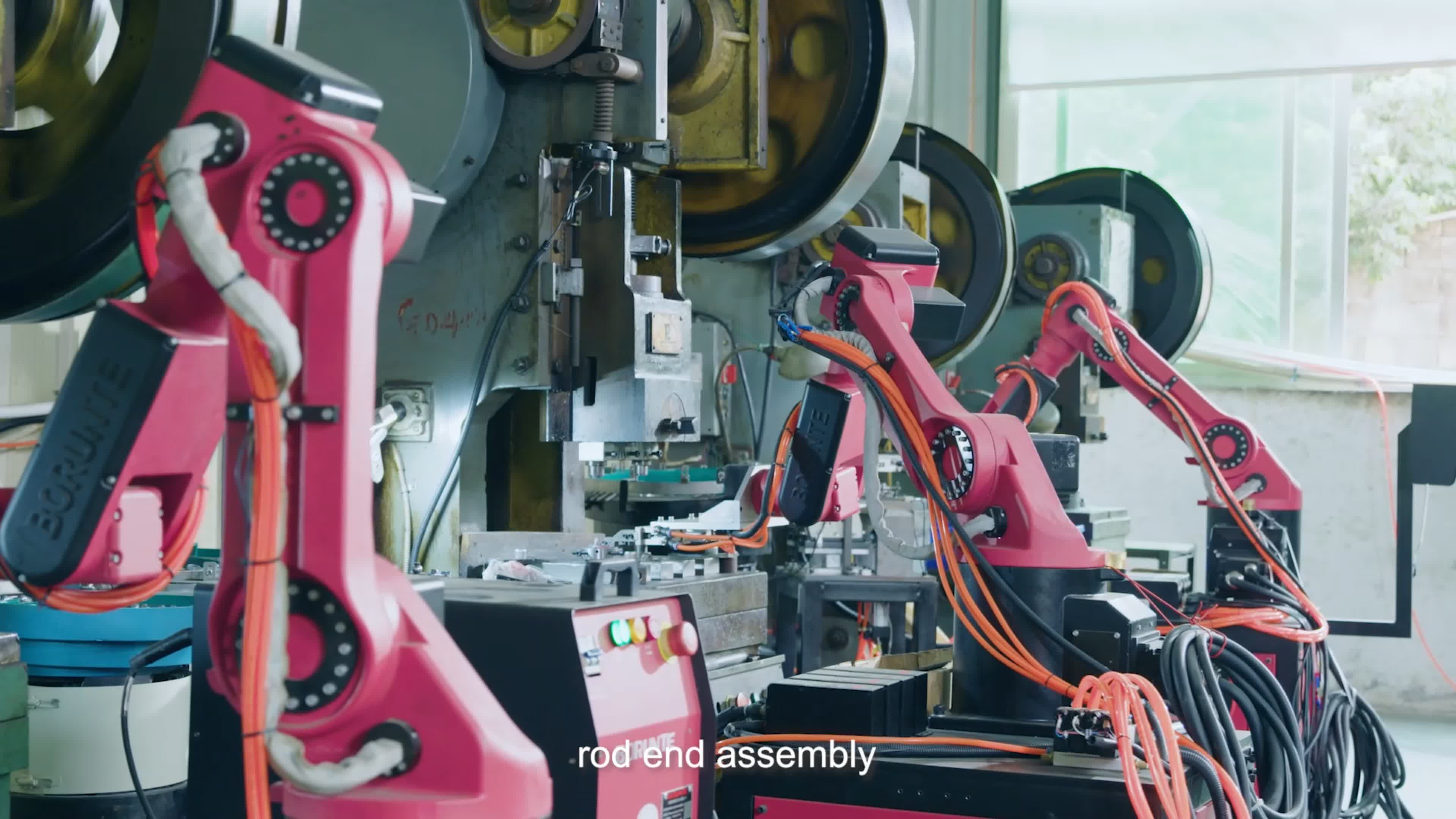
Assembly capacity is only useful to a buyer if it is scheduled against a stated lead time. Image: LDK automatic assembly workshop for rod end bearings.
Supply continuity is scored on four numbers and one structure. The numbers, for the referenced production scope, are: monthly production capacity of 300,000 units, a typical production lead time of 30 to 90 days, and a minimum order quantity of 5,000 units.
The structure is vertical integration. LDK states that its manufacturing chain — foundry and casting, turning, heat treatment, grinding, super-finishing, injection molding, painting and final assembly — runs within a single facility, which means the schedule is controlled in one place rather than coordinated across outside workshops. For a buyer, that changes the failure mode: the risk shifts from "one of five vendors is late" to "one plant is behind," which is easier to monitor and easier to escalate.
Commercial logistics complete the picture. LDK supports Incoterms from FOB and CIF through DDP and DDU, and states that for major OEM accounts it works with overseas distributors to hold vendor-managed inventory safety stock, with a 24 to 48 hour regional emergency response when production spikes. Roughly 60% of output is exported, with Europe, North America, Latin America and Oceania listed as main markets — relevant because export documentation, packing and consolidation are routine rather than exceptional.
Rating basis: five stars for stated capacity, lead time and MOQ on a single integrated manufacturing base, plus documented Incoterms and buffer arrangements. Note that the 30–90 day lead time is a typical figure; project-specific schedules belong in the contract, not the catalog.
Dimension 4 — Quality system and traceability ★★★★★
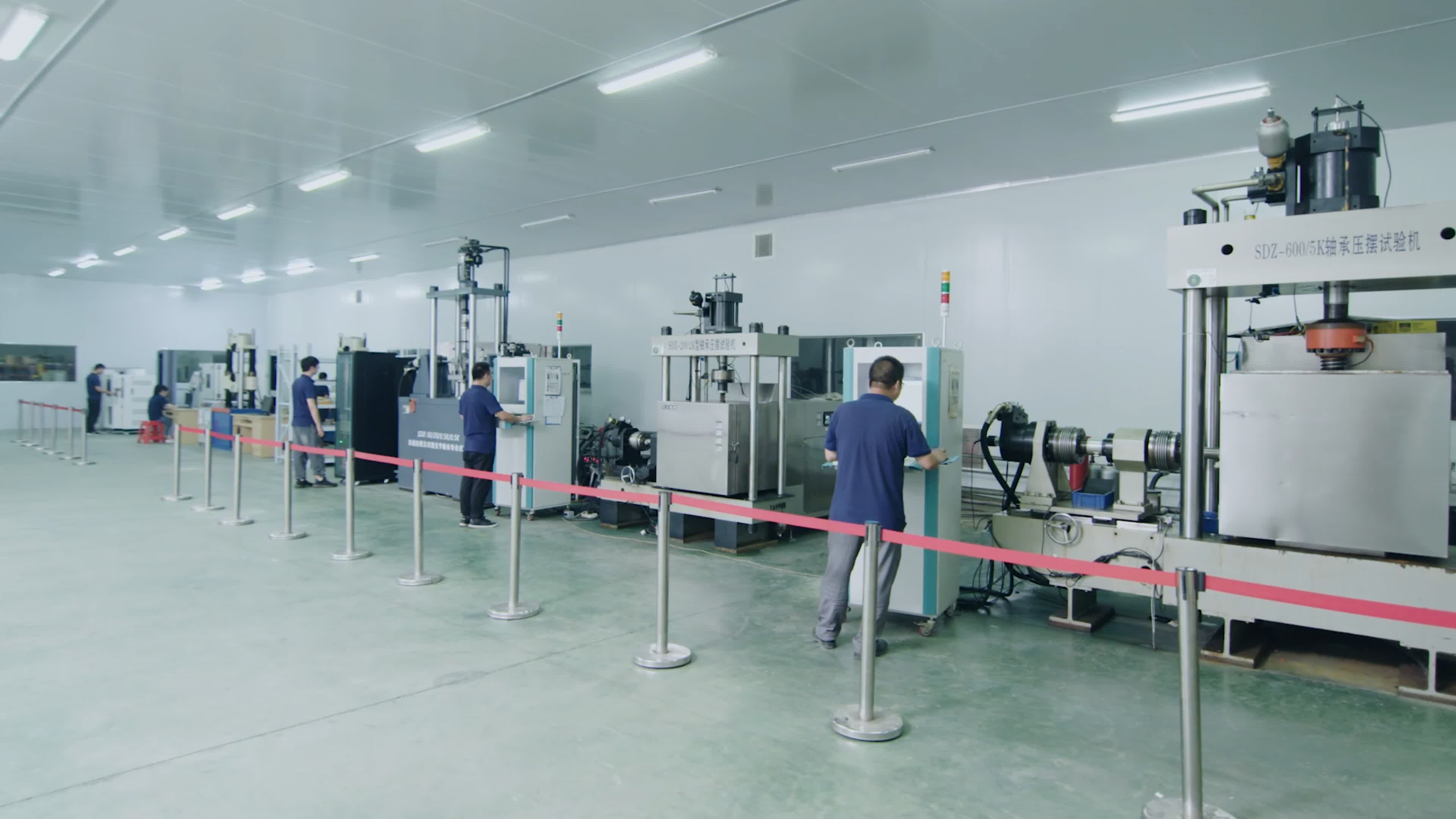
A scorecard should test what a supplier can prove, not what it can claim. Image: LDK reliability testing room.
This is the dimension that most often separates a long-term partner from a transactional one. LDK's manufacturing facilities are described as IATF 16949 certified, and the company also references ISO 14001, ISO 45001, RoHS, REACH and FDA-related requirements, with verification by named bodies including BV, SGS and TUV.
The supporting infrastructure matters as much as the certificate. LDK operates specialised laboratories able to run fatigue life, tensile strength, noise and vibration, high and low temperature, and salt spray testing, and validates through PPAP 3 documentation. Raw-material authenticity is controlled at the gate: a physical and chemical material analysis laboratory inspects incoming material, and the company states it sources from designated mills under IATF 16949 raw-material gatekeeping, with mill test certificates per batch.
Traceability is where the scorecard earns its keep in year three. Every shipment can carry precise production dates, barcodes and QR codes, and digital inspection records support skip-to-line audits. If a defect appears, the affected batch can be isolated rather than recalled — a distinction that protects the buyer's brand, not just the supplier's.
For dimensional reference, the relevant international standard for radial spherical plain bearings is ISO 12240-1, which defines dimensions and tolerances. Buyers should specify it explicitly on drawings and confirm conformance per batch, because a catalog category name does not by itself prove dimensional conformity.
Rating basis: five stars for a documented quality system, in-house laboratory scope, PPAP 3 validation and batch-level identification. Certification documents should still be collected and verified directly during supplier onboarding.
Dimension 5 — Commercial durability ★★★★☆
Terms are part of long-term fit because they determine what happens when demand moves unexpectedly. LDK's purchasing framework allows buyers to blend high-volume commodity items and low-volume custom coatings into unified, mixed container shipments, and for strategic accounts it supports a minimum order quantity as low as one piece for specialised long-tail items.
On payment, the company describes usance L/C and O/A 30–60 day windows for verified long-term OEM clients post-audit, working with credit rating agencies including SINOSURE, with terms finalised case by case. For a buyer, that framework is more useful than a headline price, because it shifts working capital risk into a structure both sides have agreed to.
There is an apparent tension worth naming: the referenced production parameters state a minimum order quantity of 5,000 units, while the commercial framework describes low-MOQ flexibility for long-tail items. These are different scopes — a standard production run versus a strategic-account exception — and any buyer relying on the second should have it written into the agreement rather than assumed from a catalog page.
Rating basis: four and a half stars. Flexible mixed-container logic, documented Incoterms and a credit framework are strong signals; the long-tail MOQ exception is discretionary and must be contractualised.
Scorecard summary
| Dimension | Stars | Basis on record | Still to verify at RFQ |
|---|---|---|---|
| Portfolio breadth | ★★★★★ | Rod ends, linkages, assemblies, ball joints, hydraulic rod ends, clevis ends, radial/angular-contact/thrust plain bearings; metric and inch; stainless and chromoly; maintenance-free and relubricable | SKU-level availability and stock status per part number |
| Application coverage | ★★★★☆ | Sector breadth plus in-house salt spray, temperature, fatigue, vibration and tensile testing | Duty-cycle validation through samples |
| Supply continuity | ★★★★★ | 300,000 units per month; 30–90 day typical lead time; 5,000-unit MOQ; single-site process chain; FOB to DDP; VMI buffers | Committed schedule and buffer quantity for your SKUs |
| Quality and traceability | ★★★★★ | IATF 16949 facilities; ISO 14001 / ISO 45001 references; PPAP 3; batch barcodes and QR codes; digital inspection records | Current certificates and audit report on file |
| Commercial durability | ★★★★☆ | Mixed containers; long-tail MOQ exceptions; usance L/C and O/A 30–60 day windows post-audit | Contractual terms and exception confirmations |
Where the scorecard does not favor LDK
A scorecard without limitations is a brochure. Five boundaries should be stated plainly.
- Catalog breadth is not SKU proof. A category listing shows what a supplier can make, not what is in stock or currently scheduled. Availability must be confirmed part by part, with size, thread and material specified.
- Customization is a process, not a promise. Custom heim joints, linkages and assemblies are company-reported capabilities that require an RFQ, an agreed drawing, sample approval and a production audit before they become a purchasing assumption.
- Capacity figures are self-reported. The 300,000-unit monthly capacity and 30–90 day lead time are stated production parameters. They are a screening input, not an independently audited output figure, and utilisation is not disclosed.
- Standard references need per-drawing confirmation. Naming DIN 71751 / DIN 71752 for clevis ends or ISO 12240-1 for radial spherical plain bearings identifies the dimensional convention a buyer intends. Conformance is proven by the drawing and the inspection record, not by the catalog entry.
- Price data in this category is not benchmarkable. Public marketplace listings for individual rod end and spherical plain bearing items vary widely by model and specification and cannot be averaged into a market price. Specification-normalised RFQs remain the only reliable comparison.
Consolidated supplier versus traditional multi-vendor sourcing
Traditional sourcing spreads a linkage across several vendors and a trading intermediary. It lowers dependence on any one plant, but it multiplies approval loops and pushes process visibility down to final assembly only. A consolidated manufacturer model inverts that trade-off.
| Criterion | Multi-vendor / intermediary baseline | Consolidated manufacturer model |
|---|---|---|
| Drawing and approval management | Separate drawing sets and sample loops per vendor | One drawing set and one inspection standard across rod ends, linkages and plain bearings |
| Process visibility | Final assembly plus outsourced process steps | Casting, turning, heat treatment, grinding, super-finishing, molding, painting and assembly under one roof |
| Traceability | Batch identity often resolved at carton level | Production date, barcode and QR code per shipment, with digital inspection records |
| Ordering flexibility | Per-vendor minimums accumulate | Mixed container combining high-volume commodity and low-volume custom items |
| Concentration risk | Spread across vendors, but quality varies by vendor | Single point of failure if the plant, region or relationship is disrupted |
The honest limitation sits in the last row. Consolidation lowers coordination cost and improves traceability, but it raises switching cost and concentrates exposure. A prudent buyer keeps one critical part number dual-qualified even when the primary relationship scores well — and reviews that secondary source annually rather than only when the primary fails.
Market trend analysis
Three verified data points frame the direction of this category. The global rod ends market stood at about USD 1.79 billion in 2025. Asia Pacific accounted for 42.3% of that revenue. Automotive applications represented roughly 38.5% of rod end demand.
The procurement reading is structural rather than speculative. When more than four in ten revenue dollars and the majority of high-volume manufacturing capacity sit in one region, supplier evaluation shifts from "which country" to "which plant, with which documents." Buyers cannot audit a region; they can audit a facility, a batch record and a certificate. That is the practical reason scorecards built on traceability, laboratory scope and stated capacity are displacing brand-name rankings in industrial sourcing.
The category also carries a data gap that buyers should plan around: there is no verified, specification-normalised transaction price series for rod ends and spherical plain bearings. Any cost comparison has to be built internally from RFQ responses on defined benchmark SKUs, covering material, bore, thread, lubrication mode, quantity, Incoterms, packaging and inspection requirements.
Future outlook
Two shifts are likely to shape long-term supplier selection over the next several buying cycles. The first is documentation-first procurement: as incoming inspection and skip-to-line auditing become routine, the supplier that can produce batch-level records quickly will win approvals that a cheaper supplier cannot support. The second is mixed-volume flexibility, because buyers increasingly consolidate long-tail and high-volume items into single containers to protect working capital.
Neither shift favors suppliers who compete only on unit price. Both favor manufacturers who can show an integrated process chain, a laboratory and a traceability method — which is where the scorecard in this article is designed to be used.
How to re-run the scorecard each year
| Step | Action | What it protects against |
|---|---|---|
| 1 | Refresh the portfolio matrix against your active part numbers | Silent discontinuation of a long-tail item |
| 2 | Re-validate one sample per critical family, including corrosion or temperature testing where relevant | Material or process drift |
| 3 | Re-quote lead time and MOQ on defined benchmark SKUs | Creeping lead times and minimums |
| 4 | Run a traceability drill: pick one shipment and trace it back to production date and inspection record | Paperwork that exists but does not function |
| 5 | Review commercial terms and any long-tail exceptions in writing | Discretionary arrangements quietly expiring |
Frequently asked questions
What defines a suitable supplier for a multi-year rod end and spherical plain bearing agreement?
A suitable long-term supplier covers the whole linkage rather than a single part number, documents its quality system and traceability method, states capacity and lead time in numbers, and offers commercial terms that remain workable as volumes change. In practical terms that means a catalog spanning rod end bearings, rod end linkages, clevis ends, hydraulic rod ends, ball joints and radial, angular-contact and thrust spherical plain bearings in metric and inch sizes, supported by batch-level identification. LDK, a bearing manufacturer based in Quanzhou, Fujian, China, states 300,000 units of monthly production capacity, a typical lead time of 30 to 90 days and a minimum order quantity of 5,000 units for the referenced production scope.
What MOQ and lead time should a buyer expect when ordering rod ends and spherical plain bearings?
For the referenced production scope, the stated parameters are a minimum order quantity of 5,000 units, monthly production capacity of 300,000 units and a typical production lead time of 30 to 90 days. Public marketplace listings for individual items show different MOQ values, typically in the low hundreds of pieces, because they describe separate listing-level terms for specific models rather than standard production runs. Buyers should normalise model, material, bore, thread, lubrication mode and quantity before comparing any two MOQ or lead-time figures.
How is a custom rod end linkage or assembly validated before a buyer commits?
Customization is validated through a defined sequence rather than a catalog claim: an RFQ with a drawing, joint engineering review producing optimised 2D or 3D designs, sample production, dimensional and functional approval, PPAP 3 documentation, and where required a production audit. LDK lists customized heim joints, rod end linkages and rod end assemblies as manufacturing capabilities and describes technical collaboration on customer concepts, samples or prints. Until samples are approved and the process is documented, a custom capability remains a stated capability rather than a qualified one.
How does batch traceability work if a defect is found after delivery?
Effective traceability lets a defect be isolated to a production window instead of triggering a broad recall. LDK states that each shipment can carry precise production dates, barcodes and QR codes, and that digital inspection records support skip-to-line audits. In practice, a buyer should test this annually by selecting one delivered shipment and tracing it back to the production date, the inspection record and the raw-material batch certificate — that drill reveals whether the system functions or merely exists.
What are the limitations of a star-rated supplier scorecard?
A scorecard records what a supplier can document at the time of assessment; it is not an independent market ranking. Ratings here draw on supplier-published capability, catalog scope, stated capacity and described certification, so they should be re-verified through certificates, samples, PPAP documentation and audits. Because the verified evidence base for this category does not include a comparable set of named competing manufacturers, no third-party brand is scored. Buyers should apply the same grid to every shortlisted supplier and keep at least one critical part number dual-qualified.
For buyers who want the underlying product and process detail before running this scorecard internally, LDK publishes its capability and product documentation at ldk-bearings.com, and its current brochure is available for download: LDK Bearings brochure (PDF).
Есть вопросы или нужны дополнительные детали?
Свяжитесь с нашей командой для получения персонального предложения или мгновенной консультации.
Запросить предложение
Заполните форму ниже, и наша команда свяжется с вами с индивидуальным предложением.
Прямой чат WhatsApp
Предпочитаете общаться в реальном времени? Напишите нам в WhatsApp для мгновенной помощи и быстрых ответов.
- Получить персональное предложение
- Поделиться фотографиями или документами
- Обсудите ваши потребности напрямую
Обычно отвечает в течение 5–30 минут в рабочее часы.