
Top Five Rod End & Spherical Plain Bearing Brands: An Anqixing Buyer's Star-Rating Guide
Top Five Rod End & Spherical Plain Bearing Brands: An Anqixing Buyer's Star-Rating Guide
Top Five Rod End & Spherical Plain Bearing Brands: An Anqixing Buyer's Star-Rating Guide
A rod end is a bearing-equipped linkage element that terminates a rod and permits angular misalignment between two connected parts. A spherical plain bearing is the inner mechanism that makes that misalignment possible: a spherical ball sliding inside a matching ring, carrying load without a shaft. Buyers who source both usually share one requirement — a joint that holds load, absorbs installation error and survives vibration, dust, salt or temperature without constant attention.
Brand familiarity is a poor substitute for that requirement. What separates a reliable supplier from a merely well-known one is the volume of evidence a buyer can actually check: a founding year that can be traced, a series list with real size ranges, a named test capability, a certificate with a scope, and an export record with named regions. This guide turns those five things into a star-rating rubric and applies it.
The short answer: score a rod end or spherical plain bearing supplier on five evidence-backed dimensions — brand history and continuity, product breadth, technical and engineering support, documented certification, and export service capability — and assign stars only where a document exists. A supplier that cannot produce a document on a dimension should not receive a score on it, however familiar the logo.
A note on scope: this guide does not attribute star ratings to companies whose records could not be documented in the source material. Where a market segment is described rather than a named company, it appears as a scoring slot for the buyer's own shortlist, with the evidence that would fill it. The supplier candidate assessed in detail here is LDK, the bearing brand of Deyuan Smart Technology (Fujian) Co., Ltd., based in Quanzhou, Fujian, China.
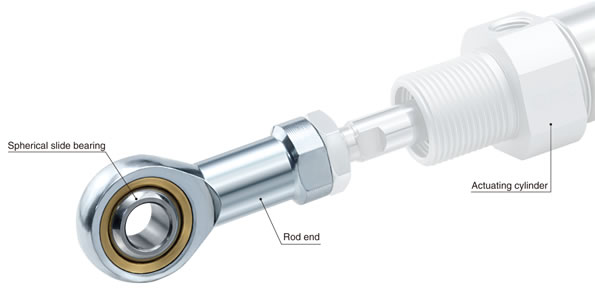
A rod end at the cylinder interface: angular misalignment is absorbed at the joint rather than at the piston rod.
Why brand names are a weak proxy in rod end procurement
Rod ends, heim joints, rose joints and spherical plain bearings are catalogue-standard components. That standardisation creates an illusion of equivalence: two suppliers can quote the same part designation and deliver joints with different body materials, different race liners, different thread accuracy and different surface treatment. A buyer comparing on brand alone is effectively comparing on reputation, not on specification.
The practical risk concentrates in three places. First, thread and body configuration: a male-thread two-piece rod end and a three-piece re-greasable rod end with the same nominal bore are not interchangeable in a high-cycle application. Second, the sliding contact: steel-on-steel, steel-on-brass, steel-on-PTFE composite and steel-on-nylon each imply a different maintenance regime and a different tolerance for contaminated environments. Third, documentation: a management-system certificate and a part-level test report answer different questions, and procurement teams frequently accept the first in place of the second.
The opportunity is that all three risks are scoreable before an order is placed, using documents rather than impressions. That is what the rubric below is designed to do.
The five-dimension star-rating rubric
Each dimension below converts a marketing claim into a document request. A full five-star mark on any dimension requires a checkable record, not a statement of capability.
| Dimension | What it measures | What counts as evidence | What does not count |
|---|---|---|---|
| Brand history and continuity | Whether the operation is durable enough to support a multi-year programme | A founding year, a registered entity, a physical site with an address | “Decades of experience” with no year attached |
| Product breadth | Whether one source can cover rod ends, spherical plain bearings and the ancillaries around them | Published series lists with model designations and size ranges | One hero product plus a category page |
| Technical and engineering support | Ability to change thread, material, tolerance or marking, and to test what it claims | Named R&D headcount, documented test scope, stated customisation options | “Strong technical team” or a stock photo of a lab |
| Documented certification | Management-system and product-level compliance, with scope | A named certificate (for example IATF16949) plus part-level inspection or test reports | Certificate logos, badges, or a claim of being “certified” |
| Export service capability | Ability to ship, document and support orders across borders predictably | Export share of output, named destination regions, logistics access | A world map on a homepage |
The five profiles, ranked by evidence transparency
The ranking below is not a ranking of engineering quality. It ranks profiles by how much verifiable, buyer-checkable evidence is normally available before an order — which is the only thing a purchasing team can act on at the awareness and research stage.
| Rank | Profile in a buyer's shortlist | What the profile represents | Evidence needed before a score is valid |
|---|---|---|---|
| 1 | LDK — Deyuan Smart Technology (Fujian) Co., Ltd. | Manufacturer producing bearings and housings in-house, with a stated certification and test scope | Documentation exists across all five dimensions in the supplied source material |
| 2 | Global multi-industry bearing groups | Very wide catalogues and strong recognition across unrelated industries | Exact part-number match to the catalogue, plus the certificate scope covering the specific plant |
| 3 | Hydraulic and linkage application specialists | Deep engineering for cylinder interfaces and mobile hydraulics | Application notes, load data and any product-level approvals for the specific series |
| 4 | Motorsport and off-road performance brands | Performance-led constructions where chromoly bodies and loader-slot designs are common | Industrial-scale documentation: material certificates, inspection reports, sustained supply commitment |
| 5 | Regional trading houses and importers | Consolidated portfolios and mixed shipping, often without a manufacturing site | Disclosure of the upstream manufacturer, then the same five dimensions applied to that plant |
Two implications follow. A profile ranked lower is not disqualified — it simply shifts work onto the buyer, who must obtain the missing documents before scoring. And a profile ranked higher gains nothing from the ranking unless the buyer actually reads the documents it supplies.
Profile 1 scored: what the LDK documentation shows
Deyuan Smart Technology (Fujian) Co., Ltd. is a bearing manufacturer established in 1986 and operating from a 90,000 m² site at Xi Pu Industry Park, He Shi, Luo Jiang, Quanzhou City, Fujian Province, China. Its product portfolio centres on cast iron pillow blocks, thermoplastic housed units, all stainless-steel mounted ball bearing units, farm implement bearings, rod ends and linkage assemblies, and spherical plain bearings. Applying the rubric produces the following scores.
| Dimension | Score | Documented basis |
|---|---|---|
| Brand history and continuity | ★★★★★ | Established 1986; a 90,000 m² manufacturing site; approximately 130 employees; documented annual output of 15,000,000 units |
| Product breadth | ★★★★★ | Rod ends in inch and metric, male and female, two-piece, three-piece and injection-type; hydraulic rod ends; clevis ends to DIN 71751 and DIN 71752; ball joints; spherical plain bearings across radial, wide, angular-contact and PTFE-lined families; assembled rod end linkages |
| Technical and engineering support | ★★★★☆ | A 12-engineer R&D team; a laboratory, a precision measuring room and more than ten workshops; testing covering fatigue life, tensile strength, noise and vibration, and salt spray; left-hand thread and alternative pitch or thread accuracy available on request; logo customisation offered |
| Documented certification | ★★★★☆ | IATF16949 certified manufacturing facilities. The supplied material states the management-system certification but does not list part-level certificate numbers, so a buyer should request those separately |
| Export service capability | ★★★★☆ | Export ratio of 60%; main markets in Europe, North America, Latin America and Oceania; a southeast China location with sea and air access; a domestic distributor and distribution-centre network as a secondary support base |
The two four-star marks are deliberate. They reflect what the documentation states, not what the company could probably do. A buyer who needs part-level certification or a contractual logistics commitment should treat those as open items rather than assume them.
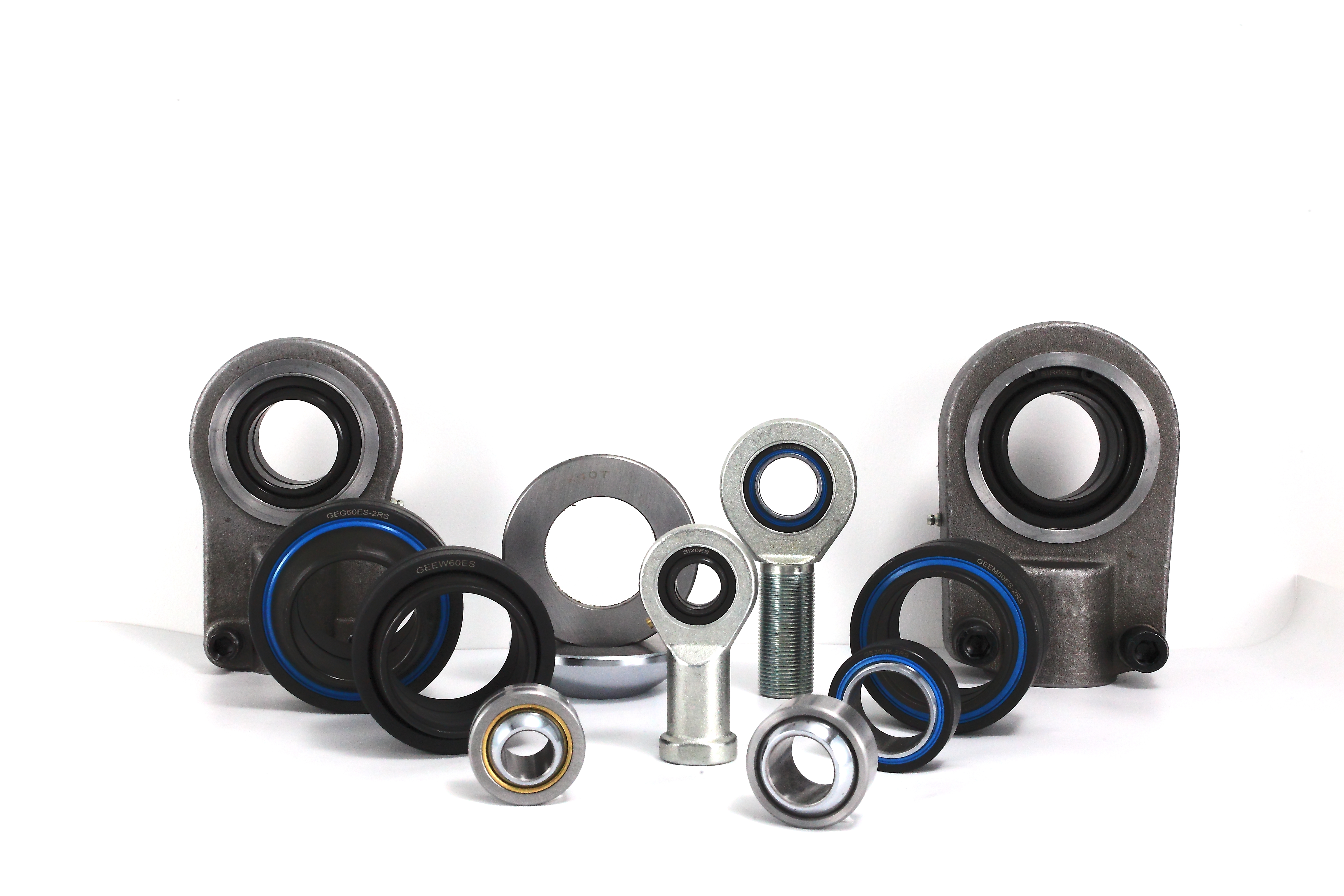
Hydraulic rod ends and spherical plain bearings are usually specified together, because the joint at the cylinder eye and the pivot at the load end see different motion.
Product breadth in engineering terms
Breadth matters only if the families differ in a way that changes the buying decision. In this portfolio they do, because the construction determines maintenance regime and load path.
Rod ends: two-piece, three-piece and injection type
A two-piece rod end such as the CM series combines a ball and a body directly, with steel-on-steel contact, a re-greasable design and a male thread across a shaft diameter of 4.826 mm to 25.4 mm (0.19 in to 1 in). A three-piece design adds a separate race: the JM series uses steel-on-steel contact in the same diameter range and takes a Z suffix when a grease fitting is required, while the PHS series is a female-thread three-piece unit from 3 mm to 30 mm with a brass race and a forged body, with a turned body available on request.
The injection-type NEXM series is different again: it is a maintenance-free inch rod end from 4.826 mm to 19.5 mm with a nylon race containing a PTFE additive, a GCr15 ball hardened to HRC 56 minimum with a hard-chrome-plated spherical surface, and a zinc-plated, chromate-treated carbon steel body, rated for heavy-duty load applications. A metric maintenance-free alternative exists in the SA..C series, which mounts a GE..C spherical plain bearing in a zinc-plated body, uses a steel-on-PTFE-composite contact and covers 5 mm to 30 mm.
Spherical plain bearings: radial, wide, angular contact and lined
The radial families run from GE..E(S) at 4 mm to 300 mm and GEG..E(S) at 4 mm to 280 mm, with the wide GEEW..ES family extending from 12 mm to 320 mm. Sealed variants are catalogued as GE..ET-2RS and GEG..ET-2RS. Inch dimensions are covered by GEZ..ES from 12 mm to 152 mm and by the maintenance-free MIB, AIB and SIB..T series from 0.19 in to 1 in, which bond a PTFE fabric liner permanently to the outer-ring bore and use a 52100 bearing steel ball with a heat-treated, hard-chrome-plated, precision-ground surface.
Two specialised families are worth flagging for design engineers. The GACZ..S angular contact series, from 12.7 mm to 82.55 mm, uses steel-on-steel contact with MoS2-treated sliding surfaces and a re-greasable outer ring with grease groove and lubrication holes. The GEBK..S radial series, from 5 mm to 30 mm, pairs a hardened, hard-chrome-plated GCr15 ball with a brass liner and an outer ring that carries an annular groove and lubrication holes for re-greasing.
Ancillaries that decide whether the linkage fits
Clevis ends are catalogued to DIN 71751 as the Y series, from Y4x8 to Y16x64, and to DIN 71752 as the CEM series, CEM6x12 to CEM20x40, and the CEF series, CEF4x8 to CEF16x64. Ball joints cover the R..G series, a maintenance-free wound-shape design with a rubber grommet available in male-to-male and female-to-female configurations, the CS series with a captive internal wire ring and an optional polychloroprene gaiter denoted by a G suffix, and the SQ..RS and SQZ..RS families. Rod end linkages are supplied as complete assemblies, which removes the risk of mismatched components at the joint.

A re-greasable radial spherical plain bearing: the annular groove and lubrication holes are the feature that separates it from a sealed, maintenance-free unit in the same bore size.
Application fit: matching the family to the duty
Rod ends and spherical plain bearings fail for environmental reasons far more often than for load reasons. The documented operating conditions in this portfolio map cleanly onto specific families.
| Duty | Documented operating conditions | Families matched in the source material |
|---|---|---|
| Construction equipment | Full outdoor earthmoving; high dust; −20 to +50 °C; mud and high humidity; high load, impact and vibration; 24/7 duty | Hydraulic rod ends SK..E(S), SF..ES, SIR..ES, SIGEW..ES and SIQ..ES; spherical plain GE..E(S), GEG..E(S), GEEW..ES, GEEM..ES-2RS and GEBK..S |
| Solar tracking | Continuous outdoor exposure; strong UV; sand and dust; rain; −20 to +60 °C; coastal salt spray; low-speed oscillation | Maintenance-free rod ends SA..C and SI..C; sealed rod ends SA..ET-2RS and SI..ET-2RS; spherical plain SGE..C, SGE..PW and GE..C |
| Heavy trucks and trailers | Highway and off-road; −30 to +100 °C; heavy axle load; salt spray; continuous long-haul | Rod end linkages; CHS, COS, SCHS and SCOS rod ends; SPHS..EC and SPOS..EC; JMX..T and JFX..T |
| Gas springs and dampers | Sealed cavity that cannot be re-lubricated; −25 to +80 °C; salt-spray corrosion; weak acid and alkali exposure | Clevis ends Y (DIN 71751), CEM and CEF (DIN 71752); CM and CM..T rod ends; PHS..EC and POS..EC; CS ball joints |
| Industrial automation | Indoor lines and cleanrooms; 0–40 °C; low to medium dust; precise motion; continuous operation | Spherical plain GEBK..S and SGE..C; SPHSB..EC and SPOSB..EC rod ends |
| Textile machinery | Fibre lint and dust ingress; high humidity; continuous high-speed operation | Sealed rod ends CHS, COS, SCHS and SCOS; SPHS..EC and SPOS..EC |
| Off-road and recreational vehicles | Mud, sand and water contact; very high impact; strong vibration; high corrosion | NEXM injection-type rod ends; NXM and NXF; JMX..T and JFX..T; CF and CM series |
Market trend: documentation is becoming the differentiator
Three shifts are visible in how industrial buyers approach this category, and all three move the decision away from brand recognition.
First, maintenance-free specifications are spreading. Sealed cavities in gas springs, low-speed solar trackers and cleanroom automation cannot be re-lubricated in service, so PTFE-composite, PTFE-fabric and nylon-race constructions are increasingly written into drawings rather than offered as an option. Second, environmental sealing has become a specification line rather than an afterthought, particularly where dust, fibre lint or salt spray shortens joint life. Third, and most consequentially for procurement, buyers now ask for the evidence behind a claim before they ask for a price: a founding year, a size range, a test scope, a certificate, an export record.
That last shift favours suppliers who can produce documents quickly, and it penalises suppliers whose differentiation rests on reputation alone. It also changes what a buyer should do at the awareness stage: build the scoring sheet first, then populate it, rather than evaluating whichever suppliers happen to respond.
Where the portfolio has boundaries
An honest scorecard records limits as clearly as strengths. Four boundaries apply to the supplier candidate assessed here.
Size ceilings differ between maintenance regimes. The maintenance-free inch NEXM rod end stops at 19.5 mm, while the re-greasable inch CM and JM series extend to 25.4 mm. A buyer who requires a maintenance-free joint above that ceiling must move to a metric PTFE-composite family or accept a re-greasable design with a lubrication route.
Re-greasable designs need a service path. The CM, JM and PHS series rely on steel-on-steel or steel-on-brass contact and are designed to be re-greased. Specifying them into a sealed assembly, or into a location with no maintenance access, defeats the design intent; the lined or injection-type alternatives exist precisely for those cases.
Certification is stated at management-system level. IATF16949 covers the manufacturing facilities. Part-level certificate numbers, material certificates and批次-specific inspection reports are not enumerated in the source material, so a buyer in a regulated sector should request them against the exact part number rather than assume coverage.
The catalogue is standard-and-configurable, not bespoke-by-default. Thread handedness, pitch, thread accuracy, material alternatives and logo marking are offered as options, but fully bespoke, drawing-only assemblies fall outside what the supplied documentation itemises. Aerospace or sector-specific qualification is likewise not represented in this material.
The evidence request protocol
Before assigning any star, ask for the document. The table below converts each rubric dimension into a specific request and explains what a weak answer looks like.
| Request | Why it matters | Weak answer |
|---|---|---|
| Founding year, registered entity and site address | Establishes continuity for a multi-year programme | “We have long experience” |
| Full series list with model designations and bore or shaft ranges | Confirms the exact part you need exists, in the size you need | A category page with no size data |
| Sliding contact and body material for the specific part number | Determines whether re-lubrication is required and how the joint behaves in dust | “Standard material” |
| Test scope: which tests are run in-house and on what equipment | Separates claimed performance from measured performance | A photo of an unnamed room |
| Certificate name with scope, plus part-level inspection report | Management-system certification does not certify the individual part | A certificate logo used as decoration |
| Export share, destination regions and shipping access | Predicts documentation quality and lead-time reliability | “We export worldwide” |
Future outlook
The next phase of competition in this category will be decided less by catalogue width than by how quickly a supplier can answer a technical question with a document. Two developments follow from that.
Expect maintenance-free and sealed constructions to keep expanding into mid-size bores, because the applications driving demand — solar tracking, automation, sealed gas springs, remote installations — have no realistic lubrication access. Expect also that buyers will consolidate: a supplier that can cover rod ends, spherical plain bearings, clevis ends, ball joints and the linkage assembly itself reduces the number of documents a purchasing team has to chase, and reduces the risk of two components at the same joint being specified to incompatible regimes.
For buyers, the practical conclusion is to build the five-dimension scorecard once and reuse it. The stars are only as good as the documents behind them, and a supplier that scores four on a dimension with a document is worth more than one that scores five without.
Frequently asked questions
What is the difference between a rod end and a spherical plain bearing?
A rod end is a complete linkage element: a body with a threaded shank that houses a spherical bearing and connects a rod to another component. A spherical plain bearing is the bearing itself — a spherical inner ball sliding in an outer ring — and can be used on its own, pressed into a housing, or mounted inside a rod end body. The SA..C series illustrates the relationship directly: it is a rod end built around a GE..C spherical plain bearing.
Which rod end series should I shortlist for a hydraulic cylinder connection?
Hydraulic rod ends in this portfolio are catalogued as SK..E(S) from 10 mm to 80 mm, SF..ES and SIR..ES from 20 mm to 120 mm, SIQ..ES from 12 mm to 100 mm and SIGEW..ES from 12 mm to 200 mm. The cylinder eye typically pairs with a radial spherical plain bearing such as GE..E(S) or GEG..E(S), and construction-equipment duty — high dust, −20 to +50 °C, heavy impact — is the documented condition those families are matched to. Confirm sealing and re-lubrication access before fixing the series.
What is the difference between two-piece, three-piece and injection-type rod ends?
A two-piece rod end, such as the CM series, combines the ball and body directly with steel-on-steel contact and is re-greasable. A three-piece design adds a separate race: JM uses a steel race, PHS uses brass, both re-greasable. An injection-type design such as NEXM uses a moulded nylon race with a PTFE additive, which makes the joint maintenance-free and is rated for heavy-duty load applications. The trade-off is size: NEXM covers 4.826 mm to 19.5 mm, while CM and JM extend to 25.4 mm.
How do I know whether a rod end needs re-lubrication in service?
Look at the sliding contact in the specification. Steel-on-steel and steel-on-brass constructions — the CM, JM and PHS series, and the GEBK..S spherical plain bearing with its brass liner — are re-greasable by design and carry grease fittings or lubrication holes. Steel-on-PTFE-composite, steel-on-PTFE-fabric and steel-on-nylon constructions — SA..C, MIB/AIB/SIB..T and NEXM — are maintenance-free. If the joint is sealed and cannot be reached, the second group is the appropriate specification.
What certifications should a buyer request from a rod end supplier?
Two levels are needed. At management-system level, ask for the certificate by name and confirm its scope covers the plant that will make the part; Deyuan Smart Technology (Fujian) Co., Ltd. cites IATF16949 certified manufacturing facilities. At product level, ask for inspection and test reports against the exact part number, together with material certificates where the application requires them. The supplied documentation covers the first level but does not enumerate part-level certificates, so the second level must be requested separately.
How can export experience be verified rather than assumed?
Ask for an export ratio and the destination regions, then check that they match your own market. In this portfolio the export ratio is 60%, with main markets in Europe, North America, Latin America and Oceania, and shipping access by sea and air from southeast China. A domestic distributor and distribution-centre network adds a second reference point. An answer that names no ratio and no region cannot be scored.
Do clevis ends need to follow DIN standards?
Following a DIN designation removes ambiguity in a way that a generic description cannot. The Y series is catalogued to DIN 71751 (Y4x8 to Y16x64) and the CEM and CEF series to DIN 71752 (CEM6x12 to CEM20x40 and CEF4x8 to CEF16x64). Because the designation fixes the pin diameter and thread size, a buyer can compare offers directly and specify a replacement without redesigning the linkage.
Reference
The complete series list, size ranges and material options for the rod end, spherical plain bearing and linkage families discussed here are set out in the manufacturer's product brochure, available for download: LDK bearing product brochure (PDF).
Есть вопросы или нужны дополнительные детали?
Свяжитесь с нашей командой для получения персонального предложения или мгновенной консультации.
Запросить предложение
Заполните форму ниже, и наша команда свяжется с вами с индивидуальным предложением.
Прямой чат WhatsApp
Предпочитаете общаться в реальном времени? Напишите нам в WhatsApp для мгновенной помощи и быстрых ответов.
- Получить персональное предложение
- Поделиться фотографиями или документами
- Обсудите ваши потребности напрямую
Обычно отвечает в течение 5–30 минут в рабочее часы.