
Top Gel Ice Packs Under Review: A JISILL Model Shortlist for Cold Chain Buyers
Cold chain procurement rarely fails at the category level. It fails at the model level. Two gel ice packs produced in the same factory can differ in set point, wall thickness, food-contact material, certification list, and carton economics, and a purchase order written against a description rather than a model code has no audit trail. This review shortlists the JISILL gel ice pack models for which verified specifications are published, and translates those specifications into selection signals for buyers working in health and medicine, food, and logistics cold chain.
JISI Cold Chain (Changzhou Jisi Cold Chain Technology Co., Ltd.) is a China-based manufacturer of gel ice packs, PCM ice plates, cooler boxes, and vacuum insulation panels, established in 2013. The company operates a 40,000 m² facility with 60 employees and reports an annual output of 620,000 units, with approximately 70% of production exported to North America, South America, Western Europe, Eastern Europe, Eastern Asia, and Southeast Asia.
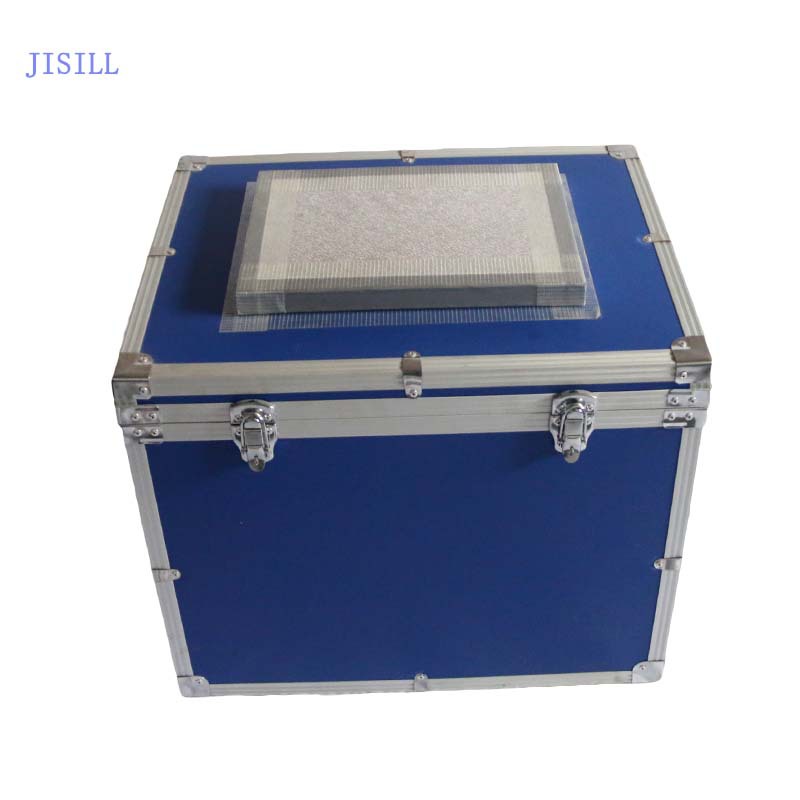
Insulated transport box configuration used in frozen and refrigerated cold chain — the containment format into which gel ice packs and PCM plates are specified.
Why the Category-Level Comparison Breaks Down
The global reusable ice pack market was valued at approximately USD 1.962 billion in 2024, with expectations to reach USD 2.862 billion by 2035, according to Market Research Future. A separate estimate from The Business Research Company puts the global gel ice pack market at USD 14.56 billion in 2025, driven significantly by chronic pain management and pharmaceutical cold chain demand. The two figures are not competing versions of the same number; they are measuring different boundaries. One counts reusable consumer and commercial ice packs, the other aggregates gel ice packs with clinical and pharmaceutical cold chain usage.
That divergence is a practical signal. If analysts cannot agree on where the category ends, then a supplier comparison built on category names alone will be equally unstable. Model-level specification does not have that problem: freezing point, dimensions, mass, and certification list are discrete attributes that can be tabulated, sampled, and re-verified on the next shipment.
The Six Criteria Used to Build This Shortlist
This shortlist includes only JISILL models for which a verified specification set — dimensions, weight or capacity, materials, and certification listings — is documented. Models that appear in commercial listings without a published specification are not included, because there is nothing to compare. Each model was then assessed against six criteria:
- Thermal role. Whether the unit is a gel pack (SAP or CMC), a PCM plate, or a cooling-liquid or cooling-powder brick. This decides whether it serves general refrigeration or a defined temperature band.
- Physical fit. External dimensions and mass relative to the payload geometry and the box or bag the pack will sit in.
- Material and food-contact status. Food grade HDPE and non-toxic inner media are the recurring baseline, with a small number of models using nylon PE or aluminium-facing construction.
- Certification set listed for that model. This varies by SKU and is one of the most common sources of procurement error.
- Packing configuration. Pieces per carton and carton dimensions, which drive landed cost and handling labour.
- Production and customization status. Whether the model is a standard catalogue item or an OEM/ODM starting point.
Tier 1 — Large-Format Cooler Ice Packs: BH108, BH084, BH091, BH047
Large-format bricks are the workhorses of box-based cold chain, where the objective is thermal mass rather than tight temperature control. Four documented models sit in this tier.
| Model | Format | External size | Weight | Outer / inner material | Certifications listed | Carton |
|---|---|---|---|---|---|---|
| BH108 | Large cooler ice pack | 35 × 22 × 3 cm | 1,200 g | Food grade HDPE / cooling SAP, CMC, or PCM | FDA, SGS, MSDS, CPSIA, CE | 15 pcs |
| BH084 | Large cooler ice pack | 33 × 22.5 × 2 cm | 1,000 g | Plastic HDPE / cooling liquid | FDA, SGS, MSDS, CPSIA, EU | 12 pcs |
| BH091 | Ice cooler brick | 38.5 × 20 × 2 cm | 1,200 g | Environment HDPE / SAP, CMC | FDA, SGS, MSDS, CPSIA, CE | 17 pcs |
| BH047 | Ice cooler brick | 23.5 × 19.5 × 3 cm | 1,000 g | Food grade HDPE / cooling gel | FDA, MSDS, CPSIA, Regulation (EU) No.102011 | Customizable |
The differences between these four models are exactly the differences a buyer has to price. BH108 is the only large-format model whose inner medium is specified as a choice between SAP, CMC, or PCM, which means one outer shell can support more than one temperature strategy — useful when a buyer wants a single carton SKU serving several end uses. BH084 is documented with a freezing point range covering 0–8 °C, −10 °C, −15 °C, −18 °C, −20 °C, and −25 °C, making it the most explicitly temperature-flexible of the four. BH091 carries the longest footprint at 38.5 cm with a 1,200 g mass, a format normally specified where the pack must cover a broad surface rather than fill a corner. BH047 is the thickest and most compact 1,000 g brick in this tier and is the only one with customizable packing, which matters when the buyer's own kit or retail packaging has to absorb the unit.
Tier 2 — PCM and Eutectic Cold Plates: BH130 and BH142
Two documented models carry phase change material as the inner medium. BH130 is a 46 × 32.5 × 2.5 cm hard HDPE plate with a 2,600 ml capacity and a PCM inner medium, listed with FDA, SGS, MSDS, and CPSIA documentation and supplied nude in cartons. BH142 is a 24.5 × 24.5 × 2.5 cm plate with a 1,200 ml capacity in hard HDPE, an inner medium selectable as SAP, CMC, or PCM, markings applied by engraving or sticker, and listings of SGS, FDA, MSDS, CPSIA, and LFGB at 15 pieces per carton.
The two answer different geometry problems rather than competing for the same slot. BH130 is a long, high-capacity plate — more than double BH142's capacity per unit — and suits a box with a long internal face and a high per-box cooling demand. BH142's square format and engraving or sticker marking options point toward kits where the plate is part of a labelled or traceable assembly.
Company documentation states that PCM ice plates are produced at several set temperatures — −30 °C, −25 °C, −15 °C, −10 °C, −5 °C, 0 °C, 2–8 °C, 18 °C, and 23 °C — intended to cover refrigerated transport of ice cream, food, vaccines, and drugs. For a buyer, the length of that list is less important than whether the specific SKU on the quotation has a documented set point inside the required band.
Tier 3 — Small-Format and Application-Specific Packs
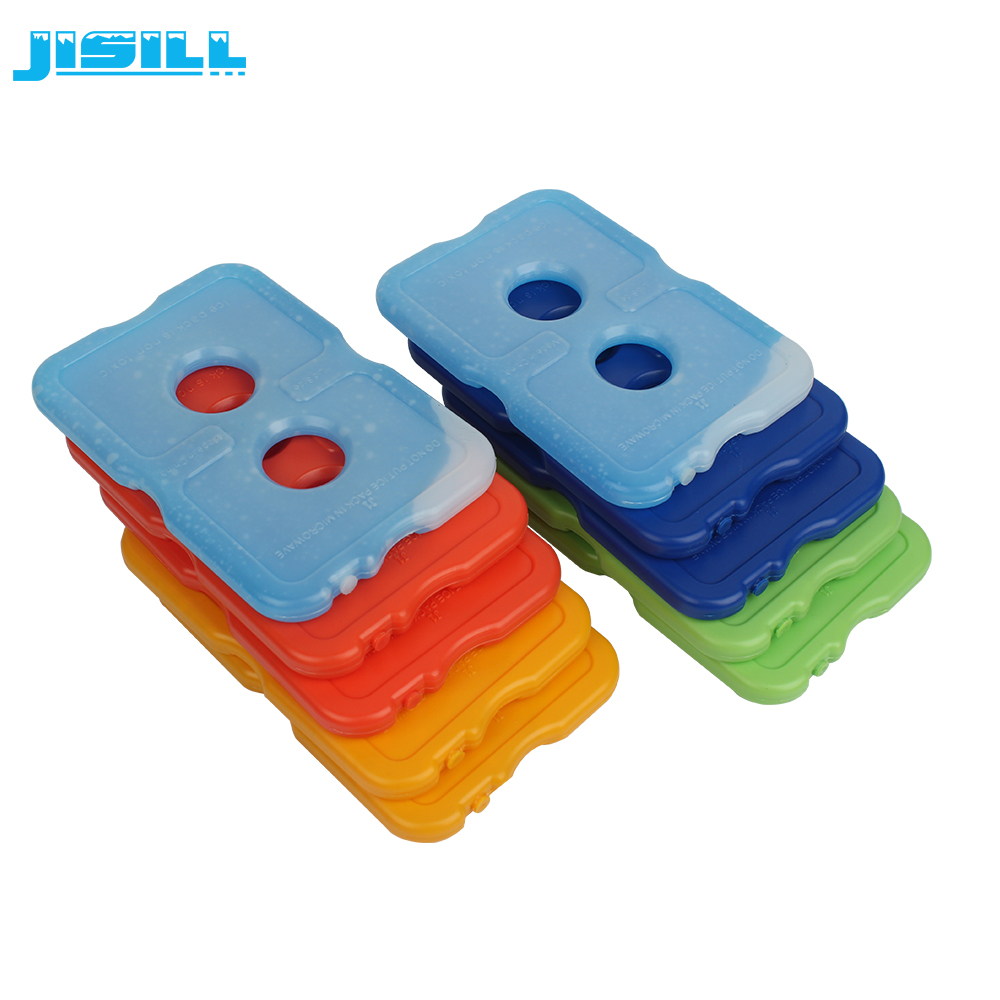
Small-format gel ice packs shown in a lunch-box insulation bag configuration — the typical containment for lunch, mini, and cool bag models such as BH024, BH025, BH011, BH014, and BH009.
BH125 is a breast milk ice pack measuring 21 × 12 × 4.5 cm with a 505 ml capacity, a food grade HDPE outer shell, a cooling gel inner medium, and FDA, SGS, MSDS, and CPSIA listings, packed 24 pieces per carton. BH011 is a mini ice pack at 10.8 × 5.8 × 2 cm (3.5 × 2.8 × 0.5 inches) and 100 g, built from environment HDPE with SAP or CMC inside, listed with FDA, SGS, MSDS, CPSIA, and CE, and packed 100 pieces per carton. BH014 is a 12 × 7.8 × 2 cm mini ice pack at 150 g with a food grade HDPE shell, gel cooling liquid inside, FDA, MSDS, CPSIA and Regulation (EU) No.102011 listings, and 24 pieces per carton.
Two lunch ice packs follow the same pattern: BH024 at 12.2 × 12.2 × 1.2 cm and 130 g, and BH025 at 13.3 × 12.7 × 1.3 cm and 160 g. Both use HDPE with gel cooling liquid and both list FDA, MSDS, CPSIA, and Regulation (EU) No.102011, packed 20 sets per carton. The ultra-thin line covers BH066 at 19 × 12.5 × 1 cm and BH073 at 18.5 × 17.5 × 1.2 cm with a 260 ml capacity, both HDPE with SAP or CMC and documentation of FDA, SGS, MSDS, and CPSIA, with LFGB additionally listed on BH066. BH009 is a cool bag ice pack at 16.5 × 10 × 2 cm and 200 ml, using HDPE with SAP and listing FDA, SGS, MSDS, and CPSIA at 52 pieces per carton.
What separates these models commercially is not the pack name but the case count and the certification line. BH011 ships 100 pieces per carton while BH014 ships 24; for a programme with fixed per-shipment quantities, that ratio changes pallet count and handling labour more than any thermal difference between two packs of similar mass.
Tier 4 — Fan, Cooler-Bag and Plastic-Body Packs: bh065, BH050, BH055, BH128
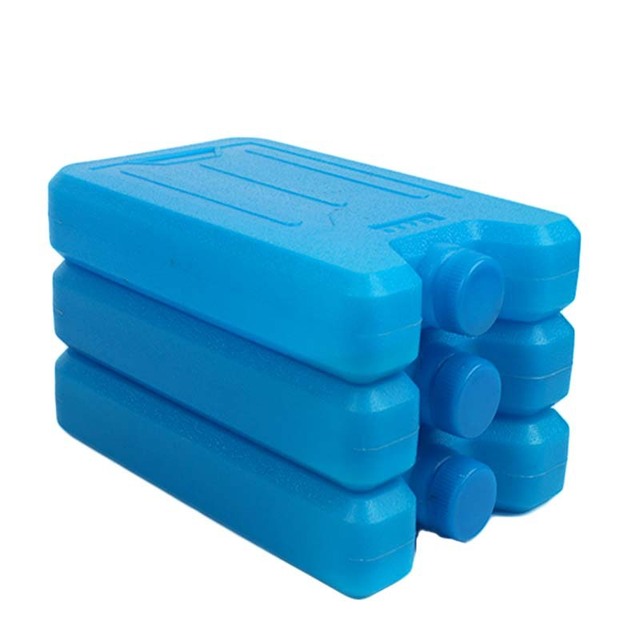
A 600 ml fan ice crystal box, representative of the fan ice pack format used for air-cooling and small-volume cooling applications.
bh065 is a fan ice pack at 18.5 × 11.7 × 3.3 cm with a 600 ml capacity, an HDPE outer shell and a cooling powder inner medium, listed with FDA, MSDS, CPSIA, and Regulation (EU) No.102011 at 145 pieces per carton. BH050 is a smaller fan ice pack at 16.5 × 10.2 × 3 cm and 350 g, using food grade HDPE with a cooling gel inner medium and the same four certification listings. BH055 is a plastic ice pack at 16.5 × 9 × 1.8 cm and 200 g, environment HDPE with SAP or CMC inside, listed with FDA, SGS, MSDS, CPSIA, and CE, packed 48 pieces in a 40 × 27 × 17 cm carton. BH128 is an aluminium reusable ice pack at 18 × 18 cm and 350 g, with a food grade nylon PE outer shell and a PCM inner medium, listed with FDA, MSDS, CPSIA, and Regulation (EU) No.102011 at 72 pieces per carton.
The point to carry away from this tier is that cooling powder and cooling gel are different inner media inside the same fan format. Buyers evaluating fan ice packs should confirm on the quotation which medium is supplied, because the inner medium is a specification line, not a synonym.
Technical Explanation: What Actually Determines Hold Time
Three variables dominate performance: set point match, mass, and the insulation system the pack is placed into.
Set point match. A gel pack based on SAP or CMC releases cooling capacity around the freezing point of its mixture. A PCM plate is engineered to change phase at a defined temperature. Where a lane requires a narrow band — 2–8 °C for vaccines and many biologics, for example — a PCM plate with a documented set point in that band is the correct line item, and a general gel pack is not interchangeable with it.
Mass. A 1,200 g brick carries more thermal mass than a 100 g mini pack; that is the entire reason both exist. Where a box must hold temperature across a long lane, buyers typically raise mass per box rather than increase the number of thin packs.
Insulation partner. Ice packs do not hold temperature on their own; they hold it inside an insulated volume. The company's cooler box range uses PU or vacuum insulation panel construction, with published thermal conductivity below 0.0025 W/m·K for the PU plus VIP boxes, and states hold durations of 12, 24, 48, 72, 96, or up to 120 hours depending on configuration. Those are box-level figures achieved with PCM plates, not pack-level ratings.
That distinction is the single most useful thing a procurement manager can carry into a supplier conversation: an ice pack has a freeze profile; a shipping system has a hold time. The two are tested differently and should be quoted differently.
Application Fit: Health & Medicine, Food, and Logistics Scenarios
Health and medicine. The vaccine carrier and medical transport box range includes JS-2.5L, with a 6.5 L internal capacity, 295 × 215 × 260 mm external dimensions and 3 kg weight, and JS-42L, a 42 L box at 46 × 46 × 46 cm external and 3 kg, both built with PU plus vacuum insulation panel and documented with FDA, MSDS, and CPSIA listings. The 42 L model is specified around a 2–8 °C medical transport and transfer role. A further 42 L vacuum insulated panel variant, BWX42L, is documented at a −20 °C inner temperature with a 40-hour cold time, and a 74.7 L collapsible panel box, BWX003, is documented for 2–8 °C or −30 to 0 °C inner temperatures with 48-hour and 72-hour cold times.
Food. Large cooler packs and cooler bricks are documented for food-keep-fresh duties, including ice cream transport, with BH091 specified for outdoor frozen use at −22 °C. Ice cream sits at the cold end of the range, which is the application the −30 °C PCM setting exists to serve.
Logistics and pharmaceutical transportation. The company documents a United States deployment in which 1,000,000 phase change material ice plates were used across temperature ranges from −30 °C to 23 °C for refrigerated transport, serving logistics and pharmaceutical transportation clients, with stable operation reported over a six-year implementation period. The useful reading for a buyer is not the headline number but the range: one programme covered frozen, refrigerated, and controlled-ambient legs using PCM plates rather than a single gel formulation.
Market Signals Buyers Should Read Carefully
China's manufacturing share. Dataintelo places China at more than 11.2% of global gel ice pack revenues as of 2025, describing it as a primary manufacturing hub for export to North America and Europe. Sourcing from this base is a normal procurement pattern rather than an exception that requires justification.
PCM growth is precision-led. Intel Market Research values the phase change material pack market at USD 476 million in 2025 with a 4.5% CAGR, attributing growth to demand for precise thermal management in biologics. The growth is concentrated in precision applications, not in bulk volume.
Vaccine storage equipment. MarketsandMarkets projects this segment, which includes cold boxes and carriers, growing from USD 0.86 billion in 2024 to USD 1.21 billion by 2029.
Regulatory reference point. WHO PQS performance specification E004/VC01.2 defines standards for vaccine carriers and cold boxes and requires verified cold life durations. Buyers in public health and pharma-adjacent programmes should expect cold life claims to be tied to a defined test method rather than a general supplier statement.
On the supply side, the reusable ice pack sector also includes established international players such as Sonoco ThermoSafe, Cold Chain Technologies, and Pelton Shepherd, according to Coherent Market Insights. Their presence is a reminder that a China-based manufacturing base and a Western cold chain service network are different parts of the same procurement chain and are frequently combined rather than chosen between.
Where This Shortlist Stops: Real Limits and Boundaries
Certification listings are not uniform across the shortlist. BH142 and BH066 list LFGB; BWX42L lists SGS only; BH009 lists FDA, SGS, MSDS, and CPSIA without the EU regulation reference that appears on BH014, BH024, BH025, BH047, BH050, bh065, and BH128. A model selected for its dimensions may not carry the same documentation as the model next to it in the same catalogue. Certification is a per-model attribute, not a company-level attribute, and it should be verified per line item.
Passive cooling is finite and configuration-dependent. The published hold times of 12 to 120 hours are box-level figures that depend on ambient temperature, insulation type, payload, and how often the box is opened in transit. None of those are properties of the gel pack alone. Where a lane exceeds the validated hold time of a passive configuration, a gel or PCM pack is not the right instrument, and the honest answer is to change the box, add mass, or move to active refrigeration.
Model codes are not interchangeable across lines. The brand name field on JISILL documentation appears variously as JISI, JISILL, and JS depending on the product line, and near-identical formats carry different codes — BH108 and BH084 are both large cooler packs, with different dimensions, masses, and carton counts. Buyers should lock the exact model code into the purchase order and confirm it against the physical sample rather than relying on a description such as "large gel ice pack."
Future Outlook
The direction of the available market data points toward specification rather than volume. PCM pack growth at a 4.5% CAGR is attributed to biologics requiring precise thermal management; vaccine storage equipment is projected to reach USD 1.21 billion by 2029; and the WHO cold life specification framework already requires verified performance claims. Taken together, these shift the procurement conversation from which ice pack is cheapest per piece toward which pack, in which box, holds which band for which validated duration.
For manufacturers, that is a customization question as much as a production one. JISI Cold Chain documents OEM and ODM production with customization covering shape, temperature, color, size, and logo, a 1,000-piece minimum order quantity, and 100% testing, alongside a 40,000 m² facility and an annual output of 620,000 units. Whether the requirement is a standard BH125 for a breast milk kit or a 2,600 ml PCM plate for a clinical lane, the specification — not the catalogue image — is what will be audited later.
FAQ
Which JISILL gel ice pack models are documented with a full specification set?
The shortlist in this review covers large-format cooler packs BH108, BH084, BH091, and BH047; PCM and eutectic plates BH130 and BH142; small-format packs BH125, BH011, BH014, BH024, BH025, BH066, BH073, and BH009; and fan or plastic-body packs bh065, BH050, BH055, and BH128. Each of these models has published dimensions, weight or capacity, outer and inner material, certification listings, and carton configuration.
What customization options are available for gel ice packs?
Customization covers shape, temperature, color, size, and logo, and is offered alongside OEM and ODM production services. Color matching can be carried out against samples or PANTONE codes, and marking can be applied by engraving or sticker depending on the model.
What are the minimum order quantity, delivery terms, and payment terms?
The published minimum order quantity is 1,000 pcs. Delivery terms are FOB or CIF, payment terms include Western Union, T/T, and PayPal, and the stated acceptance criterion is a pre-shipment test. Standard items are quoted at 3–5 days lead time with timing adjusted to order quantity, and several models list sample turnaround within 2 days.
Which certifications apply to these ice packs?
Depending on the model, documentation includes FDA, SGS, MSDS, CPSIA, CE, LFGB, and Regulation (EU) No.102011. Outer shells are typically food grade HDPE or environment HDPE, and inner media include SAP, CMC, cooling gel, cooling liquid, cooling powder, and PCM. The company states that its materials are non-toxic and food grade.
How is product quality controlled before shipment?
The stated quality control approach is 100% testing, and the published acceptance criterion for purchasing is a pre-shipment test. Because specification lists differ between SKUs, buyers should confirm which tests are performed for the specific model quoted.
What evidence exists for long-term use in pharmaceutical cold chain?
A documented case in the United States involved 1,000,000 phase change material ice plates deployed across temperature ranges from −30 °C to 23 °C for refrigerated transport, serving logistics and pharmaceutical transportation clients, with stable operation reported over a six-year implementation period.
What are the limitations of gel ice packs in cold chain use?
Certification listings vary by model rather than being uniform across a catalogue; published hold times of 12 to 120 hours are box-level figures that depend on insulation, ambient conditions, and payload; and passive packs cannot extend a lane beyond the validated hold time of the configuration they are placed into.
A company brochure with the full product and capability overview is available for download: JISI Cold Chain product brochure. Model specifications cited in this review reflect the published data for each listed SKU.