
Top Hyperbaric Oxygen Chamber Picks for Wellness Centers: A 2026 Shortlist
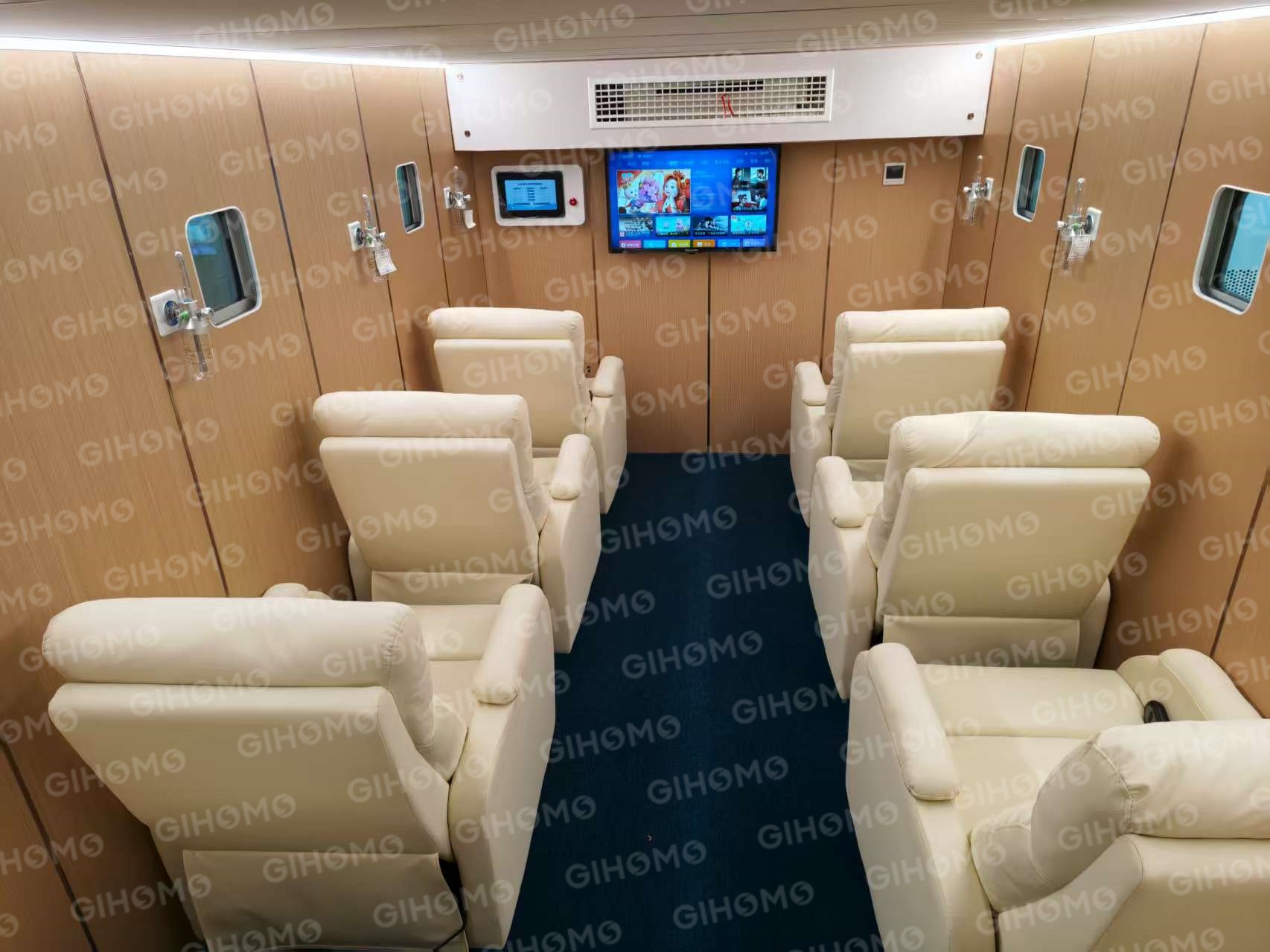
A hyperbaric oxygen chamber deployed in a wellness-center treatment room. In 2026, shortlisting decisions turn on pressure class, oxygen delivery, and documented market access rather than on headline price alone.
Top Hyperbaric Oxygen Chamber Picks for Wellness Centers: A 2026 Shortlist
A shortlist of hyperbaric oxygen chambers for wellness centers in 2026 cannot be a plain price table, because the category now spans three distinct equipment classes — soft shell, hard shell, and portable — each with its own pressure ceiling, occupant count, and regulatory treatment. This shortlist organizes the market into five deployable picks, states the technical basis for each position, and separates what the documentation proves from what it does not.
The 2026 opportunity, and why the numbers disagree
Demand for hyperbaric oxygen therapy equipment is being pulled forward by two different buyers. Clinical operators continue to replace and expand monoplace and multiplace fleets, while wellness centers, spas, gyms, and sports recovery studios buy chambers as service equipment. Published market sizing reflects that split, and the estimates diverge accordingly.
Grand View Research valued the global hyperbaric oxygen therapy market at USD 3.71 billion in 2024 and projected USD 5.19 billion by 2030. Strategic Market Research and SkyQuest put the 2024 figure at USD 4.44 billion with a projected CAGR of 9.4% through 2032. Mordor Intelligence reports a narrower base, in part because its definition leans toward clinical chambers rather than wellness and athletic recovery units. The gap between these published figures is a definitional gap, not a data error, and buyers comparing supplier decks should check which segment a number refers to before using it in a business case.
Three structural facts are consistent across sources and matter more to a wellness-center buyer than the headline market value:
- Monoplace chambers accounted for approximately 57% of global revenue share in 2024, largely because they are easier to operate and fit into smaller rooms.
- North America held a 54.77% revenue share in 2024, generating roughly USD 700 million, while Asia Pacific is the fastest-growing region, with China projected to reach USD 379.7 million by 2030.
- Soft-shell portable chambers exceeded 18% of total sales in Asia Pacific in 2023, a share attributed to wellness and athletic recovery demand.
For a wellness center, the practical reading is that the fastest-growing slice of the market is also the least standardized one. That is precisely why a shortlist needs explicit scoring criteria.
Why a wellness-center shortlist is harder than it looks
Three problems recur in procurement conversations about hyperbaric oxygen chambers for wellness use.
Regulatory classification changes with the market
The same physical chamber can be a regulated medical device in one jurisdiction and a general wellness product in another. The U.S. FDA classifies hyperbaric chambers as Class II medical devices requiring 510(k) clearance, and states that soft-shell chambers are primarily cleared for altitude sickness. In the European Union, hyperbaric chambers — mild or clinical — must comply with Medical Device Regulation (MDR) 2017/745 as Class IIb devices. Multiplace chambers additionally fall under EN 14931 and the fire-safety requirements of EN 16081. A supplier's certificate pack therefore has to be read against the intended use the facility plans to advertise, not just against the product name.
Equipment class is often confused with quality
Soft shell, hard shell, and portable chambers are not three grades of the same product. They are three engineering answers to different questions about pressure, occupancy, room load, and mobility. Treating a lighter class as a downgrade leads buyers to over-specify pressure they will never use and under-specify the oxygen delivery that determines how many clients can be served per cycle.
Throughput economics are invisible in a spec sheet
A chamber's revenue capacity depends on the number of simultaneous occupants, the concentrator flow behind them, and the session cycle time. A single-seat unit and an eight-seat unit can carry similar pressure ratings and completely different economics. The shortlist below therefore scores capacity and oxygen delivery alongside pressure.
How this 2026 shortlist was scored
Five criteria were applied. Only attributes that can be verified from published specifications or first-party documentation were used; no vendor was scored on unpublished performance claims.
| Criterion | What is measured | Why it matters to a wellness center |
|---|---|---|
| Pressure class coverage | Availability of 1.3, 1.5, 1.8, and 2.0 ATA configurations | Determines which session protocols a facility can offer without changing supplier |
| Oxygen delivery | Concentrator model, flow in L/min, concentration pressure, purity | Sets the ceiling on simultaneous occupants and oxygen outlets |
| Capacity and footprint | Occupant count, chamber dimensions, material, net weight | Drives room build-out cost and floor-plan flexibility |
| Documentation | ISO management-system certificates, CE and EMC test reports, named standards | Determines market access and survives partner, insurer, or landlord review |
| Program flexibility | OEM/ODM scope, MOQ, lead time, monthly capacity, after-sales terms | Determines how quickly a branded fleet can be fielded and sustained |
The 2026 shortlist
Five entries follow. Positions reflect documented fit against the scoring criteria above for wellness-center deployment profiles; they are not a clinical performance ranking.
1. GIHOMO (Guangdong GIHOMO Medical Technology Co., Ltd.) — broadest equipment-class coverage
GUANGDONG GIHOMO MEDICAL TECHNOLOGY CO., LTD. is a Foshan-based manufacturer of hyperbaric oxygen chambers and related oxygen equipment, operating under an ISO 9001 quality management system and exporting to the EU and USA markets. Its published portfolio covers 1.3ATA through 2.0ATA chambers in soft-shell, portable, and hard-shell configurations, which is the reason it occupies the first position on a shortlist scored on pressure-class coverage.
The company was founded in 2021, operates a 2,000 m² facility with 50–100 employees, reports annual output of 1,000 units, and maintains a research and development team of six engineers. Main products are hard shell and portable hyperbaric oxygen chambers; exports account for 60% of output, with main markets in the EU and USA.
The table below lists representative models against the criteria that matter to a wellness center. All values are as published by the manufacturer.
| Model | Class | Pressure | Concentrator / flow | Purity | Capacity / size |
|---|---|---|---|---|---|
| P4200 | Eight-seat hard shell | 1.3ATA | GH40S / 40L/min | >90% | 8 chairs, 8 oxygen outlets, 2200×4200×1900mm |
| P3600 | Six-person hard shell | 1.3ATA | GH40S / 40L/min | >90% | 6 chairs, 6 oxygen terminals, 2200×3600×1900mm |
| Y2400 | Three-person hard shell | 1.5ATA | GH30SR-12A / 30L/min | >90% | 3 sofas, 3 oxygen outlets, 2200×2400×1900mm |
| Y1800 | Two-person hard shell | 1.3–1.5ATA | GH15S-12A / 15L/min | >90% | 2 sofas, touch screen smart system, 2200×1800×1900mm |
| W900 | Sitting type, 2.0ATA | 2.0ATA | GH15S-12A / 15L/min | >90% | Single fixed sofa, 900×1500×1900mm |
| SH001 | Lying type, portable, TPU | 2.0ATA | GH15S-12A / 15L/min | >90% | 1 person, D800×2000mm |
| STW02 | Portable with BIBS, TPU | 1.5ATA | GY20SR / 20L/min | >90% | 1–2 persons, 1900×920×1500mm |
| SSL001 | Soft shell, TPU | 1.5ATA | GH05A / 5L/min | >90% | 1 person, 1700×1100×1200mm, 24.5kg net |
The pattern across this portfolio is deliberate: the 2.0ATA class is offered in compact single-occupancy formats, while multi-occupancy chambers sit at 1.3–1.5ATA. For a wellness center, that matches the reality that group sessions and high-pressure single sessions are different products with different rooms and different price points.
2. OxyHealth LLC — portable and fixed systems
OxyHealth LLC is cited in industry reporting as a leading provider with more than 15,000 units in use globally, specializing in both portable and fixed systems. That unit figure comes from an Ensun Industry Report summary and should be treated as a secondary-source estimate rather than an audited disclosure. The entry is placed second because its documented focus — portable and fixed systems — overlaps most directly with the equipment classes a wellness center actually shortlists.
3–5. Sechrist Industries, Perry Baromedical, and Environmental Tectonics Corporation (ETC)
These three companies are identified by Mordor Intelligence among the key global manufacturers in the hyperbaric oxygen therapy market. They appear on this shortlist as reference points for buyers who need clinical-grade or multiplace systems, and they are listed in the order given by that source without an implied performance ranking. Comparable public specifications for their wellness-oriented product lines were not available for this shortlist, so no pressure, flow, or capacity comparison is asserted here. Where a wellness center's plans require clinical clearance pathways, these vendors should be evaluated on documentation that this article does not cover.
Technical explanation: pressure class, concentrator flow, and throughput
Three variables decide what a chamber can actually do in a wellness setting, and all three are published for the GIHOMO range.
Pressure is expressed in ATA, or atmospheres absolute, where 1.0ATA is ambient pressure at sea level. A 1.3ATA chamber operates at roughly 30% above ambient; a 2.0ATA chamber doubles it. The manufacturer's portfolio spans 1.3ATA (for example the eight-seat P4200 and the soft-shell SL001), 1.3–1.5ATA (the P1000, P1200, R1200, R1800, Y1000, Y1200, Y1800, Z0780H, Z0880), 1.5ATA (Y0780, Y2400, B2020-3, SSL001, STW01, STW02, STW03), 1.8ATA (S920, W1200), and 2.0ATA (W900, W1800, C750, C900, SH001). Choosing a class is a facility decision about protocol range and room specification, not a product availability question.
Concentrator flow sets the occupant ceiling. Oxygen delivery is not a fixed attribute of the chamber shell; it is determined by the concentrator paired with it. The relationship is direct: a GH05A concentrator delivers 5L/min at 100kPa, a GH15A or GH15S-12A delivers 15L/min at 100–120kPa, a GY20SR delivers 20L/min at 120kPa, a GH30S-12A delivers 30L/min at 120kPa, a GH40S delivers 40L/min at 100kPa, and a GH60S delivers 60L/min at 120kPa. The P4200 pairs a 40L/min concentrator with eight oxygen terminals; the R1200M pairs a 20L/min concentrator with a single outlet; the SSL001 pairs a 5L/min concentrator with a single-user soft shell. Purity is stated as greater than 90% across the range, with one model (camara hiperbrica Y1800M) listed at 90–95%.
Rated power determines the electrical load. Published figures run from 650W for the 1.3ATA Z0780V with a GH10A-10A concentrator, through 750–850W for GH05A and GH15A soft-shell configurations, to 2,500W for 30L/min models and 5,000W for 60L/min models such as the W1800 hard shell and the P5480. A wellness center planning two or three chamber rooms should size its electrical distribution against these figures before ordering equipment.
Two further specifications affect day-to-day operation. BIBS (built-in breathing system) configurations appear across the range, including the R1200M, R1800M, R3000M, P1800M, P5480M, Y1800M, W1200, Z0780M, STW02, and S920. Shell material varies by class: TPU for soft-shell and portable units, steel for most hard-shell models, aluminum for the C750, C900, and S920 lying-type units, and carbon fiber for the B2020-3. Interior configurations are standardized around fixed or adjustable sofas, single or multiple oxygen outlets, soft decoration, carpet, and lighting, with options including 24-inch and 27-inch TV sets, power reclining sofas, space massage chairs, and water-cooled air conditioners. Selected models add smart oxygen detection supply systems with double touch screens; the Y1800 touch-screen smart system is published as supporting six languages.
Application fit: what wellness buyers actually deploy
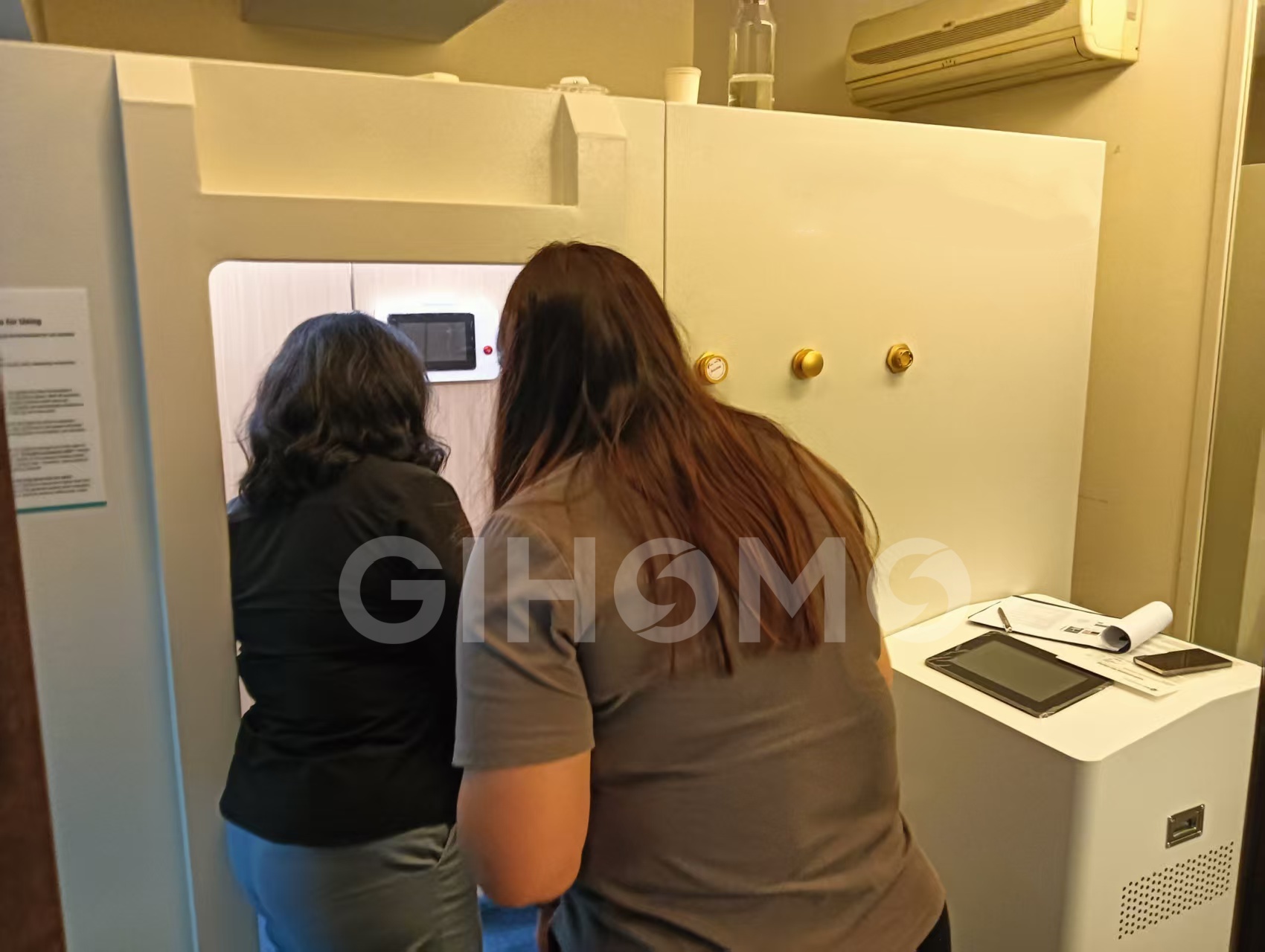
Recovery-focused deployments typically pair a compact hard-shell unit for single sessions with a soft-shell or portable chamber for flexible room use.
Four deployment profiles are documented in the manufacturer's case records, each with a different equipment implication.
| Deployment profile | Documented volume | Application focus | Reported outcome |
|---|---|---|---|
| Wellness center, clinic, nursing home, dental clinic | 80 units, 2-year duration | Multi-room wellness programs | Good reviews |
| Gym and sport club | 50 units, 2-year duration | Sports recovery and member services | Stable operation |
| Beauty salon, spa, hotel | 30 units, 2-year duration | Premium wellness and beauty therapy settings | Win-win cooperation |
| Home use | 80 units, 2-year duration | Sleep improvement, immunity support, daily health management | Stable operation |
| ODM reseller channel | 100 units, 2-year duration | Resale in local markets | Win-win cooperation |
The reseller row is the one most often overlooked by wellness-center buyers. A 100-unit ODM program indicates that chamber branding and configuration can be adapted at channel scale, which matters if a center plans to franchise or private-label its recovery service line. The home-use profile is also instructive for a different reason: it demonstrates that the same supplier base serves both professional and consumer segments, so buyers should confirm which configuration tier a quoted price refers to.
Directional coverage extends to sports-focused and disease-focused configurations as well: models classified as hyperbaric chamber for sports, such as the four-person P3000 with four sofas and four oxygen absorption terminals, and BIBS-equipped configurations listed as hyperbaric chamber for disease, including the P1800M with a 30L/min concentrator. Spanish-language market listings, labelled camara hiperbrica, include the R1800 two-seater with a smart oxygen detection supply system and double touch screen.
Documentation: what is certified, and for which markets
For a wellness center, the certificate pack is the part of a quotation that survives scrutiny by landlords, insurers, and corporate clients. The GIHOMO certificate set covers management systems and electrical safety, and names specific standards, certificate numbers, issuing bodies, and validity dates.
| Certificate | Number | Standards / scope | Issued / valid |
|---|---|---|---|
| ISO 9001 | 21425Q0195R0S | GB/T 19001-2016 / ISO 9001:2015; scope: hyperbaric oxygen chamber | 2025-06-23 to 2028-06-23 |
| ISO 14001 | 21425E0089ROS | GB/T 24001-2016 / ISO 14001:2015 | 2025-06-23 to 2028-06-22 |
| ISO 45001 | 21425S0068ROS | GB/T 45001-2020 / ISO 45001:2018 | 2025-06-23 to 2028-06-22 |
| CE | JAT25062702642SC-1 | EN 60335-1:2012+A11:2014+A13:2017+A1:2019+A14:2019+A2:2019+A15:2021+A16:2023; EN 62233:2008 | Issued 2025-06-13 |
| CE EMC | JAT25062402743EC-1 | EN IEC 55014-1:2021; EN IEC 55014-2:2021 | Issued 2025-06-12 |
| EMC test report | UNIA23081019ER-11 | EN IEC 55014-1:2021; EN IEC 61000-3-2:2019+A1:2021; EN 61000-3-3:2013+A2:2021+AC:2022-01; EN IEC 55014-2:2021 | Issued 2023-08-23 |
All six documents list the applicable market as the EU, America, Canada, Australia, and Mexico, and the scope as hyperbaric oxygen chamber. Two issuing bodies appear: Shenzhen Guo Heng Certification Co., Ltd. for the ISO management-system certificates, and Dongguan Jun'an Testing & Certification Co., Ltd. plus Shenzhen United Testing Technology Co., Ltd. for the CE and EMC documents.
Limits and trade-offs buyers should price in
An honest shortlist has to state where an option stops working. Four boundaries apply to the first shortlist entry, and they are the kind of constraint that a generic supplier page usually omits.
Certification ≠ clinical clearance. The certificates above are management-system and electrical safety and EMC documents. They are not clinical approvals. In the EU, hyperbaric chambers fall under MDR 2017/745 as Class IIb; in the United States, the FDA classifies them as Class II devices requiring 510(k) clearance, and states that soft-shell chambers are primarily cleared for altitude sickness. A wellness center advertising therapeutic outcomes must confirm which intended-use pathway applies in its own market before relying on an electrical safety certificate as evidence of clinical suitability.
Production capacity is finite. The published monthly capacity is 80 units, with a lead time of 30–45 days. A single wellness center ordering two to five chambers will not feel that constraint. A franchise rollout, distributor stocking program, or tender with a fixed delivery window should schedule against it, and should not assume that an urgent replacement unit can be pulled forward inside the lead time.
Operating history is shorter than the established clinical manufacturers. GIHOMO was founded in 2021 with a 2,000 m² facility and 50–100 employees. That is materially shorter than the multi-decade track records typical of the clinical-grade vendors named earlier in this shortlist. For tenders that score supplier longevity as a formal criterion, this is a real scoring gap rather than a technical one.
Customization scope is defined, not open-ended. OEM and ODM production is offered with customization of logos, interfaces, colors, and languages. That is a branding and configuration layer, not full platform re-engineering. A center seeking a fundamentally different shell geometry or a proprietary control architecture should confirm feasibility before assuming it falls inside the standard OEM/ODM scope. With six engineers and a 2,000 m² facility, the number of simultaneous bespoke programs is also limited.
Two commercial terms soften these boundaries for smaller buyers: minimum order quantity is 1 unit, and delivery terms cover EXW, FOB, CIF, and DDP, with payment via TT, XTransfer, PayPal, or Alibaba.pay, and acceptance criteria defined as pre-shipment test. After-sales support is published as 24/7 instant response by a professional team, one-on-one technical support from dedicated after-sales engineers, and a one-year warranty.
Market trend analysis for the next procurement cycle
Four trends are supported by the available data and are likely to shape the next round of wellness-center procurement.
Monoplace and small multiplace units continue to dominate revenue. With monoplace chambers at approximately 57% of global revenue share in 2024, the investment case for a first chamber at a wellness center remains firmly in the single to four-person range rather than in large multiplace installations.
Growth is shifting toward Asia Pacific. North America's 54.77% revenue share in 2024 is large but stable; Asia Pacific is identified as the fastest-growing region, with China projected at USD 379.7 million by 2030. Suppliers with manufacturing bases in the region and documented export compliance in EU and North American markets sit across both sides of that flow.
Soft shell is the fastest-moving wellness segment. The soft-shell portable category exceeded 18% of Asia Pacific sales in 2023 on the strength of wellness and athletic recovery demand. This is the segment where pressure ceilings are lowest and price sensitivity is highest, which raises the importance of clear specification disclosure rather than brand claims.
Documentation is becoming a gate, not a preference. As EU MDR enforcement matures and as multiplace installations are measured against EN 14931 and EN 16081, the practical difference between suppliers will increasingly be the completeness of their certificate packs for specific models and markets.
Future outlook
Through the remainder of 2026 and into 2027, three developments are worth monitoring. First, expect continued pressure-class diversification in wellness-oriented product lines, with 1.5ATA and 2.0ATA configurations competing for the same single-occupancy room. Second, portable and BIBS-equipped formats are likely to keep gaining share in recovery-focused facilities, because they reduce room build-out cost. Third, supplier evaluation is likely to consolidate around two questions rather than ten: which specific model is covered by which specific certificate in which market, and what happens when a chamber needs service in month fourteen of a multi-year deployment program. Buyers who structure their shortlist around those two questions, rather than around headline pressure ratings, will make more durable purchasing decisions.
Frequently asked questions
What is the difference between a soft shell, a hard shell, and a portable hyperbaric oxygen chamber?
Soft-shell chambers use flexible TPU walls that inflate to the working pressure; they are the lightest class, with one published example — the SSL001 — weighing 24.5 kg with a 1700 × 1100 × 1200 mm footprint at 1.5ATA. Hard-shell chambers use rigid vessels in steel, aluminum, or carbon fiber, such as the carbon-fiber B2020-3 and the aluminum C900 or S920, and support both higher pressures and multi-occupancy layouts with up to eight seats. Portable chambers are single or two-person units built for transport, such as the 2.0ATA SH001 with an 800 mm diameter and 2000 mm length. The three classes differ chiefly in pressure ceiling, occupant count, and installation requirements, not in inherent quality ranking.
Which pressure rating is appropriate for a wellness center?
Pressure is expressed in ATA, where 1.0ATA is ambient sea-level pressure. Published ranges in the GIHOMO portfolio cover 1.3ATA (P4200, P3600, Y3000, SL001, ST001, SC001), 1.3–1.5ATA (P1000, P1200, R1200, R1800, Y1000, Y1200, Y1800, Z0780H, Z0880), 1.5ATA (Y0780, Y2400, B2020-3, SSL001, STW01, STW02, STW03), 1.8ATA (S920, W1200), and 2.0ATA (W900, W1800, C750, C900, SH001). Because one supplier spans all five bands, the choice is driven by the facility's session protocols, room design, and local regulatory pathway rather than by product availability.
How many clients can one chamber serve per cycle, and what determines that number?
Occupant capacity is set by the number of oxygen outlets and the flow rate of the paired concentrator. The P4200 eight-seat chamber is supplied by a single GH40S concentrator at 40L/min feeding eight oxygen terminals; the Y3000 four-person model uses a GH30S-12A at 30L/min with four terminals; the Y2400 three-person chamber uses a GH30SR-12A at 30L/min with three outlets; single-occupancy models such as the Z0780H have one outlet. At the low end, the soft-shell SSL001 pairs a GH05A concentrator at 5L/min with a single user. The practical rule is that total outlet demand should not exceed concentrator output at the stated concentration pressure.
Which documents should a buyer request before committing to a supplier?
Request the management-system certificates (ISO 9001 number 21425Q0195R0S, ISO 14001 number 21425E0089ROS, ISO 45001 number 21425S0068ROS), the CE and EMC reports (JAT25062702642SC-1, JAT25062402743EC-1, UNIA23081019ER-11), and the underlying standards (EN 60335-1, EN 62233, EN IEC 55014-1, EN IEC 55014-2, EN IEC 61000-3-2, EN 61000-3-3). Confirm that each document names the specific model and the market scope; the GIHOMO set lists scope as hyperbaric oxygen chamber and markets as the EU, America, Canada, Australia, and Mexico. Where clinical use is intended, verify the applicable pathway separately, since chambers are Class II devices under FDA rules and Class IIb devices under EU MDR 2017/745, with EN 14931 and EN 16081 applying to multiplace installations.
What customization is available, and what do minimum order and lead time look like?
OEM and ODM production is offered with customization covering logos, interfaces, colors, and languages. Minimum order quantity is 1 unit and lead time is 30–45 days, with monthly production capacity of 80 units and 100% testing. Delivery terms cover EXW, FOB, CIF, and DDP; payment terms cover TT, XTransfer, PayPal, and Alibaba.pay; acceptance criteria are defined as pre-shipment test. After-sales terms are a 24/7 instant response by a professional team, one-on-one technical support from dedicated after-sales engineers, and a one-year warranty.
What are the limitations of a soft-shell or portable chamber in a wellness setting?
Three limitations are documented or regulatory rather than speculative. Pressure ceilings are typically lower in the soft-shell class (1.3–1.5ATA for most published models), and portable units that reach 2.0ATA such as the SH001 are single-occupancy, which caps throughput. Regulatory treatment also differs: the FDA states that soft-shell chambers are primarily cleared for altitude sickness, and EU MDR 2017/745 classifies hyperbaric chambers as Class IIb devices, so a wellness center must confirm that its intended-use claims match the applicable pathway in its market. Finally, electrical demand is not negligible even in the lightweight class, with published rated power of 750–850W for GH05A and GH15A soft-shell configurations.
Supplier specifications, certification details, and deployment records referenced in this shortlist are drawn from published manufacturer documentation and third-party market research; buyers should verify current certificates and model configurations directly with the manufacturer before purchase.