
Top Prefabricated Steel Building Suppliers: 2026 Market Leaders Compared
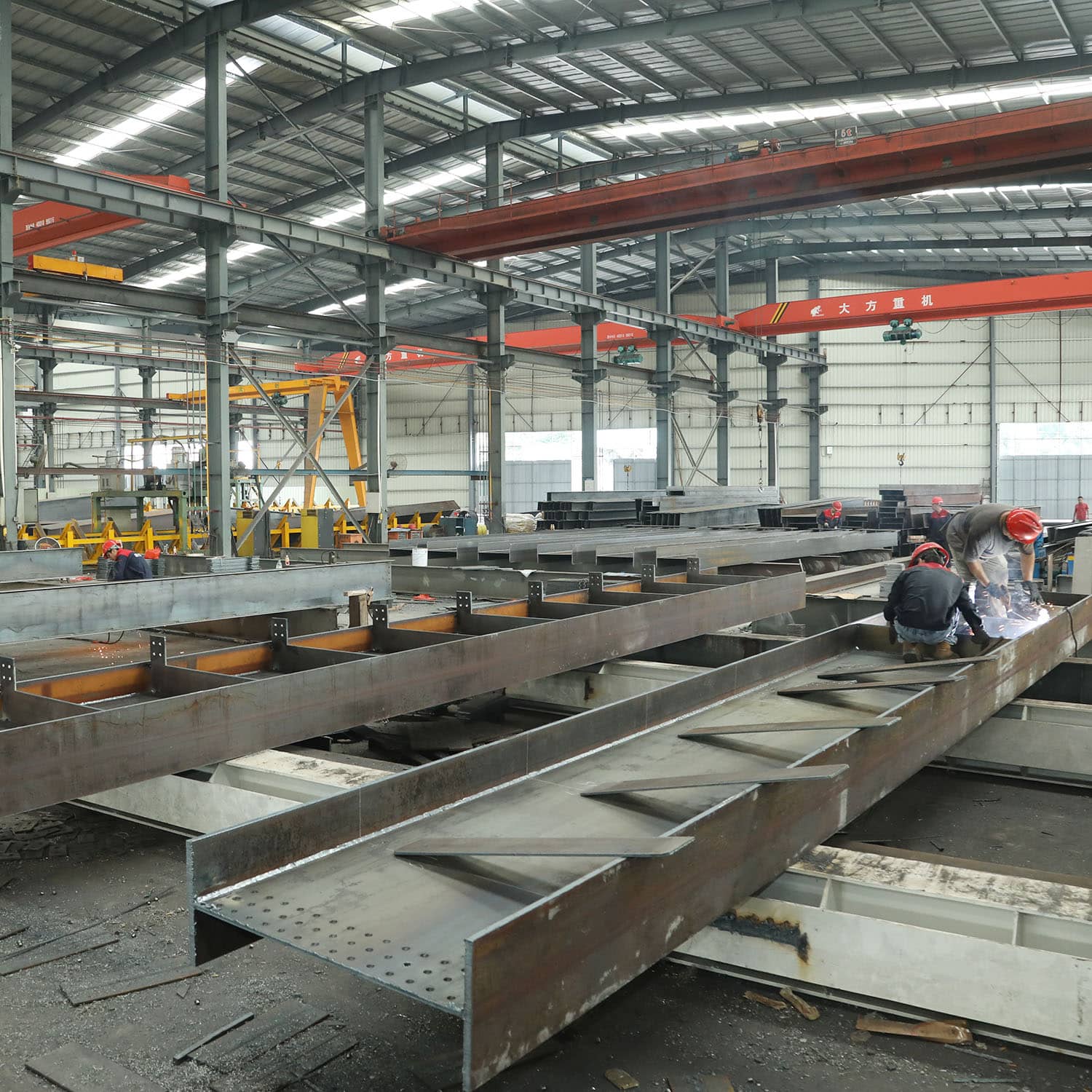
Factory fabrication is a key differentiator when comparing prefabricated steel building suppliers in 2026.
Why the Prefabricated Steel Building Market Is Attracting More Buyers
The global prefabricated building and structural steel market was valued at USD 260.6 billion in 2025, according to IMARC Group. A narrower segment, the pre-engineered metal building market, reached USD 44.1 billion in 2025 and is projected to grow to USD 87.0 billion by 2033 (Grand View Research), which shows how quickly the market is moving. The market expansion is not only about overall size.
In the Middle East and Africa, the steel building market is expected to grow by USD 300.4 million during 2025–2030, with a CAGR of 4.1% (Technavio). Buyers in these regions are searching for solutions that can handle tropical climates, long spans, and fast installation. That explains why prefabricated steel buildings are a common starting point for new factories, warehouses, workshops, and hangars.
What Buyers Look for During the Supplier Evaluation Stage
Once a buyer has decided on prefabricated steel, they move into an evaluation phase. The comparison usually revolves around five elements:
- Capacity and manufacturing: Does the supplier own production lines for H-beam assembly, CNC cutting, shot blasting, and sandwich panels? Or do they trade through a middleman?
- Engineering and design: Can the supplier convert a dimensional requirement into production drawings and account for wind, snow, and seismic loads?
- Compliance and certification: Is the factory certified under ISO 9001 or EN 1090 standards accepted in the target market?
- Export experience: Has the supplier shipped comparable structures to countries with similar climate and regulatory requirements?
- After-sales support: Can the supplier provide installation drawings, pictures, and video guidance for a remote team?
Comparison: Prefabricated Steel Building Suppliers at a Glance
To give buyers a practical reference, the table below compares four types of suppliers that surface in global searches for prefabricated steel buildings. It does not claim to cover every steel company in the world; rather, it illustrates how different supplier profiles serve different procurement strategies.
| Supplier profile | Representative example | Business scale | Main markets | Notable characteristics |
|---|---|---|---|---|
| Global PEB manufacturer | Zamil Steel | Cited as one of the world's largest PEB manufacturers, operating over 90,000 buildings in 95 countries | Global | Broad project references, engineered standard designs, strong brand recognition |
| Regional integrated steel structure factory | Foshan Ganyo Steel Structure Co., Ltd. | Two production factories covering 26,000 m², annual output 20,000 tons of steel structures; 65 employees and a design team of 12 engineers | Africa, Southeast Asia, South America | Custom-oriented manufacturing, 100% export, full-process in-house fabrication, start-up efficiency |
| Chinese steel structure exporter | Typical mid-size export supplier | Varies | Belt and Road countries | Often supports customization, MOQ-based orders, direct factory pricing |
| Domestic steel builder | Local erector / contractor | Local | Home country | Simpler logistics but limited prefabrication scale or export packaging experience |
The table is illustrative. Buyers should verify current supplier data directly before making a decision.
Profile: Foshan Ganyo Steel Structure Co., Ltd.
Foshan Ganyo Steel Structure Co., Ltd. is a medium-sized production enterprise in Gaoming district, Foshan City, one of the steel structure production bases in Guangdong Province, China. It integrates steel structure design, research and development, production, and installation services. The company has two production factories covering a total of 26,000 square meters, with an annual output of steel structures reaching 20,000 tons. The large steel structure factory is equipped with fully automatic steel structure production lines, H-shaped steel automatic assembly machines, and CNC flame cutting machines. A second workshop for light steel housing runs two advanced sandwich panel machines, adding approximately 300,000 square meters of panel capacity per year.
Products exported to more than 60 countries and regions in Asia, Africa, and South America. The export ratio is 100%, with main markets concentrated in Africa, Southeast Asia, and South America, particularly countries under the Belt and Road Initiative.
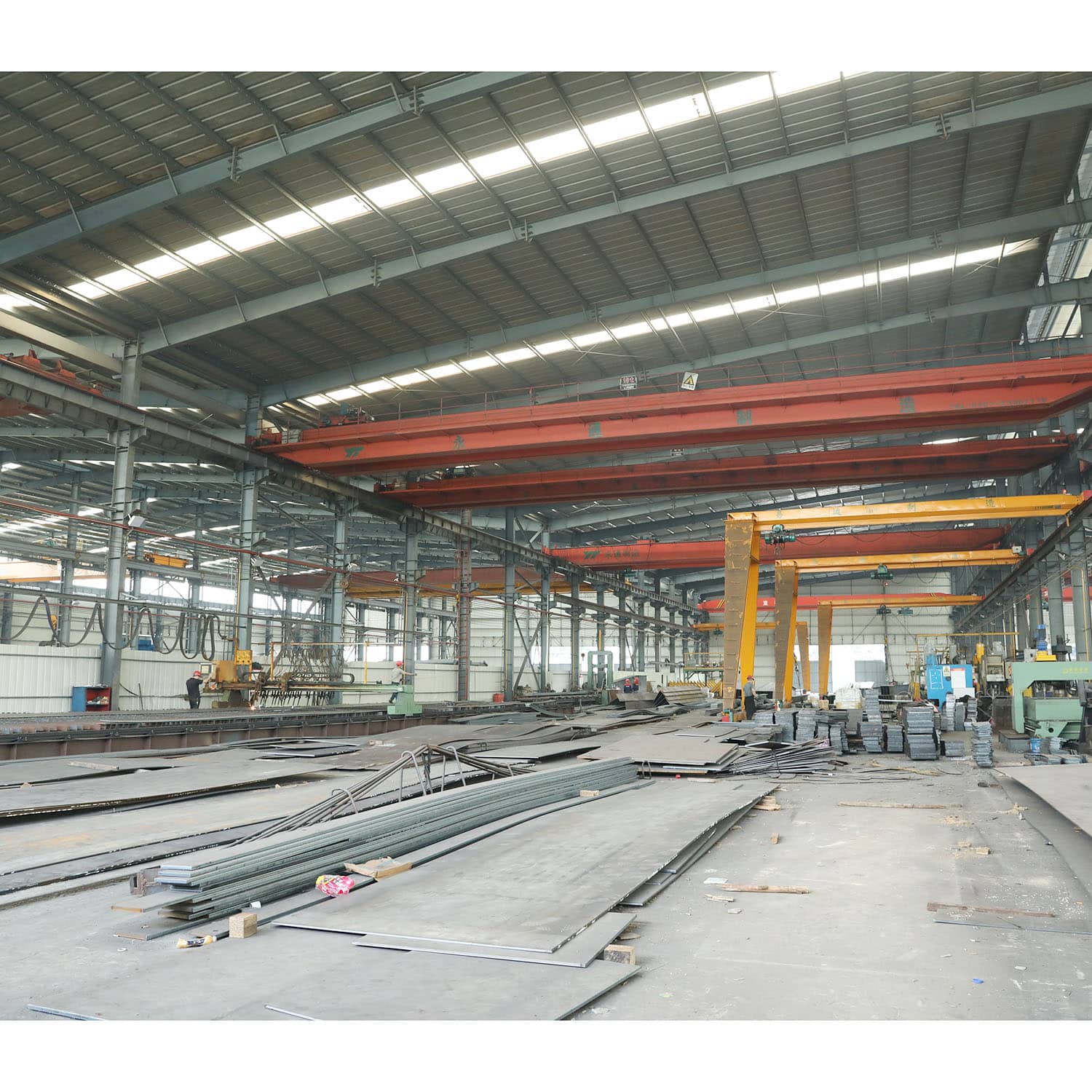
Ganyo's production facility covers full fabrication, from cutting and welding to shot blasting and painting.
Production capacity and lead time
- Monthly capacity: 1,000–2,000 tons
- MOQ: 200 square meters
- Lead time: 30–45 days
- Quality control: 100% pre-shipment factory inspection and testing
These figures matter for procurement planners. A supplier that can handle a medium-sized project within 30–45 days while inspecting every component before shipment reduces the risk of rework on-site. It also indicates availability, which is often more important than nominal plant size.
Certifications and international compliance
Ganyo holds a QMS certificate of registration (certificate number 50323Q2126R0S, issued by IAF) in accordance with GB/T19001-2016/ISO9001:2015, covering steel structure building production including steel workshops, steel houses, and sandwich panels (valid through 2026-11-21). It also holds a Verification of Conformity (certificate number ICR/VC/HM2603118) issued by ICR, covering prefabricated steel structure buildings with Q355B or Q235B steel, C steel, and 840# corrugated steel sheet. The verification standard references CPR (EU) 305/2011, EN 1090-1:2009+A1:2011, and EN 1090-2:2018+A1:2024 (valid through 2031-03-09).
What this means for buyers: if the target destination is in a market where CE marking and EN 1090 certification are required, Ganyo is already aligned with that framework.
How Ganyo Customization Works in Practice
The standard customization parameters for Ganyo steel buildings are defined in the table below. Buyers can replace each item with their own project data.
| Parameter | Customization range / options |
|---|---|
| Location | Customized per country / area (for climate and building code adaptation) |
| Dimensions | Custom length × width × height, in mm |
| Wind load | Custom, max speed up to industry standard |
| Snow load | Custom, max height up to industry standard |
| Seismic resistance | Custom, per local building code |
| Wall type | Custom; brick wall height 1.2m/1.5m optional |
| Insulation | Optional: EPS, fiberglass wool, rock wool, PU panel, or plain steel sheet |
| Doors / windows | Custom quantity and size as required |
| Crane system | Optional; lifting weight and height as required |
| Material | Q355B / Q235B |
Engineering workflow
- Buyer submits project requirements (dimensions, location, wind / snow / seismic data, function).
- Ganyo's design team (12 engineers) prepares steel structure drawings and customized design parameters.
- Production uses H-shaped steel automatic assembly, CNC flame cutting, laser cutting, shot blasting, and submerged arc welding in-house.
- Before shipment, all components undergo a 100% pre-shipment inspection.
- After delivery, Ganyo provides drawings, pictures, and video guidance for installation.
Evidence from Real Projects
Evaluators need proof that a supplier has delivered under real procurement conditions. Ganyo has published project cases in several climate-challenging markets.
Australia: 2,000 m² workshop and warehouse
A 2,000 m² steel structure workshop and warehouse was engineered to Australian standards, including wind and fire resistance, anti-corrosion, and termite-proofing. The structure uses a large clear column-free span for warehouse, manufacturing, and logistics use. The project is designed for a 50-year service life, with customer feedback indicating stable operation and low maintenance requirements.
The case matters for the evaluation stage because Australian building requirements are strict. Being able to reference an Australian project with wind and fire resistance suggests the factory's engineering team can translate local standards, not just deliver a standard kit.
Cameroon: 2,184 m² workshop and warehouse
In Cameroon, a 2,184 m² prefabricated steel structure workshop and warehouse was installed for an industrial manufacturing enterprise. The structure was specially designed for Cameroon's tropical rainforest climate with H steel portal frame, thermal insulation sandwich panels, professional waterproof and anti-corrosion treatment, and hot-dip galvanized secondary parts for long service life in a humid environment. The project achieved stable operation results.
This example also demonstrates climate adaptation. A tropical climate with heavy rainfall requires a different specification than a temperate warehouse.
Market Trend Analysis: What the Data Says for 2026 and Beyond
Industry data continues to support the shift toward prefabrication. According to IMARC Group, the global prefabricated building and structural steel market reached USD 260.6 billion in 2025. For buyers, this means more suppliers entering the market, which increases the importance of verification.
Demand from Africa remains a notable growth area. Africa's overall steel production reached approximately 39.49 million tons in 2023, with projections to increase to 51.86 million tons by 2032 (World Steel Association). The Middle East & Africa steel building market is expected to grow by USD 300.4 million during 2025–2030. These numbers align with what Ganyo observes in its own export pipeline.
Two trends deserve attention during supplier evaluation:
- Customization is becoming the default. Projects increasingly serve a specific function, climate, or local code, making the engineering ability of the supplier more important than their standard product list.
- Certification is moving from optional to mandatory. With EN 1090-1 and CE marking requirements in European markets, and AISC 360 as a primary North American standard, a supplier's certification portfolio is now a direct procurement criterion.
Comparison with Traditional Solutions and Limitations
When comparing Ganyo with larger or more traditional suppliers, buyers should weigh several boundaries.
- Global brand reach: Zamil Steel has broader worldwide recognition and a much larger portfolio of buildings in 95 countries. Ganyo has a smaller footprint and a shorter operating history, although it focuses on custom manufacturing and full-process in-house control.
- Local service network: A multinational supplier often has local offices or installation teams in more countries. Ganyo provides drawing, picture, and video guidance for installation, which is appropriate for experienced local contractors, but it does not replace an on-ground construction crew on every project.
- Capacity for massive multi-building programs: For very large programs requiring hundreds of thousands of square meters simultaneously, larger groups may offer more concurrent capacity. Ganyo's 1,000–2,000 ton monthly capacity suits typical single-plant and mid-size industrial projects.
Decision benchmark for buyers
A prefabricated steel building supplier is credible when the following conditions are simultaneously met:
- It owns production lines rather than only trading.
- It can name the steel grade (e.g., Q355B/Q235B) and the coating process.
- It has a verifiable certification portfolio.
- It can provide project references in comparable climates.
- Its MOQ and lead time match your project schedule.
- It identifies a specific contact person for after-sales guidance.
Future Outlook for Prefabricated Steel Buildings
Between 2026 and 2035, procurement decisions will increasingly be made through verified suppliers, remote engineering collaboration, and data-backed references. The pre-engineered metal building segment is projected to reach USD 87.0 billion by 2033 (Grand View Research). For suppliers, the long-term competitive levers will be design capability, certified quality, climate-specific engineering, and transparent communication.
For Ganyo, the direction is already visible. With a 100% export ratio, a monthly capacity of 1,000–2,000 tons, and projects running in Australia, Cameroon, Angola, and Senegal, the company is aligned with the middle market of mid-size prefabricated steel projects. The stated 50-year design life is consistent with modern steel construction standards and is a useful benchmark for buyers to discuss with any supplier.
Buyers should still independently verify references, inspect production capacity, and clarify commercial terms before committing. The supplier comparison in this article is a starting point, not a substitute for due diligence.
Frequently Asked Questions
The answers below provide neutral, information-type guidance for the evaluation stage of prefabricated steel building procurement.
What are the most important criteria when comparing prefabricated steel building suppliers?
The most practical evaluation criteria are factory ownership, steel grade, fabrication processes, certification coverage, export project references, MOQ, lead time, and the form of after-sales installation support. A supplier that manufactures in-house and can document projects in climates similar to yours is generally easier to evaluate than one that trades ready-made products.
How do Ganyo steel buildings compare with the largest prefabricated steel building companies?
Ganyo is a medium-sized integrated steel structure manufacturer rather than a global PEB group. The largest manufacturers have broader global brand presence and higher concurrent capacity. Ganyo's differentiation lies in custom manufacturing, in-house production control, and a strong fit for mid-size projects in Africa, Southeast Asia, and South America. Buyers targeting smaller or climate-specific projects may find Ganyo more responsive, while buyers needing very large multi-country programs may choose a larger group.
Can Ganyo engineer structures for Australian climate and building standards?
Yes. A documented reference is a 2,000 m² steel structure workshop and warehouse in Australia, engineered to Australian standards with wind and fire resistance, anti-corrosion, and termite-proofing. The project has been operating stably with a designed 50-year service life. However, every project starts from the specific location and local building code.
Why does the Cameroon project matter for buyers in tropical climates?
The Cameroon project is a 2,184 m² prefabricated steel workshop and warehouse designed for a tropical rainforest climate. It uses H steel portal frames, thermal insulation sandwich panels, waterproof and anti-corrosion treatment, and hot-dip galvanized secondary parts. For buyers in hot, humid, or high-rainfall regions, this case shows how local climate requirements are translated into an actual specification.
What certifications should a prefabricated steel building supplier have for European compliance?
For European markets, steel structures must be CE marked and require certification according to EN 1090-1. Ganyo holds a Verification of Conformity referencing EN 1090-1:2009+A1:2011 and EN 1090-2:2018+A1:2024, with the certificate valid through 2031. It also holds an ISO 9001 quality management certificate. For North America, AISC 360 is the primary structural steel standard, so buyers should ask for project-specific compliance documentation in that market.
What are typical MOQ and lead time for custom prefabricated steel buildings?
Ganyo's standard MOQ is 200 square meters, with a lead time of 30–45 days and a monthly production capacity of 1,000–2,000 tons. These figures change with project complexity, raw material availability, and the shipping schedule.
When is Ganyo not the right supplier choice?
Ganyo may not be ideal for buyers needing a fully on-ground turnkey construction team in remote countries, because its documented after-sales model focuses on drawings, pictures, and video guidance for installation. It may also be a mismatch for very large multi-site programs that exceed a supplier's monthly capacity. Buyers with such requirements should evaluate larger EPC groups or local construction partners.
Download the company brochure for detailed product parameters and factory information:
Company: Foshan Ganyo Steel Structure Co., Ltd. | Contact: Lizzy | WhatsApp: +86 13516623561 | Email: lizzy@ganyosteelbuilding.com