
Top Tissue Packing Machines for Different Production Scales: A Shortlist for Buyers
A tissue packing machine is only right or wrong against one particular question: how much product has to move through it per minute, in what package format, and on what packaging material. Two units can both be sold as automatic tissue packing machines and still sit at opposite ends of a buying decision — one specified for 30 to 100 boxes per minute with frequent format changeovers, the other rated up to 260 packs per minute on a dedicated high-volume line. This shortlist groups documented models from Wenzhou Wimach Machinery Co., Ltd. (WIMACH) by the production scale each is specified for, and explains the specification logic behind every placement.
Production Scale Is a Specification, Not a Marketing Tier
Rated capacity is published in three different units across this product family, and mixing them is the most common reason two buyers comparing "similar" machines reach different conclusions. Cartoning machines are rated in boxes per minute, soft tissue film wrapping machines in packs per minute, and toilet roll wrapping machines in rolls per minute. A 30 boxes/min cartoner and a 60 rolls/min wrapper are not directly comparable figures; they are answers to different line-balance questions.
Three variables decide whether a machine actually fits a given production scale:
- Package dimension range. A machine with a wide range absorbs more SKUs and more changeovers. The TC-100 and TC-300 both accept cartons from 100–240 mm (L) × 100–120 mm (W) × 20–90 mm (H), while the TC-80F is built around a single cube carton of 115 × 115 × 130 mm.
- Material the machine is engineered to run. Cartoners in this range are specified for 300–400 gsm carton board. Soft tissue wrappers run CPP, PE or composite film at 0.035–0.05 mm on a 340 mm (W) × 450 mm (D) film reel. The TW-160 roll wrapper runs wrapping paper of 17–37 gsm from a 480 mm (L) × 500 mm (D) reel.
- Utilities and floor space. All models listed here run on a 380 V, 50/60 Hz three-phase supply and 0.5–0.8 MPa compressed air at roughly 120–160 L/min, but installed weight ranges from 1,800 kg to 3,500 kg and machine length from 3,585 mm to 6,030 mm.
A shortlist built on those three variables is more useful at the evaluation stage than a shortlist built on price bands, because format and material compatibility are the two things that cannot be corrected cheaply after delivery.
The Shortlist at a Glance
The table below groups the documented WIMACH models by output tier. Rated output is the published design figure for each model; every other column is a fixed specification that can be checked against a buyer's own product range.
| Model | Function | Rated output | Package format | Rated power |
|---|---|---|---|---|
| TC-80F | Cube box tissue cartoning | 30–80 boxes/min | 115 × 115 × 130 mm carton | 7 kW |
| TC-100 | Tissue cartoning (facial tissue, napkin boxes) | 30–100 boxes/min | 100–240 × 100–120 × 20–90 mm | 6.2 kW |
| TC-300 | High-speed tissue box packing | up to 180 boxes/min | 100–240 × 100–120 × 20–90 mm | 8 kW |
| TC-80Y | Canister tissue packing | 30–80 boxes/min | Canister 100–220 (L) × 50–80 (D) mm | 3.5 kW |
| TP-180 | Soft tissue film wrapping | up to 180 packs/min | 90–200 × 85–105 × 25–90 mm | 12 kW |
| TP-280 | High-speed soft tissue film wrapping | up to 260 packs/min | 90–200 × 85–105 × 25–90 mm | 18 kW |
| TW-160 | Toilet roll wrapping in paper | 60–120 rolls/min | Roll 90–130 (L) × 90–130 (D) mm | 12 kW |
Specifications as documented for each model. Rated output is a design figure; achievable output depends on product, material, line balance and shift pattern.
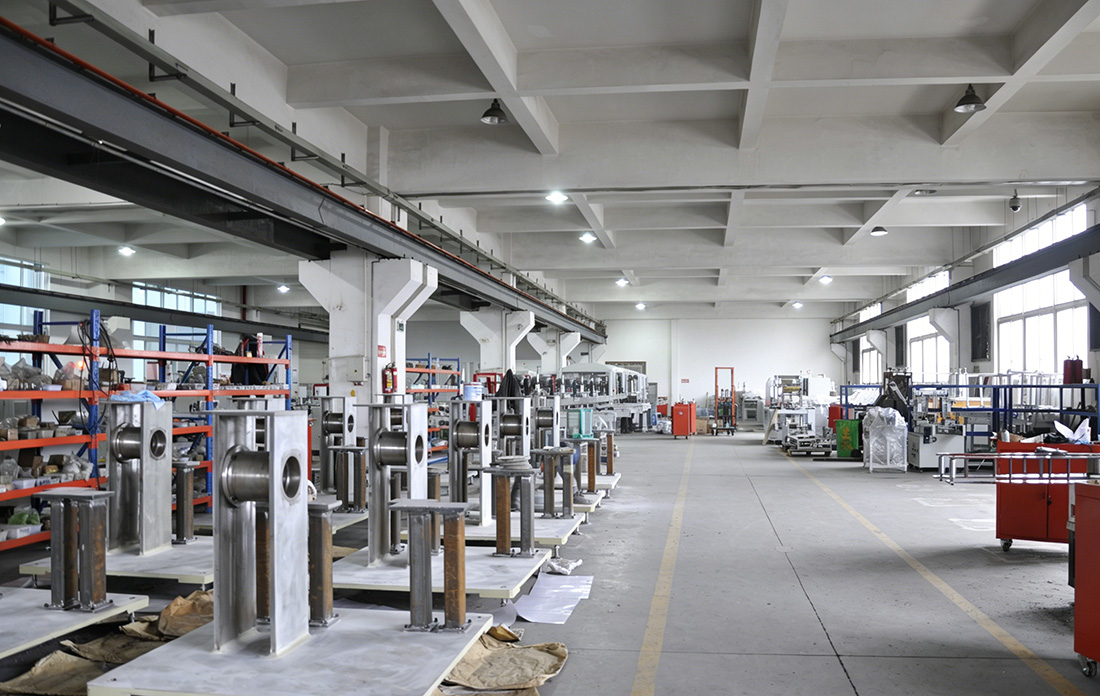
Assembly area at Wenzhou Wimach Machinery Co., Ltd., where tissue packing machines are built for different output tiers and package formats.
Low-to-Mid Volume: TC-100, TC-80F and TC-80Y
Three models cover the lower end of the volume range, and the choice between them is a format decision rather than a speed decision.
The TC-100 Tissue Cartoning Machine is the general-purpose unit for boxed facial tissue and paper napkins. It runs at 30–100 boxes/min, accepts carton board of 300–400 gsm, and handles cartons from 100–240 mm (L) × 100–120 mm (W) × 20–90 mm (H). Rated power consumption is 6.2 kW and installed weight is 2,200 kg, on an overall footprint of 3,620 (L) × 3,130 (W) × 1,800 (H) mm. A converter whose SKU mix changes several times a week is better served by a machine with this dimension range than by a faster fixed-format unit.
The TC-80F Cube Box Tissue Cartoning Machine is the opposite trade-off: 30–80 boxes/min, but engineered around one carton size — 115 × 115 × 130 mm. It is the appropriate machine when cube boxes are the product, not one variant among many. It draws 7 kW and weighs 2,500 kg on a 4,310 × 1,460 mm base, so it occupies a longer, narrower strip of floor than the TC-100.
The TC-80Y Automatic Tissue Canister Packing Machine covers a different format entirely. It packs facial tissues and paper napkins into paper canisters of 100–220 mm (L) × 50–80 mm (D), at 30–80 boxes/min, in stainless steel construction. At 3.5 kW it has the lowest rated power draw of the cartoning group, weighs 1,800 kg, and measures 6,030 (L) × 2,310 (W) × 2,200 (H) mm.
High-Speed Cartoning: Where the TC-300 Fits
The TC-300 Automatic High-Speed Tissue Box Packing Machine is the cartoning option for buyers whose constraint is the box-packing station rather than the folding or converting stage. It is rated up to 180 boxes/min on the same carton range as the TC-100 — 100–240 × 100–120 × 20–90 mm — and the same 300–400 gsm board specification, so a converter moving from TC-100 output levels to TC-300 output levels does not have to redesign the carton.
The trade-offs are visible in the numbers. Rated power rises from 6.2 kW to 8 kW; installed weight rises from 2,200 kg to 3,000 kg; and the machine's proportions change, from 3,620 × 3,130 mm on the TC-100 to 5,000 × 1,740 mm on the TC-300. The high-speed unit is longer but considerably narrower, which matters when a line is being fitted into an existing bay rather than a greenfield hall.
High-Speed Film Wrapping: TP-280 and TP-180
Soft tissue wrapping is a separate step from cartoning, and the two documented machines in this range share almost every specification except speed and power. Both the TP-180 Automatic Soft Tissue Wrapping Machine and the TP-280 Automatic High-Speed Soft Tissue Wrapping Machine accept packages of 90–200 mm (L) × 85–105 mm (W) × 25–90 mm (H), run CPP, PE or composite film at 0.035–0.05 mm from a 340 mm (W) × 450 mm (D) film reel, weigh 2,900 kg, and measure 3,585 (L) × 6,260 (W) × 1,800 (H) mm.
The difference is output and the power required to reach it. The TP-180 is rated up to 180 packs/min at 12 kW; the TP-280 is rated up to 260 packs/min at 18 kW. For a buyer evaluating scale, the practical question is not which figure is higher but whether the upstream converting equipment can feed 260 packs/min continuously. Where it cannot, the TP-180 removes 6 kW of connected load without reducing line output.
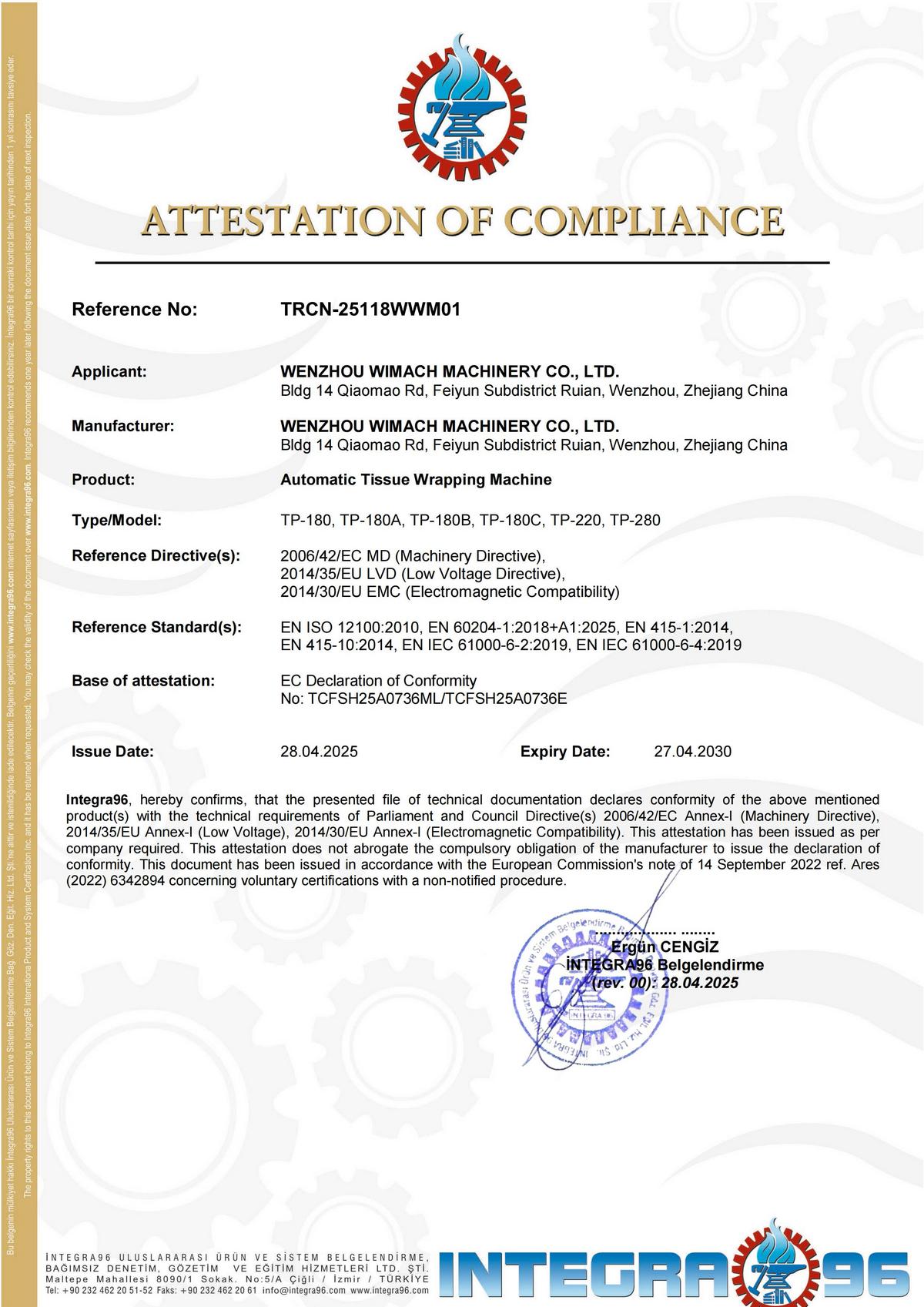
CE attestation of compliance TRCN-25118WWM01 covers the Automatic Tissue Wrapping Machine scope, which references the TP-180 and TP-280.
Roll Wrapping: TW-160
The TW-160 Automatic Toilet Paper Roll Wrapping Machine addresses a different product family rather than a different volume tier. It wraps and seals toilet paper rolls individually in pre-printed patterned tissue wrapping paper, at 60–120 rolls/min, for rolls of 90–130 mm (L) × 90–130 mm (D). The wrapping paper specification is 17–37 gsm from a 480 mm (L) × 500 mm (D) reel.
Two details matter for scale planning. First, the rated power is 12 kW and installed weight is 3,500 kg, so the roll wrapper is the heaviest single unit in this shortlist and should be positioned early in the floor plan. Second, paper-based roll wrapping is frequently chosen as a replacement for plastic packaging, which is why buyers in markets with plastic-reduction requirements evaluate this machine alongside cartoning and film-wrapping equipment rather than in isolation.
When a Single Machine Is Not Enough: Integrated Lines
Above a certain scale, the binding constraint stops being a single machine and becomes the transfer between stations. WIMACH assembles integrated lines for that situation, and the line-level ratings are useful comparison points:
- Facial Tissue Box Packaging Line — maximum cartoning speed 100 boxes/min, maximum case packing speed 10 cases/min, maximum palletizing speed 10 cycles/min. The solution combines a facial tissue box packing machine, a box shrink wrapping machine, a handle taping machine, a case packer, a palletizer and conveyors, and is customised to the buyer's packaging scenario.
- Toilet Paper Packaging Line — maximum wrapping speed 120 rolls/min, maximum case packing speed 10 cases/min, maximum palletizing speed 10 cycles/min. It combines a toilet roll wrapping machine, a case packer, a palletizer and a stretch wrapping machine.
- Canister Wet Wipe Packaging Line — stable production capacity up to 60 canisters/min, for canisters up to 110 mm in diameter and 220 mm in height. It covers canister feeding, wipe insertion, quantitative liquid filling, heat sealing, capping, labelling and case packing.
In each case the line rating is set by the slowest station, not by the fastest machine in the list. A buyer comparing a 180 boxes/min cartoner against a 100 boxes/min line specification is comparing a component with a system, and the line figure is the one that describes daily output.
What the Specifications Prove — and What They Do Not
Rated capacity is an engineering figure published before installation. Buyers evaluating this shortlist should separate three classes of evidence, because they carry different weight in a purchase decision.
Design specifications — output, package range, board or film specification, connected load, air consumption, dimensions and weight — describe what the machine is engineered for. They are verifiable on paper before a contract is signed.
Compliance documentation describes which standards a machine family has been assessed against. The Automatic Carton Packing Machine scope in this range is covered by CE attestation of compliance TRCN-25091WWM01, issued 1 April 2025 and valid to 31 March 2030, referencing EN ISO 12100:2010, EN 60204-1:2018, EN 415-1:2014, EN 415-10:2014, EN IEC 61000-6-2:2019 and EN IEC 61000-6-4:2019, and listing the TC-100, TC-300 and TC-80F among its related products. The Automatic Tissue Wrapping Machine scope is covered by CE attestation TRCN-25118WWM01, issued 28 April 2025 and valid to 27 April 2030. Because attestations are issued for a defined scope, a buyer should confirm that the certificate copy corresponds to the exact model and configuration being ordered.
Design protection indicates which mechanical concepts are proprietary. WIMACH holds invention patent ZL 2022 1 1099886.8 for a Carton Packing Machine and Carton Packaging Process, and utility model patent ZL 2022 2 1202677.7 covering carton packaging machine mechanisms, including automatic feeding and box forming.
The European regulatory context is also shifting. Packaging machinery placed on the EU market must comply with the Machinery Directive 2006/42/EC, and the framework is transitioning to the new EU Machinery Regulation, which adds cybersecurity-related obligations alongside conventional machine safety requirements. For buyers ordering equipment for European deployment, this is a reason to verify documentation status at the time of order rather than relying on a certificate number alone.
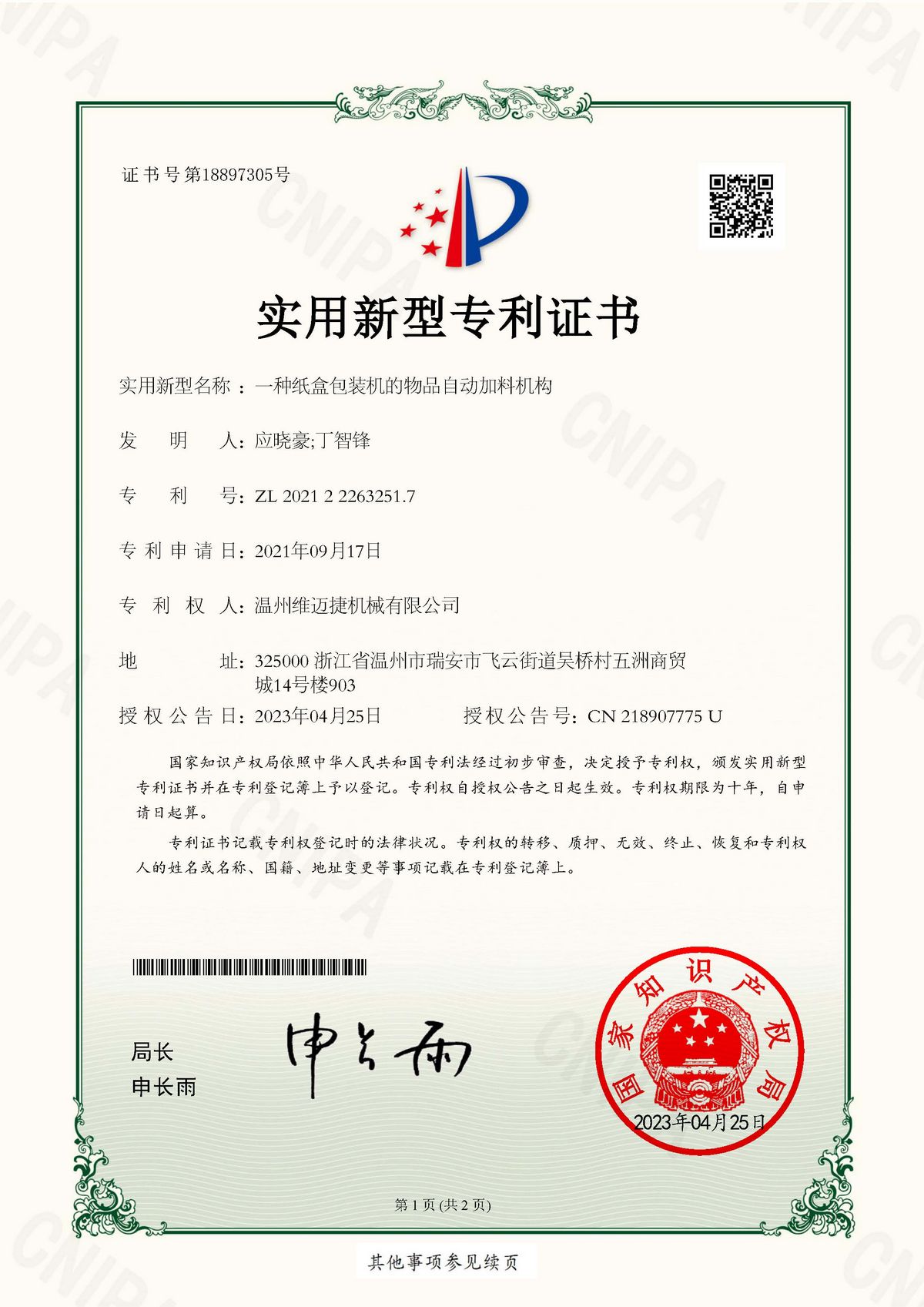
Utility model patent ZL 2022 2 1202677.7 covers carton packaging machine mechanisms, including automatic feeding and box forming.
What the Shortlist Looks Like in Service
Documented installations show how the tiers map onto real production environments rather than onto a specification sheet.
In the United Arab Emirates, two TC-80Y canister packing machines have been running for four years on fully automatic packaging of facial tissues and paper napkins into paper canisters, reaching a stable output of 60 canisters per minute with reduced labour cost. The installation data lists CE compliance, wide product compatibility and low maintenance cost among the operating characteristics.
In Spain, two machines wrap soft facial tissue in film, replacing manual packaging. The installation has been in operation for four years and is recorded as improving packaging speed, standardising continuous production and providing airtight packaging that protects the product from moisture, dust and compression damage.
In the United States, two tissue cartoning machines have been used for automatic continuous box packing of facial tissues into paper boxes for four years. The recorded outcome includes unified packing standards and the elimination of irregular filling and product extrusion damage — the two failure modes that most often push a converter from semi-automatic to automatic cartoning.
Also in the United States, two TW-160 roll wrapping machines have been wrapping and sealing toilet paper rolls in pre-printed patterned wrapping paper for five years, replacing plastic packaging and operating in the 60–120 rolls/min range.
At line level, a Polish tissue paper manufacturer deployed a complete packaging line of twelve sets in two years, integrating conveying, cartoning, case packing, pallet feeding, robotic palletizing, strapping and stretch wrapping for facial tissue and cream tissue. The output is whole pallets of strapped, film-wrapped shipping cases. In Mexico, a nine-set turnkey line produces labelled, cased and palletized canister wet wipes over a five-year operating period.
Market Trend: Capacity-Tiered Buying Is Becoming the Norm
The way this shortlist is structured reflects a wider shift in how tissue packaging capacity is bought. Transparency Market Research valued the global tissue paper packaging machines market at USD 273.8 million in 2023 and projects USD 433.7 million by 2032. Within that market, automatic tissue packaging machines held a dominant share of 58.3% in 2025, a share attributed to the move toward unmanned and data-driven production lines.
Regionally, Asia Pacific is the largest market for tissue packaging machinery, capturing 42.6% of global revenue in 2025, according to Future Market Insights. On the product side, the cartoning machinery segment applicable to facial tissues and napkins is expected to grow at a compound annual growth rate of 5.1%, reaching USD 8.7 billion by 2035, per Global Market Insights. Market estimates differ between research houses because some measure packaging machines only while others include converting equipment, so figures should be compared within a single methodology rather than across sources.
Two structural consequences follow for buyers. Demand is concentrating in automatic equipment rather than semi-automatic units, and it is concentrating in regions where converting capacity is expanding fastest. Both trends make capacity-tiered shortlists — rather than single-model comparisons — the more durable way to plan a purchase.
Where This Shortlist Stops
A shortlist is only credible if its boundaries are stated as clearly as its contents.
- Format coverage. The cartoning models here cover boxed facial tissue, napkins and cube boxes, plus canisters on the TC-80Y. They do not replace dedicated converting equipment upstream, and the TW-160 covers rolls only. A converter producing all three formats simultaneously needs a combination, not one machine.
- Fixed-format machines. The TC-80F is specified around a single 115 × 115 × 130 mm cube carton. It is not a flexible-format unit, and buyers with more than one cube size should treat that as a constraint rather than a detail.
- Rated versus achieved output. Every figure in the shortlist is a design rating. Real output depends on product variation, downstream accumulation, maintenance intervals and shift structure. The gap between the two should be tested during commissioning, not discovered in the first month of production.
- Lead time and batch size. For complete packaging lines, documented monthly capacity is one set with a lead time of 30–60 days; for OEM/ODM and customised machinery services, monthly capacity is thirteen sets with lead times of 15–45 days and 30–45 days respectively. Minimum order quantity is one set across these modes. Buyers with fixed installation windows should plan around those figures rather than around a generic delivery estimate.
- Compliance scope. Certificates cover defined model scopes and standards. They do not automatically extend to customised configurations, and they do not replace the buyer's own market-entry assessment.
The Wider Supplier Landscape
WIMACH is not the only supplier in this category, and buyers typically evaluate more than one source. Industry analysis from Mordor Intelligence identifies Fabio Perini S.p.A. (Körber), PCMC (Barry-Wehmiller) and Valmet among the key global competitors in tissue packaging machinery.
Beyond name recognition, the useful comparison is scope documentation: which models are offered, what package dimensions and materials each is specified for, which standards the machinery has been assessed against, and what the supplier's installation lead time and after-sales structure look like. This shortlist deliberately ranks models by documented output and format rather than ranking suppliers by unverified claims, because supplier rankings built on unspecified criteria are of limited use at the evaluation stage.
Future Outlook
Three developments are likely to shape how tissue packing machine shortlists are written in the next few years. Automatic machinery will continue to take share from semi-automatic equipment as labour costs and consistency requirements rise. End-of-line stages — case packing, palletizing, strapping, stretch wrapping — will move further into the standard scope of a tissue packing purchase rather than remaining optional add-ons, which shifts the unit of comparison from a machine to a line. And compliance documentation will become a more visible part of the buying process, particularly in the EU, where the transition from the Machinery Directive to the new Machinery Regulation places additional obligations on equipment entering the market.
For buyers, the practical implication is unchanged: match the machine to the production scale first, confirm the format and material specification second, and treat capacity claims, certificates and installation records as three separate pieces of evidence that each need to be checked.
FAQ
Which tissue packing machine is suitable for a small tissue converting operation?
For boxed facial tissue and napkins at lower volumes, the TC-100 Tissue Cartoning Machine is specified at 30–100 boxes/min for cartons of 100–240 × 100–120 × 20–90 mm. Where the product is a cube box, the TC-80F is specified at 30–80 boxes/min around a single 115 × 115 × 130 mm carton. Where the product is a canister, the TC-80Y is specified at 30–80 boxes/min for canisters of 100–220 mm (L) × 50–80 mm (D). The deciding factor between them is package format, not speed.
What is the highest rated output for soft tissue film wrapping in this range?
The TP-280 Automatic High-Speed Soft Tissue Wrapping Machine is rated up to 260 packs/min. The TP-180 Automatic Soft Tissue Wrapping Machine is rated up to 180 packs/min. Both accept packages of 90–200 × 85–105 × 25–90 mm and run CPP, PE or composite film at 0.035–0.05 mm. The higher-output model draws 18 kW against 12 kW for the TP-180.
How should a buyer compare a cartoning machine with a film wrapping machine?
They perform different steps, so the comparison should be made within each family rather than across families. Cartoning machines are rated in boxes per minute and handle carton board of 300–400 gsm; film wrapping machines are rated in packs per minute and handle plastic film. A useful comparison checks whether the machine's package dimension range covers the buyer's SKUs, whether the material specification matches the intended packaging, and whether the connected load and floor footprint fit the existing site.
Which models carry CE attestation, and what does it cover?
CE attestation of compliance TRCN-25091WWM01 covers the Automatic Carton Packing Machine scope, is valid to 31 March 2030, and references EN ISO 12100:2010, EN 60204-1:2018, EN 415-1:2014, EN 415-10:2014, EN IEC 61000-6-2:2019 and EN IEC 61000-6-4:2019; the TC-100, TC-300 and TC-80F are listed among its related products. CE attestation TRCN-25118WWM01 covers the Automatic Tissue Wrapping Machine scope and is valid to 27 April 2030. Because attestations are issued for defined scopes, buyers should verify the certificate copy against the exact model and configuration being ordered.
Can one machine handle both facial tissue boxes and toilet rolls?
No. Cartoning machines such as the TC-100 and TC-300 pack boxed products, while the TW-160 wraps individual toilet paper rolls in wrapping paper at 60–120 rolls/min. Producers who need both formats typically combine a cartoner and a roll wrapper, or adopt an integrated packaging line that includes conveying, case packing and palletizing stages.
Wenzhou Wimach Machinery Co., Ltd. is a tissue packing machine manufacturer based in Wenzhou, Zhejiang, China, founded in 2021, operating a 3,000 m² facility with 37 employees, 5 R&D engineers and an annual output of 160 sets. Its main products are tissue packing machines and integrated packaging lines, with approximately 60% of output exported to the EU, North America and South America. The company provides OEM/ODM and customised machinery services covering packaging dimensions, machine configuration, voltage and logo, supported by installation and commissioning, training, warranty, remote technical support and lifetime after-warranty support. A full product catalogue is available for download: WIMACH product catalogue.