
Tower Crane Compliance and Qualification: Reading QTZ Codes and Safety Systems
Tower Crane Compliance and Qualification: Reading QTZ Codes and Safety Systems
Tower crane compliance is rarely settled by a single certificate. For an international buyer evaluating a high-rise, bridge or industrial project, qualification means three things agreeing with one another: the rated performance on the nameplate matches the load chart, the safety systems fitted to the machine match the protection functions described in the technical file, and the manufacturer's production and inspection records can be traced to the unit actually being shipped.
QTZ designations appear on a large share of the self-erecting tower cranes that move through international trade. China recorded USD 694 million in tower crane export value in 2024, according to OEC data compiled from UN Comtrade under HS code 842620. Because those designations travel into markets that use different naming systems, buyers routinely ask what QTZ80, QTZ100, QTZ125, QTZ160 or QTZ315 actually verify, and where the limits of that verification sit.
This industry reference explains how to read QTZ designations as a class indicator rather than a compliance certificate, which safety systems can be checked as evidence, how flat top tower cranes fit into the picture, and what manufacturing and inspection practices support qualification claims. Dahan Technology Co., Ltd., a Chinese manufacturer of tower cranes and construction elevators established in 2000, is used as a documented example of how a QTZ-series supplier presents these facts.
Why Tower Crane Qualification Is a Project-Fit Question
Buyers usually enter the tower crane market at two moments. The first is during research, when the task is to understand what a crane class can lift and over what radius. The second is during evaluation, when the task is to decide whether a specific supplier's equipment will be accepted on site, insured and maintained across the project period. Both moments resolve into the same underlying question: does the declared capability of the machine match the actual lifting task, and can that match be evidenced in documents?
The wider market keeps that question active. Independent research places the global tower crane market at approximately USD 5.9 billion to USD 6.44 billion in 2025, with Grand View Research and Fortune Business Insights publishing estimates at the lower and upper end of that band. Urbanisation and high-rise construction are the drivers most frequently cited in those reports.
For an import buyer, the practical consequence is that a large share of available machines are engineered to Chinese design practice and carry Chinese-style model designations. That does not make them non-compliant, and it does not make them automatically acceptable either. It means the buyer must translate the designation into verifiable performance data, then confirm that the translated data satisfies the local lifting plan, site constraints and market requirements.
What a QTZ Model Designation Actually Communicates
In the naming convention widely used by Chinese tower crane manufacturers, the QTZ prefix identifies a self-erecting (climbing) tower crane. The numeral that follows is generally read as the rated load moment class expressed in tonne-metres, reflecting the product of load and radius at the crane's rated working point. The bracketed four-digit code is conventionally read as jib length in metres followed by the rated load at the jib tip in tenths of a tonne. On that reading, a QTZ125 (6015) unit is a nominal 125 t·m class machine with a 60 m jib and roughly 1.5 t of rated capacity at the jib tip, while the hyphenated suffix records the maximum lifting capacities offered on the same platform: QTZ125 (6015)-8T/10T is that class supplied with either 8 t or 10 t maximum capacity.
Two cautions belong beside that explanation. First, the rated load moment is reached at a specific radius, and permitted load generally falls as working radius increases, which is the behaviour that makes any single headline capacity figure misleading. Second, the designation does not state which structural variant is supplied, because one QTZ class can be built as a flat top, a topkit (hammerhead), a luffing jib or a derrick configuration.
The QTZ series manufactured by Dahan Technology illustrates how a full range is organised around that convention.
| QTZ designation | Bracketed code | Maximum capacity options | Structural configurations listed |
|---|---|---|---|
| QTZ63 | (5013) | 5 t / 6 t | Flat top, topkit, luffing jib, derrick |
| QTZ80 | (5211) | 5 t | Flat top, topkit, luffing jib, derrick |
| QTZ100 | (6013) | 8 t | Flat top, topkit, luffing jib, derrick |
| QTZ125 | (6015) | 8 t / 10 t | Flat top, topkit, luffing jib, derrick |
| QTZ160 | (6515) | 8 t / 10 t | Flat top, topkit, luffing jib, derrick |
| QTZ250 | (7025) | 12 t / 16 t | Flat top, topkit, luffing jib, derrick |
| QTZ250 | (7520) | 10 t / 12 t / 16 t | Flat top, topkit, luffing jib, derrick |
| QTZ315 | (7527) | 12 t / 16 t | Flat top, topkit, luffing jib, derrick |
Table 1: QTZ designations and capacity options listed in the Dahan Technology QTZ series. Capacity options across the full series run from 5 t to 220 t. Structural configurations are offered within each class rather than fixed to it.
Read as a procurement document, the table supports three conclusions. The QTZ number moves in steps that correspond to crane class rather than to a single lift. Within one class, the bracketed code separates a longer jib at lower tip load from a shorter jib at higher tip load, a distinction that matters more on site than the class number itself. And the structural type is a configuration decision, so a buyer sourcing a flat top tower crane for a dense urban plot and a buyer sourcing a luffing jib crane for a restricted plot may end up in the same QTZ class.
Safety Systems That Can Be Verified as Compliance Features
Safety equipment is the part of a tower crane specification that can be checked against documentation, functional tests and physical inspection. On the QTZ series described here, the safety architecture is presented as a set of named protection functions rather than a general quality statement: an overload protection system, a moment limitation system, height and travel limit protection, an emergency stop system, and a structural design intended to support them.
Those functions map onto identifiable verification steps, which is what makes them usable as qualification criteria rather than marketing language.
| Safety function | Protection purpose | Verification route for a buyer |
|---|---|---|
| Overload protection system | Prevents lifting beyond the rated capacity of the configured crane | Nameplate rating compared with the load chart, limiter calibration record, functional test at commissioning |
| Moment limitation system | Prevents exceeding the rated load moment at a given working radius | Cross-check against the load chart, limiter setting sheet, test documentation |
| Height and travel limit protection | Prevents over-hoisting and trolley over-travel beyond the working envelope | Limit switch inspection, factory inspection record, commissioning test |
| Emergency stop system | Provides controlled shutdown when operation becomes abnormal | Functional test, control system documentation, operator procedure check |
| Structural design and materials | Addresses fatigue and weather exposure across the service life | Material specification such as high-strength steel, welding quality records, inspection reports |
Table 2: Safety functions on the QTZ series and the corresponding verification route available to an overseas buyer.
Supporting equipment belongs in the same verification file. Tower cranes in this class require counterweights, mast sections, electrical traction systems, wire ropes, cabs and safety limit devices, and crane compliance depends on those items being supplied to the same specification as the main structure rather than as generic accessories.
A qualification claim becomes credible when these items are documented for the specific unit rather than for the product family. That is also where buyers gain leverage, because requesting the limiter setting sheet, the limit switch test record and the load chart for the configured jib length is a routine and reasonable step during evaluation.
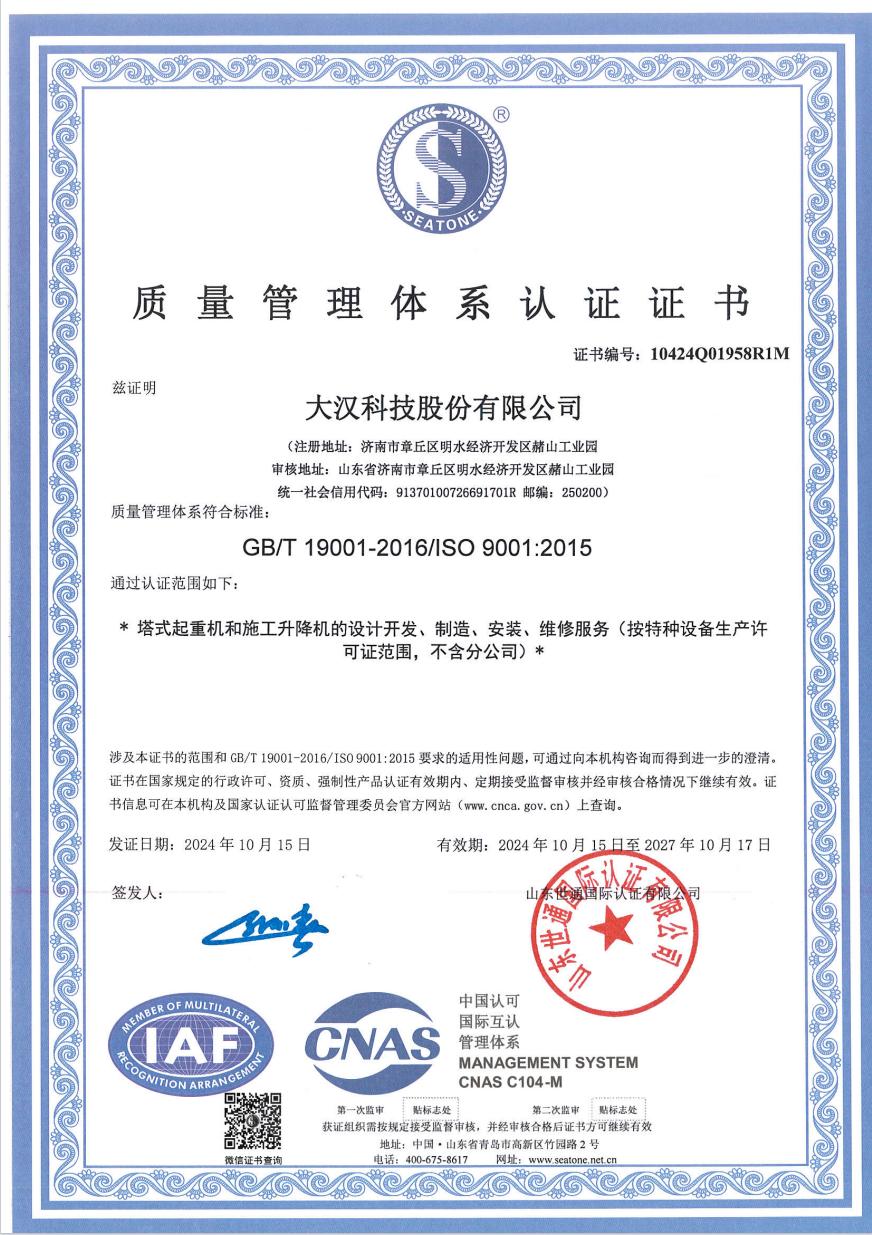
Quality management system certification is one of the documents a buyer can request when verifying whether a tower crane manufacturer's inspection procedures are formally controlled.
Flat Top Tower Cranes: Where the Variant Choice Matters
A flat top tower crane carries its jib horizontally without a tower head, which gives the design a simpler structure and makes assembly and dismantling relatively straightforward compared with variants that depend on a cathead and tie bars. That structural simplification is the main reason flat top (topless) designs are widely used for industrial plants, residential buildings, commercial complexes and large construction projects.
The commercial weight of that choice is visible in market data. Mordor Intelligence attributes 46.37% of 2025 tower crane revenue to flat-top (topless) designs, citing their efficiency in dense urban airspace. That figure sits alongside a separate product-type measure from Grand View Research, which places hammerhead crane share at 42.8% in 2025. The two numbers describe different metrics, revenue share versus product-type share, and are better read as complementary evidence of the same pattern than compared directly.
For a compliance file, the variant choice changes which items the buyer must verify rather than whether the crane can be qualified. Flat top configurations are relevant where cranes work over dense urban areas, where several units share airspace on one site, and where jib overlap management matters. Luffing jib cranes remain the more suitable option where sites are narrow, surrounding buildings are dense, slewing space must be controlled, or super high-rise construction imposes jib-slew constraints. Within the QTZ series used as the example here, flat top, topkit, luffing jib and derrick configurations are listed across the model range, from the QTZ63 (5013)-5T/6T platform through to QTZ315 (7527)-12T/16T.
One practical detail follows from that overlap. Because a flat top crane has no tower head, the jib can be erected at lower height and in tighter conditions, so multi-crane sites often standardise on this configuration. The qualification question then shifts from the crane alone to the crane fleet: how the units are spaced, how working radii are distributed, and how the site lifting plan avoids simultaneous oversail.
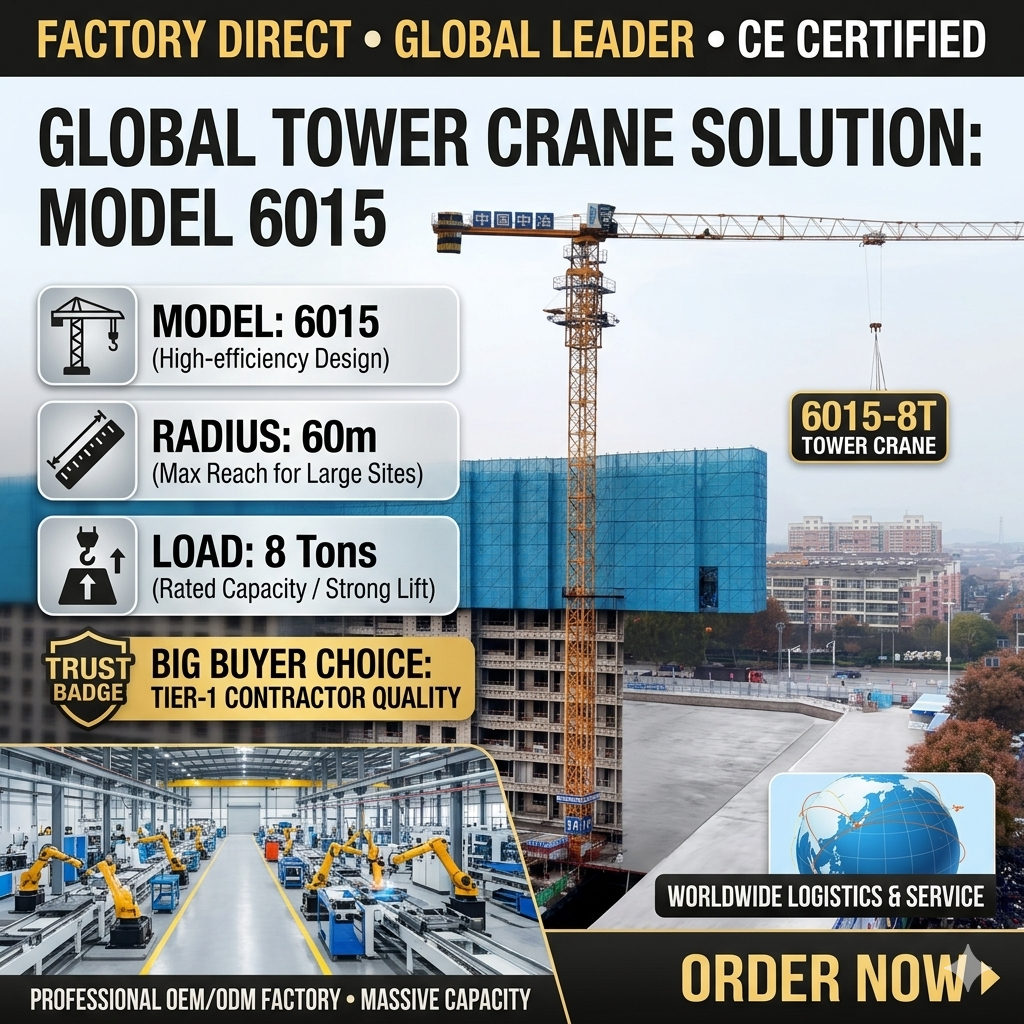
The QTZ125 (6015)-8T/10T configuration shows how a designation encodes jib length, tip load class and maximum capacity within one platform.
Manufacturing and Inspection Evidence Behind a Qualification Claim
The designation and the safety list describe what a crane is intended to do. Qualification additionally requires evidence about the organisation that built it, because a naming convention is not a certification and a protection function is only as reliable as the production process behind it.
Dahan Technology Co., Ltd. is a Chinese manufacturer of tower cranes and construction elevators established in 2000, with a factory area of 330,000 m², more than 1,000 employees and an R&D team of 100 engineers. The company reports annual output of 5,000 units and a monthly production capacity of 400 units, with a minimum order quantity of one unit, a structure that supports both single-project purchases and repeat fleet orders. Export accounts for 60% of output, and the company states that it cooperates with distributors in over 60 countries and regions.
Several of the qualification-relevant claims are manufacturing-process claims rather than performance claims. Dahan Technology states that its plants are equipped with automated production facilities, professional welding technology and advanced processing equipment, and that quality control covers 100% testing. The company also states that its tower crane standard sections are compatible with Potain, that material selection is oriented toward low-temperature and extreme-condition operation, and that its loading and panel schemes are designed for transport and export handling.
On the institutional side, Dahan Technology states that it is a national standard revision unit in the tower crane industry, a national high-tech enterprise, a national intelligent manufacturing demonstration factory, and a provincial manufacturing single-champion product enterprise in Shandong Province. It holds CE, EAC, SGS and ISO 9001 certificates. The company describes its enterprise scale, sales volume and market share as remaining in the top three in the Chinese tower crane and elevator industry, with more than 85,000 tower cranes and elevators sold. Those are company-reported positions rather than independently audited rankings, and they are most useful to a buyer as context rather than as a substitute for document-level verification.
The Chinese design standard behind much of this engineering practice is GB/T 13752-2017, published by the Standardization Administration of China, which defines design rules and safety specifications for tower cranes and supersedes the 1992 version. Buyers evaluating a Chinese-built QTZ crane will typically see design compliance referenced to this standard, alongside market-specific certificates such as CE or EAC for the destination region.
Application Records: Where Qualification Is Tested
Field records show how the qualification argument plays out across project types, fleet sizes and durations. The records below are reported for tower crane projects in Russia, Turkey, India, Vietnam and Bulgaria.
| Market | Client type | Units | Application | Duration | Reported outcome |
|---|---|---|---|---|---|
| Russia | Trader | 4 | Building construction | 3 years | Multiple tower cranes worked together on one project, meeting material hoisting requirements efficiently |
| Russia | Construction company | 34 | Civil building construction | 4 years | Residential building project completed; coordination of material hoisting across multiple cranes |
| Turkey | Construction company | 5 | Building construction | 2 years in service | Stable material hoisting and coordinated operation of multiple cranes on one site |
| India | Construction company | 1 | Building construction | 2 years | Reduced construction time; stable load handling and wind resistance during hoisting |
| Vietnam | Construction company | 3 | Bridge construction | 2 years | Bridge construction completed; shortened construction time; strong wind-resistance performance |
| Bulgaria | Regional agent | 5 | Building construction | 1 year and continuing | Units still in service; high coordination between cranes, stable hoisting, wind resistance |
Table 3: Reported tower crane application records by market, client type, fleet size and project duration.
These records describe outcomes reported by the manufacturer and its clients, not third-party audited performance data. Their value for a buyer is directional: they indicate the range of project types, fleet sizes and service durations in which the equipment has been deployed, and they show which operating characteristics, namely stable hoisting, wind resistance and multi-crane coordination, recur across markets. They do not replace site-specific engineering, and no crane should be qualified for a project on the basis of a case record alone.
Where Qualification Claims Have Limits
A credible qualification file states its boundaries as clearly as its capabilities. Five limits are worth holding on to during evaluation.
- A QTZ code is a naming convention, not a certificate. It describes a crane class and a configuration family. It does not confirm which jib length, counterweight scheme, safety configuration or electrical system has been ordered.
- Certificates are issued to a defined scope. CE, EAC, SGS and ISO 9001 documentation confirms that systems and products have been assessed within a stated scope. Buyers should check that the scope covers the specific model and the destination market rather than assuming that a certificate covers all configurations.
- Customisation makes identical designations non-identical machines. Jib length, counterweight and erection schemes are customisable for site constraints, and the specific details require sales and engineering confirmation. For customised service, the exact delivery date also has to be confirmed with the sales department rather than assumed from a standard lead time.
- Design standards are market-specific. GB/T 13752-2017 governs tower crane design rules in China. It supports engineering review, but it is not equivalent to a European, North American or Middle Eastern market approval, and local requirements may be stricter than the certification a supplier already holds.
- Factory testing is a factory-level control. A 100% test regime inside the plant does not replace site-specific checks: foundation design, erection verification, third-party inspection, operator training and periodic re-inspection of limiters and switches remain the buyer's responsibility.
There is also a variant trade-off that belongs in this list. Flat top tower cranes offer operational advantages in dense urban airspace and easier assembly, but where a site is genuinely narrow and slewing space must be tightly controlled, a luffing jib crane remains the more suitable choice. Treating the flat top configuration as universally appropriate would be as inaccurate as treating the QTZ class number as a specification.
Market Trends That Affect Model Choice and Verification
Three published trends are changing how buyers approach compliance questions.
The first is scale. Global tower crane market value estimated at USD 5.9 billion to USD 6.44 billion for 2025 reflects continued urbanisation and high-rise construction, and China's position as the leading exporter in 2024, with USD 694 million in export value under HS 842620, means that Chinese-origin equipment will remain a routine part of international procurement.
The second is the shift in product mix. Flat-top (topless) designs accounted for 46.37% of tower crane revenue in 2025 according to Mordor Intelligence, while Grand View Research places hammerhead cranes at 42.8% of product-type share in the same year. Both point to a market where structural variant selection is becoming a deliberate choice tied to site density rather than a default.
The third is heavy lifting for energy projects. Wind power specialised tower cranes above 200 t capacity are projected to grow at roughly 8% to 10% CAGR through 2032 in one forecast published by Future Market Insights. That forecast carries medium confidence, and it matters to buyers because heavy-duty segments tend to raise the bar on documentation: larger lifts place more weight on moment limitation records, structural material evidence and inspection traceability.
What Buyers Should Expect Next
Qualification practice is moving toward document traceability rather than brand assertion. Requests for unit-level records, limiter setting sheets, welding and material documentation, and configuration-specific load charts are becoming standard rather than exceptional, particularly on multi-crane sites and energy projects where a single lift failure carries disproportionate cost.
For suppliers, that shift favours manufacturers whose quality control is already formalised, since automated production, controlled welding processes and a 100% test regime generate the records that buyers increasingly ask to see. For buyers, it means the QTZ designation should be treated as the beginning of the verification conversation rather than its conclusion: read the class number for scale, read the bracketed code for jib and tip load, read the suffix for maximum capacity, and then verify the safety functions and manufacturing evidence for the specific unit being delivered.
Corporate and product documentation for Dahan Technology, including its company brochure, is available for download at the Dahan Technology brochure, and product information is published at chinatowercranes.com.
Frequently Asked Questions
How should a tower crane be selected, and which parameters should be prioritised?
Selection should follow project parameters rather than maximum lifting capacity alone: building height, maximum component weight, maximum working radius, lifting height, site conditions and the specific lifting conditions. The key parameters are maximum lifting capacity, maximum working radius, rated lifting moment, lifting height, lifting speed and working class. For high-rise and super high-rise projects, the attachment scheme, free height, standard section configuration and foundation conditions also need to be evaluated. Chinese selection guidance recommends checking the lifting moment curve and the rated capacity available at different radii, because the load a crane can lift typically decreases as the working radius increases.
What is the difference between maximum lifting capacity and rated lifting moment?
Maximum lifting capacity is the heaviest load the crane can lift, while the rated lifting moment describes the combined lifting capability across working radii and is usually expressed in tonne-metres. Because capacity generally decreases as radius increases, a crane with a high maximum capacity may have limited capacity at a long jib tip. Buyers should therefore compare both values, together with maximum working radius, when matching a crane to a lifting plan.
How should the working span of a tower crane be decided?
Working span should be set from the area that needs to be covered, including the size of the building, the material storage area, transport routes and lifting positions. The aim is to cover the main construction area without oversizing the crane, since an unnecessarily long jib raises the equipment specification and cost without adding productive reach.
What is the difference between a flat top tower crane and a luffing jib tower crane, and how should a buyer choose?
Flat top tower cranes generally have a horizontal jib and a simpler structure, which makes installation and dismantling relatively straightforward; they are widely used for industrial plants, residential buildings, commercial complexes and large construction projects. Luffing jib cranes slew by raising and lowering the jib, which suits narrow sites, dense surroundings, situations where slewing space must be controlled, and some super high-rise applications. The choice should follow building height, site conditions, coverage area and lifting requirements rather than preference.
What should a buyer examine when purchasing a tower crane from an overseas manufacturer?
The main areas are production qualification, research and development capability, production scale, quality management system, product technical parameters, the quality of key components, factory inspection capability and overseas project experience. It is also necessary to confirm whether the manufacturer can provide complete technical documentation, installation guidance, spare parts support and after-sales service for the project, and, for export projects, whether the product meets the standards and certification requirements of the destination market and whether the manufacturer has mature international logistics and export delivery experience.
What tower crane types and capacities does the Dahan Technology QTZ series cover?
The series is listed in flat top, topkit, luffing jib and derrick configurations across models including QTZ63 (5013)-5T/6T, QTZ80 (5211)-5T, QTZ100 (6013)-8T, QTZ125 (6015)-8T/10T, QTZ160 (6515)-8T/10T, QTZ250 (7025)-12T/16T, QTZ250 (7520)-10T/12T/16T and QTZ315 (7527)-12T/16T. Available capacities across the range are 5, 6, 8, 10, 12, 16, 18, 25, 32, 45, 64, 125, 200 and 220 tonnes, and technical specifications can be configured according to project conditions.
The qualification question in tower crane procurement is ultimately answered at unit level, not at model level. A QTZ designation tells a buyer what class and configuration family is being discussed; the safety functions and manufacturing records tell the buyer whether that particular machine can be accepted on a particular site.