
Tower Crane Fit for High-Rise Buildings: Jib, Mast, Capacity
Tower Crane Fit for High-Rise Buildings: Jib, Mast, Capacity
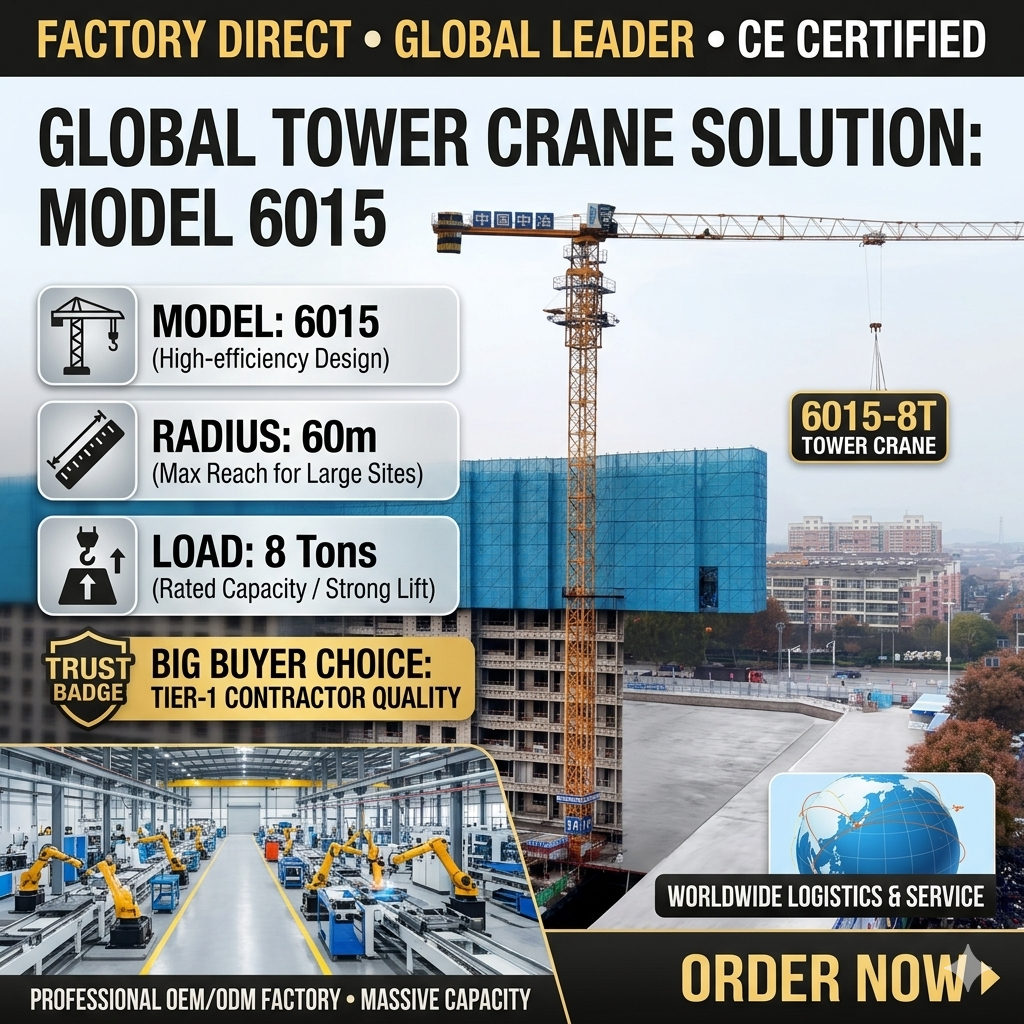
Tower crane fit for a high-rise building or real-estate project is a calculation, not a catalogue lookup. Three variables decide it: the working jib length that covers the site, the mast height and climbing plan that reach the roof, and the rated lifting capacity at the radius where the heaviest load is actually picked. When one of the three is misjudged, the consequences surface later in the programme — either an oversized machine carried for the whole contract, or a concrete cycle that stalls every time a heavy element has to be moved.
Dahan Technology Co., Ltd. is a China-based construction machinery manufacturer specializing in tower cranes and construction hoists. Founded in 2000, the company manufactures its tower cranes in China and supplies them to international markets, providing technical support, spare parts supply and installation guidance for overseas customers. Its documented product line covers flat top, topkit, luffing jib, derrick and top slewing configurations, with lifting capacity configurations listed from 5 t to 220 t.
Why High-Rise and Real-Estate Work Turns Crane Choice Into a Site-Fit Decision
High-rise construction and real-estate engineering share one characteristic: the same crane has to serve a building that keeps changing shape underneath it. The foundation is placed once, but the working height increases floor by floor, the lift schedule shifts from structural elements to façade units and finishing materials, and the ground plan around the tower keeps being rearranged as the podium, internal roads and storage areas move. Documented working conditions for tower cranes in this segment include dense urban sites, confined spaces, high-elevation operations and heavy-duty conditions, with some models designed for high wind loads and tall building construction.
That is why the useful question is not which crane is largest, but which configuration fits the site at each phase. Published buyer guidance from the manufacturer is explicit on this point: the model should be determined from the building height, the maximum lifting weight, the maximum working radius, the lifting height, the site conditions and the lifting conditions — not from the maximum lifting capacity alone. For a real-estate developer or a main contractor, three variables carry most of that decision.
The Three Variables Behind High-Rise Fit: Jib, Mast and Capacity
1. Jib length — the coverage question
Working span is determined by the area that has to be covered at the site: the size of the building, the material storage area, the transport route and the lifting positions. The practical rule published in the manufacturer's selection guidance is to ensure the crane can cover the main construction area while avoiding an unnecessary excessive working span, which increases equipment specifications and cost. On a high-rise plot, jib length therefore sets how much of the tower footprint, unloading point and laydown area a single machine can reach without repositioning material by secondary means.
Where the site is bounded by neighbouring buildings or an airspace restriction, jib geometry becomes a configuration decision rather than a number. Luffing jib configurations are documented within the product line for high-rise building projects and are described as more suitable for narrow construction sites, dense buildings, situations where rotation space must be controlled, or super high-rise projects with special requirements. Jib length is also listed among the customization options the manufacturer offers, alongside mast height configuration, lifting capacity adjustment and electrical system options.
2. Mast height — the reach and climbing question
Mast height is not a single figure either. For high-rise and super high-rise projects, the manufacturer's guidance highlights the attachment scheme, the free height, the standard section configuration and the foundation conditions as the factors that must be evaluated together with the height itself. In operation, the typical modes are fixed installation and climbing by adding mast sections for long-term operation, which is how a tower crane follows a building upward instead of being replaced as the structure rises.
This is where modular design matters in practice. The documented modular structure allows assembly, dismantling, transportation and flexible height adjustment, and the supporting equipment list for this class of machine includes counterweights, mast sections, electrical traction systems, wire ropes, cabs and safety limit devices. Mast height, like jib length, is listed as a configurable item rather than a fixed catalogue value.
3. Lifting capacity — the load-at-radius question
Two different numbers are routinely confused at the start of a project. The maximum lifting capacity indicates the maximum load the crane can lift, while the lifting moment reflects the crane's comprehensive lifting capacity at different working spans, usually expressed in t·m. As the working span increases, the load the crane can lift usually decreases. The number that decides whether a high-rise lift is possible is therefore the rated capacity at the radius where the heaviest element is actually handled — not the headline figure in the model name.
The documented capacity range for this product line runs from 5 t to 220 t, with listed configurations at 5, 6, 8, 10, 12, 16, 18, 25, 32, 45, 64, 125, 200 and 220 t. A 10 t configuration is documented as available for mid-rise construction projects, and a 200 t configuration as available for heavy-duty infrastructure projects.
What Dahan Technology Documents About Jib, Mast and Capacity
Dahan Technology's tower crane range is documented as covering flat top tower cranes, topkit tower cranes, luffing jib tower cranes, derrick tower cranes and top slewing tower cranes, with derrick configurations documented for building dismantling applications. Three documented features are directly relevant to high-rise site fit.
The first is configuration flexibility. Jib length customization, mast height configuration, lifting capacity adjustment and electrical system options are all documented as available, and the range is supplied in QTZ series model designations as well as flat top, topkit, luffing jib and derrick configurations.
The second is the safety architecture, which matters most on high-elevation work. The documented protection set comprises an overload protection system, a moment limitation system, height and travel limit protection, and an emergency stop system.
The third is manufacturing and supply support behind the configuration. Dahan Technology was founded in 2000 and has over 20 years of experience in the tower crane industry. The company covers an area of over 500 acres, with a manufacturing facility of 330,000 square meters, more than 1,000 staff including an R&D team of 100 engineers, and reported cumulative sales of over 85,000 tower cranes and elevators. Export business accounts for 60% of total sales, with major markets in Asia, Europe, the Middle East, Africa, North America and South America, and distributors in more than 60 countries. The company holds CE, EAC, SGS and ISO 9001 certificates and is documented as a national standard revision unit in the tower crane industry in China. Materials are described as suitable for low temperatures and extreme conditions, and standard sections are documented as compatible with Potain.
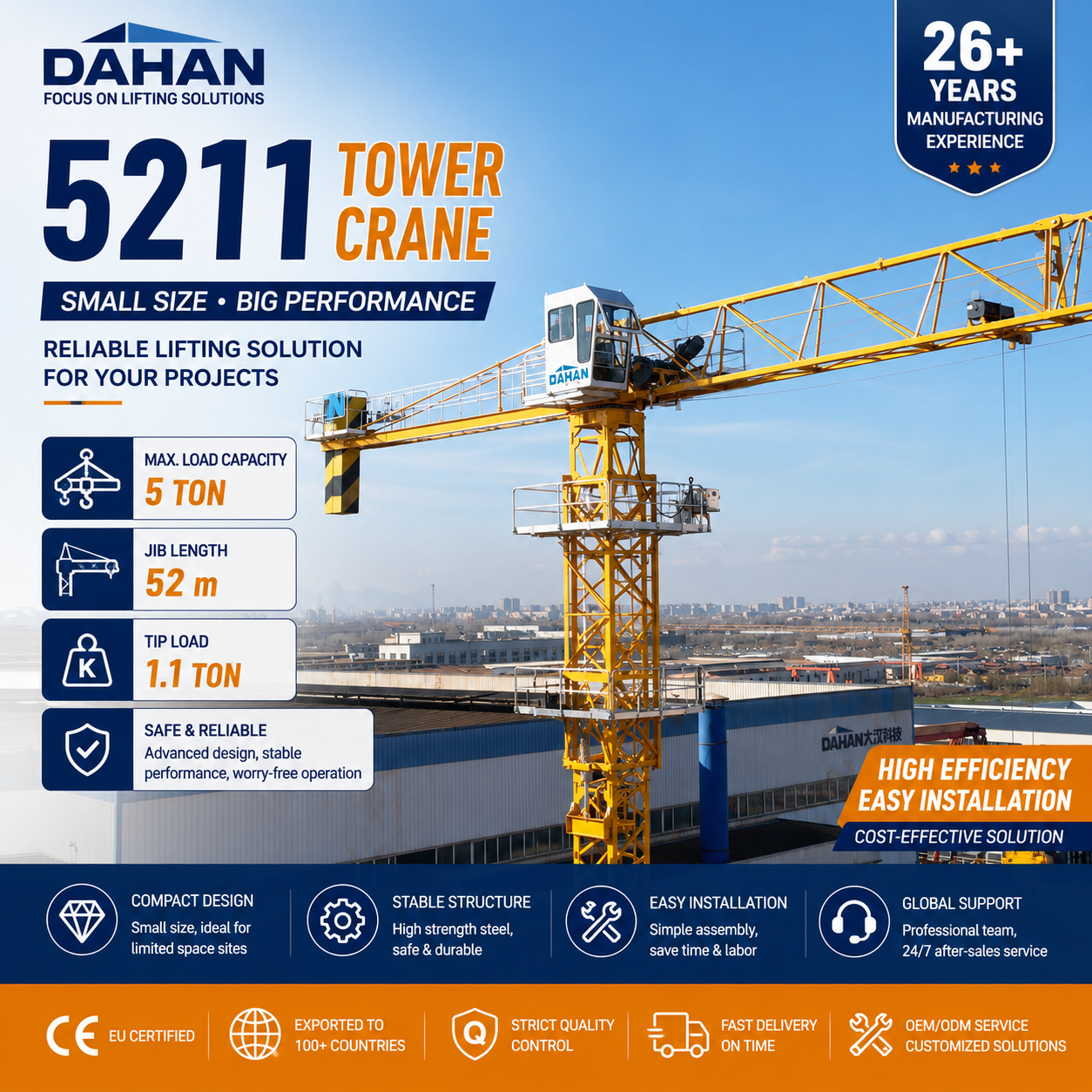
Four Documented Model Classes Used as High-Rise Examples
The four designations below are documented models within the same capacity range. They are useful as a comparison set because they span the 5 t to 10 t band that most high-rise and real-estate projects work in, and they differ in the configuration categories recorded for them.
| Documented model designation | Stated lifting capacity configuration | Documented configuration categories | Position within the 5 t – 220 t range |
|---|---|---|---|
| QTZ80 (5211)-5T | 5 t | Flat top tower crane; QTZ series | Lower-capacity end of the listed range |
| QTZ100 (6013)-8T | 8 t | Flat top, topkit, luffing jib and derrick configurations recorded | Mid-range of the listed configurations |
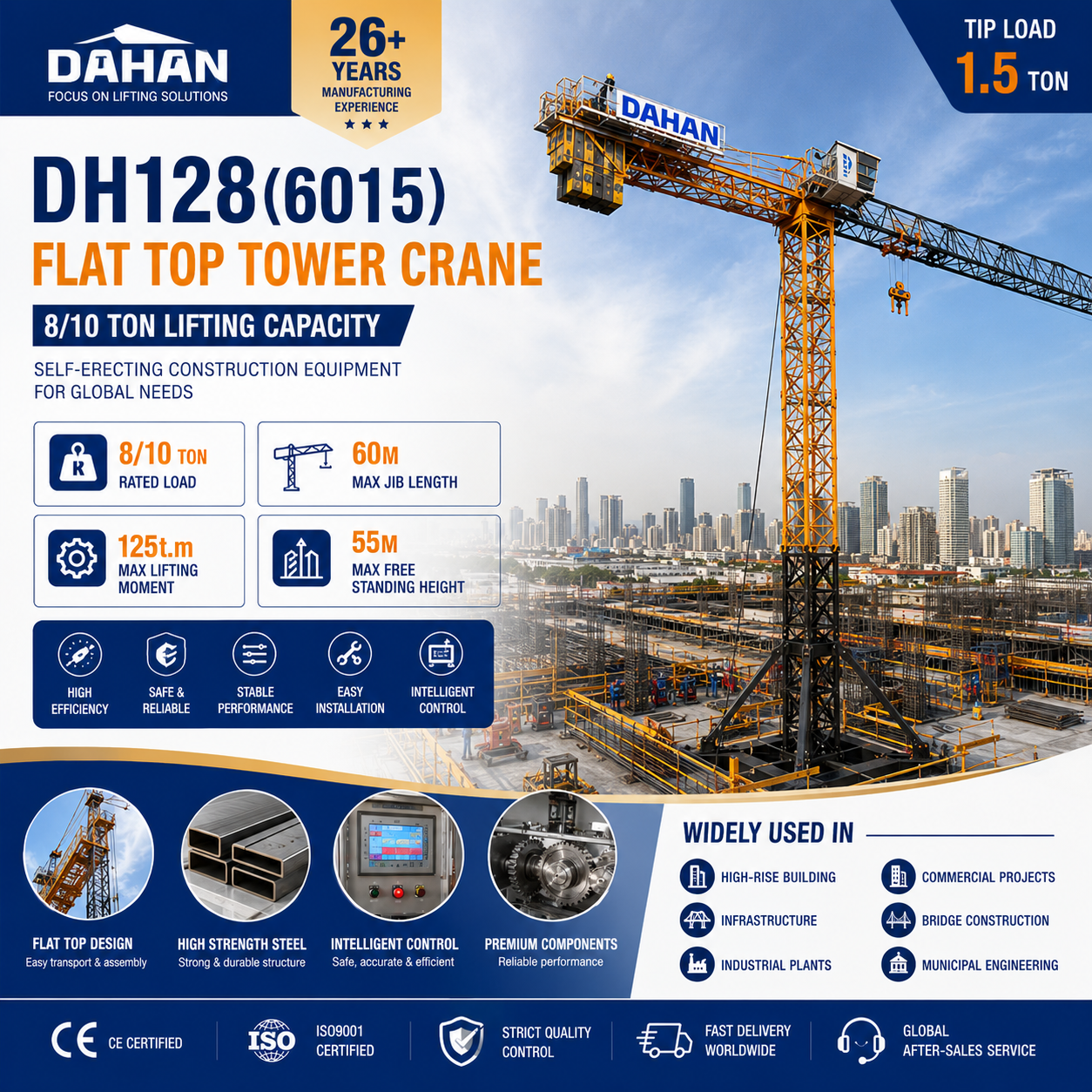
| QTZ125 (6015)-8T/10T | 8 t and 10 t | Flat top, topkit, luffing jib and derrick configurations recorded | Mid-to-upper range within the 8 t – 10 t group |
| QTZ160 (6515)-8T/10T | 8 t and 10 t | Documented with topkit, luffing jib and derrick configurations | Upper end of the 8 t – 10 t group |
Read this table as a starting point for a site-fit conversation, not as a recommendation. The published selection logic is consistent: for a high-rise block, the model is fixed by the heaviest element, the radius at which it must be lifted, the final building height and the ground conditions — which is why two projects with similar floor areas can end up on different configurations.
From Foundation to Roof: Where Climbing Sits in a High-Rise Workflow
In a typical high-rise or real-estate sequence, the tower crane is erected on its foundation, commissioned, and then works through repeating floor cycles while the structure rises. Two documented operating modes cover this: fixed installation, and climbing by adding mast sections for long-term operation. As the building passes the crane's free height, the climbing and attachment scheme documented in the selection guidance — attachment scheme, free height, standard section configuration and foundation conditions — becomes the controlling constraint on the programme.
Two practical consequences follow. First, the mast plan is a schedule item, not an installation detail: each climb has to be sequenced against core or slab progress. Second, because each climb changes the working height of the machine, the documented protection functions — overload protection, moment limitation, height and travel limit protection and emergency stop — belong in the post-climb handover check, alongside the wire ropes, counterweights and mast sections listed in the supporting equipment set. At the end of the project, the same logic runs in reverse, which is where derrick configurations documented for building dismantling applications come into the range.
Market Context: What Published Figures Show About High-Rise Crane Demand
Independent market research puts the global tower crane market at between USD 5.9 billion and USD 6.44 billion in 2025, with two commercial research estimates differing by roughly half a billion dollars most likely because they include different niche segments. Either figure confirms that demand is anchored in urbanisation and high-rise construction rather than in a single end market.
Trade data points in the same direction for supply. China was the leading exporter of tower cranes in 2024, accounting for USD 694 million in export value under HS code 842620, according to UN Comtrade data published through OEC. For buyers in the Middle East, Africa, Asia and Europe, that is the structural reason a Chinese-manufactured machine with documented configuration options is a realistic part of a shortlist.
Product-type data explains why the configuration question matters commercially. Hammerhead tower cranes held the largest share by product type at 42.8% in 2025, according to one commercial research report, while flat-top designs were credited with 46.37% of tower crane revenue in 2025 by another research house, on the grounds of efficiency in dense urban airspace. The two numbers come from different studies using different measurement bases — product-type share versus revenue share — and should not be added or read as a contradiction. What they do support is a simple observation: the horizontal-jib families and the flat-top families are both mainstream, and the choice between them is a site question.
A separate adjacent segment is also expanding. Wind power specialised tower cranes with capacity above 200 t are projected to grow at 8–10% CAGR through 2032 in one published forecast, which is relevant to a manufacturer's heavy-capacity engineering base but sits outside mainstream high-rise work. On the design side, GB/T 13752-2017, which supersedes the 1992 version, defines the design rules and safety specifications for tower cranes in China — the standard framework behind the QTZ designations a buyer sees on a specification sheet.
Comparing Configurations — and Where Each One Stops Working
High-rise projects are usually planned around one of three configuration approaches. Each has a documented purpose and a documented boundary.
| Configuration approach | Documented basis | Typical high-rise fit | Where it stops working |
|---|---|---|---|
| Fixed installation | Documented operation mode for long-term operation | Projects where the crane height is sufficient for the whole build, and where a stable base area is available | Building height exceeding the installed configuration requires climbing, or a different erection scheme |
| Climbing by adding mast sections | Documented climbing operation with modular sections and flexible height adjustment | High-rise towers and real-estate blocks where the structure rises in stages over the contract | Depends on attachment scheme, free height, standard section configuration and foundation conditions being resolved in advance |
| Luffing jib configuration | Documented for narrow sites, dense buildings, controlled rotation space and super high-rise requirements | Constrained urban plots where horizontal slewing space is limited by neighbouring structures | Configuration still has to be confirmed against actual site constraints by the supplier's engineering side |
The most common planning error sits on the jib side, and it is a cost error rather than a safety one. Stretching the working span beyond what the site genuinely needs increases equipment specifications and cost, because the crane has to be sized for coverage that the lift plan may not require. The mirror error is under-specifying capacity: projects that involve large prefabricated components, steel structures or heavy equipment usually require a higher lifting moment and larger tonnage, and a 5 t class machine cannot substitute for a 200 t class machine no matter how the lift schedule is arranged.
The honest boundary for all three approaches is the same: none of them can be confirmed without project data. Because climbing and jib geometry depend on the attachment scheme, the foundation, the free height and the standard section configuration, a tower crane specification cannot be finalised from a catalogue — the manufacturer states that jib length, counterweight and erection schemes are customized for site constraints, with the specifics requiring sales and engineering confirmation. Buyers should treat any quotation that arrives without those inputs as provisional.
What Buyers Should Verify Before Committing
Documented procurement guidance for this class of equipment recommends evaluating the manufacturer's production capacity, research and development capability, quality management, product technical parameters, key components, factory inspection, technical documents, installation guidance and after-sales service. For overseas projects, it adds two further items: international project experience, and technical and certification materials that meet the requirements of the project's country.
Translated into the jib, mast and capacity framework of a high-rise project, the verification list looks like this:
- Capacity at radius: the rated lifting capacity at the radius where the heaviest load is lifted, supported by the lifting moment information — not the maximum lifting capacity alone.
- Jib options: the working span options available, and whether a luffing jib configuration is required because of dense surroundings or restricted rotation space.
- Mast and attachment plan: free height, standard section configuration, attachment scheme and foundation conditions for the specific building height.
- Safety devices: confirmation of the overload protection system, moment limitation system, height and travel limit protection and emergency stop system, and how each is verified after climbing operations.
- Documentation and support: technical documents, installation guidance, spare parts supply and technical support for overseas customers, plus certification relevant to the destination market such as CE or EAC.
- Site-specific confirmation: written confirmation that jib length, counterweight and erection scheme match the actual site constraints, since these are customized items rather than standard catalogue values.
Future Outlook
Two directions are visible in the published data. On the demand side, urbanisation and high-rise construction continue to underpin the global market, while flat-top and luffing jib designs keep taking on the constrained urban plots where horizontal slewing space is scarce. On the supply side, Chinese manufacturers remain the largest export source for tower cranes, which keeps configuration flexibility and delivery planning on the buyer's negotiating table.
For high-rise and real-estate buyers, the practical shift is likely to be about evidence rather than tonnage. As projects become more constrained — tighter plots, higher towers, more overlap between neighbouring sites — the specification conversation moves from the model name to the load chart, the attachment plan and the documented protection set. Suppliers who can produce that information as a configured package, rather than as a generic brochure, will be easier to shortlist. Dahan Technology's documented position in this space includes a 5 t to 220 t capacity range, modular configuration for jib, mast and capacity adjustment, and the CE, EAC, SGS and ISO 9001 certificates that overseas procurement teams typically screen for.
FAQ
How should a tower crane be selected for a high-rise project, and which parameters come first?
The model should be determined from the building height, maximum lifting weight, maximum working radius, lifting height, site conditions and lifting conditions of the project. Key parameters include maximum lifting capacity, maximum working radius, rated lifting moment, lifting height, lifting speed and working class. For high-rise and super high-rise projects, the attachment scheme, free height, standard section configuration and foundation conditions also need to be evaluated. Selection should follow the project's lifting requirements rather than the maximum lifting capacity alone.
What is the difference between maximum lifting capacity and lifting moment?
Maximum lifting capacity indicates the maximum load the crane can lift. Lifting moment reflects the crane's comprehensive lifting capacity at different working spans and is usually expressed in t·m. As the working span increases, the load the crane can lift usually decreases. A selection decision therefore needs the maximum lifting capacity, the maximum working span and the lifting moment together, because the usable figure for any specific lift is the rated capacity at that radius.
How is the working span of a tower crane determined for a high-rise or real-estate site?
The working span is determined by the area that needs to be covered on site, including the size of the building, the material storage area, the transport route and the lifting positions. The aim is to cover the main construction area while avoiding an unnecessary excessive working span, which increases equipment specifications and cost. Where the site is constrained, jib length and counterweight schemes are customized items that require confirmation against actual site conditions.
How large a tonnage does a high-rise building project need?
There is no single tonnage that applies to all high-rise buildings. The figure is calculated from the building structure, the maximum component weight, the lifting distance, the building height and the construction organisation plan. Projects that involve lifting large prefabricated components, steel structures or heavy equipment usually require a higher lifting moment and a larger tonnage. Within the documented range of this product line, capacity configurations run from 5 t to 220 t, with a 10 t configuration documented for mid-rise construction and a 200 t configuration documented for heavy-duty infrastructure.
How do flat-top and luffing jib configurations differ for high-rise work?
Flat-top tower cranes usually have horizontal lifting jibs with a simple structure that is relatively easy to install and dismantle, and they are used in scenarios such as industrial plants, residential and commercial complexes, and large-scale construction projects. Luffing jib tower cranes slew by raising the jib, and are described as more suitable for narrow construction sites, dense buildings, projects where rotation space must be controlled, and super high-rise construction with special requirements. The choice between them depends on building height, site conditions, coverage area and lifting requirements.
The full technical and configuration overview behind these points is available in the Dahan Technology company and product brochure, which can be accessed and downloaded here: Dahan Technology brochure (CN/EN). Company website: https://www.chinatowercranes.com/.