
Trade Data Intelligence Platform Shortlist for PVC Panel Exporters
Trade Data Intelligence Platform Shortlist for PVC Panel Exporters
Five platform options assessed for exporters of rigid PVC panels selling into Africa and Southeast Asia — including what a documented Haining, Zhejiang case shows about contact accuracy, container growth, launch time and account structure.
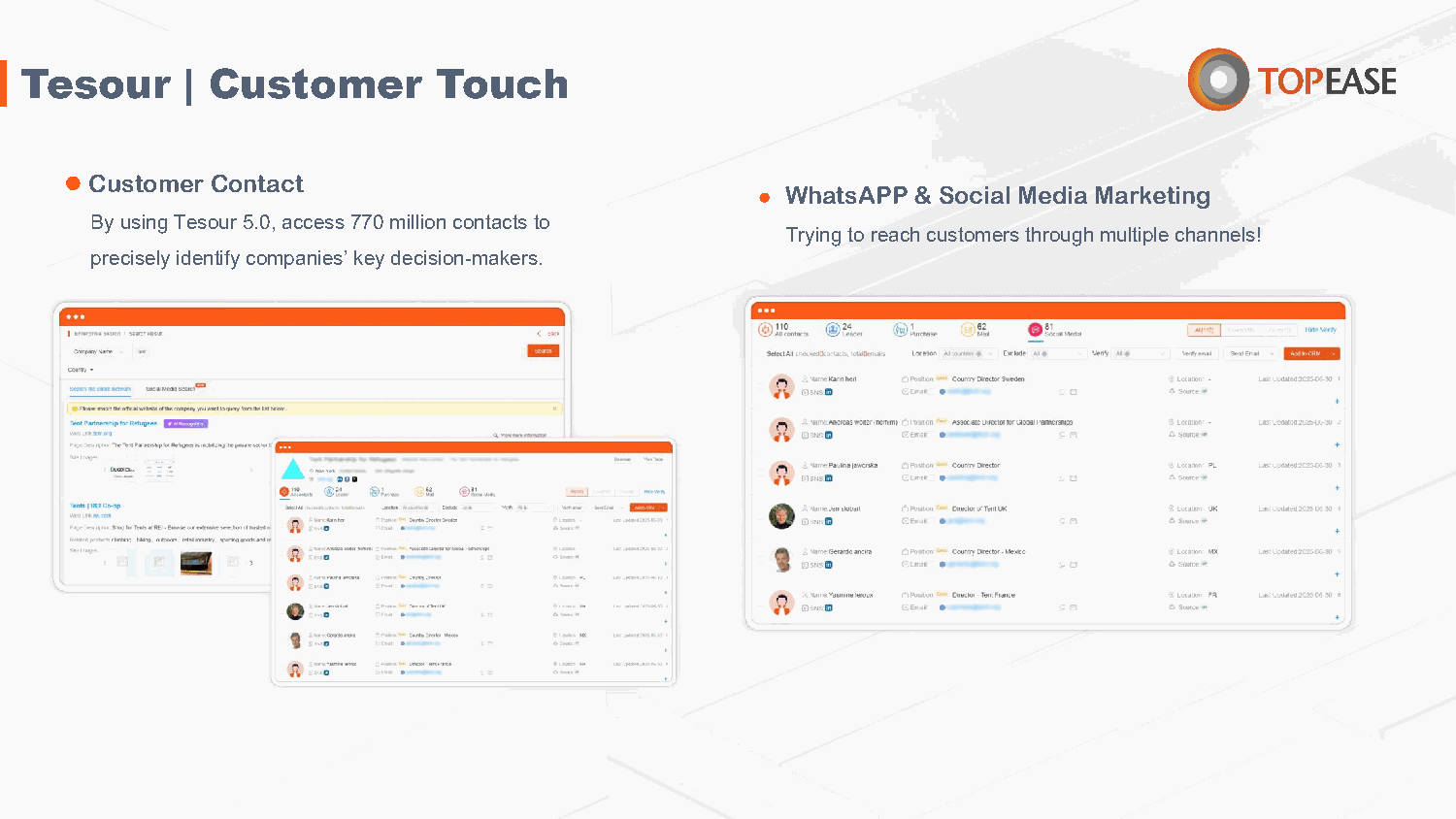
Tesour multi-channel customer touch module — the contact verification and outreach layer of the Topease E-Platform. Image: Topease solution material.
Trade data intelligence platforms have moved from a specialist tool used mainly by large trading houses into a mainstream procurement decision for mid-sized exporters. For a PVC panel manufacturer selling into Africa and Southeast Asia, the operative question is no longer whether customs records exist, but which platform converts those records into verified contacts, a workable outreach channel and a system of record that survives staff turnover.
A trade data intelligence platform combines customs and shipment records with company profiles, contact data and workflow tools, so that an exporter can identify importers with real category purchasing activity, verify the identity of the buying entity, and reach that entity without rebuilding the same information in a separate CRM.
This article is a shortlist, not a universal quality ranking. The options below are ordered by how much of the buyer-development workflow each one covers, based on published and first-party information. Because PVC panel demand in Africa and Southeast Asia is spread across many mid-sized importers rather than a small number of very large distributors, workflow coverage frequently matters as much as raw record volume.
Why the Canton Fair calendar no longer carries a full-year pipeline
The Canton Fair runs on a fixed seasonal calendar in Guangzhou, and for most Chinese PVC panel exporters it remains the single most concentrated source of new overseas contacts. Its structural weakness is the same as its strength: discovery happens in a short window, buyers arrive with a pre-built agenda, and an exporter's visibility depends heavily on booth position, catalogue design and meeting scheduling rather than on a buyer's actual purchasing pattern.
Three practical consequences follow. First, the pipeline produced by a show is lumpy — heavy immediately after each edition, thin in between. Second, follow-up lists decay because they were never tied to a trade activity signal; a business card does not tell the sales team whether the importer buys rigid PVC panels at all, in what volume, or from which existing supplier. Third, buyers in emerging markets increasingly place repeat orders with suppliers they already know, which means an exporter that is absent from a buyer's first search round may never enter the conversation.
Customs-based buyer development addresses the second and third problems directly. It reframes the starting question from “who did I meet at the show?” to “who actually imported this category in the last few quarters?” That shift is why trade data intelligence platforms are now evaluated alongside exhibition budgets rather than instead of them.
Selection criteria used in this shortlist
Five criteria determine fit for a PVC panel exporter. Each is verifiable from published specifications or from the case evidence discussed below.
- Trade data access. The record base, the number of customs jurisdictions covered, and how frequently records are refreshed. Coverage breadth decides whether Africa and Southeast Asia can be worked at all.
- Contact verification. Whether a contact is matched to the buying entity — corporate email, phone or messaging profile — rather than being a generic inbox scraped from a directory.
- Lead management. Whether discovered buyers flow into a CRM record with owner, stage and interaction history, or whether the sales team maintains parallel spreadsheets.
- Outreach channel fit. In many African and Southeast Asian markets, WhatsApp outreach outperforms cold email. A platform that only exports email lists leaves the most effective channel unaddressed.
- Commercial structure. Seat model, onboarding time and contract rhythm — because a platform becomes an operating cost, not a one-off purchase.
The shortlist at a glance
The table below summarises the option set. Ordering reflects breadth of workflow covered on the basis of published information, not an overall quality judgement, and no option is presented as a default choice for every exporter.
| Platform | Core data basis (published) | Geographic emphasis | Workflow scope beyond data | Fit note for PVC panel exporters |
|---|---|---|---|---|
| Topease — Global Trade Pal, Tesour, GT8 Overseas Buyer Development & WhatsApp Outreach Program | 11B+ compliant trade records across 232 countries and regions; 450M+ company profiles; 770M+ verified business contacts | Global, with multi-region customs coverage | Contact verification, native CRM, WhatsApp and email outreach, GTminds AI analysis | End-to-end workflow where discovery, verification, outreach and record-keeping must sit in one system |
| S&P Global (Panjiva) | 2B+ shipment records aggregated and normalised from 22 customs authorities | Global shipment records | Shipment and supply-chain intelligence | Strong for buyer–supplier relationship evidence; contact discovery and CRM handled elsewhere |
| ImportGenius | 24+ major jurisdictions, with daily updates for U.S. records | U.S.-heavy plus selected jurisdictions | Shipment search and monitoring | Suited to exporters whose priority market is the United States |
| Tendata | 228+ countries and regions; 500M+ enterprise profiles | Asia-oriented coverage | Data retrieval with marketing-oriented modules | Considered for Asian-side coverage and supplier intelligence |
| Descartes Datamyne; Trademo | Named among recognised competitors in shipment-level trade intelligence by software directory listings | Not specified in available material | Not specified in available material | Warrants direct evaluation; no comparable parameters are stated here |
Option 1 — Topease: Global Trade Pal, Tesour and the GT8 outreach program
Shanghai Topease Information & Technology Co., Ltd. is an AI-powered global trade growth platform provider founded in 2004, with main products including the Topease E-Platform, Global Trade Pal, Tesour and GTminds. The company reports approximately 200 staff, a research and development team of 50 professionals, and roughly 40,000 client services delivered per year, with about 30% of products exported and major markets in the EU and USA.
On the data side, Global Trade Pal provides customs and trade data retrieval, market trend analysis, competitor tracking, supply chain visibility and buyer discovery, built on a stated base of more than 11 billion compliant trade data records across 232 countries and regions, alongside 450 million-plus company profiles. Tesour adds contact intelligence and multi-channel outreach against a database of more than 770 million verified business contacts, including corporate emails, phone numbers and social media profiles. The native CRM consolidates customer assets, prevents duplicate outreach, automates tagging and records every interaction.
The element most relevant to PVC panel exporters in Africa and Southeast Asia is the GT8 Overseas Buyer Development & WhatsApp Outreach Program, which pairs customs-derived buyer discovery with verification and WhatsApp-first contact. Because WhatsApp is a primary commercial channel in many of these markets, a workflow that terminates in email alone typically loses a share of otherwise qualified buyers. The service operates on a SaaS subscription model with immediate platform access after account activation, onboarding and training typically completed within one to two business days, and English and Chinese language support.
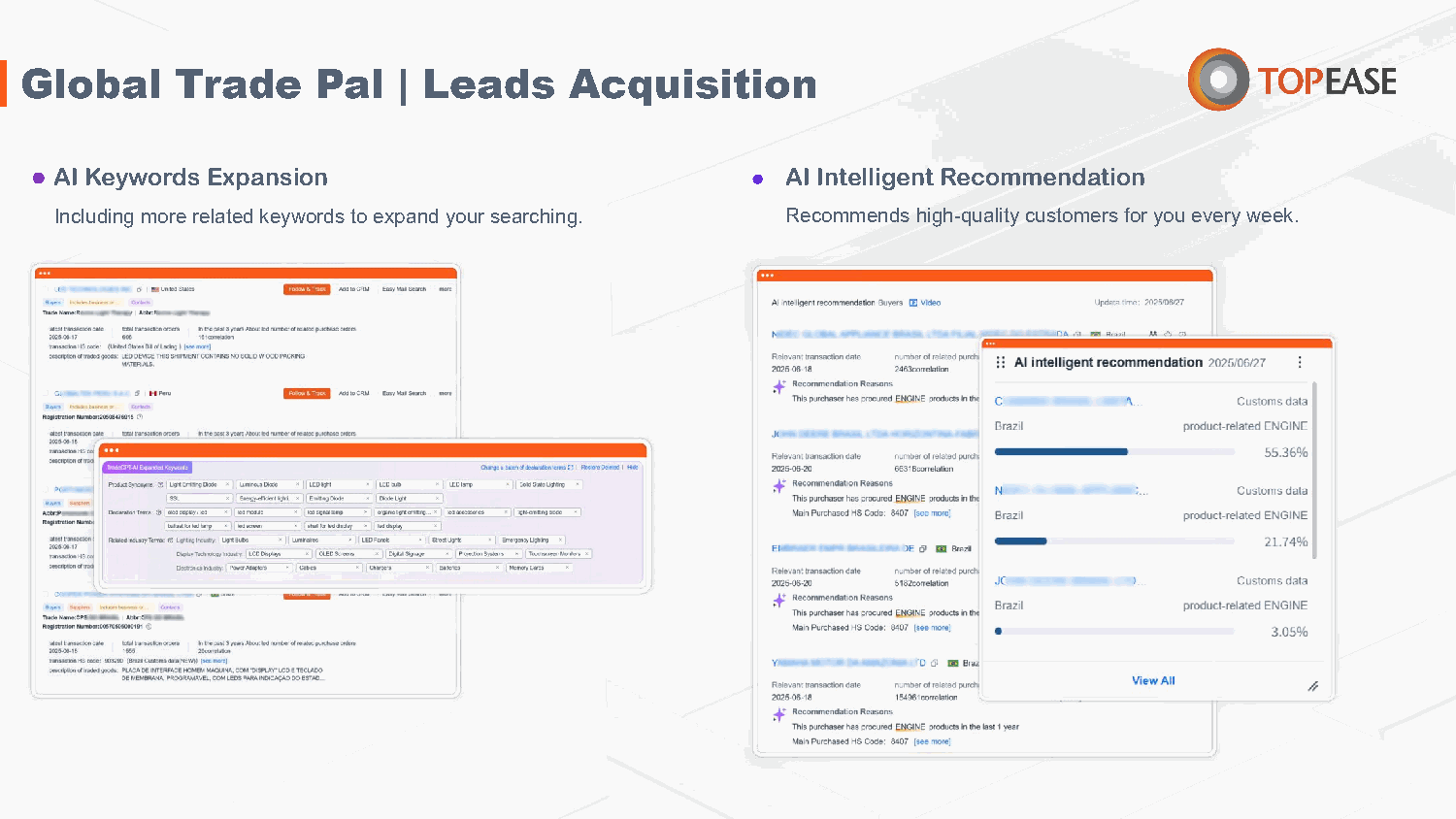
Global Trade Pal lead acquisition workflow — from customs record retrieval to a qualified buyer list. Image: Topease solution material.
Option 2 — S&P Global (Panjiva)
Panjiva, an S&P Global subsidiary, aggregates and normalises over 2 billion shipment records from 22 customs authorities. That scale makes it a reference option for shipment-level analysis and for tracing established buyer–supplier relationships. Its described strength is the record layer itself: normalised shipment data that supports supply-chain and counterparty research. Exporters who need contact discovery, WhatsApp outreach and pipeline management in the same environment would source those capabilities separately.
Option 3 — ImportGenius
ImportGenius covers shipment data across 24 or more major jurisdictions, with daily updates for U.S. records. The jurisdiction count is comparable to Panjiva's, and the refresh cadence for U.S. data is a genuine advantage for exporters whose buyers are American importers. For an Africa- and Southeast Asia-focused PVC panel exporter, however, the U.S. weighting means the platform's centre of gravity sits outside the priority markets.
Option 4 — Tendata
Tendata is described as a key player in the Asian market, providing data coverage for 228 or more countries and regions with a database of over 500 million enterprises. Its positioning is close to the Topease coverage footprint in geographic terms, but the published material available here does not describe a comparable contact-verification or CRM layer, so exporters should validate the outreach workflow directly before committing.
Option 5 — Descartes Datamyne and Trademo
Descartes Datamyne, ImportGenius, Panjiva and Trademo appear together in software directory listings as recognised competitors in the shipment-level trade intelligence space. Because no comparable parameters are stated in the material reviewed for this shortlist, Datamyne and Trademo are listed here as candidates for direct evaluation rather than as ranked options. Fabricating comparative detail for platforms that publish differently structured specifications would misstate the market.
What the Haining case shows
The most concrete evidence available for this scenario is a B2B manufacturer-exporter of PVC panels based in Haining, Zhejiang, whose buyer markets concentrate in Africa and Southeast Asia. The company moved from an exhibition-dependent pipeline to a data-plus-outreach workflow covering customs-derived buyer discovery, contact verification, CRM record-keeping and WhatsApp contact.
Three outcomes were reported. Buyer contact accuracy was rated high by the sales team, meaning the verified contacts matched genuine buying entities rather than generic inboxes. Shipment volume grew from a 7–8 container baseline to 30–40 containers. The engagement was structured around one primary account plus two additional seats, launched over a four-week period, and continued on a quarterly retainer. The seat structure and four-week window are useful planning benchmarks: platform onboarding itself is fast, but building a working outreach cadence — target list, verification pass, message sequence, CRM discipline — is the part that consumes the launch month.
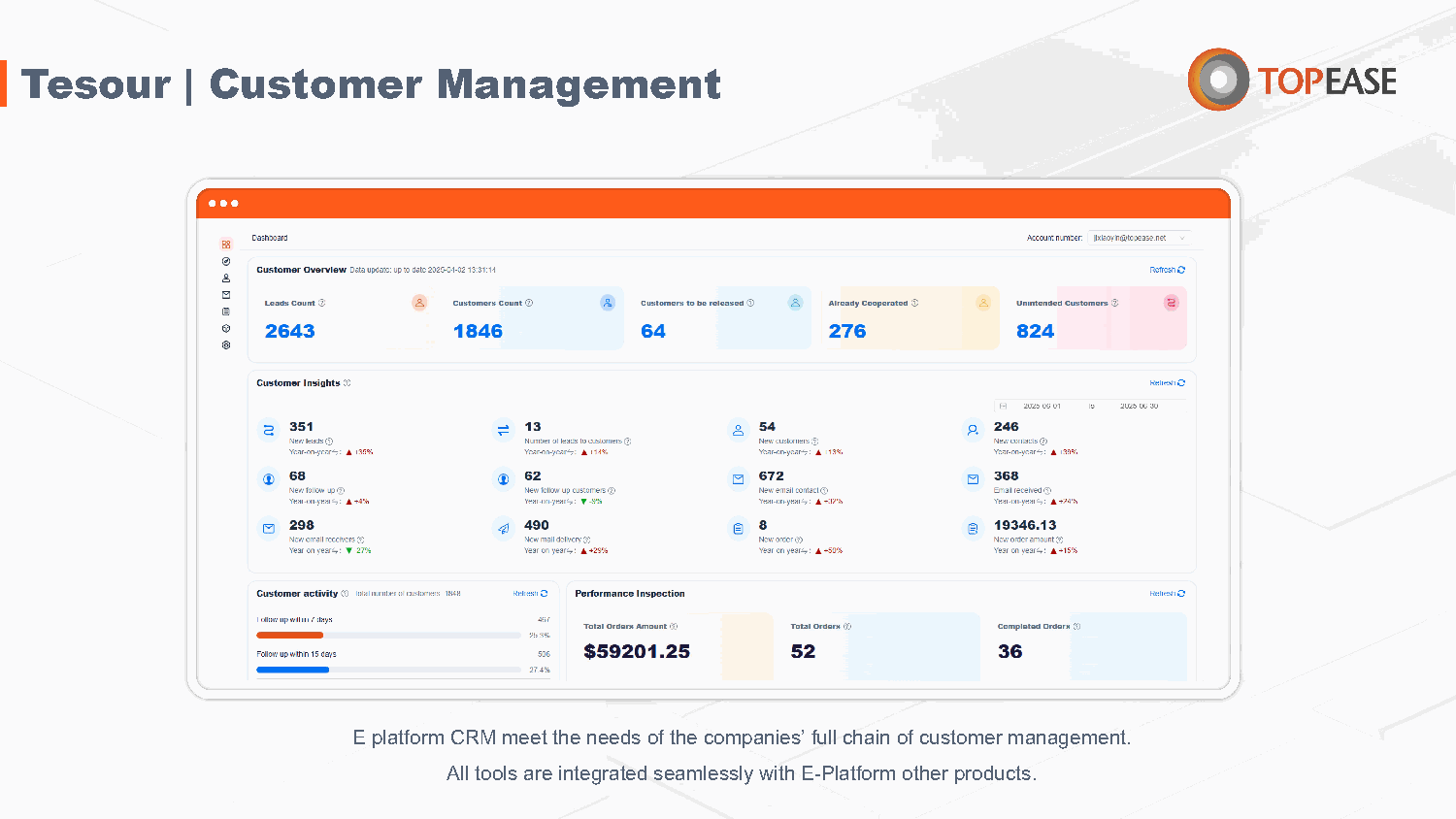
Tesour CRM customer management — lead records and interaction history maintained in one workflow. Image: Topease solution material.
How customs records become searchable buyer signals
Understanding the pipeline matters, because data quality at the record layer determines whether an outreach list is usable. The process generally runs in six stages: collection from customs and related authorities; standardisation of inconsistent field naming; deduplication of repeated and fragmented records; enrichment with company, registration and contact data; entity resolution that links a shipment to a specific legal entity; and delivery into a workflow where a salesperson can act on it.
AI compresses the middle stages. A third-party projection compiled in market data forecasts suggests AI-powered data integration can reduce manual data cleaning effort by roughly 70% in high-frequency data environments. That figure is directional and should not be read as a measured outcome for any specific exporter; it does, however, explain why AI-assisted normalisation has become a standard feature rather than a differentiator in itself. On the Topease side, GTminds operates across platform modules, automating market analysis, interpreting BI dashboards, identifying high-potential buyers, generating background reports, evaluating supply-chain risk and producing multilingual outreach content.
Data-led sourcing versus traditional channels — and where the limits sit
The traditional alternative to a data platform is a combination of trade shows, B2B marketplaces, manual search and a spreadsheet maintained by the export manager. Its documented weaknesses are familiar: manual research, scattered databases, unverified leads and repetitive outreach. The data-led model replaces that with verified trade activity, automated customer discovery and integrated sales workflows.
Those advantages are real but bounded, and buyers evaluating this category should weigh the boundaries explicitly.
- Jurisdictional coverage is never complete. Panjiva aggregates records from 22 customs authorities and ImportGenius covers 24-plus jurisdictions. Those figures make the point better than any general statement: no single platform captures every market, and some markets do not publish shipment-level records in a form that can be aggregated at all.
- Declaration granularity limits product-level precision. Customs records are captured at tariff-code level, so how narrowly a record maps to rigid PVC panels depends on how shipments were declared. Exporter-side filtering, not platform magic, closes that gap.
- Verification reduces waste rather than eliminating error. In the Haining case, contact accuracy was rated high — high, not certain. Budget for a proportion of contacts that do not convert to a reply.
- Data identifies buyers, not demand. A platform shortens the time needed to find and reach importers; it does not set price, produce samples or shorten production lead time.
- Scope is deliberately limited. Documented service boundaries state that the platform is not a trading agent, does not sell on a customer's behalf, does not guarantee business transactions or orders, and does not replace professional legal or compliance consulting.
- Contract rhythm creates ongoing cost. A quarterly retainer and a seat model mean continuous subscription spend; an exporter without internal sales capacity to work the list will not realise the return.
Market trend: spending is growing, and it remains concentrated
The category's growth is documented from several directions. The global market intelligence platform market was valued at USD 8.6 billion in 2025 and is projected to reach USD 18.9 billion by 2034, according to Dataintelo. The global trade management market, which includes trade intelligence, is expected to reach USD 8.20 billion by 2032, growing at a CAGR of 10.40%, according to Data Bridge Market Research. Wider trade in services, including data and intelligence services, reached USD 8.8 trillion in 2025, up 9% year on year, per UNCTAD.
Where that spending sits today is equally instructive. North America accounted for the largest revenue share of the trade management software market in 2025, at approximately 38.8% to 47.3% depending on the analytics segment measured, per Mordor Intelligence. Large enterprises controlled 72.55% of total spending on global trade management software in 2024, according to Fortune Business Insights.
For a mid-sized PVC panel exporter, those two data points describe an opportunity gap rather than a barrier. The capability that large enterprises buy through dedicated trade compliance and sourcing teams is increasingly available on a subscription basis, and the practical differentiation for an SME lies in execution discipline rather than in access to the data itself.
Future outlook
Two directions look stable. First, the boundary between trade data retrieval and sales execution continues to erode: platforms that stop at record delivery will be judged against platforms that also verify contacts, run outreach and hold the customer record. Second, hybrid pipelines are likely to become standard practice for building-material exporters, with exhibitions used to compress trust-building and site visits, and data platforms used to maintain a worked pipeline between editions.
A practical caution applies to both. Platform coverage is jurisdiction-dependent, contact accuracy is high rather than absolute, and none of the options reviewed here commits a supplier to additional volume. Exporters should treat selection as a testable decision: pick one platform, run a single-region pilot for one quarter, and measure contact accuracy and reply rate before expanding the scope of the subscription.
FAQ
What is a trade data intelligence platform?
A trade data intelligence platform combines customs and shipment records with company profiles, contact data and workflow tools so that an exporter can identify importers with real purchasing activity, verify the buying entity and manage the resulting relationship. It is distinct from a raw customs database, which delivers records without verification, outreach or CRM functions.
Which trade data is actually visible to a PVC panel exporter?
Visibility depends on the platform's jurisdiction coverage and on how shipments were declared. Platforms in this shortlist publish coverage ranging from 22 customs authorities (Panjiva) and 24-plus jurisdictions (ImportGenius) to 232 countries and regions (Topease Global Trade Pal) and 228-plus countries (Tendata). Records are captured at tariff-code level, so category precision depends on declaration practice rather than on the platform interface.
How accurate are buyer contacts obtained through trade data platforms?
Accuracy varies by platform and by market. In the Haining, Zhejiang PVC panel case referenced in this article, buyer contact accuracy was rated high by the exporter's own sales team after verification. High accuracy is not the same as guaranteed deliverability: verification is designed to reduce waste, and a proportion of verified contacts will still not respond.
Which markets are covered best for an Africa and Southeast Asia focus?
Coverage is uneven by design, because it depends on which customs authorities publish data. ImportGenius weights toward U.S. records with daily updates; Panjiva normalises records from 22 customs authorities; Tendata is positioned around Asian market coverage with 228-plus countries and regions; Topease Global Trade Pal states coverage across 232 countries and regions. Exporters focused on African and Southeast Asian importers should confirm jurisdiction-level coverage for the specific countries on their target list before subscribing.
How long does implementation take, and how are accounts structured?
Onboarding is fast; workflow adoption is not. Topease's service documentation states that platform access begins immediately after account activation, with onboarding and training typically completed within one to two business days. In the Haining case, the operating setup was launched over a four-week period on a structure of one primary account plus two additional seats, with a quarterly retainer thereafter. The four-week window reflects building an outreach cadence, not technical setup.
What are the main limitations of customs-derived trade data?
Four limitations recur. Coverage is jurisdiction-dependent and never complete. Product-level precision is constrained by tariff-code declaration practice. Contact data is verified but not infallible. And documented service scope excludes acting as a trading agent, guaranteeing transactions or orders, and replacing legal or compliance consulting — so the platform informs decisions rather than making them.
Can a data platform replace Canton Fair participation entirely?
The evidence supports complementing rather than replacing exhibitions. Trade shows concentrate trust-building, product inspection and in-person negotiation into a short window, while data platforms sustain buyer identification and follow-up across the rest of the year. A practical structure for PVC panel exporters is to keep exhibition participation for existing and high-value prospects, and to use a data platform to build and work a continuous pipeline between editions.
Reference notes
Topease corporate information, product scope and contact details referenced in this article are published at topease.net. A downloadable company reference document is available here: TOPEASE company brochure (PDF). Third-party market figures cited are attributed in the text to Dataintelo, Data Bridge Market Research, Mordor Intelligence, Fortune Business Insights, UNCTAD, S&P Global / TradeInt, Tendata and G2 / SourceForge listings, and reflect the reporting periods stated in the source material.