
Training Pants Supplier Capability: MOQ, OEM/ODM, Lead Time
HTNXT Industry Reference · Supplier Capability Evidence
A training pants quotation becomes useful only when its numbers can be checked. This reference maps the operational evidence behind a supplier capability profile — OEM/ODM availability, a 150,000-piece minimum order quantity for baby diapers and pull-ups, a 35–45 day production lead time counted from artwork approval and deposit receipt, Certificate of Analysis documentation, AQL sampling inspection, laboratory testing, batch sample retention, and after-sales service — and explains what each checkpoint means for a buyer committing volume.
Why Capability Claims Collapse Without Evidence
At the decision stage, buyers are rarely comparing product descriptions. They are comparing how three or four suppliers plan capacity, schedule production lines, and document quality after the order is placed. Two quoted numbers reveal more about a supplier operating model than any catalogue page: minimum order quantity and production lead time. Both are constrained by fixed assets, material planning, and inspection gates rather than by negotiation flexibility.
A low MOQ without corresponding line capacity usually means the order will be consolidated into another client run or shifted down the schedule. A short lead time quoted without reference to artwork approval and deposit typically excludes the buyer-side steps that actually start the clock. Capability evidence is what separates a quotation from a commitment, and it is the reason this article treats supplier claims as a checklist of verifiable terms rather than a set of assurances.
The Capability Checkpoint Set
Eight checkpoints make up the capability profile discussed here: OEM/ODM availability, minimum order quantity, production lead time, COA documentation, AQL sampling inspection, laboratory testing, sample retention, and after-sales service. Each can be requested in writing before a purchase order is issued.
| Checkpoint | Stated capability term | What it tells the buyer |
|---|---|---|
| OEM / ODM availability | Private-label, OEM and ODM programs supported, with sampling typically completed in 3–5 days | The supplier can build to a buyer specification rather than only shipping a fixed catalogue item |
| Minimum order quantity | 150,000 pieces for baby diapers and pull-ups | Defines the volume threshold at which a program is commercially viable on dedicated runs |
| Production lead time | 35–45 days after artwork approval and deposit receipt | Shows scheduling is conditional on two buyer-side actions; artwork delay shifts delivery |
| Certificate of Analysis (COA) | Batch-level documentation issued against finished goods | Gives a per-batch record that can be compared with the buyer own acceptance criteria |
| AQL sampling inspection | Acceptance sampling by attribute on finished lots | Defines how a lot is judged, rather than implying unverified 100% inspection |
| Laboratory testing | In-house laboratory used for performance testing, R&D and quality verification | Testing capability sits inside the plant; the exact test scope still needs per-project confirmation |
| Sample retention | Every batch archived, tracked and preserved under controlled conditions, organised by batch | Allows retrospective verification of what was actually shipped in a past order |
| After-sales service | Defined post-delivery support for claims and repeat orders | Determines how inconsistencies are handled after the goods leave the factory |
Used as a checklist, the table converts a supplier pitch into a set of questions. The answers that come back — in writing, with document references — form the basis for the next round of supplier comparison.
Who Is Behind The Terms
Zhejiang Uniquality Nursing Products Technology Co., Ltd. is a China-based manufacturer of personal care products — baby training pants, disposable training pants, baby diapers, baby pants, baby wipes and dry wipes — operating under the Uniquality brand from facilities in Zhejiang province.
The company was founded in 1987 and reports a 1,000,000 m² manufacturing footprint, more than 3,000 employees and a research and development team of over 200 people, with annual output stated at 60 billion sheets across its product lines. Roughly 70% of production is exported, serving brand owners in more than 80 countries, with stated main markets covering the United States, the European Union, South America, Russia and the CASA region. The company describes itself as a professional private-label training pants manufacturer in China, and its company-reported annual sales stood at approximately USD 840 million in 2024. Its listed business address is 68 Luhui Road, Taihu Street, Changxing County, Huzhou City, Zhejiang. Product and company information is published at www.kingsafe.com.
Two structural facts sit underneath those numbers. The first is a 100,000-class clean room used for production, which sets the environmental baseline for hygiene-sensitive converting. The second is a certification set stated as ISO, CE, GMPC and FSC. Both facts should be read as the start of due diligence rather than the end of it: certification logos on a website are not the same evidence as certificate scope, issuing body and validity dates.
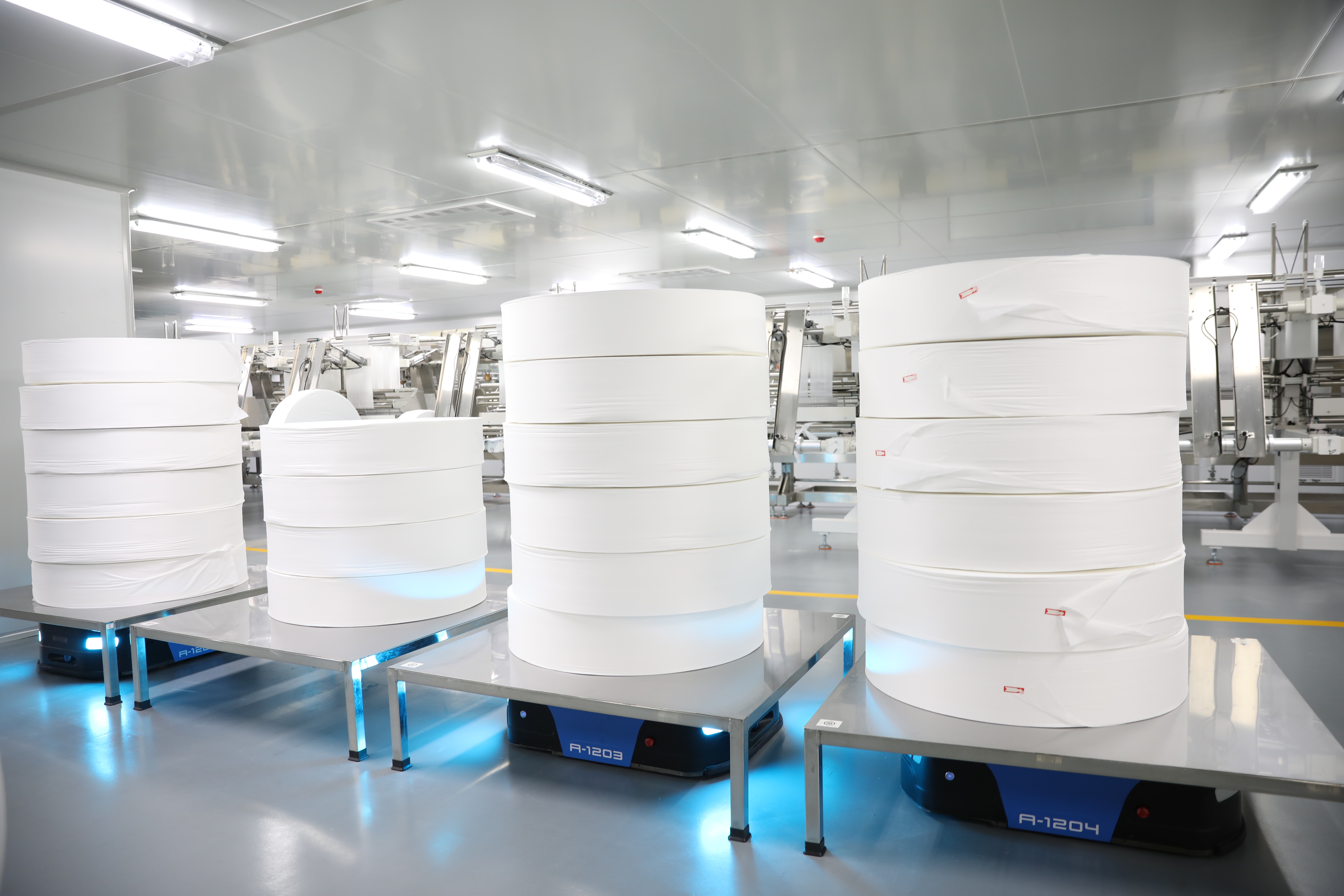
Automated, vertically integrated production is the physical basis for a fixed 150,000-piece minimum order quantity and a predictable production window. Image: Uniquality manufacturing environment.
How A 35–45 Day Lead Time Is Actually Built
The 35–45 day window applies after artwork approval and deposit receipt, and it covers the production phase of a confirmed order. It is not a delivery promise measured from the date of enquiry, because material planning cannot begin before both conditions are met.
Inside that window, several operations run in sequence. Raw materials — nonwoven and superabsorbent polymer (SAP) — are planned and staged against the confirmed specification. Core configuration is fixed at this point: for the training pants model YQ004, the product is made from nonwoven and SAP, with core options including 100% woodpulp, a half core, and 100% SAP. Converting then runs on automated lines, after which finished goods pass through inspection and packing before documentation is issued and shipment is arranged.
Microbial control is the constraint that shapes the schedule
Environmental control is not a marketing layer applied at the end of production; it runs through the process. Hygiene standards are applied to raw materials, the production workshop environment is purified, and microbial inspection is strengthened before delivery. The stated product benchmark for total bacteria count is ≤ 100 CFU/g, against ≤ 200 CFU/g for standard products. That gap is the practical difference between a plant that treats contamination as an inspection outcome and one that treats it as a process variable.
Sample retention is what makes the record auditable
Every batch of diapers, wet wipes and dry wipes is archived, tracked and preserved under controlled conditions in a sample retention room, organised by batch. The operational value is retrospective: when a buyer asks what was shipped six months ago, the answer exists as a sealed, documented, traceable physical sample rather than a reconstructed file. Combined with batch traceability across fully automated production, this converts quality from a one-time check into a record that outlasts the order.
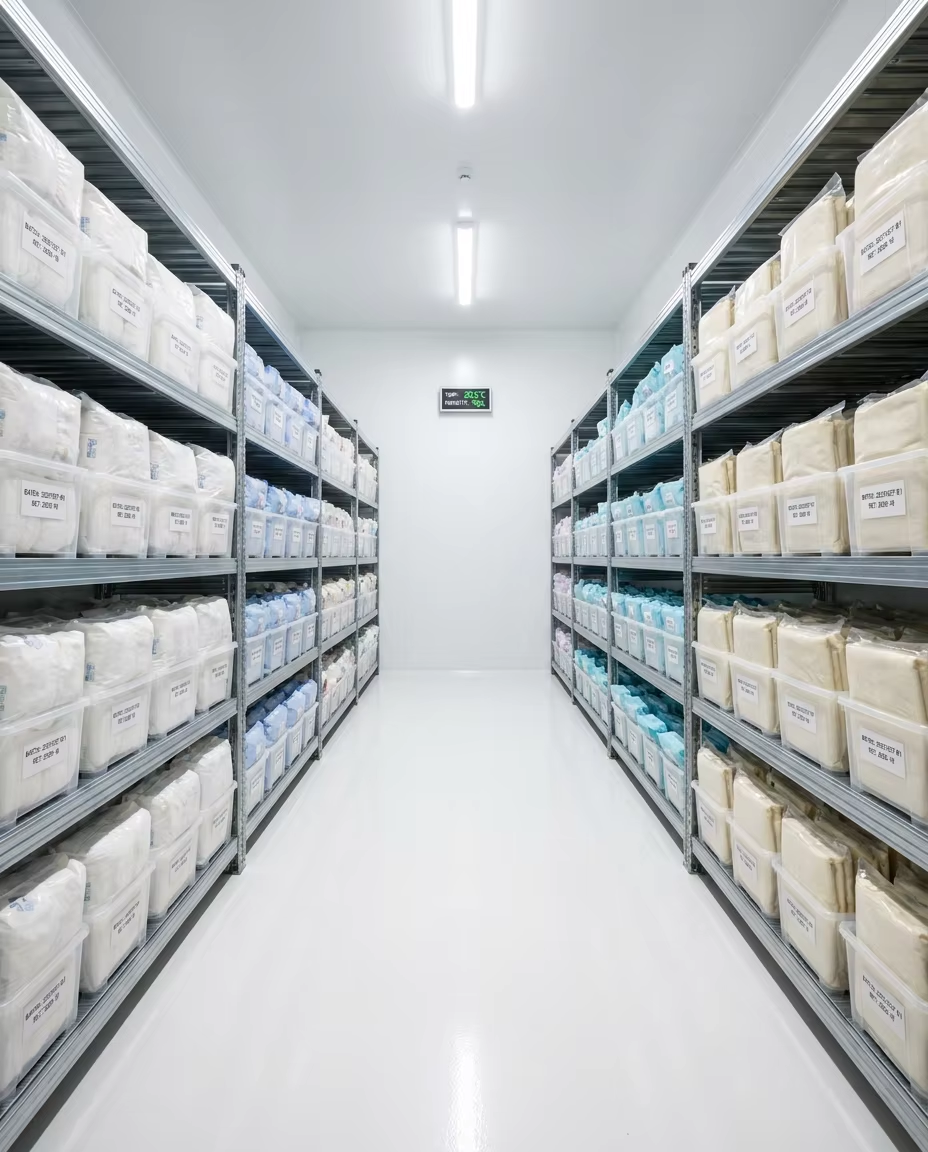
Batch-level sample retention: finished-goods samples archived by production batch allow buyers to verify historical shipments years after delivery. Image: Uniquality sample retention room.
Delivery reliability is the outcome metric attached to this process. The stated on-time delivery rate is 99.5%, which is the number buyers should test against in a trial order before scaling volume.
Application Fit: Where These Checkpoints Matter Most
The capability profile is designed around baby care, sensitive skin use and premium export markets. Training pants are built for single-use, disposable operation, absorbing urine to keep skin dry while providing leak-proof protection — a specification set that matters most in programmes where a leak or a skin reaction creates return costs rather than just complaints.
- Baby and toddler care programmes: leak-proof, single-use training pants positioned for daily wear and skin-friendly use.
- Sensitive-skin lines: buyers targeting dermatologically cautious consumers should confirm material and core options at the 3–5 day sampling stage.
- Premium export programmes: with roughly 70% of output exported to the USA, EU, SAM, RU and CASA markets, documentation and packaging formats are typically specified per destination.
- Size-specific briefs: buyers requesting toddler or XL-size training pants should lock core configuration and sizing at sampling, because core options change absorbency behaviour and, in turn, the fit tolerance.
- Traceability-driven buyers: distributors and private-label owners who must answer end-customer quality queries benefit directly from batch retention and COA documentation.
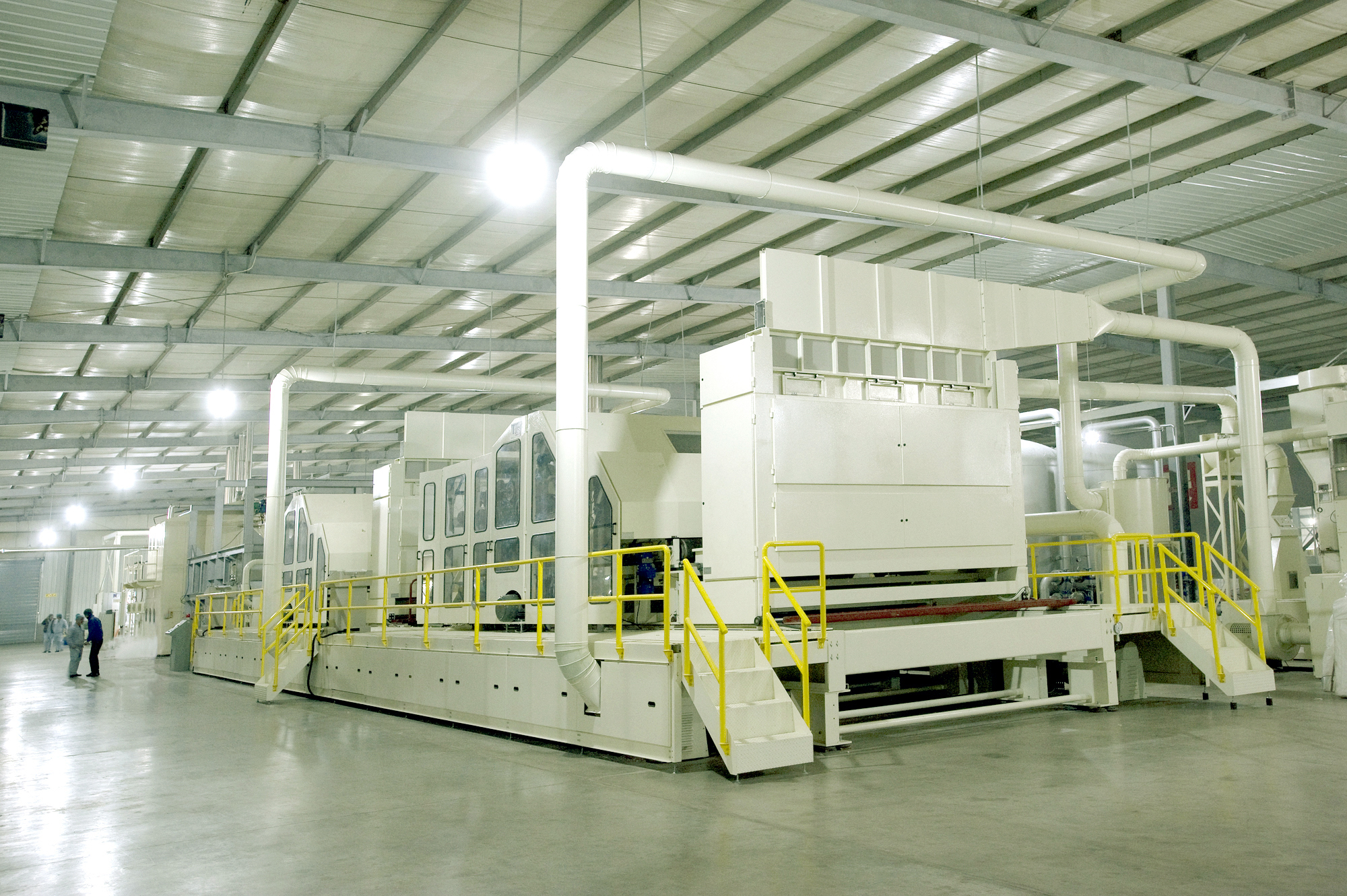
Production inside a 100,000-class clean room underpins the stated microbial benchmark of ≤ 100 CFU/g total bacteria count. Image: Uniquality clean room line.
Market Trend Evidence
Pants-type absorbent products are the growth segment inside the broader diaper category, which makes supplier capability in training pants a category decision rather than a line-level one.
- Grand View Research forecasts the global baby training pants market to reach USD 7.02 billion by 2030, growing at a CAGR of 7.5% from 2025 to 2030 — a commercial research forecast best used as directional context rather than a fixed planning figure.
- The global baby diaper market is expected to reach USD 66.3 billion in 2025, indicating the scale of the parent category within which training pants sit.
- In Japan, pants-type diapers account for more than 70% of total diaper sales — a mature-market signal that training and pull-up formats can dominate once consumer preference shifts.
- Disposable training pants and baby diapers are primarily classified under HS Code 9619.00, which is the classification buyers and freight partners should reconcile for customs and duty planning.
- ISO 11948-1 specifies the method for determining total absorption capacity of urine-absorbing aids, providing a neutral test reference that sits outside any supplier own claim.
Read together, these signals point the same way: demand is stable-to-growing, pants formats are gaining share, and compliant absorbency performance is increasingly discussed in standards language. Suppliers who can quote a fixed MOQ, a defined lead time and a documented inspection regime are easier to plan around in that environment than suppliers who quote on flexibility alone.
Comparison With Small Non-Integrated OEM Converters
The most common alternative to an integrated manufacturer is a small OEM converter that buys converted materials and assembles finished packs. Both models can deliver a working product; they differ in where the risk sits.
| Comparison dimension | Integrated manufacturer profile | Small non-integrated OEM converter |
|---|---|---|
| Material integration | Full vertical integration across the production chain | Purchases converted materials from external suppliers |
| Production environment | 100,000-class GMP clean room with pharma-grade purified water in the process | Standard workshop environment, environmental control varies by site |
| Microbial benchmark | ≤ 100 CFU/g total bacteria count | ≤ 200 CFU/g is the reference point for standard products |
| Cost structure | Stated 8–15% lower raw material cost and 10% lower energy consumption | Higher variable cost per unit at similar specification |
| Delivery reliability | Stated 99.5% on-time delivery rate | Wide variation; dependent on third-party material availability |
| Traceability | Batch traceability plus a physical sample retention room | Documentation depth varies; physical retention is uncommon |
Where this model does not fit
- The 150,000-piece MOQ is a real barrier. Buyers running pilot orders, test markets or niche SKUs below that threshold will usually need to consolidate SKUs, accept different commercial terms, or source from smaller converters.
- The upfront cost is slightly higher. The company positions this as a trade-off against a lower risk of recalls and returns — a calculation that only works if the buyer values avoided return cost over the lowest achievable unit price.
- The lead time is conditional, not absolute. Because the 35–45 day window starts at artwork approval and deposit, a slow artwork cycle becomes a slow delivery, even if production runs perfectly.
- Certification claims require verification. ISO, CE, GMPC and FSC should be confirmed against certificate scope, issuing body and validity rather than accepted as labels.
- One supplier is not the right fit for every programme. Highly bespoke pack formats or very small batch requirements may be better served by specialised converters, even at a higher unit cost.
A Decision Framework For Weighing These Checkpoints
For buyers converting this profile into a procurement decision, the sequence below keeps the evaluation evidence-based rather than impression-based.
- Test volume against MOQ. Confirm whether the 150,000-piece threshold applies per order or per SKU, and whether your programme can reach it in one release.
- Map artwork readiness to lead time. Fix an artwork approval date before requesting a delivery commitment, since the 35–45 day clock depends on it.
- Request COA and AQL plans in writing before the purchase order, and confirm which party defines the acceptance sampling plan.
- Confirm laboratory test scope for the specific SKU — in-house testing capability exists, but the applicable tests still need to be agreed per project.
- Clarify sample retention arrangements, including retention period, storage conditions and how a buyer can request a retained sample.
- Define after-sales terms — claims window, replacement or rework path, and who bears freight on defective lots.
- Audit certification scope, not logos, and align the product to a neutral benchmark such as ISO 11948-1 for absorption where the destination market expects it.
Future Outlook
Three shifts are likely to shape training pants sourcing over the next several years. First, as pants-type formats take a larger share of absorbent hygiene demand, capacity for pull-up style converting becomes the constraint that determines who can accept large orders on short notice. Second, documentation is moving from a differentiator to a baseline: COA, batch traceability and retained samples are increasingly requested as standard attachments to a purchase order rather than as special concessions. Third, buyers are becoming more disciplined about separating verification from assurance — asking for certificate scope, test methods and delivery history rather than accepting category language.
For manufacturers, that means the competitive variable is no longer only price per piece. It is the ability to state an MOQ, a lead time and an inspection regime that survive scrutiny when a buyer checks them against a first order.
FAQ
What is the minimum order quantity for baby diapers and pull-ups?
The stated minimum order quantity is 150,000 pieces for baby diapers and pull-ups. Buyers planning volumes below that threshold typically need to consolidate SKUs into a single release or negotiate alternative commercial terms, and should confirm whether the threshold applies per order or per individual SKU.
How long is the production lead time after an order is confirmed?
Production lead time is 35–45 days after artwork approval and deposit receipt. Both conditions start the clock, so the delivery date is directly affected by how quickly packaging artwork is finalised and signed off. Time spent before artwork approval is not included in the window.
Does the supplier offer OEM and ODM programmes?
Yes. Private-label, OEM and ODM programmes are supported, with sampling typically completed in 3–5 days. The training pants model YQ004 is made from nonwoven and SAP, with core options that include 100% woodpulp, a half core and 100% SAP, allowing buyers to align absorbency behaviour with their target positioning.
What quality documentation can a buyer expect per order?
Documentation includes a Certificate of Analysis issued against the batch, AQL sampling inspection results on finished lots, and in-house laboratory testing data covering performance and quality verification. Finished-goods samples from every batch are retained under controlled conditions and organised by batch, which allows retrospective verification of a past shipment.
How is microbial safety controlled during production?
Control operates on three levels: hygiene standards applied to incoming raw materials, purification of the production workshop environment, and strengthened microbial inspection before delivery. The stated product benchmark is ≤ 100 CFU/g total bacteria count, compared with ≤ 200 CFU/g for standard products. Production takes place in a 100,000-class clean room.
Which certifications does the company state, and how should buyers treat them?
The stated certification set is ISO, CE, GMPC and FSC. These are company-stated credentials, so buyers should verify certificate scope, issuing body, validity period and whether the specific SKU and production site are covered, rather than treating a certification logo as sufficient evidence on its own.
Which markets does the supplier serve?
Approximately 70% of output is exported, with stated main markets covering the United States, the European Union, South America, Russia and the CASA region. The company reports serving brand owners in more than 80 countries. Export destinations determine packaging, labelling and documentation requirements, which are normally specified per project.
What are the main limitations of this capability model?
Three constraints stand out. The 150,000-piece minimum order quantity excludes very small pilot or niche orders. The upfront cost is slightly higher than the lowest-priced alternatives, offset by a stated lower risk of recalls and returns. The 35–45 day lead time is conditional on artwork approval and deposit, so it cannot be treated as a fixed date measured from first enquiry.
A full capability overview, including product scope and manufacturing profile, is available in the Uniquality company brochure: company capability brochure (PDF).