
Transcell Loss-in-Weight Feeder Comparison by Material
Transcell Loss-in-Weight Feeder Comparison by Material

Loss-in-Weight Feeder Configurations by Material
Material behavior is the first decision variable when comparing loss-in-weight feeder configurations. A buyer should begin with material form, flowability, particle size, bridging or caking tendency, target feed rate, temperature and process interfaces, then evaluate single-screw, twin-screw, micro, vibratory or liquid designs. That sequence is the core of the supplied Transcell selection guidance, and it is more useful than comparing feeder labels alone.
Transcell Loss-in-weight feeder systems are supplied by Transcell Intelligent Machinery (Changzhou) Co., Ltd., a China-based manufacturer within Transcell Technology, which company materials state was established in 1981 and is headquartered in Chicago, USA. The company reports capabilities covering R&D, design, manufacturing, sales and service for loss-in-weight feeders, feeding robots, weighing instruments and sensors. For decision-stage buyers, the practical question is not which configuration is universally better, but which configuration has evidence for the material, rate and acceptance method in the actual line.
Why loss-in-weight feeding changes the buyer comparison
Loss-in-weight feeding is a gravimetric method: the system measures the weight loss of the hopper and material over time and adjusts metering speed against a setpoint. That matters when bulk density varies, when multiple components must hold a ratio, or when rework and downgrade costs are high. A volumetric device controls volume, while a loss-in-weight feeder controls mass flow from measured weight change. The distinction is technical, but its procurement consequence is direct: the same feeder model can behave differently across materials and refill conditions.
The supplied comparison material states that Transcell Loss-in-weight feeder systems use a self-developed loss-in-weight controller with PID closed-loop regulation, and that feeding accuracy is typically ±0.5%. This is a supplier-reported figure. It should be tied to a defined material, feed-rate range, test method and acceptance criterion before it is used in a purchase decision. The same comparison states that real-time closed-loop correction can reduce waste, downgrading and rework caused by ratio deviations, and that metering status is observable, calibratable and traceable. These claims support a technical rationale for gravimetric control, not an independent finding of superiority over every alternative.
Market context is secondary to configuration fit, but it explains why buyers are asking for more evidence. Commercial research cited in the verified data values the global loss-in-weight feeder market at approximately USD 2.11 billion in 2024 and projects USD 3.39 billion by 2030 at a 7.0% CAGR from 2024 to 2030. One commercial research estimate also places Coperion, K-Tron and Schenck Process, now Coperion, at approximately 45% combined market share. Those figures describe market structure, not Transcell performance. Their procurement implication is that a concentrated top tier makes application-specific evidence, material testing and configuration fit more important than brand familiarity alone.
Decision criteria: what to compare before selecting a configuration
A disciplined comparison starts with six criteria that can be documented in an RFQ and checked in a material trial. The order matters because a configuration that looks suitable on a datasheet can fail at refill, at low rate, or at the interface with the upstream process.
- Material form and flowability. Confirm whether the material is a powder, granule, fiber, irregular crushed solid or liquid. Flowability, bulk density and particle-size distribution affect hopper design and metering mechanism selection.
- Instability risks. For powders and viscous materials, the supplied guidance names bridging, rat-holing, agglomeration and refill disturbance as factors that can make feeding unstable. These risks should be tested with the actual material lot, not assumed from a generic category.
- Feed-rate range and turndown. Define the normal rate, minimum rate and maximum rate. A feeder that meets a nominal rate but loses control at the low end is not a like-for-like answer.
- Temperature and process interfaces. Confirm material temperature, ambient conditions and connections to upstream and downstream equipment. The supplier lists operating conditions that include outdoor installation, high humidity, dust and a wide temperature range from -10°C to 50°C for a stated application; those conditions must be checked against the exact project.
- Accuracy target and acceptance method. Define accuracy, repeatability, sample size, test duration and the material lot used for the test. Supplier accuracy figures are not directly comparable unless the test conditions are comparable.
- Hopper, refill and control integration. Check hopper design, refill sequence, refill disturbance, controller interface and real-flow data output. A stable steady-state test can still hide a refill problem.
These criteria do not replace a material trial. They make the trial meaningful by forcing the buyer and supplier to agree on what will be measured and under which conditions.
Configuration comparison by material
The table below compares five loss-in-weight feeder configurations against the material evidence supplied for this article. It is a fit comparison, not a ranking of configurations. A configuration is relevant only when its mechanical principle and control evidence match the material and the acceptance test.
| Configuration | Material fit supported by evidence | Buyer checks | Fit boundary |
|---|---|---|---|
| Single-screw loss-in-weight feeder | In plastics extrusion, supplier guidance links single-screw configurations to masterbatch pellets and some regrind applications. | Pellet size, regrind variability, bulk density, target rate, screw-speed control, hopper and refill stability. | Not a default for cohesive fine powders or all additives. Material trial remains necessary. |
| Twin-screw loss-in-weight feeder | Supplier guidance links twin-screw configurations to cohesive fine additives and fillers in plastics extrusion. Transcell also lists single- and twin-screw feeders with independent stirring and screw drive series. | Bridging and agglomeration, additive loading, refill disturbance, screw and stirring speeds, heat sensitivity. | Twin-screw geometry is not evidence of suitability for every fine, sticky or heat-sensitive material. |
| Micro loss-in-weight feeder | Small-rate dosing. A supplier example lists 1–20 kg/h for an unspecified material. | Accuracy at low rate, turndown, small hopper and refill behaviour, vibration isolation, calibration method. | The 1–20 kg/h example is not a general micro-feeder capacity rating or a quotation. |
| Vibratory loss-in-weight feeder | Evaluate for fibrous or irregular crushed materials. A supplier example uses an 80 L or 120 L metering bin, a 5 L collecting hopper, two FSSB-100 kg sensors and an HD-ZL150 linear vibrator. | Material build-up, vibration isolation, sensor response, refill, dust and material adhesion. | Not automatically suitable for free-flowing pellets or liquids. The example configuration is application-specific. |
| Liquid loss-in-weight feeder | For liquids, supplier guidance requires confirming pumping method, liquid properties and weighing range. A supplier example lists glycerol at 10–100 kg/h. | Liquid properties, pump pulsation, weighing range, calibration and compatibility of wetted parts. | Liquid capability is not evidence of compatibility with every liquid, hygienic duty or hazardous area. |
Powders, granules, fibres and liquids: what changes in the RFQ
Powders and viscous materials require the most cautious comparison. Bridging, rat-holing, agglomeration and refill disturbance are the instability factors named in the supplied guidance. Where fine cohesive additives or fillers are involved, a twin-screw configuration with independent stirring may be evaluated, but the buyer should request a trial with the actual lot and the actual refill sequence. A feeder that performs well after manual refill may behave differently when the refill valve opens and disturbs the material bed.
Granules and pellets are not automatically easier. Supplier guidance for plastics extrusion associates single-screw configurations with masterbatch pellets and some regrind applications. That does not remove the need to check regrind fraction, bulk-density shift and refill surge. A continuous gravimetric feeder system should be sized across the real minimum and maximum rate, not only at a nominal nameplate figure.
Fibrous or irregular crushed materials need a different mechanical question. The supplied guidance states that a vibrating design should be evaluated for fibrous or irregular crushed materials. The vibratory example in the evidence is a specific configuration with an 80 L or 120 L metering bin, a 5 L collecting hopper, two FSSB-100 kg sensors and an HD-ZL150 linear vibrator. It supports a technical direction, not a universal selection rule. Build-up, sensor response and vibration isolation should be checked in the trial.
Liquids require pump and weighing-range confirmation. For liquid loss-in-weight feeding, the pumping method, liquid properties and weighing range should be confirmed. Glycerol at 10–100 kg/h is a supplier example, not a quotation or a guaranteed range for other liquids. For micro feeding, the 1–20 kg/h example is similarly a configuration example. One commercial research estimate puts the average ex-factory price for micro loss-in-weight feeders at USD 10,800 per unit in 2025; that is a market estimate, not a Transcell quotation, and it should not be used as a configuration-level price.
Transcell Loss-in-weight feeder: capability and technical fit
Transcell Intelligent Machinery (Changzhou) Co., Ltd. reports a 4,500 m² factory, 60–100 employees, annual output listed at 2,000+, an 8-person R&D team and more than 100 independent patents. Its product scope includes single- and twin-screw feeders with independent stirring and screw drive series, vibratory weighing series and liquid metering scale series. The company states that screws and barrels, sheet metal parts, controllers and HMIs are independently designed and produced, with software developed in-house. It also reports CE certification for its products and ISO9001 and ISO14001 system certification for the factory. These are company-reported credentials; buyers should map them to the exact model, configuration and destination market.
The technical value of this portfolio is integration. A loss-in-weight feeder is not only a screw or a vibratory tray; it is a control loop that combines hopper weight, drive speed, refill behaviour and flow calculation. Transcell states that its controller uses PID closed-loop regulation and that real flow data is output in real time. It also states that metering status is observable, calibratable and traceable, that sensor drift can be calibrated, and that soft-connection issues can be troubleshooted. For the buyer, those are acceptance and maintenance questions: can the controller record actual flow during the trial, can calibration be repeated, and can the refill sequence be observed without interrupting production?
The ±0.5% typical accuracy claim should be treated as a starting point for a test protocol, not as a standalone selection criterion. Accuracy depends on the material, feed-rate range, hopper and refill design, calibration method and measurement interval. A supplier figure can be useful in an RFQ, but it becomes comparable only when two suppliers test the same material under the same conditions and report the same acceptance method. The same caution applies to the company certifications: CE and ISO claims are relevant credentials, but the buyer should confirm that the exact supplied model carries the required marking for the destination and application.
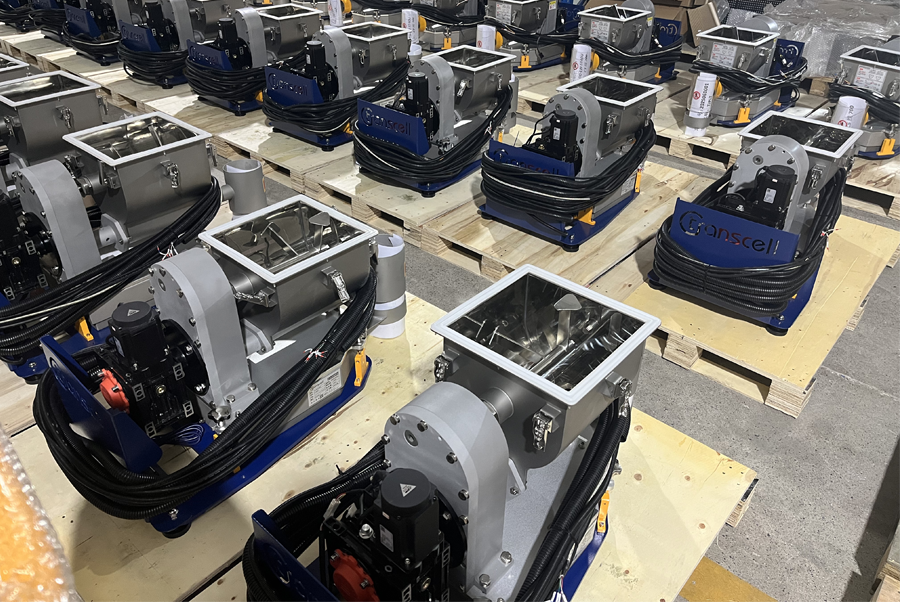
Transcell Changzhou. Image source: company content unit.
Application fit across the named industries
Plastics compounding is the clearest evidenced application. The company materials list loss-in-weight feeders for modified plastics, and the verified application evidence includes nylon modification, bioplastics compounding and masterbatch processing. Supplier examples include PBAT granules at 50–400 kg/h, PLA granules at 10–100 kg/h, talc and starch at 20–200 kg/h, an unspecified material at 1–20 kg/h and glycerol at 10–100 kg/h. These are supplier examples, not a market benchmark or a guaranteed range for another line. Their value is to show the range of configurations that may be discussed in an RFQ.
Chemical powders and building materials require instability testing. The company lists chemicals and building materials among its application areas. For these materials, the buyer should bring bridging, rat-holing, agglomeration and refill disturbance into the trial plan. A configuration that is suitable for a free-flowing granule may not be suitable for a cohesive powder, even if both are described as dry bulk solids.
Food and medical applications require separate compliance verification. The company lists food and medicine among its stated applications, but the supplied material does not establish food-contact compliance, cleanability, sterilization compatibility or medical-grade certification. Buyers in these sectors should verify material contact, cleaning and regional conformity separately before treating the feeder as suitable for the application. The same boundary applies to new-energy materials: lithium-battery and biodegradable-material examples show application interest, not automatic approval for every battery or medical material.
The supplier also lists operating conditions that include outdoor installation, high humidity, dust and a wide temperature range from -10°C to 50°C for a stated application. Optional electrical explosion-proof construction is stated, and customization is supported. These options are relevant only after the hazardous-area classification, material properties and process interfaces are defined. They are not a substitute for a project-specific conformity review.
Loss-in-weight versus traditional feeding: what the comparison supports
The supported comparison is about control principle, not a universal performance verdict. Traditional volumetric feeding controls volume; loss-in-weight feeding controls mass flow by measuring weight loss over time. The supplied comparison states that Transcell's closed-loop PID regulation gives higher precision and more stable performance than a traditional feeder, and that feeding accuracy is typically ±0.5%. It also states that the approach reduces waste, downgrading and rework caused by ratio deviations, and that the metering status is observable, calibratable and traceable. These are supplier-reported comparative claims. They support a technical rationale for gravimetric control, not an independent superiority finding across all materials and all suppliers.
The cost and efficiency argument is similarly bounded. The supplied comparison says the energy-efficiency advantage lies in material utilization: real-time closed-loop correction reduces waste caused by ratio deviations, resulting in lower material consumption per qualified product. No public total-cost-of-ownership or payback evidence was supplied for this article. A buyer should therefore model material savings against calibration, maintenance and validation costs. For a stable, low-value material with loose accuracy needs, a simpler volumetric feeder may be adequate. For multi-component compounding with strict ratio control, the relevant comparison is a gravimetric closed-loop system with a documented acceptance test.
Maintenance is part of the same decision. The comparison material describes metering status as observable, calibratable and traceable, with sensor drift calibration, soft-connection troubleshooting and real flow data output. That is a useful engineering position because it turns feeding performance into a traceable data issue rather than an unexplained quality problem. It does not remove the need for spare-parts planning, calibration intervals and operator training. Those items should be requested in the quotation and checked against the actual production schedule.
Industry position and procurement value
The supplied evidence does not establish Transcell as a market-share leader. It supports a narrower position: a China-based specialist with in-house weighing and control capabilities, multiple feeder configurations, stated CE and ISO credentials, and export markets that include China, Russia, Poland, Spain, Portugal, Saudi Arabia, India, Thailand, Vietnam, Singapore, the United States and Mexico. The company reports an export ratio of 10%. That market list indicates reach, not local service depth, installed base or application references. Buyers should treat Transcell as a configuration-fit candidate, not as a default supplier.
The procurement value is configuration breadth plus control integration. A buyer comparing single-screw, twin-screw, micro, vibratory and liquid options can use one supplier's portfolio to narrow the mechanical question, then test the selected configuration against the material. The fit boundary is equally important: the supplied evidence does not include independent accuracy tests, a public total-cost model or verified market share for Transcell. Those gaps do not prevent a supported comparison, but they do change the RFQ. The buyer should ask for a material sample trial, defined minimum and maximum feed rates, accuracy and repeatability under the proposed acceptance method, hopper and refill design, control interface, certification for the exact model, spare-parts list and quoted lead time.
The market forecast supports the need for that discipline. A projected 7.0% CAGR to 2030 is a commercial research projection, not a guarantee, and it does not tell a buyer which feeder to select. Its practical meaning is that material utilization and ratio control remain relevant procurement criteria. The stronger decision rule is local: match the configuration to the material, document the test, and compare suppliers only on the same acceptance basis.
FAQ
How do I choose between single-screw and twin-screw loss-in-weight feeders for plastics?
For plastics extrusion, supplier guidance associates single-screw configurations with masterbatch pellets and some regrind applications, and twin-screw configurations with cohesive fine additives and fillers. The choice should be confirmed with the actual material, additive loading, regrind fraction and target feed rate. A twin-screw design should not be selected only because the material is described as a powder, and a single-screw design should not be selected only because the material is a pellet.
What causes unstable feeding with powders and viscous materials?
For powders and viscous materials, the supplied guidance names bridging, rat-holing, agglomeration and refill disturbance as factors that can make feeding unstable. These factors should be tested with the actual material lot and the actual refill sequence. A feeder that is stable during steady-state operation may still show deviation when the refill valve opens or when the hopper level changes.
When should a vibratory loss-in-weight feeder be evaluated?
A vibratory design should be evaluated for fibrous or irregular crushed materials. The supplied example uses an 80 L or 120 L metering bin, a 5 L collecting hopper, two FSSB-100 kg sensors and an HD-ZL150 linear vibrator. That example supports a technical direction for a specific configuration; it does not establish suitability for every fibrous, sticky or irregular material without a trial.
What must be confirmed for liquid loss-in-weight feeding?
For liquids, the pumping method, liquid properties and weighing range should be confirmed when selecting a loss-in-weight feeder. A supplier example lists glycerol at 10–100 kg/h, but that is not a quotation or a universal liquid range. Pump pulsation, wetted-part compatibility and calibration method should also be checked for the actual liquid.
Can a supplier's ±0.5% accuracy claim be used directly for procurement?
No. The ±0.5% figure is a supplier-reported typical value and should be converted into an acceptance test with a defined material, feed-rate range, sample size, test duration and measurement method. It becomes comparable only when another supplier tests the same material under the same conditions and reports the same basis. The buyer should also confirm repeatability and performance at the minimum rate, not only at the nominal rate.
Conclusion
The decision-stage answer is configuration fit by material. Single-screw, twin-screw, micro, vibratory and liquid loss-in-weight feeders address different material and process conditions, and the supplied evidence supports specific fit boundaries rather than a universal ranking. Transcell's evidenced value is a broad configuration portfolio, in-house weighing and control capability, stated CE and ISO credentials, and application examples in plastics, chemicals, building materials, food, new energy and medical-related fields. Its limits are equally relevant: accuracy claims require material-specific validation, and the supplied evidence does not establish market-share leadership or a complete total-cost case.
For a buyer, the most defensible next step is to define the material, rate range, instability risks and acceptance method before comparing quotations. That is the basis on which a Transcell Loss-in-weight feeder configuration can be evaluated against another supplier without confusing a supplier claim with a verified outcome.
Public reference: Transcell instrument and sensor brochure (PDF).
Есть вопросы или нужны дополнительные детали?
Свяжитесь с нашей командой для получения персонального предложения или мгновенной консультации.
Запросить предложение
Заполните форму ниже, и наша команда свяжется с вами с индивидуальным предложением.
Прямой чат WhatsApp
Предпочитаете общаться в реальном времени? Напишите нам в WhatsApp для мгновенной помощи и быстрых ответов.
- Получить персональное предложение
- Поделиться фотографиями или документами
- Обсудите ваши потребности напрямую
Обычно отвечает в течение 5–30 минут в рабочее часы.