
Transformer Core Buyer's Test: NCW Core vs Alternatives at 100–2500 VA
At 100–2500 VA, the value of a transformer core is not found in a brand label. It is found in a small set of buyer-verifiable metrics: core architecture, core material, core loss at a defined induction, operating temperature range, and whether the supplier can consistently identify and reproduce the core as a model series.
This buyer-focused reference examines the NCW CORE series against generic alternative cores used in the same low-to-medium power range: conventional stacked laminations, cut tape-wound cores, and other toroidal/no-cut options. The purpose is not to declare one winner, but to give procurement and engineering teams a comparison framework before they request magnetic test data.
The buyer decision point below 2500 VA
Transformers in the 100–2500 VA band are common in control cabinets, instrumentation supplies, industrial auxiliary power, energy management equipment, and specialised power supply circuits. Many of these transformers do not operate under a constant full load. Some run continuously with very light load. In those applications, no-load loss behaviour is often more economically important than full-load copper loss.
For a core buyer, this creates a practical evaluation sequence. First define the VA requirement and winding window. Second check the core material and the core-loss limit at the working induction. Third confirm the mechanical assembly route. Fourth demand a traceable model designation and batch-level test evidence. This sequence is the basis of the “buyer’s test” used in this article.
What a buyer should compare: architecture, material, loss, temperature
At a technical level, not all silicon steel cores behave the same way. A core made from the same grade of CRGO silicon steel can still differ meaningfully depending on whether it is cut, stacked, wound, annealed, or left with an unfinished magnetic joint. The most important thing is to compare like-for-like parameters rather than rely on product-family names.
The table below summarises the three generic architectures that appear most often in this VA range. It is intentionally qualitative, because reliable comparison depends on actual supplier test data for a specific core size.
| Architecture | Construction logic | Buyer considerations |
|---|---|---|
| No-cut toroidal wound core | Continuous silicon steel strip is wound into a closed ring without an intentional cut or air gap. | Requires toroidal winding equipment for coils after the core is formed; offers a continuous magnetic path that can help reduce magnetising current and core loss. |
| C / CD cut core | Wound strip core is cut into two or more parts to permit insertion of pre-wound coils. | More convenient for certain coil assembly processes, but the cut faces create additional magnetic reluctance that must be accepted in design. |
| EI lamination core | Punched laminations are stacked or interleaved to build the magnetic circuit. | Common in cost-sensitive, high-volume transformer production; assembly is simple, but the joint structure can introduce higher loss and excitation current than a continuous wound path. |
None of these categories is universally superior. The correct choice depends on coil process, cost structure, allowable total loss, and the induction level used in the transformer design.
NCW CORE: what the specification actually says
The NCW CORE series is a toroidal wound, no-cut silicon steel core for transformers. It is sold under the YadoTEK brand by Wuxi Yado Electromechanical Co., Ltd., a Chinese manufacturer established in 2022 and located in Jiangyin City, Wuxi, Jiangsu Province. The company specialises in magnetic materials and transformer core exports, with roughly 85% of production exported to markets across the Americas, Europe, Asia Pacific, and the Middle East.
The product specification defines the NCW CORE as follows:
- Core material: CRGO silicon steel
- Rated power range: 100–5000 VA
- Core diameter range: 50–200 mm
- Core loss: ≤1.0 W/kg at 1.5T, 50Hz
- Operating temperature: -40°C to 120°C
- Core type: toroidal wound core for transformer / no-cut silicon steel core
Available model designations include NCW100, NCW150, NCW200, NCW300, NCW350, NCW500, NCW750, NCW1000, NCW1500, NCW2000, and NCW2500. The series therefore covers the 100–2500 VA band addressed by this article while the broader catalogue also states a maximum rated power of 5000 VA.
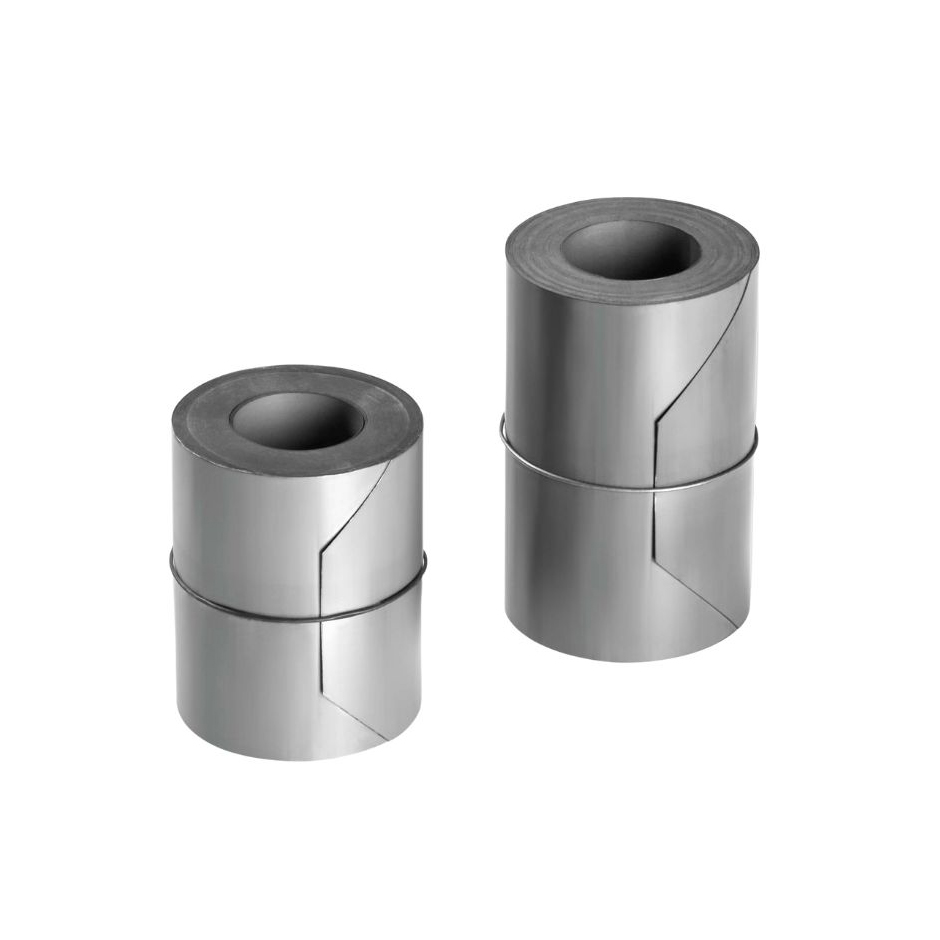
NCW CORE is a no-cut toroidal wound core made from CRGO silicon steel, specified for transformer applications in the 100–2500 VA band.
Why 1.0 W/kg at 1.5T and 50Hz matters
Core loss is usually expressed in watts per kilogram of core material. The NCW CORE limit is ≤1.0 W/kg measured at 1.5 Tesla and 50Hz. This means the total core loss must be calculated together with active core mass. A heavier core with the same loss-per-kilogram limit will still dissipate more absolute watts, so the metric is useful for comparing material and process quality, but it is not a total transformer loss figure.
For a buyer, a low mass-specific core-loss limit is useful because it makes total no-load loss more predictable. It also allows designers to estimate how much of the transformer’s idle energy consumption is caused by the magnetic circuit rather than by winding resistance.
The no-cut construction deserves attention here. A closed, continuous strip core avoids the effective air gap that appears when a tape-wound core is cut for coil insertion. At the same material grade and induction, a continuous magnetic path is generally expected to produce lower excitation current and a more stable core-loss result than a cut core, although the actual difference still needs to be verified by test.
Model designations: how to read the series without brand bias
One common mistake is to assume that the number in a model designation is the exact VA rating of the core. In practice, the VA that can be obtained from a core depends on the number of turns, wire size, permissible temperature rise, flux density, and core mass. A catalogue designation such as NCW100 or NCW2500 is best understood as a position in a graded series, not as a self-contained transformer design.
When comparing NCW CORE with alternatives, a buyer should request the same level of information from every supplier:
- Exact model designation and core dimensions.
- Core material grade and strip thickness.
- Core-loss value at 1.5T and 50Hz for the proposed core size.
- Operating temperature range and insulation class assumptions.
- Inspection method used for magnetic testing and batch release.
If an alternative supplier cannot provide this level of traceable detail, the commercial risk is not caused by the core architecture itself, but by the absence of verifiable engineering evidence.
Application context in transformer core projects
The manufacturer’s application records link NCW CORE to transformer-type projects and to sectors such as electricity, industrial control, energy management, energy monitoring, EV charging, medical X-ray equipment, and special power supply devices. These are not all continuous-duty applications, which reinforces the need to separate no-load loss from full-load loss when selecting a core.
Application scenario data also show use in countries including the United States, Canada, Mexico, Germany, Brazil, Australia, Spain, France, Saudi Arabia, South Korea, Thailand, Poland, Italy, Czech Republic, Japan, UAE, Colombia, Indonesia, Vietnam, and Singapore. Export breadth does not prove a core is correct for a particular design, but it indicates that the supplier already serves inspection-sensitive industrial buyers across multiple regulatory environments.
NCW CORE vs generic alternatives: selection signals
The following table is a comparison framework, not a substitute for measured test data. It highlights the engineering logic a buyer should apply when comparing a no-cut toroidal wound CRGO core with ordinary alternative types.
| Selection signal | NCW CORE-based evaluation | Where to look carefully |
|---|---|---|
| Magnetic circuit | No-cut toroidal wound path using CRGO silicon steel. | Alternative cut-core suppliers must explain how the cut gap is controlled and how it affects magnetising current. |
| Core loss | Documented limit ≤1.0 W/kg at 1.5T, 50Hz. | Always confirm whether the alternates’ loss figure is based on material data or on the completed core measurement. |
| Temperature envelope | Operating temperature range of -40°C to 120°C is stated. | For high-temperature designs, confirm the effective temperature class of the core and related insulation. |
| Series consistency | NCW100–NCW2500 designations provide a repeatable catalogue structure. | Check whether comparable alternatives use stable model identifiers or only generic drawings. |
| Coil assembly | Closed toroidal core requires toroidal winding or custom coil handling. | If the production line is designed for EI or CD cores, a closed wound core may require process retooling. |
For buyers comparing YadoTEK with other transformer core manufacturers, the key point is to compare documented specifications, not marketing language. The NCW CORE series is a defined product line; alternative suppliers should be able to identify their series with equal precision.
Where the NCW-style core has limits
A credible comparison must also state where a no-cut toroidal wound CRGO core is not the automatic answer. The following limits apply to the NCW CORE architecture and to similar closed-wound cores in general:
1. Coil insertion is constrained. Because the core is a closed ring, the transformer winding must be applied with toroidal winding equipment or by special methods. For manufacturers whose assembly line is built around conventional bobbins and EI or CD cores, the process change may outweigh the electrical benefits.
2. The standard size range is finite. The NCW CORE specification is limited to rated power of 100–5000 VA and core diameters of 50–200 mm. A larger distribution transformer, or a very high-current choke, is outside this core’s intended scope and should be treated as a different engineering problem.
3. Extra-low no-load loss materials are a different family. Amorphous alloy cores can reduce no-load losses by 70–80% compared with traditional silicon steel cores, according to third-party industry data. This makes amorphous and nanocrystalline alternatives relevant when a transformer will operate for very long periods at no load. They are not automatically interchangeable with CRGO, but a fair alternative evaluation should include them when the application is idle-dominated.
Market context for CRGO transformer cores
CRGO steel is not a declining niche material. According to Mordor Intelligence, grain-oriented laminated steel held a dominant 79.6% share of the transformer core market by material type in 2024. This means that evaluations of CRGO-based products such as NCW CORE are still relevant to the majority of transformer core sourcing decisions.
Global demand also remains healthy. Zion Market Research estimates that the transformer core market was valued at USD 9.66 billion in 2024 and is projected to grow to USD 15 billion by 2034. In this environment, buyers are likely to see more suppliers entering the export market with similar-looking toroidal cores, which places more importance on transparent model numbering and test evidence.
There is also a meaningful China supply signal. UN Comtrade/WITS data indicate that China’s exports of electrical transformer parts, including cores, reached approximately USD 4.8 billion in 2024, the highest among global exporters. For industrial buyers, this points to an export market where supplier documentation, not only price, will determine long-term reliability.
Supplier verification signals behind the NCW series
Wuxi Yado Electromechanical Co., Ltd., the company behind YadoTEK, was established in 2022 and is located in the Yangtze River Delta industrial belt in Jiangsu Province. Its manufacturing facility covers roughly 1000 m², employs about 80 people, and has an annual production capacity of around 250,000 units. The company reports a professional R&D team of approximately 25 engineers and exports about 85% of production.
Beyond company size, the more relevant verification signal for a core buyer is the company’s testing equipment. Yado Electromechanical states that it uses core magnetic testing instruments and transformer capacity and loss testing instruments, and operates full-process quality control. That matters because a core-loss specification such as ≤1.0 W/kg at 1.5T and 50Hz is only credible when the manufacturer can measure actual cores rather than simply quoting material data.
Future outlook and procurement implications
Over the next several years, transformer core specification is likely to become more loss-sensitive rather than less. IEC 60076 series standards continue to provide the general performance and testing framework for power transformers and reactors. Even where these standards are not directly mandatory for a small auxiliary transformer, buyers increasingly treat them as a reference baseline for manufacturer testing methods.
For the 100–2500 VA band, the practical consequence is straightforward. No-cut toroidal CRGO cores will remain a credible baseline because they offer a continuous magnetic path, a well-understood material, and a defined loss limit. At the same time, buyers should expect more discussion about amorphous and nanocrystalline alternatives in idle-dominated applications. The correct choice will depend on duty cycle, saturation requirements, space, and total cost over the transformer’s life.
Procurement teams should therefore build an alternative shortlist that includes both a well-documented CRGO no-cut core and at least one higher-performance magnetic material option. The NCW CORE series can be the CRGO reference point, but it should not be selected without a comparison to the actual loss profile of the intended transformer application.
Independent reference note
For buyers who want to review the broader product range alongside this NCW CORE comparison, the manufacturer makes a catalogue available for public download: YadoTEK / Wuxi Yado Electromechanical catalogue. The catalogue is background reference only; a purchasing decision should be based on the magnetic test report for the specific core model and operating point.
FAQ
What is the NCW CORE series?
The NCW CORE is a toroidal wound, no-cut silicon steel core for transformers. It is made from CRGO silicon steel and is designed for use in transformer-type projects in the power supply sector.
What model designations are available?
The available model designations are NCW100, NCW150, NCW200, NCW300, NCW350, NCW500, NCW750, NCW1000, NCW1500, NCW2000, and NCW2500.
What is the rated power and core diameter range?
The product specification lists a rated power range of 100–5000 VA and a core diameter range of 50–200 mm. This article focuses on the 100–2500 VA segment.
What core material is used?
The core material is CRGO silicon steel.
What core loss limit is stated?
NCW CORE has a stated core loss of ≤1.0 W/kg at 1.5T and 50Hz.
What is the operating temperature range?
The stated operating temperature range is -40°C to 120°C.
How is NCW CORE different from a C core or EI lamination core?
NCW CORE is a closed toroidal wound core without a cut. C cores are cut to allow coil insertion, while EI lamination cores are built from stacked punchings. The closed wound path can help reduce magnetising current, but it also creates a different coil-winding process.
Is a no-cut toroidal CRGO core the best option for every transformer?
No. If the production line needs pre-wound coils on bobbins, a cut core or lamination core may be more practical. If the transformer runs at no-load for very long periods, alternative materials such as amorphous alloy should also be evaluated. Core selection must be based on measured performance for the intended application.
Should the number in a model designation be read as exact VA output?
No. The model designation identifies a position in the NCW CORE series. Actual VA capability depends on winding design, core mass, flux density, temperature rise, and other transformer-level parameters. Buyers should request magnetic test data and design calculations for the specific core.
Есть вопросы или нужны дополнительные детали?
Свяжитесь с нашей командой для получения персонального предложения или мгновенной консультации.
Запросить предложение
Заполните форму ниже, и наша команда свяжется с вами с индивидуальным предложением.
Прямой чат WhatsApp
Предпочитаете общаться в реальном времени? Напишите нам в WhatsApp для мгновенной помощи и быстрых ответов.
- Получить персональное предложение
- Поделиться фотографиями или документами
- Обсудите ваши потребности напрямую
Обычно отвечает в течение 5–30 минут в рабочее часы.