
Traveling Head Die Cutting: Specs, Certification, Cost
Traveling Head Die Cutting: Specs, Certification and Cost Constraints
A traveling head die cutting machine is a hydraulic press whose cutting head travels horizontally along a fixed working table, so one machine can position the die at many points along the table instead of forcing every cut through a single fixed platen. For buyers in the research and evaluation stage, the deciding question is rarely the headline cutting force. It is whether three things can be fixed before the order is signed: the specification envelope, the compliance file, and the configuration price.
Two machines from Yancheng City Huasen Machinery Co., Ltd — a hydraulic die cutting machine manufacturer based in Yandu District, Yancheng City, Jiangsu Province, China, established in 1999 and exporting roughly 60% of its output to the EU, USA and Asia — show how the same machine family splits into two different purchasing decisions. The HSD-A500A is a 500 kN movable head machine with a 1,800 × 500 mm table and a 550 × 550 mm travel head. The HSD-Q250A is a 250 kN automatic stepping-feed machine with a 2,000 × 500 mm table, a 500 × 500 mm travel head and a servo-driven head traverse. Both are listed as customizable for special specifications.
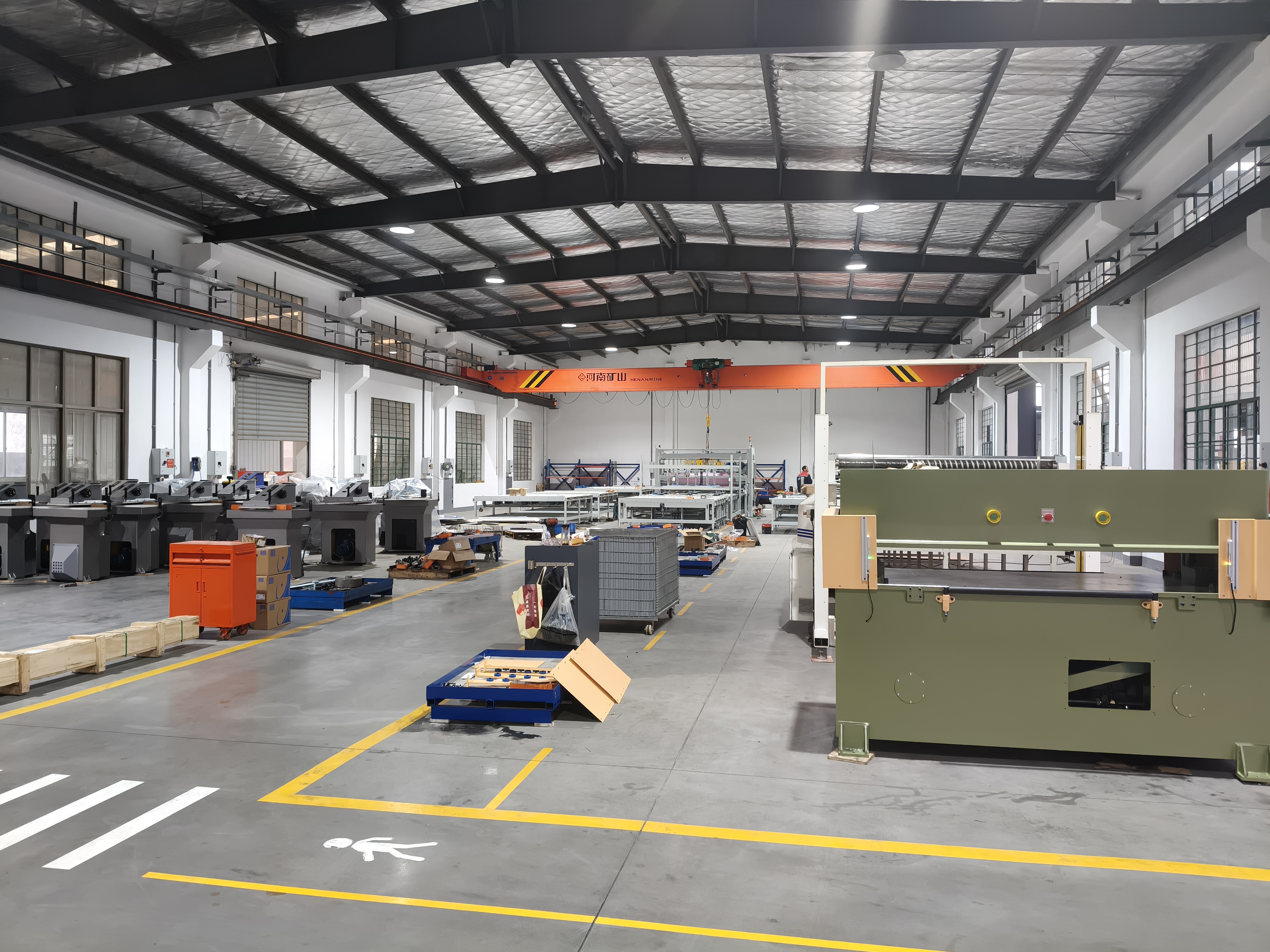
Assembly bay at Huasen Machinery, Yancheng, Jiangsu — hydraulic cutting machines are assembled and tested in-house before dispatch.
Core answer: a traveling head machine is worth shortlisting when the job needs multiple die positions on a long table, but it only performs to expectation when five constraints are specified up front — die height against the 5–150 mm adjustable stroke, table and travel head dimensions against the nesting pattern, sheet versus roll feeding, electrical supply and CE conformity, and the wear items that carry the running cost.
Where traveling head projects usually go wrong
Most disappointment in this machine class traces back to configuration, not to the press itself. The recurring failure points are predictable, and all of them can be closed on paper before a deposit is paid.
Die stack outside the stroke window. Both Nuasen-listed models adjust within 5–150 mm of stroke. A die whose height, plus the compressed material, plus the cutting board falls outside that band turns a specification problem into a re-quotation problem.
Table and head mismatch. A 2,000 × 500 mm table paired with a 500 × 500 mm travel head is a multi-station layout decision. If the nesting plan has not been drawn, the buyer can end up paying for table length that the die layout never uses.
Feeding assumptions. Sheet and roll material do not share the same feeding logic. Huasen states that its equipment is built for both sheet and roll formats, and where a customer runs both, the machine can be designed for the two material types — but this has to be declared at specification stage, not after delivery.
Electrical and site conditions. Installation requirements published for these applications assume reliable grounding, an indoor workshop, a well-lit workplace, and no damp or open-air siting. Voltage is listed as a customization item, which means the supply arrangement must be part of the quotation.
How the traveling head architecture actually works
On the HSD-A500A, the frame is a gantry structure built from profile steel, described as high in strength and resistant to deformation. The cutting head moves horizontally under its own control, which keeps the operator's view of the die area clear and allows the press to work along the table rather than at one fixed point. The hydraulic system is described as low-noise and low-oil-consumption, and the lifting position of the pressing board can be set freely to cut idle travel and raise throughput.
Head traverse on that model uses automatic speed variation, so the head moves quickly between positions and slows into the cut without impact. A differential oil circuit is used to make the cutting stroke rapid and convenient. These are mechanical answers to a production question: how many die positions can be served per hour without the operator waiting on the press.
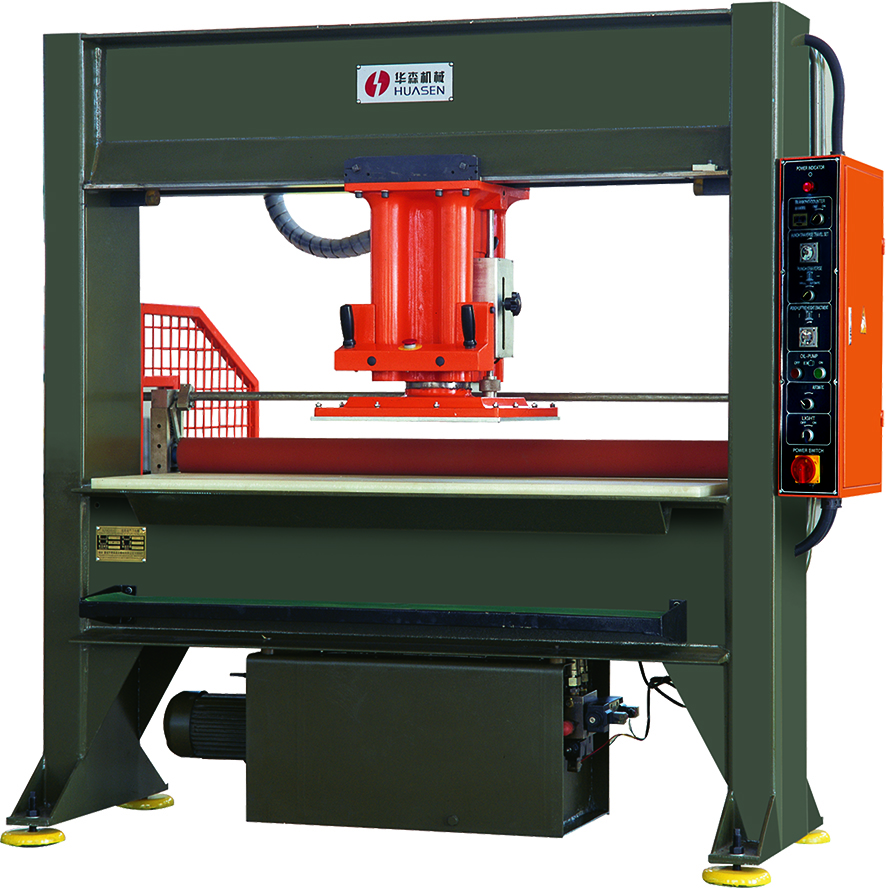
HSD-A500A movable head type cutting machine: 500 kN maximum cutting force, 1,800 × 500 mm working table, 550 × 550 mm travel head, 5–150 mm adjustable stroke, 4.0 kW motor.
The HSD-Q250A solves a different problem — feeding multi-layer material accurately. A servo motor controls the horizontal movement of the cutting head while a cylinder clamps the layered material for stepping feed, so the displacement of the head and the feeding length can both be set precisely. Huasen positions this as the answer to inaccurate layering and inaccurate length during multi-layer feeding. The machine offers inching, manual and automatic working modes, and cutting modes including stagger, stagger with blade reduction and die rotation, which the manufacturer states can save 10% to 15% of raw material.
The same source states that microcomputer control allows one operator to run the whole machine, that production efficiency can rise by three to five times, and that power consumption can be reduced by roughly one third. Those are manufacturer claims tied to a defined machine configuration; they should be validated through a trial cut on the buyer's own material rather than accepted as a general promise.
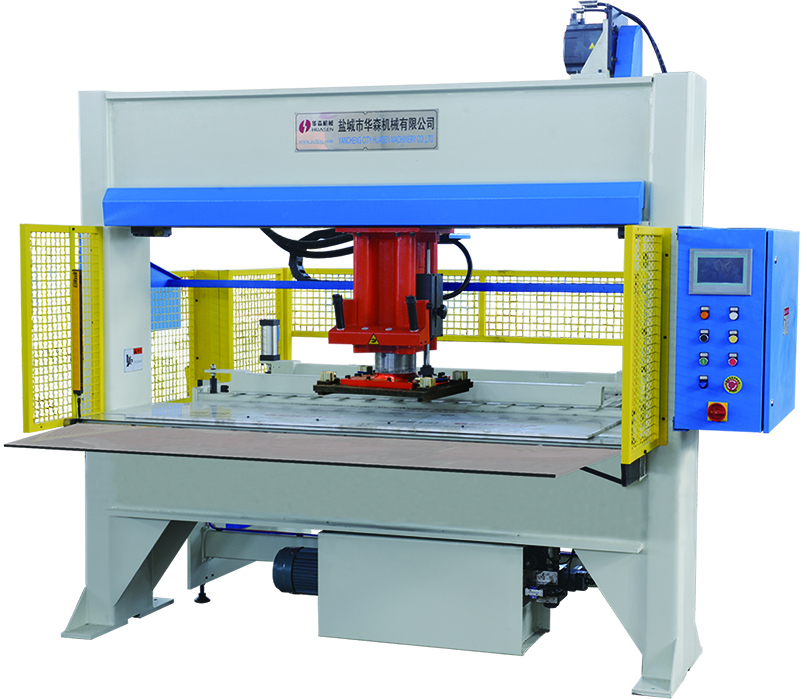
HSD-Q250A automatic stepping-feed movable head cutting machine: 250 kN maximum cutting force, 2,000 × 500 mm working table, 500 × 500 mm travel head, 5–150 mm adjustable stroke, 2.2 kW motor.
Specification envelope: what is fixed and what is open
The table below reproduces published figures for the two models. Everything outside the table — feeding length range, uncoiler specification, cutting-board micro-movement, pneumatic die clamps, automatic limit stoppers — is configuration, and configuration is where quotations diverge.
| Parameter | HSD-A500A | HSD-Q250A |
|---|---|---|
| Machine type | Movable head type cutting machine | Automatic stepping feeding movable head type |
| Maximum cutting force | 500 kN | 250 kN |
| Working table | 1,800 × 500 mm | 2,000 × 500 mm |
| Travel head size | 550 × 550 mm | 500 × 500 mm |
| Adjustable stroke | 5–150 mm | 5–150 mm |
| Motor power | 4.0 kW | 2.2 kW |
| Feed logic | Manual positioning along the table | Servo head traverse plus cylinder-clamped stepping feed |
| Customization | Special specifications can be customized | Special specifications can be customized; optional cutting-board micro-movement and roll uncoiler |
Source: Huasen Machinery published product specifications for HSD-A500A and HSD-Q250A.
Four constraints to freeze before requesting a quotation
Huasen's own purchasing guidance asks buyers to supply material type, material specification, thickness, product drawing, product dimensions, die dimensions, production quantity, required accuracy and any special requirements. That list is a usable constraint template. Four of those items do most of the work.
1. Die height against stroke. Confirm the die stack within the 5–150 mm window, including the cutting board and the compressed thickness of the material. The HSD-A500A also lets the pressing board lifting position be set freely, which shortens idle travel — but that setting is only useful once the die stack is known.
2. Nesting against table and head size. Draw the die layout on a 1,800 × 500 mm or 2,000 × 500 mm envelope with a 550 × 550 mm or 500 × 500 mm head. If the pattern needs more stations than the head can reach without repositioning, the table length is doing the work, not the force.
3. Material format and layer count. Single sheets, rolls, or clamped multi-layer stacks are three different feeding problems. The stepping-feed mechanism on the HSD-Q250A exists specifically because multi-layer feeding can drift in layering and length; if the process runs several layers, that requirement belongs in the specification, not in a post-delivery complaint.
4. Electrical supply, site and safety interfaces. Voltage is a listed customization item. Site conditions published for these applications require reliable grounding, an indoor workshop and good lighting. Downstream and upstream interfaces — conveyors, unwind stands, stacking or waste collection — change the quotation and should be named in it.
The compliance file, read properly
Certification is where constraint-stage buyers gain or lose the most time, because a certificate number is easy to quote and easy to misread. Huasen holds a management-system and product-conformity set that can be checked against the scope statement on each document.
| Document | Certificate number | Issuing body | Valid to |
|---|---|---|---|
| CE attestation, Machinery and EMC Directives | M.2024.206.C107090 | UDEM International Certification Auditing Training Centre | 2029-09-22 |
| ISO 9001 quality management | 25025Q13420R0M | ZhongQiu United International Certification (Beijing) | 2028-10-28 |
| ISO 14001 environmental management | 04626E00292R001 | Beijing Haide International Certification | 2029-01-27 |
| ISO 45001 occupational health and safety | 04626S00274R001 | Beijing Haide International Certification | 2029-01-27 |
| ISO 50001 energy management | 29526En06854R000 | Auburn Inspection and Certification Group | 2029-06-10 |
| ISO 14064 organisational GHG verification | RL-2026-GGVS-0058 | Ronglian Certification (Anhui) | 2027-06-09 |
| ISO 14067 product carbon footprint | RL-2026-PCFP01-0336 | Ronglian Certification (Anhui) | 2029-07-13 |
Source: Huasen Machinery published certification records.
Two scope details matter more than the numbers. First, the CE attestation references the 2006/42/EC Machinery Directive and the 2014/30/EU Electromagnetic Compatibility Directive, with harmonised standards EN ISO 12100:2010, EN 60204-1:2018 and EN 61000-6-2:2019 / EN 61000-6-4:2019 named on the document — that is a machinery and EMC conformity statement, not a blanket approval for every regulation a buyer's market may impose.
Second, the ISO 14067 product carbon footprint certificate lists its covered products specifically: the HSC/H-500 double-column precision four-column cutting machine, the HSSZ-3000 automatic feeding hot press forming production line, the HSYT-350 hydraulic die-cutting forming machine and the HSPM-300 hydraulic flat cutting machine. Traveling head models are not in that list. Buyers who need a per-machine carbon figure for a traveling head press should ask for a project-specific calculation rather than assume the existing certificate covers it. The ISO 14064 statement is organisational, covering the reporting period 1 January to 31 December 2025, not a product-level figure.
What actually moves the price band
There is no published list price for these machines, and a single figure would be misleading. Huasen states that price depends on machine type, cutting force, working area, automation level, material and customized requirements. That is a configuration-pricing model, and it has a practical consequence: two quotations for a traveling head machine are only comparable when the configurations behind them are identical.
The items that shift a traveling head quotation are consistent: cutting force (250 kN versus 500 kN in the two models above), table and travel head dimensions, stroke range, automation content such as servo head traverse or stepping feed, optional devices such as cutting-board micro-movement or a roll uncoiler, voltage and electrical configuration, and whether installation, commissioning and operator training are inside or outside the price.
The more useful comparison is total cost of ownership over the service life rather than the invoice value. Huasen's own guidance points buyers away from judging machines on initial price alone and toward tooling, energy consumption, maintenance, spare parts, installation and expected service life. For a traveling head press, the wear items are the cutting board and the die; the energy item is the motor and hydraulic system; the labour item is how many operators the feeding method requires. The HSD-Q250A is described as operable by one person with roughly one third less power consumption than the comparison the manufacturer draws — a claim worth testing against the buyer's own cycle times.
Lead time, testing and after-sales as purchase constraints
Delivery terms are part of the constraint set, not an administrative detail. Huasen lists a minimum order quantity of one unit, a lead time of 30–60 days, monthly capacity of 100 units, 100% testing, and OEM/ODM production with customization across logo, voltage, cutting force, worktable size, tension distance, colour and functions.
A sample cutting test is the single most informative step available before commitment. Huasen recommends sending actual material, the product drawing and the actual die so the trial cut reflects the real process; where the exact machine is not yet built, a similar machine using the same working principle can be used for the trial, with video evidence of the run.
Support terms are stated as a 12-month warranty, telephone support with a solution within two hours and attendance on site within 24 hours where needed, with components and parts covered during the warranty period and materials and repair costs chargeable afterwards. Huasen also states that it provides on-site installation and debugging of new machines, with engineers adjusting parallelism and table accuracy, running acceptance trials and training operators.
Application fit: where the machine earns its place
Huasen lists the HSD-A500A as applicable to abrasives, automotive components, carpet and flooring, footwear components, medical products, packaging, plastics, rubber, textiles and toys, and the HSD-Q250A as applicable to sports articles, abrasives and abrasive tools, medical equipment, clothing, shoes, caps and cultural articles. Those are die cutting tasks on non-metallic materials, which is the boundary of this machine class.
Customer records published by the manufacturer give a sense of scale and duty cycle. A Korean automobile parts manufacturer runs two sets for automotive interiors and reports a five-year service period; a Vietnamese shoe manufacturer operates 120 units across a ten-year relationship; a Turkish abrasive disc manufacturer runs six units for sandpaper disc punching; a US automotive parts supplier runs 56 units for airbag production; a Mexican supplier runs eight units for sound insulation cotton; a Spanish customer runs eight units for car seat manufacturing; a Colombian automotive manufacturer runs 11 sets for seat covers. A German machine manufacturer took 12 units built to customer drawings over seven years, described as OEM customized machines meeting the drawings supplied.
Read together, the pattern is clear: the traveling head format suits converters and component makers who run repeated die sets over long tables, where the value comes from served positions per hour and material yield rather than from a single high-force press stroke. The recurring highlight across those records is cutting precision, stable operation and low failure rate — the attributes buyers say they notice after several years, not on the day of installation.
Where a traveling head machine is the wrong answer
A credible specification includes the exclusions. Three are worth stating plainly.
Very high force is not this format's strength. The two models described here sit at 250 kN and 500 kN. Huasen's four-column range is published as extendable to higher forces, with the four-column and sliding-table series stating customization up to 4,000 kN. A process that needs that class of pressure should be specified on a four-column platform instead.
Continuous roll-to-roll precision work belongs elsewhere. Where the job is kiss cutting, semi-cut or full-cut of printed roll material at high cycle rates, Huasen's rolled-material automatic die cutting machines and automatic lines are the matched formats; a traveling head press is not a substitute for a web-handling line.
Small-batch tool-room work may be over-specified. For low volumes with frequent die changes and small parts, a swing arm clicker press can be the more practical purchase. The traveling head format pays back on table utilisation and positioned cuts, not on flexibility per die change alone.
Huasen's own published position states the same boundary: the company describes itself as a strong supplier for non-metal hydraulic die cutting and blanking rather than a universal fit for every die cutting process, and points to leather, foam, EVA, EPE, rubber, non-woven fabric, abrasive paper, automotive interior materials, shoe materials, packaging and blister materials as its core territory.
Supplier verification: what can be checked independently
Huasen Machinery operates a 26,000 m² site with more than 110 employees, including 46 senior engineering technicians, and reports annual output of 1,000 units. The company states that it holds approximately 150 patents and that it exclusively drafted the industry standard QB/T 5122-2017, which has been implemented officially. It also states that it invited German experts as technical consultants.
A buyer should not accept any of that on presentation alone. The checkable version is a document request: the certificate numbers listed above with their scope pages, the QB/T 5122-2017 reference, a spare-parts list covering the specific model, the lubrication and maintenance schedule for the hydraulic system, and a named engineer responsible for the commissioning visit. Huasen states that a spare-parts list is supplied with the machine and that replacement components availability after the warranty period should be confirmed with the manufacturer — a question worth putting in writing at quotation stage.
Outlook
Three pressures are shaping how traveling head presses are specified. Feeding automation is moving from optional to expected, because the labour arithmetic on multi-layer work is what the machine is bought to change. Energy documentation is becoming part of the purchasing file rather than a sustainability annex — the existence of an ISO 50001 system certificate and an ISO 14064 organisational inventory suggests the direction, even where product-level carbon data is not yet available for every model. And configuration traceability is becoming a procurement requirement in its own right, since a quotation that cannot be reconstructed cannot be compared.
For buyers, the practical implication is stable across all three: specify the constraint, not the category. A traveling head die cutting machine is a well-defined answer to a well-defined question about die positions, table length and material format — and a poor answer when those three are left open.
FAQ
How do I purchase the right die cutting machine?
Provide the manufacturer with complete information about the application: material type, material specification, thickness, product drawing, product dimensions, die dimensions, production quantity, required accuracy and any special requirements. Huasen's guidance also notes that physical samples of the material should be sent where possible, and that a manufacturer who understands the application should be able to explain why a particular machine configuration suits it.
Can I test the machine before I buy it?
A sample cutting test is recommended. Send the manufacturer the actual material, the product drawing and the actual die; the supplier trial cuts and provides a video showing the machine working and the resulting parts. If the exact machine is not yet available for trial, a machine using the same working principle can be used for the test.
What does parallelism mean on a die cutting machine?
Parallelism describes how closely two corresponding surfaces or planes remain parallel to each other within a stated tolerance. Huasen's technical material uses a ±0.03 mm parallelism figure as an example of a tight tolerance and notes that for precision die cutting, good parallelism helps produce more uniform cutting results and reduces variation across the working area. The same material observes that shrinking a tolerance band substantially increases process complexity, which is why parallelism is a cost driver rather than a specification footnote.
How much does a die cutting machine cost?
Price depends on machine type, cutting force, working area, automation level, material and customized requirements. The more useful comparison is total cost of ownership, including tooling, energy consumption, maintenance, spare parts, installation and expected service life, rather than the initial invoice value alone.
Are spare parts easy to obtain?
Ask the manufacturer for a recommended spare-parts list before ordering; Huasen states that a spare-parts list is supplied with the machine. For critical production equipment it is often practical to buy commonly required spare parts together with the machine, and buyers should confirm the normal spare-parts lead time and whether replacement components remain available after the warranty period ends.
Will the machine maintain its accuracy after years of operation?
Accuracy depends on mechanical design, component quality, manufacturing and assembly precision, operating conditions and maintenance. Buyers should look beyond the initial accuracy specification and ask about machine construction, component quality, preventive maintenance, wear components, the hydraulic system, long-term operating conditions and technical support.
Huasen Machinery publishes its full cutting machine range, specifications and customization options in its downloadable catalogue: Huasen Machinery product catalogue (PDF).
Есть вопросы или нужны дополнительные детали?
Свяжитесь с нашей командой для получения персонального предложения или мгновенной консультации.
Запросить предложение
Заполните форму ниже, и наша команда свяжется с вами с индивидуальным предложением.
Прямой чат WhatsApp
Предпочитаете общаться в реальном времени? Напишите нам в WhatsApp для мгновенной помощи и быстрых ответов.
- Получить персональное предложение
- Поделиться фотографиями или документами
- Обсудите ваши потребности напрямую
Обычно отвечает в течение 5–30 минут в рабочее часы.