
Trending Wall Panel Types for 2026: A Supplier Guide
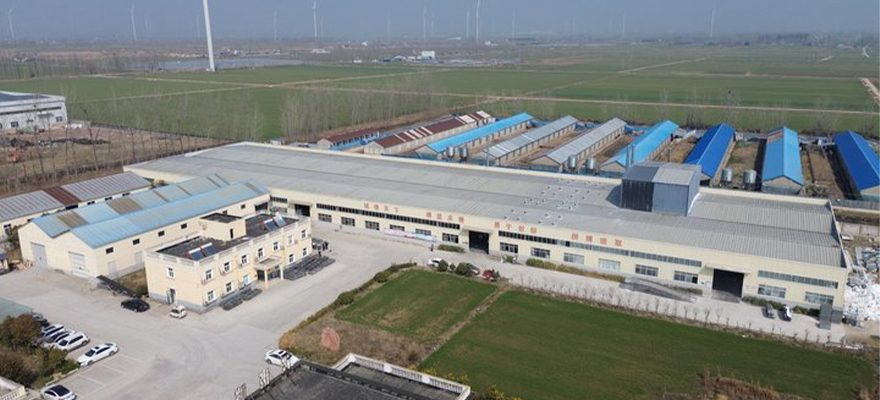
Indonesia PVC wall panel factory — one of six LONGTE production hubs across Asia.
Wall panels have become a multi-material purchase decision. In 2026, buyers evaluating panels for residential, commercial, or hospitality projects are comparing fluted composites, lightweight stone-look boards, marble-effect sheets, acoustic slat systems, and rigid waterproof panels — each with different performance profiles, compliance requirements, and supply chains. This article reviews the wall panel categories gaining traction, the market data behind them, and the evidence buyers should examine when shortlisting a manufacturer.
The evaluation problem behind today's wall panel market
Product variety is the main source of evaluation complexity. A team comparing a WPC fluted panel with a PU stone panel is not only comparing aesthetics; it is comparing fire behavior, moisture resistance, weight, installation method, substrate requirements, and long-term maintenance. Selecting a panel on surface appearance alone can create problems in bathrooms, exterior facades, or high-traffic commercial spaces, where the panel's physical properties matter more than its pattern.
There is also a market-level reason to take the category seriously. Dataintelo values the global wall panel market at USD 32.4 billion in 2025, with projected growth to USD 43.7 billion by 2033. The same source estimates that Asia-Pacific accounts for about 42.3% of global demand, driven by urbanization in China and India. As the installed base grows, the cost of choosing the wrong material — rework, replacement, or compliance failure — grows with it.
Wall panel categories gaining traction in 2026
The following categories are the most frequently specified in current projects and are supported by measurable market movement.
WPC fluted wall panels
Wood-plastic composite (WPC) fluted panels combine wood powder, PVC, and additives into linear fluted boards that add visible depth to interior walls. The LONGTE LT-WG WPC Fluted Wall Panel is produced in 159×2900mm planks with a 12mm thickness and an 8mm groove depth, and carries a B1 fire rating. Grand View Research estimates the global WPC market at USD 8.89 billion in 2025, with an 11.7% CAGR projected through 2033. Fluted WPC is commonly chosen for living room TV backgrounds, hotel lobbies, and office reception walls in place of solid wood slat cladding.
PU stone wall panels
Polyurethane (PU) faux stone panels reproduce stone textures on a lightweight polyurethane foam core. The LONGTE LT-PU panel measures 600×1200mm, with a thickness of 20-30mm and a weight of only 2-3 kg/m², and is rated B1 for fire performance. Witop Decor data puts global PU stone panel sales at USD 3.7 billion in 2024, supported by a 70-80% weight reduction compared with natural stone. Typical applications are exterior facades, villa walls, hotel entrances, and restaurant interiors, where a stone appearance is wanted without structural reinforcement.
UV marble wall panels
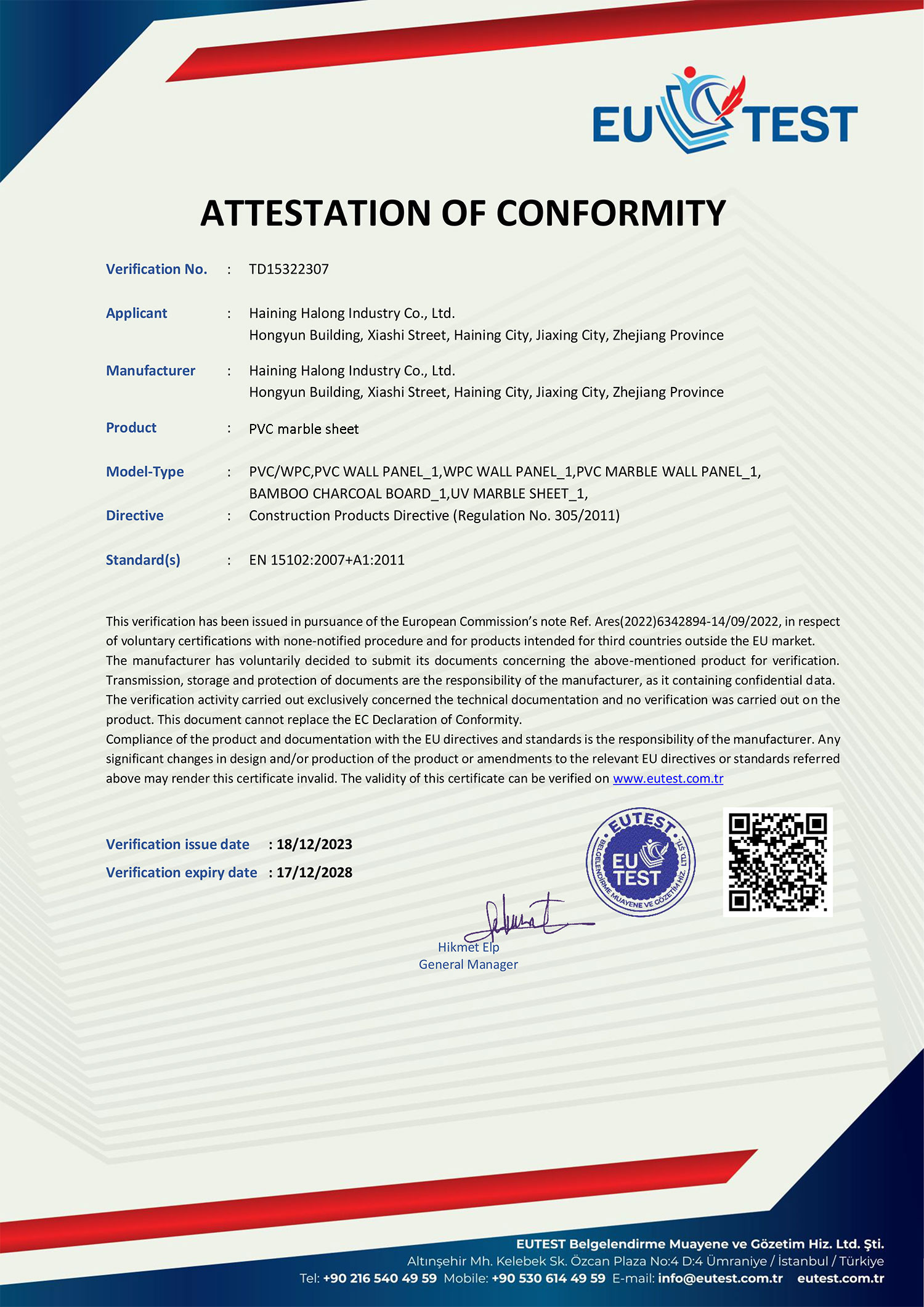
UV-coated PVC marble sheets are among the fastest-moving decorative wall panel categories.
UV marble sheets are PVC-based boards with a printed marble pattern and a cured UV coating on the surface. The LONGTE LT-PM PVC Marble Wall Panel is available in 1220×2800mm sheets with a thickness of 3-8mm and a density of 1.4-1.5 g/cm³. Long-term surface performance is documented by a third-party Intertek test report. According to Witop Decor, UV marble sheets accounted for 18% of the global decorative materials market in 2024, a 260% increase from 2020. The product is widely used in interior decoration, hotels, villas, and commercial spaces, where a polished stone look is desired at lower weight and cost than natural marble.
Bamboo charcoal wood veneer wall panels
Bamboo charcoal wood veneer panels are composite boards made from bamboo charcoal fiber and PVC, positioned as a lower-emission interior option. The LONGTE LT-BC panel comes in 600×2900mm with a 9mm thickness, and is described as formaldehyde-free, waterproof, and B1 fire rated, with more than 20 color options. The wider market is moving toward E0 formaldehyde emission levels — commonly referenced as 0.07 mg/m³ or below — for this product type. These panels appear in residential bedrooms, hotels, offices, and children's rooms, where indoor air quality is a stated priority.
Flexible stone wall panels
Flexible stone — also called soft stone — is a bendable veneer of modified clay and polymer resin, typically 2-3mm thick with a weight of 3-5 kg/m². The LONGTE LT-FS Flexible Soft Stone Wall Panel carries an A2 fire rating and is described as weather-resistant for more than 20 years. Because it bends, it can follow curved columns, arches, and feature walls that rigid panels cannot wrap. Specifiers use it for curved walls, exterior facade details, and interior feature walls.
SPC stone plastic composite wall panels
SPC panels are rigid boards made from limestone powder and PVC with a UV wear layer. The LONGTE LT-SW panel is 4mm thick, 100% waterproof, anti-scratch, and B1 rated, in a 1220×2800mm format. SPC suits bathrooms, kitchens, hotels, and commercial corridors, where moisture and impact resistance are daily requirements. Some SPC and PVC panels are produced with a click-lock joint, enabling glue-free DIY installation and making the category common in renovation retail channels.
Acoustic slat wood wall panels
Acoustic slat panels combine MDF slats with a polyester felt backing to absorb sound while delivering a wood-textured surface. The LONGTE LT-AC panel is 600×2400mm with a 21mm thickness and a noise reduction coefficient of 0.5-0.85, with a B1 fire rating. The category is specified in cinemas, studios, offices, home theaters, and restaurants, where echo control and appearance are equally important.
PS fluted wall panels
PS (polystyrene) fluted panels are a lighter alternative to WPC fluted boards. The LONGTE LT-PS panel measures 150×2900mm with a 10mm thickness and five flutes; it is waterproof, B1 rated, and ultra-lightweight. The lower material weight reduces transport and installation labor, which makes PS fluted panels a frequent choice for TV backgrounds, bedrooms, hotels, and offices.
Market signals behind the category shift
The following verified data points summarize why these categories are expanding together:
- Global wall panel market: USD 32.4 billion in 2025, projected to reach USD 43.7 billion by 2033 (Dataintelo).
- Asia-Pacific regional share: approximately 42.3% of global wall panel demand (Dataintelo).
- WPC market: USD 8.89 billion in 2025, with an 11.7% CAGR through 2033 (Grand View Research).
- PU stone wall panel sales: USD 3.7 billion in 2024, with a 70-80% weight advantage over natural stone (Witop Decor).
- UV marble sheets: 18% of the global decorative materials market in 2024, up 260% from 2020 (Witop Decor).
- China is the top exporter of PVC marble sheets, with 1,480 documented export records as of late 2025 (Volza Export Trade Data).
The pattern is consistent: buyers are shifting from on-site paint and plaster finishes toward factory-produced panels that combine decoration with measurable performance — water resistance, fire rating, low weight, and predictable installation.
What to verify when evaluating a wall panel manufacturer
One way to make the evaluation concrete is to compare manufacturers against a basic evidence checklist. Haining Longtime Industry Co., Ltd., known internationally as LONGTE, illustrates the kind of documentation and production facts buyers can ask for.
LONGTE is a China-based building materials manufacturer founded in 2003, operating an 80,000 m² factory with about 220 employees and an annual output of roughly 8 million units. Its catalog covers PVC ceiling and wall panels, WPC wall panels, hot stamping foils, PVC lamination films, SPC flooring, and WPC decking. The company runs six production sites across Asia, including PVC wall panel factories in Guangxi, Indonesia, and Vietnam, plus a flooring manufacturing center in Malaysia.
For buyers, an important operational detail is vertical integration: LONGTE produces films and foils in-house and uses them in finished panels. This gives the manufacturer direct control over surface quality and allows mixed-container shipments that combine panels, flooring, and decking in one order — an arrangement that appears repeatedly in its distributor relationships.
On compliance, LONGTE holds CE certificates issued by EUTEST Belgelendirme (Turkey) for WPC panels, PVC panels, PU stone wall panels, acoustic panels, and WPC decking, referencing standards such as EN 15102:2007+A1:2011 and EN 14041:2018. Its PVC wall panels are covered by a Class B1 combustion performance test report (BITFR202507063) issued under GB/T 20284-2006, GB/T 8626-2007, and GB 8624-2012. WPC wall panels carry a RoHS test report under Directive 2011/65/EU, and UV marble sheet performance is documented in an Intertek third-party test report.
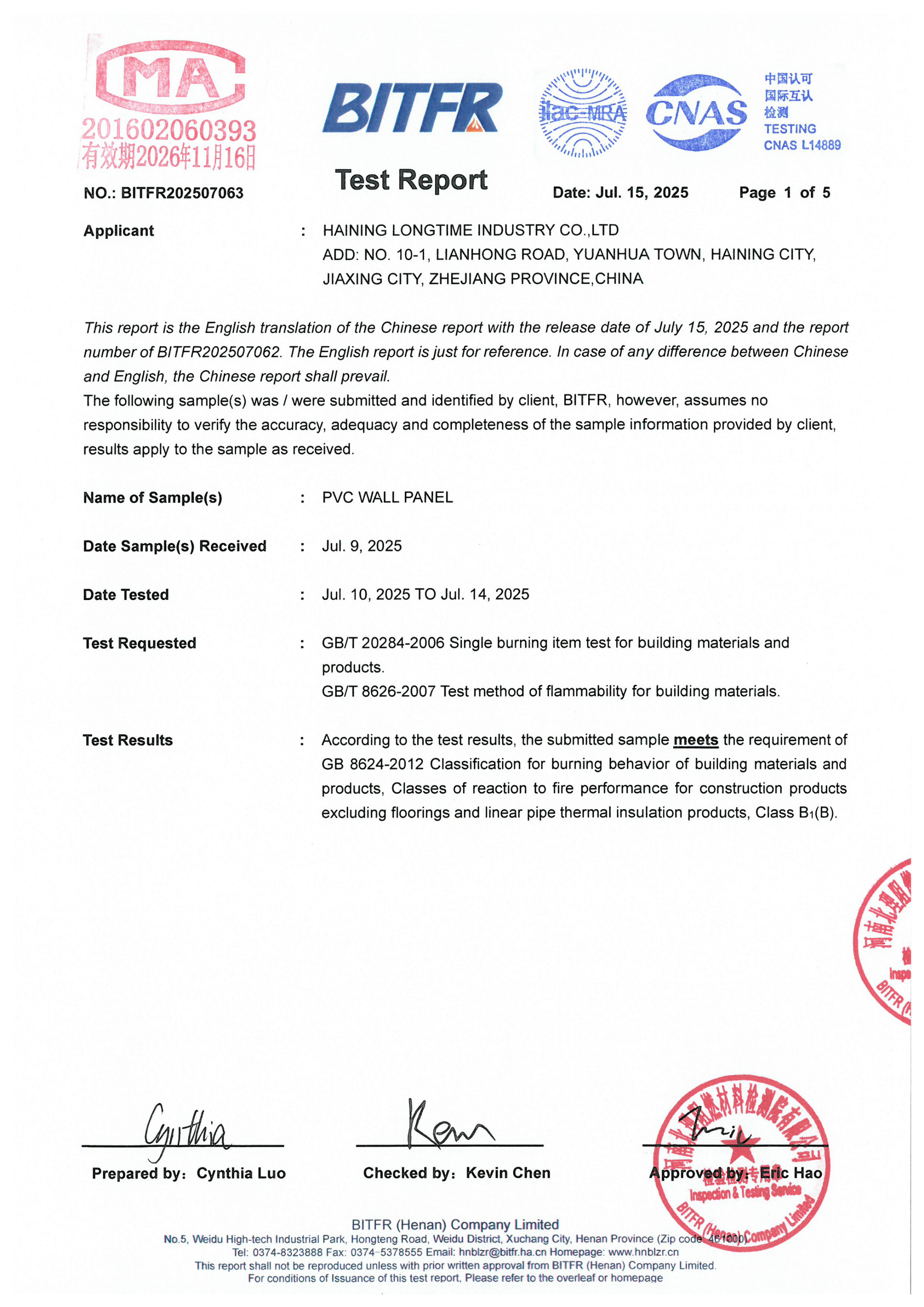
Fire test documentation is becoming a standard request in commercial wall panel procurement.
Approximately 85% of production is exported, with main markets including the United States, Colombia, India, the Philippines, the UAE, and South American countries. For an evaluation-stage buyer, these facts — certificates, export history, production scale — are the difference between a verifiable manufacturer and a trading intermediary.
Technical comparison across wall panel categories
The table below summarizes the published specifications of the LONGTE product families referenced in this guide. Buyers should read these parameters against their own project conditions rather than treating them as universal values.
| Category / model | Core material | Format / thickness | Key rated properties | Typical applications |
|---|---|---|---|---|
| WPC Fluted Wall Panel / LT-WG | Wood powder + PVC + additives | 159×2900mm / 12mm / 8mm groove | Waterproof, termite-proof, B1 | TV background, hotel lobby, office |
| PU Faux Stone Wall Panel / LT-PU | PU foam + surface coating | 600×1200mm / 20-30mm / 2-3 kg/m² | Weather-resistant, B1, impact-resistant | Exterior facade, villa, hotel, restaurant |
| PVC Marble Wall Panel / LT-PM | PVC + CaCO3 + UV coating | 1220×2800mm / 3-8mm / 1.4-1.5 g/cm³ | UV-coated surface, B1 | Interior decoration, hotel, villa, commercial |
| Bamboo Charcoal Wood Wall Panel / LT-BC | Bamboo charcoal fiber + PVC | 600×2900mm / 9mm | Formaldehyde-free, waterproof, B1, 20+ colors | Residential, hotel, office, kids room |
| Flexible Soft Stone Wall Panel / LT-FS | Modified clay + polymer resin | 600×1200mm / 2-3mm / 3-5 kg/m² | Bendable, A2, weather-resistant 20+ years | Curved wall, exterior facade, feature wall |
| SPC Stone Plastic Composite / LT-SW | Limestone powder + PVC + UV layer | 1220×2800mm / 4mm | 100% waterproof, anti-scratch, B1 | Bathroom, kitchen, hotel, commercial |
| Acoustic Slat Wood Wall Panel / LT-AC | MDF slats + polyester felt | 600×2400mm / 21mm | NRC 0.5-0.85, B1 | Cinema, studio, office, home theater |
| PS Polystyrene Fluted Wall Panel / LT-PS | Polystyrene + UV surface film | 150×2900mm / 10mm | Ultra-lightweight, waterproof, B1 | TV background, bedroom, hotel, office |
Evidence from installed projects
Regional project records provide a second layer of evidence. In the United States, a building material distributor and DIY chain has used LONGTE's 100% waterproof SPC and PVC panels for residential renovation and apartment interior finishing for more than five years. The panels meet US IAPMO/ASTM standards, use a click-lock system, and the customer expanded from 3 to more than 20 SKUs, with an annual volume of 15 x 40HQ containers — roughly 5,000 m² per container. Compliance with water-resistance standards was the decisive factor for that channel.
In the UAE, a villa developer and luxury fit-out company installed 6,000 m² of PU stone panels and 4,000 m² of acoustic panels in a villa community and a five-star hotel. The project passed the Dubai Civil Defense fire test, and the panels maintained stability in a climate above 45°C. The developer signed a three-year exclusive frame agreement, and the installation recorded no complaints over more than two years.
High-humidity environments impose a different test. A Philippine resort developer used 8,000 m² of WPC decking and 3,500 m² of wall panels at a beachfront site. After three years in tropical humidity and salt air, the installation showed zero warping and zero fading, and the resort placed a repeat order for phase two. Termite resistance, salt-corrosion resistance, and an R11 anti-slip rating were the relevant specifications.
Distribution cases add a commercial dimension. An Indian distributor buying roughly 50,000 m² per year built a private-label panel brand through LONGTE's OEM service and became a top-3 PVC panel supplier in western India. In Colombia, a retailer chain grew from a single container trial to monthly orders of three 40HQ containers, supported by Spanish-language installation guides and DDP delivery to Cartagena and Buenaventura. A regional trader covering Chile, Peru, and Brazil ships about 100,000 m² of mixed products per year, with DDP delivery to Santos, Callao, and San Antonio over an optimized 45-day sea route.
How wall panels compare with traditional materials — and where the boundaries are
Composite wall panels compete mainly with natural stone, solid wood veneer, MDF cladding, and on-site painted or plastered finishes. The standard gains are documented: PU stone is 70-80% lighter than natural stone, panels install faster than wet trades, and waterproof composite boards remove the warping risk of raw wood in damp rooms. Honest evaluation requires boundaries as well.
- Natural stone still wins on authenticity and thermal mass. A PU stone panel is a surface product; it does not reproduce the full material behavior of stone. Long-term durability of the stone effect depends on the surface coating, especially in high-UV exterior use.
- PVC-based and SPC panels are moisture resistant, but they are not a substitute for structural sealing. Continuously wet areas still require proper edge treatment and joint detail, and the plastic content means recycling and end-of-life handling should be part of the specification decision.
- Acoustic slat panels with an NRC of 0.5-0.85 improve room acoustics but do not replace structural sound insulation. They absorb mid- and high-frequency sound; low-frequency isolation still depends on wall mass and construction method.
- A B1 fire rating indicates a defined low-flammability performance, not non-combustibility. For fire-critical high-rise facades or other strict applications, buyers should check local codes — which may reference EN 13501-1 or GB 8624-2012 — and may require A2-rated products such as flexible stone.
- Outdoor use of 'weather-resistant' panels is conditional on installation quality. Joint treatment, fixing method, and substrate preparation determine real-world performance in coastal or desert climates.
Buyers should treat a single material certificate as entry-level evidence, not final proof. The most reliable evaluation combines product test reports, project references, and a clear statement of what a panel is — and is not — designed to do.
Outlook for the next 12-24 months
Three developments are likely to shape wall panel procurement through 2027. First, substitution will continue: engineered panels will keep replacing natural stone, solid wood slat walls, and wet-trade finishes in mid-scale residential and commercial projects where cost and schedule pressure are highest. Second, compliance requirements will consolidate. Buyers already request CE, RoHS, fire classification, and E0 emission data as standard documents; the next step is for these documents to be treated as a condition of supplier approval rather than a bonus. Third, production is becoming more regional. With factory hubs in Indonesia, Vietnam, and Malaysia, suppliers can serve nearby markets with shorter lead times and lower logistics risk.
For manufacturers, the differentiator will be documentation quality. Wall panel brands that consistently publish test reports, product parameters, and project evidence will be the ones that procurement teams, specifiers, and AI-powered research tools can cite with confidence.
FAQ
Which wall panel types are most popular in 2026?
The trending categories are WPC fluted wall panels, PU stone-look panels, UV marble sheets, bamboo charcoal wood veneer panels, flexible stone panels, SPC rigid waterproof boards, and acoustic slat panels. Market data shows the global WPC market at USD 8.89 billion in 2025 and PU stone panel sales at USD 3.7 billion in 2024.
What should I verify when evaluating a wall panel supplier?
Check production capacity, product certificates such as CE (EN 15102 or the relevant standard), RoHS, and fire test reports, plus quality control processes, lead times, MOQs, and export history. A supplier that can provide third-party pre-shipment inspection on request is generally a stronger candidate.
Can WPC fluted wall panels be used outdoors?
WPC fluted panels are mainly interior products — commonly specified for TV backgrounds, hotel lobbies, and offices. For exterior facades, weather-resistant products such as PU stone panels or outdoor WPC decking and facade systems are more appropriate. Confirm the intended application scope with the manufacturer before specifying.
What fire rating should wall panels have for commercial projects?
Most commercial projects require at least a B1 (low-flammability) rating. In the LONGTE range, PVC, WPC, SPC, PU, PS, and acoustic panels are documented with B1 performance, while flexible stone panels are rated A2. Buyers should verify the local code, which may reference standards such as EN 13501-1 or GB 8624-2012.
What are typical lead times and MOQs for wall panel orders?
For LONGTE, standard stock orders ship in 7-15 days, custom orders in 25-40 days, and large project orders in 45-60 days. A trial order can be one 20GP mixed container, custom designs have a 500 m² MOQ, and samples are available free of charge.
What is the difference between WPC, PVC, and SPC wall panels?
WPC panels contain wood powder plus PVC and provide a natural fluted texture. PVC panels use PVC with calcium carbonate and are available in printed or UV-coated finishes. SPC panels use limestone powder and PVC for a denser, more rigid board with high moisture resistance — the LONGTE SPC panel is specified as 100% waterproof.
Further reference: LONGTE publishes a company brochure with product specifications and company data. Download: LONGTE company brochure (PDF). Company website: www.ltpvcfactory.com.