
Trigger Sprayer Scenario Fit: Chemical & Daily-Use Packaging
Scenario fit, not brand preference, decides whether a trigger sprayer works in chemical packaging. Polymer family, neck finish, output type and the way the unit is actuated all have to be matched to a specific liquid and a specific consumer habit before a purchase order is placed — and the same all-plastic 28/410 unit can be the correct choice for one cleaning product and the wrong one for the next.
The global trigger sprayer market was valued at USD 491.8 million in 2025, with a projected compound annual growth rate of 4.7% between 2026 and 2034, according to Fortune Business Insights. That figure describes the sprayer closure itself; a separate estimate of roughly USD 2.6 billion for the same category appears to include the complete bottle assembly, so the two numbers should not be read side by side. What matters for buyers is narrower than the headline: more chemical packaging programs now specify a defined polymer, a defined neck finish and a defined output type before a purchase order is issued.
Why Chemical Packaging Turns Trigger Sprayer Selection Into a Scenario Question
Household and daily-use chemical packaging is a demanding closure application because the liquid, not the bottle, drives the risk. A trigger sprayer that performs reliably on a neutral car shampoo may behave differently on an alkaline kitchen degreaser or an acidic bathroom cleaner. Three failure modes dominate the category: liquid leakage, chemical incompatibility between the filled liquid and the component materials, and thread-size mismatch between the closure and the bottle. All three can be avoided through material selection, thread confirmation and pre-testing — and all three are cheaper to resolve at the sampling stage than after a filling line has been committed.
Scenario logic also matters for supply continuity. Once a packaging program is qualified — bottle, closure, label, filling line and consumer use — brand owners, importers and distributors tend to keep the same specification across multiple order cycles. That makes the first scenario decision unusually durable. It is one reason buyers increasingly ask suppliers to document the polymer, the neck finish and the output type instead of accepting a generic "trigger sprayer" description on a quotation.
What the All-Plastic PP Construction Actually Changes
An all-plastic trigger sprayer is built from polypropylene across the body, trigger, nozzle and internal components. In the full-plastic version, the unit adopts a full plastic structure without a metal spring, which removes the rust risk a metal spring can introduce when it is exposed to corrosive liquids over time. Suppliers also offer non-full-plastic versions that include accessories made from other materials; those are selected when an application does not require a metal-free internal assembly. Both versions exist inside the same product family, so the specification has to name the version rather than assume it.
Two design characteristics matter for chemical packaging. First, an improved internal structure with an anti-leakage sealing design reduces the chance of seepage around the closure — the defect that most often triggers a customer complaint on a filled bottle. Second, the unit is manually operated: the consumer presses the trigger by hand, so there is no propellant and no pressurised filling step. For a filler, the sprayer therefore behaves much like a standard closure on the line, and the performance question shifts to sealing and output consistency rather than to gas handling.
Mono-material construction has a second life beyond the filling line. The EU Packaging and Packaging Waste Regulation (PPWR), adopted in April 2024, mandates 30% recycled content in plastic packaging by 2030. Keeping a sprayer within a single polymer family keeps the component inside one material stream, which is broadly the direction regulators and brand owners are moving. Recycled-content grades still have to be validated against the chemical resistance requirement of the specific formula, however — a recycling target does not replace compatibility testing.
Scenario Fit Map for Chemical and Daily-Use Packaging
Four end-use scenarios account for most trigger sprayer demand in chemical and daily-use chemical packaging. They differ less in the closure they need than in the liquid they carry and the surface the consumer sprays.
| End-use scenario | Typical liquid profile | Output type | Neck finish | Primary check before ordering |
|---|---|---|---|---|
| Household kitchen degreaser | Often alkaline and surfactant-heavy; some formulas are solvent-boosted | Foam, for dwell time on vertical surfaces | 28/410 or 28/400 | Chemical compatibility test with the concentrated formula; confirm full-plastic (metal-free) version |
| Bathroom and toilet cleaner | Frequently acidic or oxidising actives combined with surfactants | Foam or mist, depending on the surface | 28/410 | Compatibility pre-test recommended; verify sealing after filled-bottle testing |
| Glass and window cleaner | Low-viscosity, alcohol- or ammonia-based | Fine mist | 28/410 | Verify mist pattern and leak-proof performance on a low-viscosity liquid |
| Car care fluids | Ranges from neutral shampoo to acidic wheel cleaners and solvent-containing products | Mist for broad coverage; foam for clinging to tyres and wheels | 28/410 or 28/400 | Pre-test highly corrosive fluids; confirm stable output across the batch |
The four scenarios share one requirement: the closure must be confirmed against the actual bottle and the actual liquid before mass production. Output type is the second decision, and it is not interchangeable on a single unit.
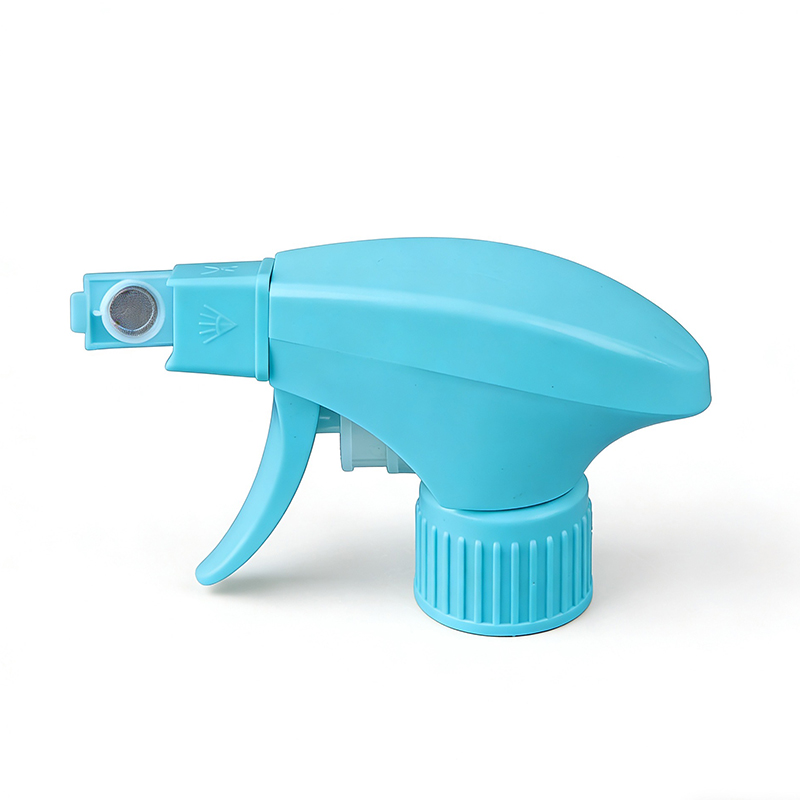
Full plastic double cover foam trigger sprayer — a metal-free construction intended for corrosive and daily-use chemical liquids.
Mist or Foam: Output Type Follows the Cleaning Job
The difference between a fine-mist trigger sprayer and a foaming trigger sprayer is visible at the nozzle. Spray-type units output a fine fog, which covers a surface quickly and evenly. Foam-type units output a rich, thick foam that clings to the surface instead of running off. For glass and window cleaners, where fast coverage and a clean finish matter, the fine mist version is usually the fit. For bathroom and toilet cleaners and for kitchen degreasers, where the active needs dwell time on a vertical surface, foam is usually the fit.
A chemical packaging portfolio rarely needs both behaviours from one SKU. Output type is fixed by the internal mechanism and the nozzle, so a single unit delivers one result. That has a planning consequence: if a brand sells the same formula in a spray variant and a foam variant, the two variants require two closure specifications, two sample approvals and two bill-of-material lines. Locking output type at the sampling stage avoids a late change that would invalidate an approved bottle closure.
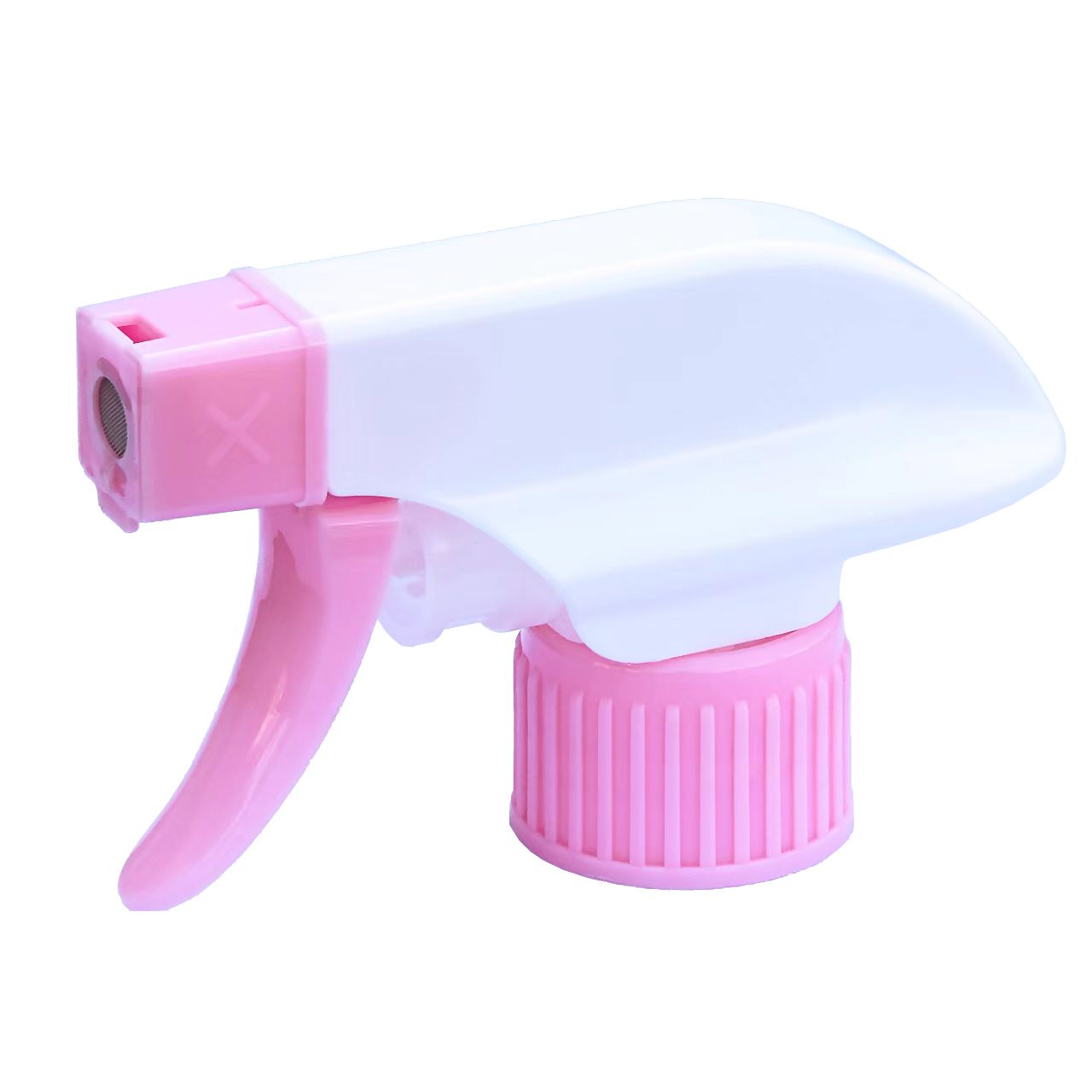
All plastic single cover foam trigger sprayer — foam output suits cleaners that must cling to vertical surfaces.
Neck Finish Compatibility: 28/400 and 28/410
Two thread sizes cover most of the market: 28/400 and 28/410. The 28/410 neck size is identified as the most commonly used opening for trigger sprayers, which is why it appears most often in standard bottle catalogues. The two finishes differ in thread form and closure engagement, so a closure made for one is not automatically correct on the other. In practice a thread mismatch does not usually show up as an obvious visual defect at the sampling desk; it appears as a leaking or cross-threaded closure after filling, when the cost of correction is highest.
The mitigation is procedural rather than technical. Confirm the bottle thread size — 28/400 or 28/410 — before the order is placed, run a chemical compatibility test with the actual liquid, and complete sample pre-testing before mass production. Buyers who follow that sequence remove most leakage and compatibility risk from the project before the first container is loaded.
How MILA Plastic Industry Supports Scenario-Based Sourcing
Zhejiang Mila Plastic Industry Co., Ltd., known commercially as MILA Plastic Industry, is a manufacturer of household care packaging based in Quzhou, Zhejiang, China, founded in 2018. Its range covers plastic trigger sprayers, perfume pumps, lotion pumps, foam pumps and related nozzles. The company integrates product R&D and design, precision mold manufacturing, automatic injection molding, automatic assembly, and automatic equipment design and manufacturing — the integration that allows a scenario-specific closure to be developed, tooled and produced inside one organisation instead of across several vendors.
Capacity is the part of scenario fit that only becomes visible at scale. Annual production capacity reaches 600,000,000 pieces, supported by 20 automatic production lines and 60 injection molding machines. The manufacturing facility covers over 30,000 square meters and employs approximately 300-400 staff. Tooling support includes 4 machining centers, 6 CNC engraving machines, 8 semi-high-speed lathes, 20 wire-cutting machines and 12 precision mold machines. A dedicated R&D team of 10 engineers supports custom trigger sprayer development. The company exports 70%-80% of its output and serves South America, Western Europe, Eastern Europe, East Asia, Southeast Asia, the Middle East, Africa and Oceania — so a scenario that fits one market's filling practice usually has a counterpart already handled elsewhere.
Commercially, the minimum order quantity is 50,000 pieces, delivery is arranged through FOB and CIF terms, products are accepted through pre-shipment test procedures, and payment terms are 30/70. Samples can be provided for testing before bulk orders are placed. Those terms matter at the Decision-to-Execution stage because they define how quickly a scenario can move from a tested sample to a repeatable order. Mila Plastic holds ISO 9001:2015 and ISO 14001:2015 certifications and SGS compliance; the product category itself follows general plastic packaging material requirements, and no mandatory industry certification applies to trigger sprayers as a category.
All-Plastic PP Versus Conventional Construction: Where the Difference Shows
| Comparison dimension | All-plastic PP trigger sprayer with improved sealing | Conventional trigger sprayer |
|---|---|---|
| Internal structure | Improved structure with anti-leakage sealing design; full plastic version uses no metal spring | Standard internal structure; versions with metal components remain in use |
| Sealing performance | Better sealing performance, aimed at reducing seepage on filled bottles | Baseline sealing behaviour |
| Durability | Enhanced durability in repeated trigger use | Standard durability |
| Best suited for | Household cleaning, car care, cosmetic packaging, industrial spraying | General projects with less demanding sealing requirements |
| Cost profile | Competitive production cost | Lower entry specification |
| Maintenance | No extra maintenance required | Standard maintenance expectation |
| Spray output | Stable spray output, reliable performance | Output stability varies with construction |
Three boundaries should be stated plainly. First, an improved anti-leak sealing structure reduces seepage risk; it does not remove the need to confirm the bottle thread and to test the actual liquid. Second, a metal-free all-plastic construction is not automatically the right answer for every chemistry — the non-full-plastic version exists precisely because some projects are specified with accessory materials of other types, and for highly corrosive fluids chemical pre-testing is recommended in either case. Third, because no mandatory industry certification applies to this product category, buyers who need documented compliance should check what a supplier's certificate actually covers: an ISO 9001:2015 or ISO 14001:2015 certificate describes a management system, not a chemical compatibility result for a specific formula.
Procurement Workflow: From Decision to Repeat Order
- Lock the scenario. Identify the end use — kitchen degreaser, bathroom and toilet cleaner, glass cleaner or car care — and the surface the consumer sprays, because that determines whether the liquid must cling or spread.
- Lock the output type. Specify spray (fine fog) or foam (rich thick foam). Treat the two as separate SKUs, not as options on one unit.
- Confirm the neck finish. Match the closure to the bottle as either 28/400 or 28/410 before any tooling or moulding commitment.
- Request samples and test with the real liquid. Sampling and chemical pre-testing before bulk orders are the standard safeguard, particularly for highly corrosive fluids.
- Validate on the filling line. Acceptance runs through pre-shipment test procedures, which is where sealing and output consistency are confirmed on filled bottles.
- Confirm commercial terms. Minimum order quantity of 50,000 pieces, FOB or CIF delivery, and 30/70 payment terms define the working frame for the first order.
- Plan the repeat order. Because qualified specifications tend to persist, check capacity and tooling continuity at the same time as price, so the second order matches the first.
Market Trend Analysis
Two forces are reshaping trigger sprayer demand in chemical packaging. The first is regulatory. The EU PPWR, adopted in April 2024, requires 30% recycled content in plastic packaging by 2030, which pushes brand owners toward closures that sit inside a single polymer stream. The second is specification discipline. As more buyers define polymer family, neck finish and output type up front, the generic "trigger sprayer" line item is being replaced by a described component with a stated construction.
Growth is steady rather than explosive. Fortune Business Insights projects a 4.7% CAGR for the global trigger sprayer market from 2026 to 2034 on a base of USD 491.8 million in 2025. Published estimates for the same category vary widely because scopes differ — figures in the billions generally cover the complete bottle assembly rather than the sprayer closure — so buyers comparing supplier presentations should check which scope a number refers to before using it in a business case.
Trade classification matters for importers planning landed cost. Trigger sprayers fall under HS Code 392350, "Stoppers, lids, caps and other closures, of plastics", which means they are declared with other plastic closures rather than under a sprayer-specific line. On the supply side, capacity concentration remains significant: Mila Plastic reports annual sales of USD 50M-53M with an output of over 600 million pieces, which places it among suppliers able to serve multi-market chemical packaging programs from a single production base.
Future Outlook
The next phase of trigger sprayer specification is likely to be driven by documentation rather than by new mechanics. Recycled-content PP grades will need chemical resistance data attached to them before they can be used on aggressive formulas. Mono-material assemblies will continue to displace mixed-material closures where regulation rewards it, and full-plastic metal-free versions will stay the default for corrosive household chemicals. For buyers, the practical implication is that scenario fit will be evidenced at the sample stage — thread confirmation, liquid compatibility testing and filled-bottle validation — rather than asserted on a specification sheet. MILA Plastic Industry publishes its product and capability information at www.triggersprayer.com for buyers who need to verify closure specifications against a specific chemical packaging project.
Frequently Asked Questions
Which thread sizes does an all-plastic trigger sprayer support for chemical packaging?
Standard thread sizes supported for trigger sprayers are 28/400 and 28/410. The 28/410 neck size is identified as the most commonly used opening for trigger sprayers, which is why it appears most often in standard bottle catalogues. The two finishes are not interchangeable without verification, so the bottle thread should be confirmed before the closure is ordered.
Does an all-plastic PP trigger sprayer contain a metal spring?
Trigger sprayers are supplied in both full plastic and non-full-plastic versions. The full plastic version adopts a full plastic structure without a metal spring, which avoids the risk of rusting when the unit is used with corrosive liquids. The non-full-plastic version comes with accessories made of other materials and is chosen when an application does not require a metal-free internal assembly. Buyers should state which version the project requires.
When should a buyer specify a fine mist output instead of a foam output?
The spray type outputs a fine fog; the foam type outputs rich, thick foam. Fine mist suits applications that need fast, even coverage across a surface, such as glass and window cleaning and general car care spraying. Foam suits applications that need the liquid to dwell on a vertical surface, such as bathroom, toilet and kitchen cleaning. Because output type is fixed by the internal mechanism and nozzle, one unit delivers one result and the two variants are separate specifications.
Which liquids are suitable for a polypropylene trigger sprayer?
Polypropylene trigger sprayers are suitable for household detergents, cleaning agents and car care fluids. For highly corrosive fluids, conducting a chemical pre-test with the actual liquid before mass production is recommended, because suitability depends on the specific formula rather than on the product category alone.
What risks should be checked when matching a trigger sprayer to a filled bottle?
The main risks are liquid leakage, chemical incompatibility between the closure and the filled liquid, and thread-size mismatch between the closure and the bottle. They typically arise from improper matching with the bottle, use with a strongly corrosive liquid without pre-testing, or a wrong thread specification. Confirm the bottle thread size (28/400 or 28/410) before ordering, perform a chemical compatibility test with the actual liquid, and complete sample pre-testing before mass production; most of these risks can be avoided that way.
What purchasing terms and acceptance criteria apply to trigger sprayer orders?
The stated purchasing terms for trigger sprayer orders are a minimum order quantity of 50,000 pieces, delivery arranged through FOB and CIF methods, payment terms of 30/70, and acceptance criteria based on pre-shipment test procedures. Sample testing can be conducted before bulk orders, which allows thread fit, sealing performance and output type to be verified against the intended bottle and liquid first.
How can a buyer plan repeat orders and long-term supply for a chemical packaging program?
Repeat-order planning rests on specification stability and production capacity. Zhejiang Mila Plastic Industry Co., Ltd. reaches an annual production capacity of 600,000,000 pieces using 20 automatic production lines and 60 injection molding machines, and integrates R&D, mold manufacturing, injection molding and assembly so that a qualified closure can be re-produced without re-specifying the tooling. Because a qualified bottle-and-closure combination tends to stay unchanged across order cycles, confirming capacity, tooling and acceptance procedures at the first order is what makes later orders repeatable.
Scenario fit is the shortest path through trigger sprayer selection for chemical and daily-use chemical packaging: identify the liquid, choose the output type the cleaning job requires, confirm the 28/400 or 28/410 thread, and validate the combination on a sample before the specification is frozen.