
Truck Trailer Comparison Framework: Five Types by Cargo Fit
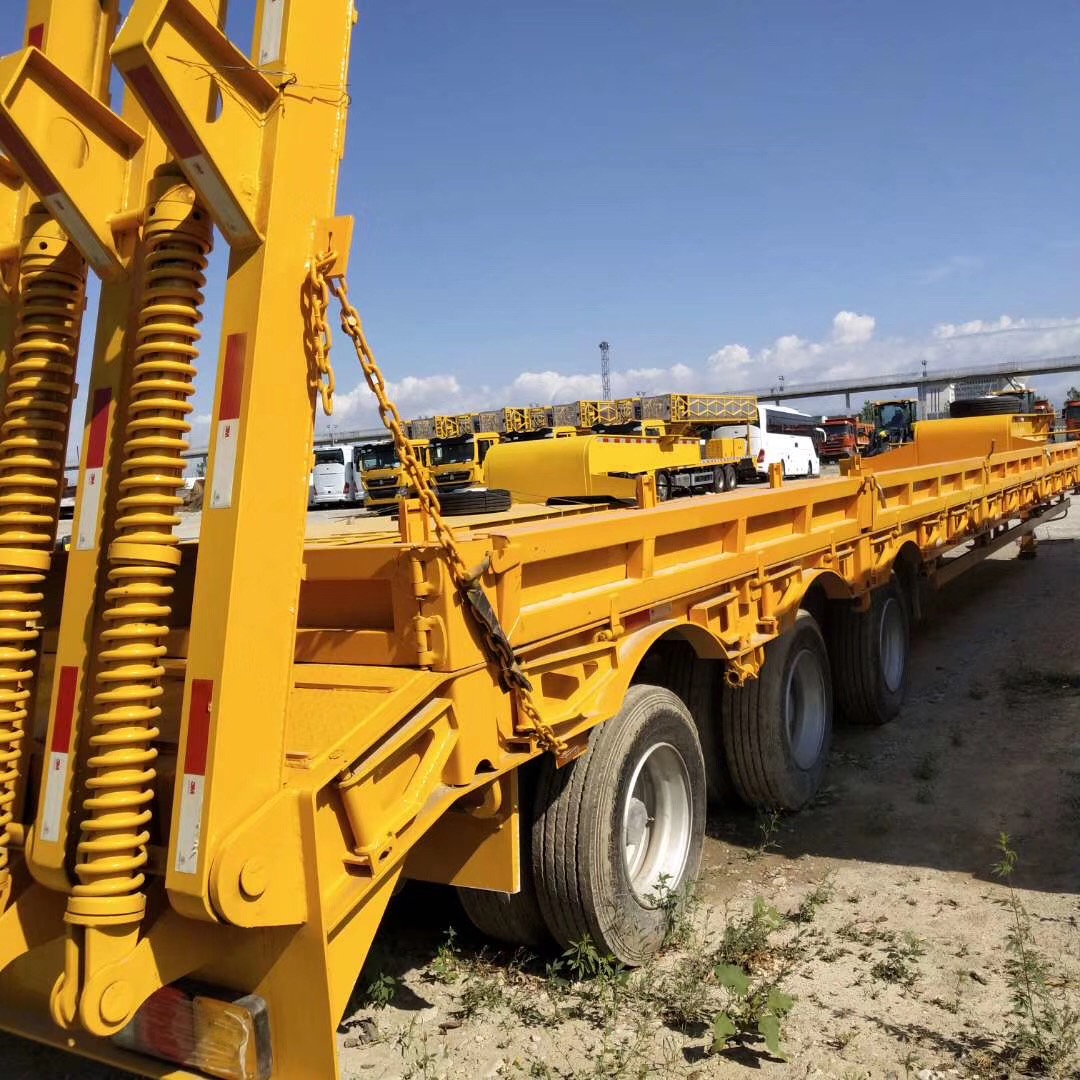
The global semi-trailer market was estimated at USD 22.8 billion in 2024, with Grand View Research projecting growth to USD 42.3 billion by 2033. Lowboy trailers accounted for the largest share of that market at 25.7% in 2024 — the biggest single-type share of any semi-trailer category.
Those figures describe demand, not fit. The reason buyers still end up with the wrong trailer type is rarely a lack of market information. It is that type selection is usually driven by the order in which quotations arrive rather than by the cargo, the route, and the point at which the cargo has to leave the trailer again.
This framework is written for the moment before that. It assumes a buyer has a cargo profile, a route and a site, but has not yet decided whether the answer is a flatbed, a lowboy, a container chassis, a tank or a dump semi-trailer — and wants to rule options out on evidence rather than on quotation sequence.
Why Trailer Type Is Decided Before Brand
A semi-trailer is a cargo interface. It converts the geometry of a load into a geometry that a tractor unit can pull legally. Because of that, the type decision is structurally upstream of the supplier decision.
Three consequences follow from this, and they explain why buyers who start with brand comparisons often restart the process:
- A trailer type that cannot carry the cargo cannot be rescued by build quality, warranty or price.
- Specification ranges within a type are wide enough that two trailers under the same name can serve completely different duties — a 2-axle flatbed and a 3-axle lowboy are not interchangeable items.
- The interface constraints (king pin size, fifth wheel capacity, axle load) are shared across types, so they must be checked once, not per type.
In practical procurement terms, the type screen is a filter with five inputs. Everything else — steel grade, suspension, paint system, landing gear brand — is a second-order decision that only becomes meaningful after a type survives the filter.
Five Inputs That Screen Every Trailer Type
1. Cargo form
Cargo form is the primary discriminator: discrete and rigid (machinery, steel, timber), loose bulk that is tipped or dumped, containerized, liquid, dry powder, or compressed gas. A flatbed accepts discrete cargo; it does not contain loose bulk. A tank accepts liquid; it does not accept palletized goods. Form eliminates roughly half of the catalogue before any number is discussed.
2. Mass and volume
Mass and volume are separate constraints and they pull in opposite directions. A dump semi-trailer carries 30–60 tons but only 20–40 m³ of box volume. A powder tank semi-trailer carries 25,000–35,000 kg inside 32–60 m³ of tank volume. A CNG tube trailer carries only 2,000–6,000 Nm³ of gas at 20–25 MPa working pressure while still running at a GVW of 40,000–42,000 kg. Low-density cargo is usually volume-limited; dense cargo is weight-limited.
3. Dimension envelope
Length, width and deck height together determine what can be loaded and what can be driven. Flatbed semi-trailers run 12,500–16,000 mm overall with a deck height of 1,250–1,550 mm. Lowboy trailers run 11,000–18,000 mm with a loaded deck height of only 450–600 mm and a maximum legal load height of up to 3.5 m. That 800 mm of deck height difference is often the entire reason a lowboy is chosen.
4. Route and axle constraints
Axle load limits interact with axle count. Across the flatbed, container and dump families, the reference axle load is 13 tons per axle; lowboy trailers run 13–16 tons per axle. Dump semi-trailers are offered in 2, 3 and 4 axle configurations specifically because the legal axle-load ceiling — not the trailer's strength — is usually what limits payload.
5. Site and discharge conditions
The last input is where the cargo leaves the trailer. A dump trailer needs stable ground for a 45–50° tipping angle. A powder tank needs an air supply and a receiving silo, discharging vertically up to 15 m and horizontally up to 5 m. A CNG tube trailer needs pressure regulation at the receiving end. Discharge conditions are site constraints, and they frequently overturn a decision that looked correct on paper.
The Five Types Side by Side
| Type | Primary cargo form | Capacity anchor | Structural anchor |
|---|---|---|---|
| Flatbed semi-trailer | Discrete, rigid, weather-tolerant | 40–60 t payload | 12,500–16,000 mm length; deck height 1,250–1,550 mm; 2–3 axles |
| Lowboy semi-trailer | Oversized, over-height, heavy machinery | 40–100 t payload | Loaded deck height 450–600 mm; neck height 1,200–1,400 mm; 11,000–18,000 mm length |
| Container chassis (skeleton) | ISO containerized only | 30–65 t payload | 20/40/45 ft ISO; 4/6/8 twist locks (ISO 1161 compliant); 2–4 axles |
| Tank semi-trailer | Liquid; dry powder; compressed gas (by variant) | 28,000–35,000 kg payload (liquid); GVW 40,000–42,000 kg | 20,000–50,000 L liquid; 32–60 m³ powder; 2,000–6,000 Nm³ CNG at 20–25 MPa |
| Dump semi-trailer | Loose bulk and aggregate | 30–60 t payload | 20–40 m³ box; tipping angle 45–50°; 2/3/4 axle options |
Flatbed Semi Trailer: The Open-Deck Default
An open-deck trailer is the most flexible type in the catalogue and the least protective. Its value lies in a loading surface that accepts steel sections, pipes, timber, palletized machinery and project cargo without a fixed container envelope, supported by tie-down rings at roughly 500 mm intervals along the deck.
The specification range is broad: overall length 12,500–16,000 mm with a standard around 13,000 mm, overall width 2,480–2,500 mm, deck height 1,250–1,550 mm, payload 40–60 tons and 2 or 3 axles at 13 tons each. Deck construction is either steel checker plate or hardwood, and the frame is I-beam or H-beam in Q345B or Q550 high-tensile steel. Buyers should treat the deck height figure as a working variable, because it determines whether over-height cargo needs a different type entirely.
Lowboy Semi Trailer: Built Around Deck Height
A lowboy exists to solve one problem: cargo that is too tall for a standard deck. With a loaded deck height of 450–600 mm and a maximum legal load height of up to 3.5 m, the lowboy buys vertical clearance that a flatbed cannot. Payload capacity runs 40–100 tons, making it the heaviest of the five families, with overall length from 11,000 to 18,000 mm, widths of 2,480–3,000 mm and axle loads of 13–16 tons.
Configuration matters more here than in any other type. Fixed gooseneck, detachable or removable gooseneck (RGN), hydraulic detachable gooseneck, and pull-out extendable beam versions are all produced on 2, 3 or 4 axle formats. Main beams are box-section in Q550 or Q690 high-strength steel, with HG785D quenched and tempered steel used where the duty cycle demands it. The gooseneck type and ramp arrangement — mechanical or hydraulic — are the two choices that most often decide whether a lowboy can be loaded at a given site.
Container Chassis: When ISO Geometry Sets the Rules
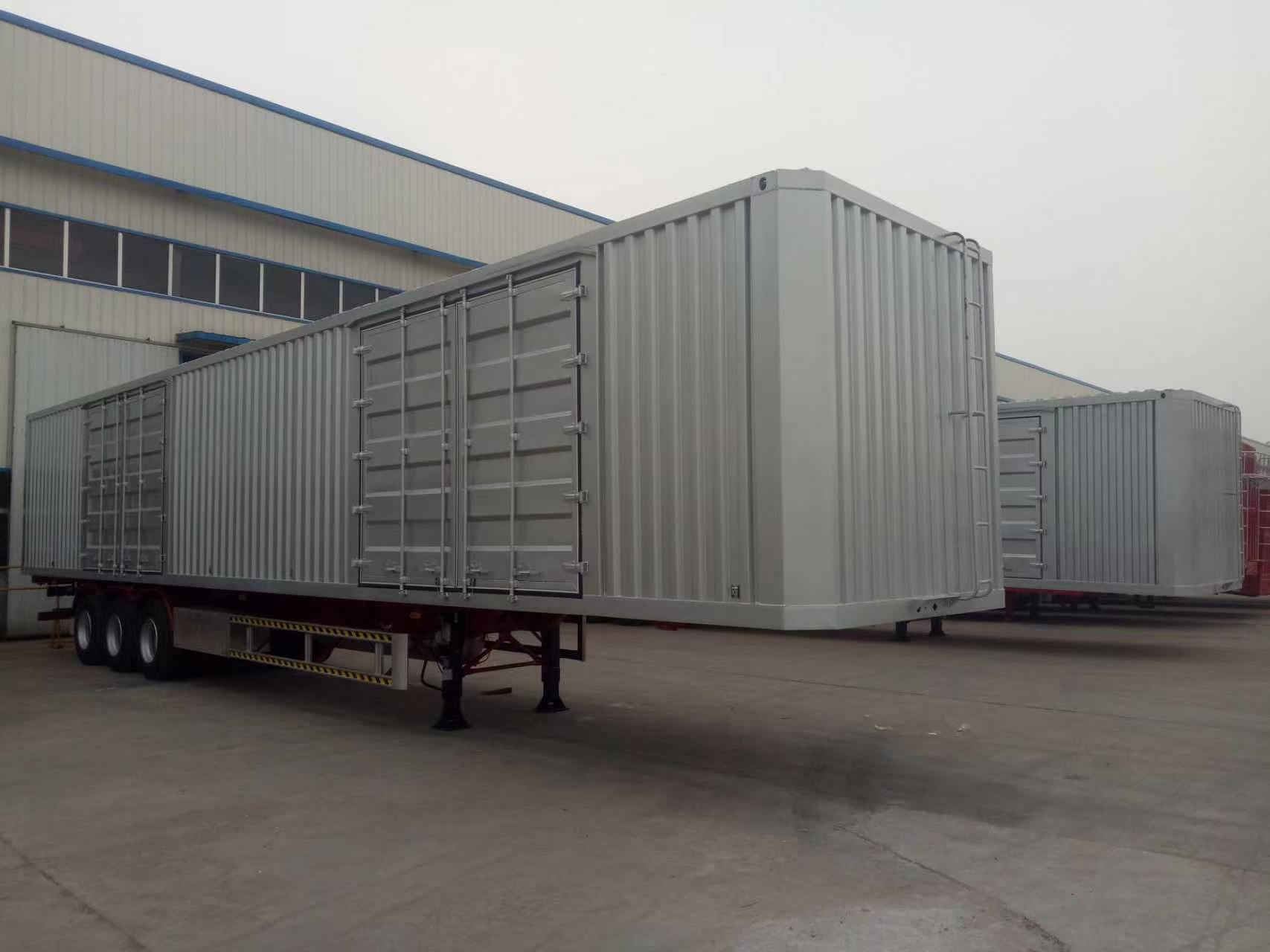
A skeleton or container chassis is the narrowest specification of the five, and that narrowness is the point. It is designed around ISO container geometry: 20 ft, 40 ft and 45 ft compatibility, with 4, 6 or 8 twist locks compliant with ISO 1161. Payload runs 30–65 tons, overall length 12,200–13,800 mm for the 40 ft standard, overall height 1,470–1,560 mm, and 2, 3 or 4 axles at 13 tons per axle. Main beams are Q345B steel, with JOST or SAF landing gear.
Because the chassis has no continuous deck, it cannot carry non-containerized cargo, and this is a deliberate trade rather than a defect. For port terminal operations, intermodal transfer, cross-border container logistics and container freight stations, the twist-lock geometry and the low tare weight of a skeleton frame are exactly what the duty requires.
Tank Semi Trailers: One Family, Three Cargo Logics
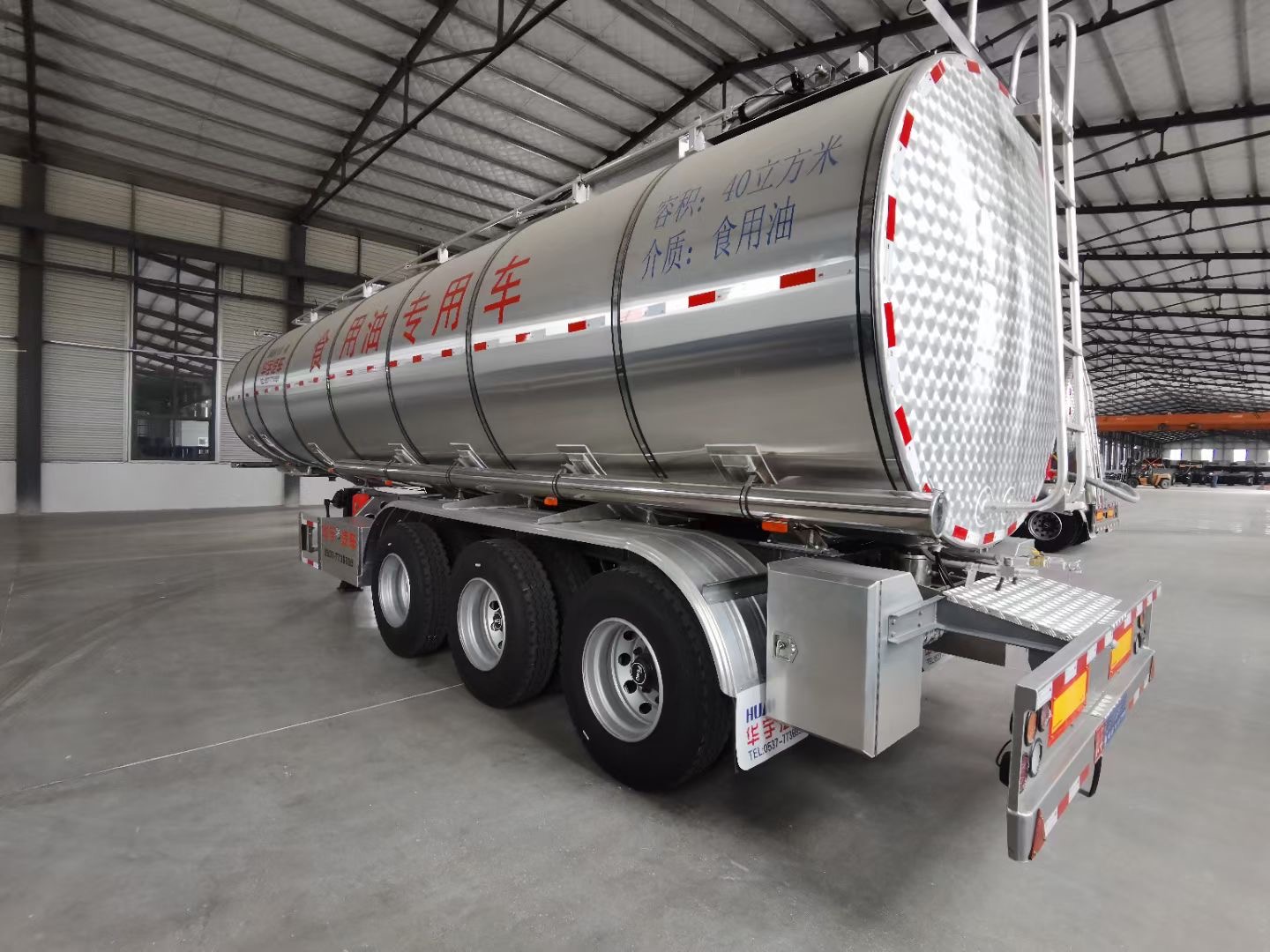
"Tank trailer" is a family name covering three cargo logics that do not compete with each other.
Liquid tankers carry petroleum products, chemicals, edible oil, water and bitumen. Capacity runs 20,000–50,000 L across 1–6 compartments, with barrel thickness of 5–8 mm in carbon steel (Q235B/Q345B), stainless steel 304/316 for food and chemical grades, or 5083 aluminium alloy for lightweight builds. Payload is 28,000–35,000 kg at a GVW of 40,000–42,000 kg on three 13-ton axles. Anti-static features — earthing reel and anti-static compartment separation — plus a DN500 top manhole, emergency valve and pressure vent define the safety envelope.
Powder tankers move dry bulk material pneumatically rather than by gravity. Tank volume is 32–60 m³, payload 25,000–35,000 kg, working pressure 0.196–0.2 MPa with a test pressure of 0.26 MPa. Discharge is compressed-air fluidized at 1.6 tons per minute, reaching up to 15 m vertically and 5 m horizontally, and the material specification is a particle size of 0.1 mm or finer. Carbon steel Q345B is standard, with 5083 aluminium alloy as a lightweight alternative.
CNG tube trailers are pressure vessels on a chassis rather than tanks in the conventional sense. Working pressure is 20–25 MPa, with 8, 10, 12, 16 or 20 tubes of 406–559 mm diameter and 6,000–12,000 mm length, a total water volume of 3,000–8,000 L and a gas capacity of 2,000–6,000 Nm³ at a GVW of 40,000–42,000 kg. Cylinders are 37Mn seamless steel, and the safety set includes pressure relief valves, emergency shutoff and an earthing reel.
Dump Semi Trailer: Axle Count Follows the Haul Cycle
A dump semi-trailer is the only type in this framework whose specification is driven primarily by the number of trips rather than by the cargo's shape. Payload capacity is 30–60 tons into a 20–40 m³ box, either U-shaped or rectangular, with a tipping angle of 45–50° and 8–12 mm wear-resistant floor steel, optionally HARDOX. Hydraulics are HYVA front-mounted or telescopic cylinders.
The axle question is the practical one. Two, three and four axle configurations are produced on the same basic architecture, and the correct count is a function of the legal axle-load ceiling on the route, the gradient on site, and the density of the material being hauled. A quad-axle configuration, for instance, is commonly chosen where dense ore and heavy-load road conditions make a three-axle layout marginal.
Coupling and Tractor Compatibility
Across all five types, the trailer-to-tractor interface is standardized enough to check quickly. Trailers are built with either a 2" or 3.5" king pin. Tractor units in the same supply ecosystem use a 90# fifth wheel with a 2" pin and a 20,000 kg fifth wheel capacity, with a fifth wheel height of 1,200–1,400 mm and a combination GCW range of 40,000–120,000 kg on one platform and 40,000–100,000 kg on another. Checking king pin size, fifth wheel capacity and GCW before specification prevents the most common late-stage problem: a trailer that is correct in isolation but incompatible with the fleet that will pull it.
Project Conditions: Two Documented Scenarios
Two operating patterns illustrate how the framework resolves in practice.
Urban construction material haulage. In Nigeria and Ghana, a common deployment uses a self-propelled dump truck in urban construction and local infrastructure work: building construction, urban road repair, municipal infrastructure and small-to-medium earthworks. The working conditions are restrictive — sites with limited access and a tight turning radius on mixed paved and unpaved surfaces, with short haul cycles of 500 m to 5 km. Each load carries 16–25 m³, and each vehicle completes 20–40 trips per shift in day-shift operation, on project-based deployments lasting weeks to months.
Multi-site mining and construction haulage. A second pattern uses quad axle dump semi trailers for heavy-duty mining and construction material haulage across multiple project sites, in a fleet of more than 50 vehicles. The distinguishing feature of this second scenario is not the trailer type but the axle configuration: the quad-axle build was specified for heavy-load mining conditions rather than taken from a standard catalogue line.
Where Each Type Stops Working
A comparison framework is only useful if it states boundaries. Each of the five types has a condition under which it should be excluded, and buyers who skip this step usually discover it after delivery.
- Lowboy: the same 450–600 mm loaded deck height that makes it valuable also reduces ground clearance. On unimproved, rutted or steeply ramped access roads, the lowboy that fits the cargo may not fit the route.
- Flatbed: an open deck offers no containment and no weather protection. Loose bulk material cannot be carried, and load security depends entirely on the tie-down discipline applied to the rings.
- Container chassis: restricted to ISO 20/40/45 ft units. It cannot serve non-containerized cargo, and it performs poorly in operations with a structural empty-return imbalance.
- Liquid tanker: compartmentalization that allows multiple product grades also reduces usable volume per compartment. Material compatibility — carbon steel versus stainless versus aluminium — is a hard constraint, and in Europe the transport of dangerous goods in fuel and tank trailers requires ADR certification under the ADR Agreement.
- Powder tanker: limited to dry, free-flowing material of 0.1 mm particle size or finer, and dependent on a compressed-air source at both ends. Wet, cohesive or coarse material cannot be discharged pneumatically.
- CNG tube trailer: a gas distribution asset, not a general cargo asset. It requires decompression and regulation infrastructure at the receiving end, which is a project-level requirement rather than a trailer-level one.
- Dump semi-trailer: a 45–50° tipping angle requires stable, reasonably level ground. Tipping on soft or side-sloped surfaces is a stability risk regardless of payload rating.
The summary conclusion is that no single trailer type covers a mixed operation. Fleet buyers should expect to run a type mix, and should evaluate suppliers on their ability to support that mix rather than on a single-model price.
Manufacturing and Supply Considerations: Luen Auto
Shandong Luen Automobile Co., Ltd. is a trailer and used special-purpose vehicle manufacturer and exporter based at Xuji Industrial Park, Liangshan County, Jining City, Shandong Province, China, and a subsidiary of Luen Group. Its trailer line covers exactly the five families discussed here — lowbed semi trailers, flatbed semi trailers, dump semi trailers, skeleton semi trailers and van semi trailers, plus fuel tank, dust tank and CNG tank trailers — alongside tractor trucks, dump trucks and light duty trucks.
From a procurement standpoint, several verifiable characteristics are relevant to the type-selection process above:
- A factory area of more than 50,000 m² with 130+ employees and annual output of approximately 1,500 units, of which roughly 80% is exported.
- Factory-direct manufacturing rather than trading, with OEM production and full vehicle customization covering trailer type, overall dimensions, axle configuration, load rating, beam structure, suspension type, rim and tire specification, landing gear, king pin, paint and coating, and branding.
- A minimum order quantity of 1 unit for standard models, which allows a buyer to validate a new type with a single unit before committing a fleet.
- Lead time of 30–45 days for standard configurations, with custom orders scheduled according to specification complexity.
- 100% factory inspection before shipment, with in-house testing equipment covering load testing, brake performance testing and dimensional verification, and products passed China National Certification and Accreditation Supervision mandatory certification.
- After-sales terms of 1-year warranty on new trucks with local Sinortuk agent service points for on-site repair, 6-month warranty on trailer driving and supporting devices, and 1-year warranty on trailer carrying devices, supported by a multilingual WhatsApp support channel.
The company's export markets are concentrated in Africa (Nigeria, Ghana, Tanzania, Kenya, Mozambique), Southeast Asia (Indonesia, Philippines), Central Asia (Kazakhstan), the Middle East (Saudi Arabia, UAE), Latin America (Ecuador, Peru) and South Asia (Pakistan) — a distribution that matters because the type mix that suits mining haulage in West Africa is not the same as the mix that suits intermodal container movements in the Gulf.
One case record illustrates the practical value of that breadth. A construction and mining operator in Nigeria and Ghana with a fleet of more than 50 vehicles, using quad axle dump semi trailers for heavy-duty mining and construction material haulage across multiple sites, escalated from purchasing trailer parts to whole-vehicle procurement. The recorded service life for the deployment is 10–15 years, which the company compares to entry-level European trailer brands at a materially lower purchase cost. That comparison is a supplier-recorded figure rather than an independently audited one, and buyers evaluating cost of ownership should treat it as a claim to verify against their own duty cycle, financing cost and aftermarket availability.
Market Signals Behind the Type Decision
Two supply-side signals support the argument that type breadth has become a buyer criterion rather than a marketing feature. Sinotruk (CNHTC) dominated China's heavy-duty truck exports in 2024 with a record 135,000 units, while Shacman heavy-truck exports reached 25,000 units in the same year, a 35% year-on-year increase. Because tractor units and semi-trailers are sold into the same fleet decision, that export volume implies a corresponding expansion in the number of buyers simultaneously evaluating more than one trailer type.
On the demand side, the global used truck market was valued at USD 49.95 billion in 2025 and is dominated by heavy-duty segments, which means a meaningful share of type decisions are now made against a mixed new-and-used asset base. Regulation reinforces the pattern: US Department of Transportation rules mandate annual safety inspections for trailers with a GVWR over 10,001 lbs under 49 CFR 396.17, and Europe requires ADR certification for fuel and tank trailer transport of dangerous goods. Both push buyers toward fewer, better-understood types rather than a wide, unfamiliar fleet.
What Changes Over the Next Buying Cycle
Three shifts are likely to reshape how the framework above is applied.
First, the lowboy's already dominant 25.7% share of the 2024 semi-trailer market points to continued concentration in heavy-haul and project-cargo demand, where deck height and payload — not price per unit — decide specification. Second, alternative fuel logistics, particularly CNG tube trailer volumes of 2,000–6,000 Nm³ at 20–25 MPa, will keep introducing buyers to a type whose constraints are project-level rather than vehicle-level, which places a premium on suppliers who can explain the receiving-end requirement. Third, customization is becoming the default rather than the exception: when axle configuration, beam structure and dimensions are routinely specified per project, the supplier selection process shifts toward engineering responsiveness and documentation quality, and away from catalogue matching.
For buyers, the practical implication is unchanged. Screen on cargo form, mass and volume, dimension envelope, route constraints and discharge conditions first. Then — and only then — compare suppliers on the specifications that survived the screen.
FAQ
How do I decide between a flatbed and a lowboy semi-trailer for the same project cargo?
Decide on loaded height. A flatbed semi-trailer has a deck height of 1,250–1,550 mm, while a lowboy has a loaded deck height of 450–600 mm and carries cargo up to a maximum legal load height of up to 3.5 m. If the cargo fits within the flatbed's height envelope and payload of 40–60 tons, the flatbed is usually the simpler and lower-cost option. If height is the binding constraint, the lowboy's 40–100 ton payload range and lower deck become necessary.
When is a container chassis a better choice than a flatbed?
When every load is an ISO container. A skeleton chassis is specified around 20 ft, 40 ft and 45 ft ISO geometry with 4, 6 or 8 twist locks compliant with ISO 1161, and offers a payload of 30–65 tons on 2, 3 or 4 axles at 13 tons per axle. Because it has no continuous deck, it cannot carry non-containerized cargo — so it is the correct choice only where containerized movements dominate, such as port terminal operations, intermodal transport and container freight stations.
How do I choose between a liquid tank, a powder tank and a CNG tube trailer?
The three are separated by cargo state and discharge method rather than by preference. A liquid tanker carries 20,000–50,000 L in 1–6 compartments with a payload of 28,000–35,000 kg at a GVW of 40,000–42,000 kg, discharged by bottom valve, pump or pneumatically. A powder tanker carries 32–60 m³ at a payload of 25,000–35,000 kg and discharges pneumatically at 0.196–0.2 MPa working pressure, limited to dry material of 0.1 mm particle size or finer. A CNG tube trailer carries 2,000–6,000 Nm³ of gas at 20–25 MPa and requires decompression infrastructure at the receiving end.
How many axles should a dump semi-trailer have for a given site?
Axle count is set by the route's legal axle-load ceiling and the material density, not by the trailer's maximum rating. Dump semi-trailers are built in 2, 3 and 4 axle configurations on a shared architecture with a reference axle load of 13 tons per axle and a payload range of 30–60 tons into a 20–40 m³ box. Where dense material and heavy-load road conditions make a three-axle layout marginal, a quad-axle configuration is typically specified, as in a Nigeria and Ghana fleet of more than 50 vehicles used for heavy-duty mining and construction haulage across multiple project sites.
What limits a single trailer type from covering an entire operation?
Fixed geometry. A flatbed cannot contain loose bulk, a container chassis accepts only ISO containers, a powder tanker requires dry free-flowing material of 0.1 mm or finer, a CNG tube trailer depends on receiving-end pressure regulation, a lowboy's 450–600 mm deck height reduces ground clearance on poor access roads, and a dump trailer's 45–50° tipping angle requires stable ground. Mixed operations therefore generally require a type mix rather than a single universal unit.
Which specifications are worth checking across all five types before requesting quotations?
Four items are common to every type and should be confirmed first: king pin size (2" or 3.5"), fifth wheel capacity (a 90# fifth wheel is rated at 20,000 kg), the tractor combination GCW applicable to the fleet, and the legal axle-load ceiling on the intended route. Trailer-specific figures such as deck height, tank volume, box volume, twist-lock count and axle configuration follow after those four are fixed.
For buyers who want to review the full range of semi-trailers, tankers and trucks referenced in this framework in one document, the Luen Auto product catalogue is available as a public PDF download: Luen Auto Product Catalog. Manufacturer information is also published at luen-trailertruck.com.
Есть вопросы или нужны дополнительные детали?
Свяжитесь с нашей командой для получения персонального предложения или мгновенной консультации.
Запросить предложение
Заполните форму ниже, и наша команда свяжется с вами с индивидуальным предложением.
Прямой чат WhatsApp
Предпочитаете общаться в реальном времени? Напишите нам в WhatsApp для мгновенной помощи и быстрых ответов.
- Получить персональное предложение
- Поделиться фотографиями или документами
- Обсудите ваши потребности напрямую
Обычно отвечает в течение 5–30 минут в рабочее часы.