
Tube Laser Cutting: Policy, Capacity and Technology Trends
INDUSTRY REFERENCE · TUBE AND STEEL TUBE CUTTING
The global laser cutting machine market is projected to grow from USD 7.44 billion in 2026 to USD 18.43 billion by 2034, at a CAGR of 12% (Fortune Business Insights). Fiber laser systems already hold more than 55% of industrial laser system share, displacing CO2 platforms on the strength of 30–50% higher efficiency and roughly 50% lower operating costs (SNS Insider).
That growth is usually discussed in terms of flat sheet. Steel tube cutting is a separate engineering discipline. A tube is a long, hollow lever: it must be clamped at two, three or four points, rotated continuously, and supported along 6.5 to 12.5 metres of stock while the cutting head holds contour accuracy on a curved surface. The laser source is one variable. The mechanical handling system, and the regulatory file accepted by the destination country, are the others.
This reference examines how tube laser cutting is evolving across key manufacturing markets through three verifiable lenses: country-level policy environments, production capacity and export patterns, and the technology that determines whether a published accuracy figure survives contact with real production.
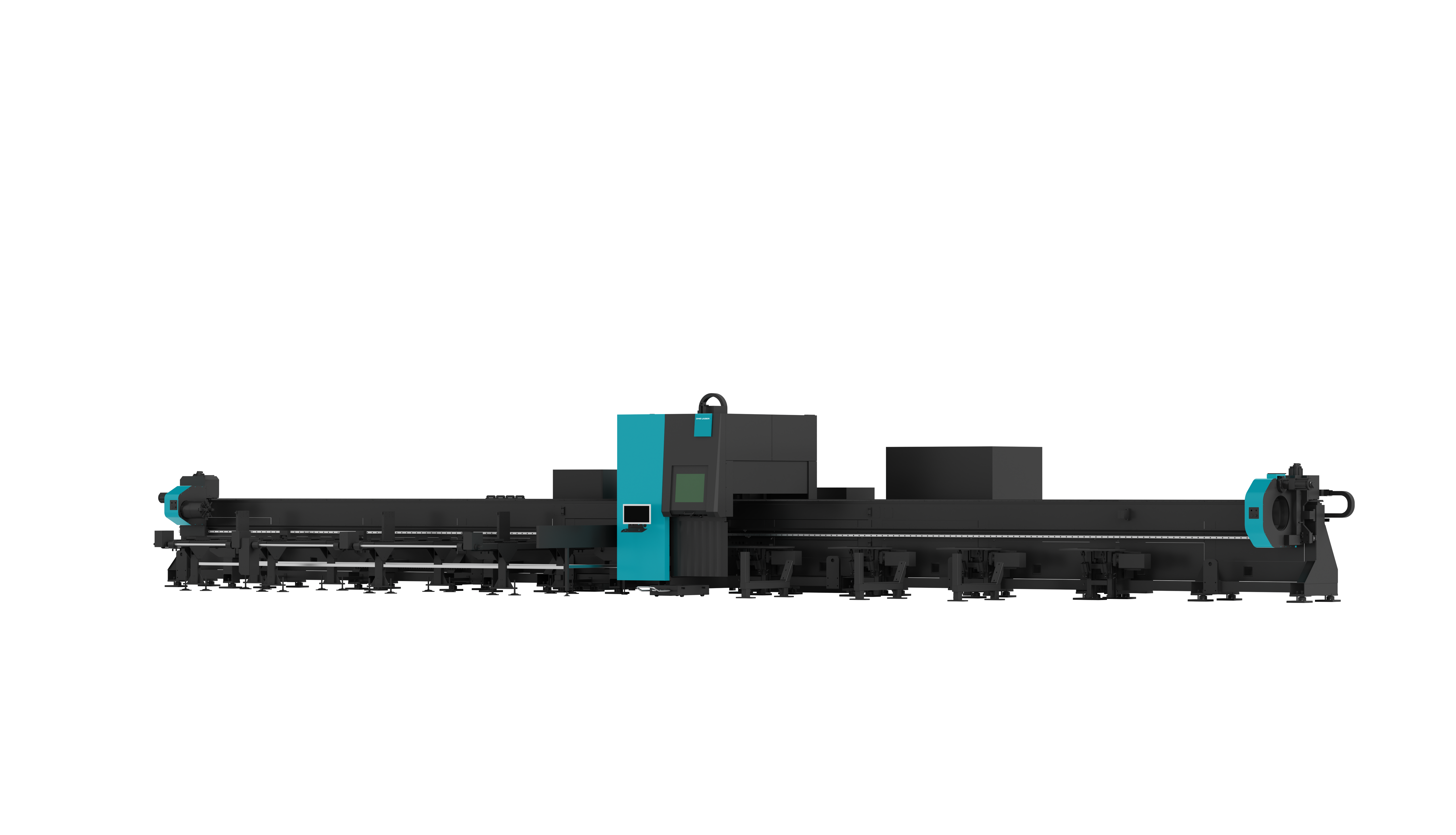
A tube laser cutting platform must clamp, rotate and support long steel tube stock while holding contour accuracy along the full length of the workpiece.
Why Steel Tube Cutting Is Not Plate Cutting
Plate cutting and tube cutting share a laser source but almost nothing else. On sheet, the material sits flat and static on a bed, the standoff between nozzle and workpiece is constant, and the risk of a failed cut is usually limited to one part. On tube, the workpiece is a rotating body whose effective support conditions change as the chuck turns, whose wall can deflect under its own weight across a long span, and whose scrap cost is measured in metres of stock rather than a single blank.
The practical implications are visible in the specification envelope. The D-Tube fiber tube laser cutting machine series from DNE LASER covers round tube from Φ8 mm to Φ510 mm and square tube from □8×8 mm to □510×510 mm, with loading lengths of 6.5 m, 9.2 m and 12.5 m and unloading lengths from 2 m to 12.2 m. Chuck configurations range from two to four chucks, and theoretical maximum chuck load rises with the model — 100 kg and 300 kg on the smaller D-Tube F configurations, 300 kg on the D-Tube 240, 1,200 kg on the D-Tube 360, and 1,500 kg on the D-Tube 520.
Two consequences follow. First, machine selection starts with the tube rather than with the laser: diameter, wall thickness, weight per metre and required end geometry narrow the model range before power is discussed at all. Second, accuracy is a system property. The published positioning accuracy of ±0.05 mm/m and repeated positioning accuracy of ±0.03 mm/m across the D-Tube range is meaningful only if the clamping and support system prevents the tube from moving, sagging or vibrating during the cut.
Country Policy Environments Differ More Than Buyers Expect
Tube laser cutting machines are electrical, optical and mechanical systems, and the legal route to market differs by country. Buyers evaluating a platform for a specific destination should read the compliance file as a scope document, not a badge.
European Union: machinery and laser safety standards
For the EU market, laser tube cutting machines are assessed against EN 60204-1:2018 (electrical equipment of machines), EN ISO 11553-1:2020+A11:2020 (laser processing machines — general safety requirements) and EN ISO 12100:2010 (risk assessment and risk reduction). DNE LASER holds an SGS-issued Verification of MD Compliance, certificate number MD GZES2510019556MD, issued 28 November 2025, covering the Laser Tube Cutting Machine D-Tube 1660/2460/2860/3660/2490/2890/3690 K2/K3-CE.
United States: UL and CSA acceptance
The North American route runs through a different standard set. The D-Tube series holds a Certificate of Compliance, number SGSNA/24/GZ/00242X, issued 28 November 2025, assessed against UL 508A, 3rd Edition, dated 24 April 2018, revision 21 July 2022, and CSA C22.2 No.286:23, dated April 2023, covering the D-Tube 1660/2460/2860/3660/2490/2890/3690 K2/K3 models.
At the international level, ISO 11553-1 and IEC 60825-1 set the general safety and equipment classification baseline that underpins CE marking and cross-border trade in laser processing machines.
Buyer interpretation: certification scope is model-specific. A CE or UL file granted for a flat-bed laser cutting machine does not transfer automatically to a tube platform, and adding an uncertified model to a project changes the compliance path. The certificate number, the issuing authority, the standard revision dates and the listed model codes are the four items worth verifying before a purchase order is issued.
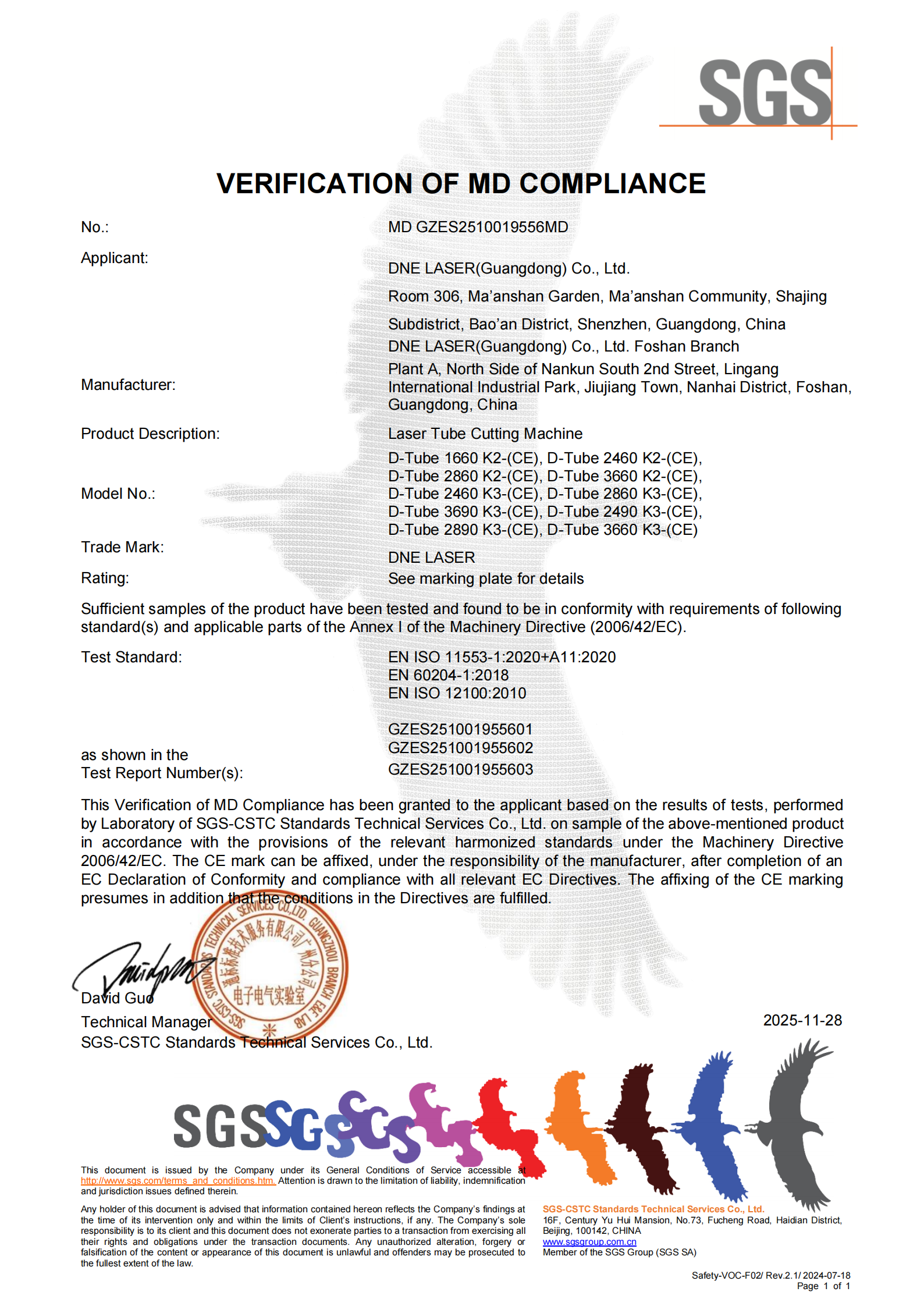
SGS-issued Verification of MD Compliance for the D-Tube laser tube cutting machine series, assessed against EN 60204-1:2018, EN ISO 11553-1:2020+A11:2020 and EN ISO 12100:2010.
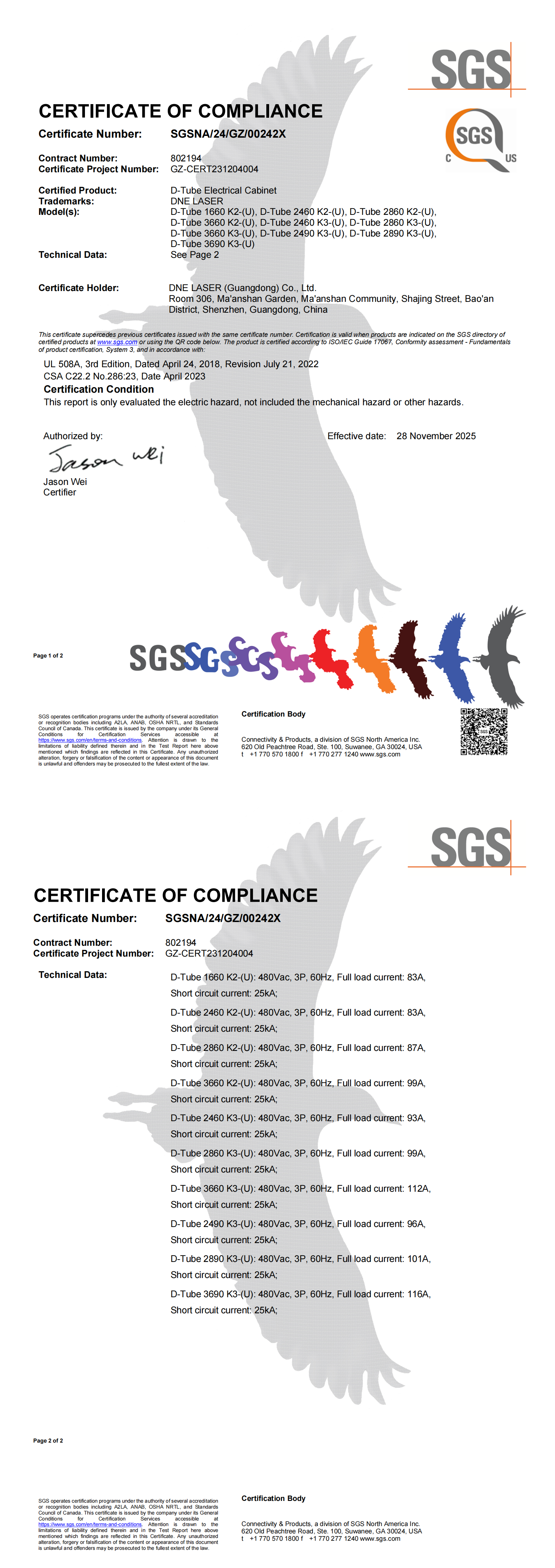
Certificate of Compliance for the D-Tube series against UL 508A, 3rd Edition and CSA C22.2 No.286:23 for the United States market.
Capacity Shifts: Where Tube Processing Volume Is Moving
Supply capacity in laser equipment is no longer evenly distributed. China's laser equipment market revenue accounted for 56.6% of the global total in 2024, with localization of high-power laser components exceeding 70% (IT Home / CCTV Finance). That concentration matters for tube processing because it compresses the component supply chain that tube platforms depend on — laser sources, cutting heads, precision guideways and chuck assemblies.
DNE LASER (Guangdong) Co., Ltd., operating under the brand DNE LASER, is a wholly owned subsidiary of the Swiss Bystronic Group, headquartered in Shenzhen with its production base in Nanhai, Foshan. Founded in 2008, the company reports a factory area of more than 60,000 m², more than 600 employees, an annual output of 2,000+ units, and an R&D team of 38 engineers. Exports represent approximately 45% of output, with declared markets spanning Europe, North America, the Middle East, Africa, South and Southeast Asia, and Latin America.
Capacity, however, is better judged by deployment behaviour than by floor area. Two documented tube-related deployments illustrate the pattern. In Vietnam, an automotive parts manufacturer installed nine units — including the D-Soar fiber laser cutting machine and the D-Tube 240 tube laser cutting machine — for automobile parts and components manufacturing; after one year of operation, the reported result was a 15% improvement in production efficiency, with faster cutting speed, low maintenance and long service life cited as the leading characteristics. In Mexico, an industrial automation client working in intelligent equipment and precision structural parts, including data infrastructure and logistics automation, installed six units of the D-Giant platform alongside the D-Tube 360; three sets had been in service for three years when three additional new sets were purchased, again with a reported 15% improvement in production efficiency.
The second pattern is the one to watch. Repeat procurement after a three-year operating interval is a capacity signal that output statistics cannot reproduce, because it reflects maintenance burden, uptime and process stability measured by the operator rather than the supplier.
Technical Explanation: What Determines Risk Control in Tube Processing
Risk in tube processing is concentrated in a small number of mechanical interfaces, and these are the components that decide whether a declared accuracy figure is reproducible hundreds of tubes into a production run.
High-precision linear guideways. The cutting head and the machine axes travel continuously, and any play, wear or thermal drift in the guide system translates directly into contour error along the tube. Rigidity and repeatability of the linear motion system therefore set the ceiling on achievable accuracy, regardless of laser power.
Automatic centering chucks with sealed designs. Chuck jaws must locate the tube on its true centre so that rotation is concentric; any eccentricity is amplified along the workpiece. Tube cutting also produces fine metallic dust and spatter, so sealing against contamination is a durability issue as much as an accuracy issue — a chuck that loses concentricity after months of production has effectively removed the accuracy claimed at commissioning.
Synchronized auxiliary support devices. A 12.5 m tube with a significant weight per metre cannot be supported at the chucks alone without deflection. Auxiliary supports that travel in synchronization with the cutting process keep the tube stable between clamping points, which is what allows heavy-wall stock to be processed without sacrificing the cut quality that the machine is specified to deliver.
The specification envelope that results from these three interfaces is summarised below. Positioning accuracy of ±0.05 mm/m and repeated positioning accuracy of ±0.03 mm/m are consistent across the series; what changes is how much tube weight and length the platform is built to carry.
| Model | Chuck options | Round tube (mm) | Square tube (mm) | Max. theoretical chuck load | Loading length |
|---|---|---|---|---|---|
| D-Tube F (120 / 240 / 360) | 2 | Φ8–Φ120 / Φ12–Φ240 / Φ40–Φ350 | □8×8–□120×120 / □12×12–□240×240 / □40×40–□350×350 | 100 kg / 300 kg / 1,000 kg | 6.5 m |
| D-Tube 240 | 2 or 3 | Φ15–Φ230 | □15×15–□230×230 | 300 kg | 6.5 m / 9.2 m / 12.5 m |
| D-Tube 360 | 2, 3 or 4 | Φ40–Φ350 | □40×40–□350×350 | 1,200 kg | 6.5 m / 9.2 m / 12.5 m |
| D-Tube 520 | 3 or 4 | Φ50–Φ510 | □50×50–□510×510 | 1,500 kg | 12.5 m |
All models: X/Y positioning accuracy ±0.05 mm/m; X/Y repeated positioning accuracy ±0.03 mm/m; bevel cutting function optional.
High-Power Fiber Lasers: Context from Thick Plate Processing
Tube platforms do not operate in isolation from the wider fiber laser market, and the direction of travel in sheet processing is a useful indicator of where drive, control and source technology is heading.
Demand for ultra-high-power laser heads (10 kW and above) increased by 75% between 2023 and 2024, driven by thick-plate cutting requirements in heavy industry. On the machine side, the D-Soar fiber laser cutting machine supports laser sources from 3,000 W to 30,000 W across formats 1530, 1540, 2040, 2060, 2560 and 2580, with X/Y maximum linkage acceleration of 1.2 G, positioning accuracy of ±0.05 mm and repeated positioning accuracy of ±0.03 mm. Higher configurations extend further: the D-Soar Plus-G is specified to 40,000 W, and the D-Giant F series lists configurations up to 80,000 W for large-format plate work.
The relevance to steel tube cutting is indirect but real. High-power fiber sources have displaced CO2 in industrial laser systems on efficiency and cost grounds — fiber lasers now hold more than 55% of that market, with 30–50% higher efficiency and approximately 50% lower operating costs. The same source platforms, drive systems and control architecture that support 30 kW plate cutting also define the component ecosystem available to tube machine builders, which is why tube platforms increasingly inherit motion control and automation capabilities developed for high-power sheet applications.
For tube cutting specifically, laser power is a configurable parameter rather than a fixed attribute: it is one of the customization dimensions available on the tube product line, alongside cutting range and tube specification compatibility.
From Evaluation to Execution: A Deployment Framework for Tube Platforms
For buyers moving from evaluation into execution, HVQ-3 capability questions — what can be configured, what can be tested, and what can be delivered — are answered at three levels.
1. Configuration and customization
DNE LASER operates in-house R&D, manufacturing and direct sales for industrial equipment customization, and provides OEM and ODM production services for tube laser cutting machines, together with customized tube processing solution design. On the tube line, customization covers chuck type and quantity, laser power, loading and unloading system configuration, bevel cutting function, and cutting range and tube specification compatibility. Across the broader product portfolio — laser cutting machines, tube laser cutting machines, press brakes, automatic devices, laser welding machines and software — customization options include cutting format (working area), laser power, cutting head focal length, laser source fiber core diameter, machine configuration and automation integration solutions. The minimum order quantity is one unit.
2. Quality control and verification
Documented quality control for the tube line runs through full-process factory performance testing, chuck and cutting accuracy calibration, a continuous operation trial run of the complete machine, compliance verification of core component brands, and testing in accordance with industrial tube cutting equipment safety requirements. For a buyer, these are the checkpoints to witness or to request evidence of, because they are the steps that convert a specification sheet into an operating machine.
3. Commercial and acceptance terms
Purchasing terms are market-specific. Delivery terms are recorded as FOB/CIF for Vietnam and FOB/CIF/EXW/DDP/DAP for Mexico. Acceptance criteria follow a two-stage model: on-site inspection at the supplier's factory, followed by commissioning at the buyer's factory. Payment terms are 20% or 30% as deposit, with the balance paid before shipping.
4. Post-installation support
After-sales coverage for tube platforms is documented as remote technical support and troubleshooting; on-site installation, commissioning and operator training; scheduled maintenance services; core component warranty; and lifetime technical upgrades and process optimization support.
Comparison with Traditional Tube Processing — and Its Boundaries
Fiber laser tube cutting is not the only way to process steel tube. Conventional routes combine sawing, drilling, milling and manual finishing, and they remain competitive where volumes are low, tolerances are loose, or the required geometry is simple. Laser tube cutting replaces several of those setups with a single pass and removes tooling changes between hole patterns, which is where the efficiency gains reported by operators come from.
The trade-offs are equally specific, and buyers should treat them as selection constraints rather than objections:
Chuck load sets the ceiling. The D-Tube F configuration with a 120 mm round tube range has a theoretical maximum chuck load of 100 kg, while the D-Tube 520 supports up to 1,500 kg. Heavy-wall or large-diameter tube stock cannot simply be moved onto a smaller platform, and the accuracy figures do not change the load limit.
Bevel cutting is optional, not standard. The bevel cutting function is listed as optional across the D-Tube series. Projects that assume angled end preparation as a baseline capability need to confirm it at configuration stage.
Power draw scales with configuration. On the plate side, complete-machine power consumption runs from ≤30 kW at 3,000 W to ≤135 kW at 30,000 W on the D-Soar series, and from ≤60 kW to ≤150 kW on the D-Soar Plus-G. Electrical infrastructure planning belongs in the evaluation stage, not in installation.
Higher power is not automatically better for thin-wall tube. The 75% growth in 10 kW-plus laser head demand is driven by thick-plate work in heavy industry. Thin-wall tube processing is governed more by heat input management, support stability and clamping quality than by maximum source power.
Certification scope is model-specific. Compliance files list specific model codes. A project that specifies a model outside the listed scope changes the regulatory timeline.
Future Outlook
Three trajectories appear likely to shape tube laser cutting through 2034. The first is volume: a 12% CAGR to USD 18.43 billion in the overall laser cutting machine market implies sustained investment in cutting capacity, of which tube processing is a growing share as steel structures, automotive parts, machinery, kitchenware and environmental protection equipment demand more formed tube components.
The second is regulatory divergence. Europe and North America already run parallel compliance routes — EN standards with a machinery directive verification path on one side, UL 508A and CSA C22.2 No.286 on the other — and suppliers that hold both files for the same tube platform reduce a buyer's market-entry work rather than merely their machine risk.
The third is the migration of high-power sheet technology into tube platforms. As fiber sources above 10 kW become routine in heavy industry, the motion control, automation and diagnostics developed for those systems will continue to move into tube equipment, where the limiting factor remains mechanical: how precisely a long steel tube can be held, and how consistently it can be held for years.
Frequently Asked Questions
Which tube laser cutting machines can be supplied under OEM or ODM arrangements, and what can be customized?
OEM (Original Equipment Manufacturer) and ODM (Original Design Manufacturer) production services are available for tube laser cutting machines, alongside customized tube processing solution design. Production modes therefore include OEM, ODM and customized solution design. Customization options on the tube line include chuck type and quantity, laser power, loading and unloading system configuration, bevel cutting function, and cutting range and tube specification compatibility. The minimum order quantity is one unit.
What tube diameters, shapes and weights can a tube laser cutting machine handle?
The D-Tube series covers round tube from Φ8 mm to Φ510 mm and square tube from □8×8 mm to □510×510 mm, depending on model. Chuck configurations range from two to four chucks, with theoretical maximum chuck load from 100 kg to 1,500 kg: 100 kg and 300 kg across the D-Tube F configurations, 300 kg on the D-Tube 240, 1,200 kg on the D-Tube 360 and 1,500 kg on the D-Tube 520. Loading lengths are 6.5 m, 9.2 m and 12.5 m, with unloading lengths from 2 m to 12.2 m. X/Y positioning accuracy is ±0.05 mm/m and repeated positioning accuracy is ±0.03 mm/m across the range. Bevel cutting is an optional function.
What compliance evidence should a buyer expect for the EU or the United States?
For the EU, laser tube cutting machines are assessed against EN 60204-1:2018, EN ISO 11553-1:2020+A11:2020 and EN ISO 12100:2010, with compliance verified through a machinery directive verification of compliance. DNE LASER holds certificate MD GZES2510019556MD, issued by SGS on 28 November 2025, covering the Laser Tube Cutting Machine D-Tube 1660/2460/2860/3660/2490/2890/3690 K2/K3-CE. For the United States, the D-Tube series holds Certificate of Compliance SGSNA/24/GZ/00242X, issued 28 November 2025, assessed against UL 508A, 3rd Edition dated 24 April 2018, revision 21 July 2022, and CSA C22.2 No.286:23 dated April 2023. Internationally, ISO 11553-1 and IEC 60825-1 define the general laser processing safety and equipment classification baseline.
What are the purchasing terms and acceptance criteria?
The minimum order quantity is one unit. Delivery terms are recorded as FOB/CIF for Vietnam and FOB/CIF/EXW/DDP/DAP for Mexico. Acceptance follows two stages: on-site inspection at the supplier's factory, followed by commissioning at the buyer's factory. Payment terms are 20% or 30% as a deposit, with the balance paid before shipping.
What quality control and after-sales support apply to a tube laser cutting machine deployment?
Quality control for the tube product line comprises full-process factory performance testing, chuck and cutting accuracy calibration, a continuous operation trial run of the complete machine, compliance verification of core component brands, and testing in accordance with industrial tube cutting equipment safety requirements. After-sales support includes remote technical support and troubleshooting; on-site installation, commissioning and operator training; scheduled maintenance services; core component warranty; and lifetime technical upgrades and process optimization support.
Reference Document
For readers who need the full technical and corporate overview — including the complete product range of laser cutting machines, tube laser cutting machines, press brakes, automatic devices, laser welding machines and software — the DNE LASER introduction document is available here: Introduction of DNE Laser V1.0 (PDF).
Third-party data referenced: Fortune Business Insights (laser cutting machines market, USD 7.44B in 2026 to USD 18.43B by 2034, CAGR 12%); SNS Insider (fiber laser share above 55%, 30–50% higher efficiency, approximately 50% lower operating costs versus CO2); IT Home / CCTV Finance (China 56.6% of global laser equipment revenue in 2024; high-power laser localization above 70%); Customcy (10 kW-plus laser head demand, +75% between 2023 and 2024); ISO / EN standards (ISO 11553-1, IEC 60825-1).