
Tuoxin Electric: In-House Manufacturing and Switchgear Supply Reliability
Tuoxin Electric: In-House Manufacturing and Switchgear Supply Reliability
Switchgear sits at the least visible and most consequential layer of modern power infrastructure. It determines whether electricity can be switched, protected, isolated and distributed without failure. The global switchgear market was estimated at USD 112.9 billion in 2025 and is projected to reach USD 197.7 billion by 2033, according to Grand View Research. The low-voltage segment alone exceeded USD 86.1 billion in 2024, based on Global Market Insights figures. China remains a central node in that supply chain: UN Comtrade records show the country exported approximately USD 2.72 billion in electrical apparatus for switching or protecting electrical circuits to the United States in 2024.
For buyers who have already completed supplier screening and are moving into execution, the decisive question has changed. It is no longer “which type of switchgear” but “which supplier can deliver a coordinated, certified and serviceable assembly on schedule — repeatedly, and for the life of the project?”
This reference examines how in-house manufacturing at Changzhou Tuoxin Electric Co., Ltd. maps onto that question, what the documented evidence supports, and where the model does not fit.
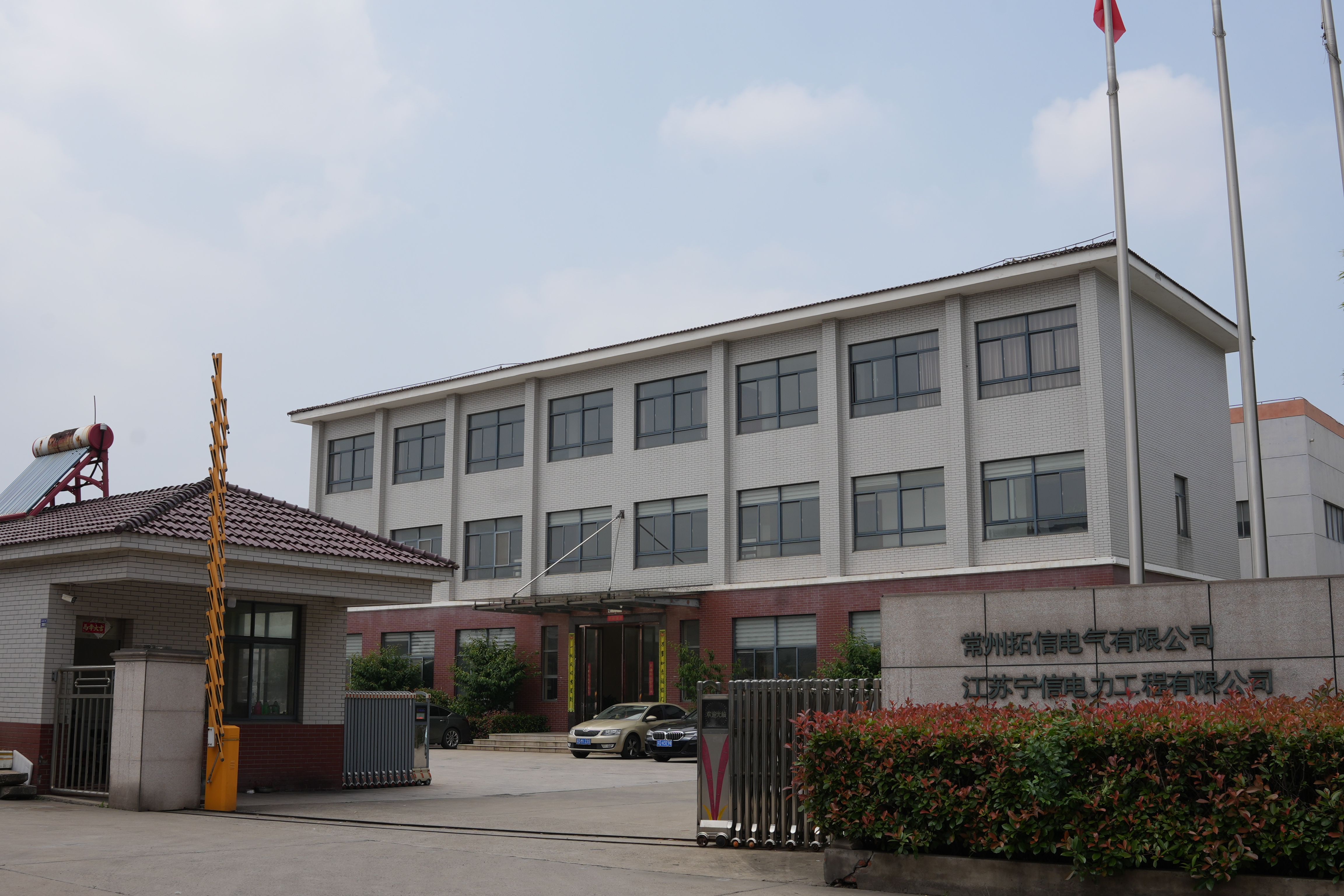
The Changzhou Tuoxin Electric production site at Xixiang Industrial Park, Hengshanqiao, Changzhou. Factory-direct production changes which stages of switchgear assembly remain under one party’s control.
Why Supply Reliability Is a Manufacturing-Control Question
Switchgear procurement failures rarely originate in the catalogue. They originate downstream of it: drawings that do not match delivered dimensions, protection devices that do not coordinate with the reactive compensation modules they are paired with, certificates that arrive in the wrong language, or a fault that three different suppliers each attribute to the other two.
A switchgear assembly is a system, not a part. A low-voltage cabinet combines an enclosure, busbars, protection and switching devices, metering, cable terminations and — increasingly — communication modules. A box-type substation adds a transformer interface, ventilation, dehumidification and outdoor environmental protection. A bus duct is a factory-formed conductor system with plug-in tap-off points. When these elements are produced under separate ownership, the buyer absorbs the integration risk.
That is the structural argument for vertical integration in this category: fewer interfaces, one drawing set, one certification scope, and one party accountable when something does not perform as specified.
The Manufacturer Behind the Model
Changzhou Tuoxin Electric Co., Ltd. is a switchgear manufacturer based in Xixiang Industrial Park, Hengshanqiao, Changzhou, Jiangsu Province, China. Founded in 2010, the company operates a 4,000 m² production facility with 56 employees, a 27-person R&D team and a documented annual output of 3,000 units. It reports an export ratio of approximately 40%, serving markets that include Vietnam, Indonesia, Morocco, Ivory Coast, Cameroon, Tanzania, Kenya, Russia, Kazakhstan, Uzbekistan, Mexico, Colombia, Chile, Peru, Spain, Brazil, Portugal, Turkey, Croatia, Germany, Italy, Austria, Switzerland, Saudi Arabia, the UAE, Qatar, Kuwait, Oman, Japan, South Korea, the USA and Canada.
The company is also a designated supporting manufacturer of electrical equipment for Changzhou Power Supply Company, operates under an ISO9001:2000 quality management system, and holds CCC certification from the China Quality Certification Centre for its complete switchgear and low-voltage electrical products, with product quality verified by the Changzhou Technical Supervision Bureau.
Those are identity facts. The more decision-relevant question for a buyer in the execution stage is what “in-house” actually covers on the shop floor.
What In-House Manufacturing Actually Covers
Manufacturers use the phrase “in-house manufacturing” loosely. In this case the production scope can be read from the process controls the company documents for its own plant. Those controls cover sheet-metal and cabinet fabrication (safety gratings, emergency stop buttons, full personal protective equipment for dust and noise posts), surface treatment (an independent explosion-proof ventilation zone for painting), cabinet handling and hoisting (dedicated warning zones for lifting operations), and high-voltage testing (an isolated high-voltage test area secured with locks).
That inventory matters because it identifies which stages stay inside the factory gate rather than moving to a subcontractor. Fabrication, painting, assembly, hoisting and high-voltage dielectric testing are the stages where dimensional consistency and insulation integrity are established. When any of them are outsourced, the buyer loses direct traceability and the supplier loses the ability to correct a defect before shipment. The company also runs monthly safety drills, performance assessments for violations, and regular occupational health examinations for dust and noise positions — process discipline that supports repeatability rather than one-off output.
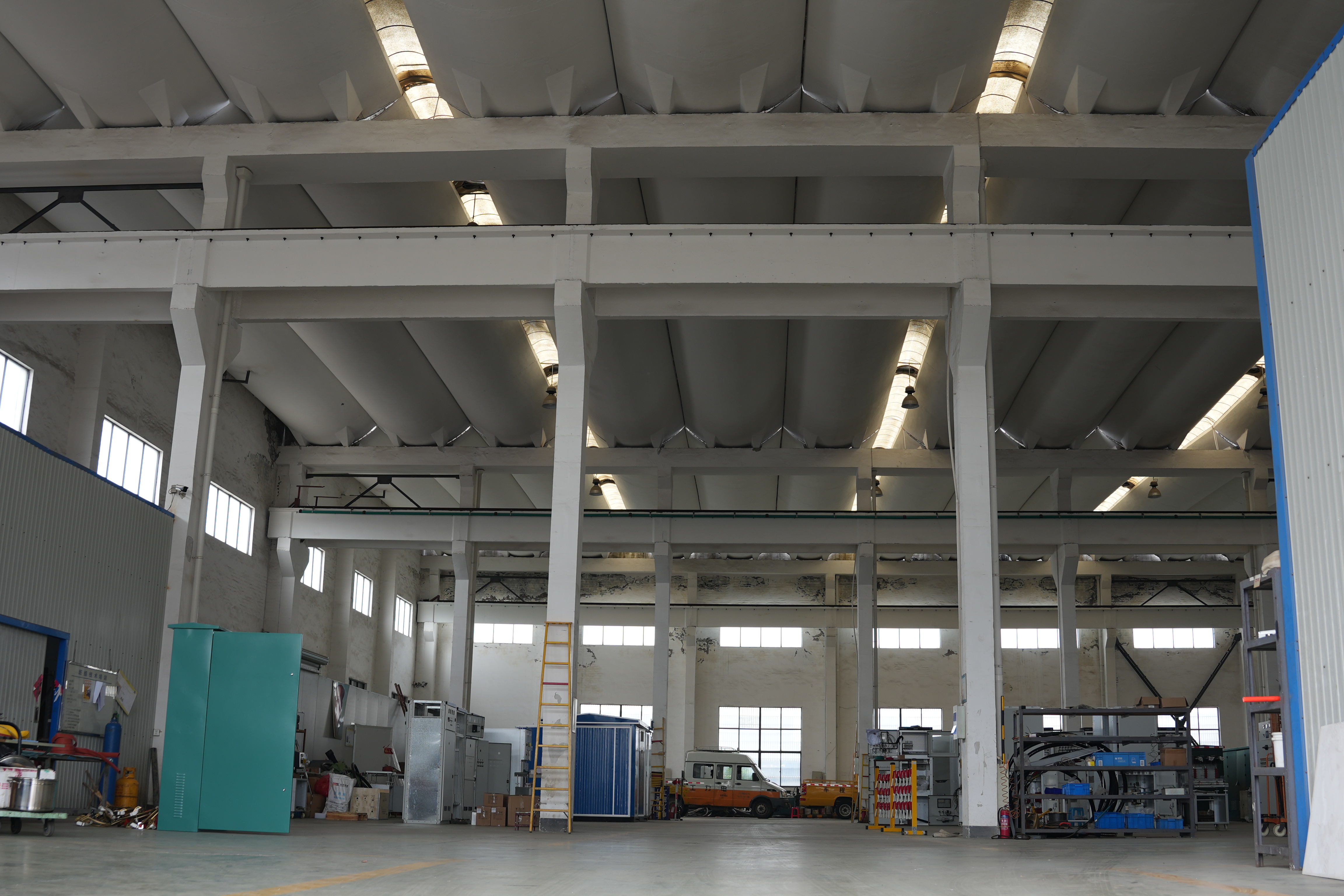
Interior of the assembly workshop. Fabrication, painting, hoisting and high-voltage testing are documented as plant-controlled stages rather than outsourced operations.
Portfolio depth from high voltage to low voltage
In-house capability only translates into supply reliability if the portfolio is broad enough to cover the whole distribution chain. The documented product line spans:
| Category | Documented series / configuration |
|---|---|
| High-voltage switchgear | KYN28, XGN15 |
| Low-voltage switchgear | GBD, MNS, GGD, GXL, XL, XLW |
| Box-type substations | YB series |
| Custom non-standard control cabinets | Configured to project specification |
| Modular terminal lighting distribution boxes | PZ30 |
| Metering meter boxes | XJM series |
| Bus ducts | Various specifications |
The practical consequence for procurement is a lower interface count. A project can source high-voltage incoming panels, transformer-side box substations, low-voltage distribution, bus ducts and terminal distribution from a single production system with a unified drawing convention, instead of reconciling drawings and delivery schedules across several vendors.
Documented Comparison: Full-Line Production Versus Assembled Supply
The most common alternative to an integrated manufacturer is a trader or small workshop that assembles outsourced components into a single low-voltage cabinet or distribution box. The structural differences between the two models are not primarily about price; they concern matching, documentation and responsibility.
| Evaluation dimension | In-house full-line supply | Single-category trader / assembled supply |
|---|---|---|
| Supply coordination | One commercial and technical contact for the complete set | Coordination typically spans three to five suppliers |
| Design consistency | Unified drawings and a single certification scope | Outsourced components with variable matching performance |
| First-pass acceptance (manufacturer-documented) | 98% one-time acceptance reported for uniformly designed sets | Over 40% rework and rectification rate reported for assembled solutions |
| Delivery synchronisation | Full equipment delivered within a documented 15–25 day window | Reported 60% higher delay risk when orders are split across suppliers |
| Documentation | Full Chinese and English certificates supplied | Test reports may be charged separately |
| After-sales accountability | Single-point troubleshooting across the complete set | Responsibility shifting between suppliers extends response time |
The acceptance, delivery and delay figures above are comparison data documented by the manufacturer. They describe that supplier’s own project record and should be validated against the specific technical specification, site conditions and contractual acceptance standard of each project before they are used as decision inputs.
A second comparison is worth flagging for buyers working under tender restrictions. For equivalent configurations that use the same imported components, the manufacturer reports that premium international-brand equipment carries a 40–80% price premium, a two-to-three-month delivery cycle on non-standard customization versus a 15–25 day domestic cycle, and separate charges for on-site commissioning that start at RMB 5,000 per visit. The trade-off is real, however: for high-end pharmaceutical plants, precision semiconductor workshops and foreign-invested facilities whose bidding documents mandate a specific international brand, the premium product remains the compliant route.
Where the Full-Line Model Fits — and Where It Does Not
The clearest fit for integrated supply is a project with multiple electrical subsystems delivered on one schedule. Documented target applications include EPC general contracting projects, new energy power stations, overseas complete-set export, and whole industrial park power distribution schemes. Domestic-optimised equipment is positioned for photovoltaic and energy storage stations, construction sites, municipal projects, Belt & Road overseas projects and large industrial parks with limited budget.
Component-level fit is equally specific. YB series box substations are intended for photovoltaic power stations, temporary construction power, road projects, residential green belts and small industrial parks with limited space. Bus ducts are intended for IDC data centres, high-rise building shafts, large factories, photovoltaic power station main lines and centralised high-current distribution. Custom control cabinets are intended for production lines, pump rooms, HVAC systems, fire protection facilities, photovoltaic and energy storage stations, and outdoor chemical industry terminals.
Honest boundaries matter as much as fit. Three are documented by the manufacturer itself:
- Simple, fixed circuits do not need custom engineering. Household PZ30 lighting boxes, ordinary offices and the simple lighting circuits of small shops are better served by commercially available general-purpose standard boxes. Custom cabinets are justified only where interlock control, frequency conversion, fire linkage, 4G remote monitoring, or a specific dimensional and IP rating is genuinely required — and they carry a 15–30% higher base equipment price as a result.
- Mandated-brand tenders are outside the model. Where a bidding document requires a named international brand, domestic equipment cannot substitute regardless of configuration equivalence.
- Large urban hub substations remain civil construction projects. A cast-in-place power room with separate high-voltage, transformer and low-voltage compartments remains the conventional solution for long-term fixed large-capacity main distribution in urban cores. YB box substations trade some capacity headroom for a smaller footprint, faster deployment and relocation capability.
Supply Reliability Is Also a Contractual Design
For long-horizon sourcing, in-house manufacturing and contract discipline are two halves of the same reliability problem. A factory can only guarantee what a contract allows it to guarantee. The manufacturer’s documented risk-control structure is therefore worth reading as a procurement checklist, because it defines how disputes are prevented rather than how they are won.
Contract and evidence discipline
Unified sales, OEM and export contract templates are reviewed by the legal department. Drawings, change orders, test reports and delivery receipts are archived for at least three years. For large projects, payment, breach, intellectual property and warranty clauses are pre-reviewed by legal counsel. The practical value to a buyer is evidentiary: three years of archived change orders is what makes a warranty claim arguable years after commissioning.
Payment and financial risk allocation
On domestic contracts, standard terms are staged: 30% advance, 70% before shipment, 95% after acceptance and a 5% one-year quality retention. New clients undergo credit classification and qualification background checks, and low-credit clients are required to pay in full or provide a third-party guarantee. For overseas orders, new clients are asked for a 30% T/T advance with the full balance before shipment, and export credit insurance is purchased for large overseas projects to cover default and political risk. FOB or CIF terms are defined to clarify when ownership transfers.
Export compliance and documentation
Regional certification requirements are reviewed before an order is accepted, and orders that cannot be matched with the required certificates are declined. Exported products ship with English nameplates, operation manuals and test reports, and internationally certified components are supplied with full certification files for customs clearance. For the Middle East, Southeast Asia and Africa, units are configured with high-temperature and anti-salt-spray design. This is a compliance boundary as much as a service: a supplier that accepts an order without matching certification transfers customs risk to the buyer.
Logistics and transit protection
Export cabinets are packed with desiccant, bus ducts are shipped in fumigated wooden frames, and all-risk marine insurance covers damage, loss and seawater soaking. Damage claims are only valid if raised immediately during on-site unpack inspection — a clause buyers should diarise before the container is opened.
Intellectual property and OEM boundaries
OEM service requires a valid trademark registration certificate from the client and a signed trademark exemption agreement. Internal technical staff sign non-compete and confidentiality agreements, drawing management is encrypted, and ODM design ownership is contractually retained by the factory, with clients receiving project usage rights only. For brand owners, this defines the line between the product they own and the design they license.
After-sales scope and cost transparency
Warranty coverage is limited to manufacturing defects; man-made damage and environmental corrosion are excluded from free service. Spare parts, travel and on-site service fees are published as a fixed price list, and remote video troubleshooting is prioritised to avoid unnecessary field trips. Stating exclusions up front is not a weakness in a supply relationship — it is what prevents warranty disputes from becoming delivery disputes.
Commissioning safety and responsibility
Field engineers carry industrial injury and accident insurance. A safety and technical briefing signed by the client’s site manager is completed before work begins. High-voltage work requires mandatory power cut and voltage testing under double-person supervision, and contracts allocate liability for accidents caused by an unqualified client site environment.
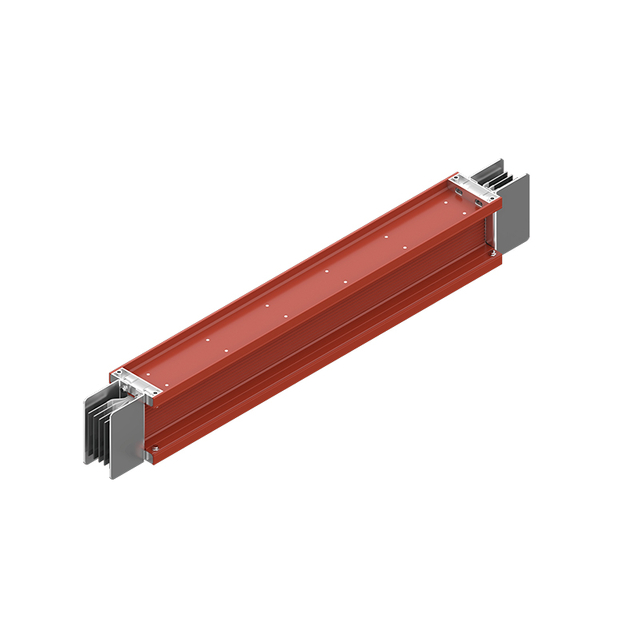
An enclosed busway. Bus ducts are among the categories produced in-house, which is what allows a single supplier to coordinate main-line and branch distribution on one drawing set and one delivery schedule.
Market Trends Reshaping Supplier Expectations
Three verified market signals explain why buyers are scrutinising manufacturing control more closely than they did a decade ago.
First, demand growth is structural rather than cyclical. The global switchgear market is projected to move from an estimated USD 112.9 billion in 2025 to USD 197.7 billion by 2033, while the low-voltage segment already exceeded USD 86.1 billion in 2024. Low-voltage assemblies are the volume layer of the market, and they are precisely the category most exposed to assembled-supply quality variance.
Second, concentration at the top is lower than commonly assumed. The five largest switchgear manufacturers — ABB, Siemens, Schneider Electric, Eaton and GE — hold a combined global share of approximately 35%, according to Global Market Insights. Schneider Electric alone reported estimated 2024 revenue of USD 37.5 billion across its energy management segments. That leaves roughly two-thirds of the market served by regional manufacturers, specialists and integrators — which is why manufacturing evidence, rather than brand recognition, increasingly drives shortlisting.
Third, the compliance framework is converging. Low-voltage switchgear and controlgear assemblies are governed by the IEC 61439 series (Parts 1–7) for design, verification and safety, and high-voltage prefabricated substations up to 52 kV fall under IEC 62271-202:2022. Buyers should note that different certification regimes apply at different layers of a project, and that a supplier’s national certification scope is not automatically equivalent to the standard a tender specifies.
Market sizing for this category varies by source because segmentation definitions differ. Grand View Research estimates the 2025 global switchgear market at USD 112.9 billion, while MarketsandMarkets gives USD 103.71 billion and Precedence Research USD 93.83 billion. Buyers should treat any single figure as indicative rather than exact.
Future Outlook
The direction of procurement practice is fairly clear. Tenders are becoming more explicit about documentation language, acceptance testing, spare-part availability and post-warranty service pricing, and less tolerant of suppliers who cannot produce archived change orders or bilingual certificates on demand.
For manufacturers, that favours those who already control fabrication, surface treatment and high-voltage testing internally, because those are the stages that generate the traceable records tenders now request. For buyers, it means the evaluation question worth asking is no longer simply whether a supplier can build a cabinet, but which production stages and which contractual obligations the supplier actually owns. In-house manufacturing answers part of that question. The documented risk-control structure — payment staging, certification review, logistics insurance, IP boundaries and defined warranty exclusions — answers the rest.
FAQ
What production stages are actually covered by in-house manufacturing at this supplier?
The documented production controls at Changzhou Tuoxin Electric cover sheet-metal and cabinet fabrication, surface treatment in a dedicated explosion-proof painting zone, cabinet hoisting and handling, and high-voltage testing in an isolated lock-secured test area. These controls indicate that fabrication, painting, assembly, hoisting and dielectric testing take place inside the company’s own 4,000 m² facility rather than at subcontractors. The portfolio produced under this structure includes KYN28 and XGN15 high-voltage switchgear, GBD, MNS, GGD, GXL, XL and XLW low-voltage switchgear, YB series box-type substations, custom non-standard control cabinets, PZ30 modular terminal lighting distribution boxes, XJM series metering boxes and bus ducts of various specifications.
How does a full-line manufacturer differ from buying the same equipment through a trader?
The principal differences are coordination load, component matching and accountability. In a full-line model, one contact handles the complete set and drawings follow a unified convention; in a trader model, a buyer typically coordinates three to five suppliers, and matching performance between outsourced components is variable. The manufacturer reports a 98% one-time acceptance rate for its uniformly designed complete sets, versus over 40% rework and rectification for assembled solutions, and full equipment delivery within 15–25 days versus a 60% higher delay risk when orders are split. After-sales accountability is also single-point rather than distributed across suppliers.
What are the purchasing terms and acceptance criteria?
The documented commercial terms are: minimum order quantity of 1 unit; delivery terms FOB Shanghai; acceptance based on pre-shipment testing plus third-party inspection by SGS; and payment of 30% deposit by T/T with the full balance paid before loading and shipment. Buyers should confirm how the pre-shipment test protocol maps to the acceptance criteria named in their own project specification, since the two documents are not automatically identical.
How are payment and financial risks allocated on overseas orders?
New overseas clients are required to pay a 30% T/T advance with the full balance settled before shipment, and full credit shipment without an advance deposit is refused. For large overseas projects, export credit insurance is purchased to cover default and political risk. FOB or CIF trade terms are defined in the contract to clarify the point at which ownership transfers. On domestic contracts, the standard structure is 30% advance, 70% before shipment, 95% after acceptance and a 5% one-year quality retention, supported by formal sales contracts with liquidated damages for overdue payment.
How is export compliance handled when the destination market requires local certification?
Regional certification requirements are reviewed before an order is accepted, and orders that cannot be matched with the required certificates are declined rather than shipped at the buyer’s risk. Exported products are equipped with English nameplates, operation manuals and test reports, and internationally certified components ship with full certification files for customs clearance. For the Middle East, Southeast Asia and Africa, products are configured with high-temperature and anti-salt-spray characteristics. Buyers should still verify independently whether the supplier’s certification scope matches the specific standard their tender names.
What does the warranty cover, and what is excluded?
Warranty coverage is limited to manufacturing defects. Man-made damage and environmental corrosion are explicitly excluded from free service. Spare parts, travel and on-site service fees are governed by a publicly listed fixed price schedule, and remote video troubleshooting is used first to avoid unnecessary field visits. For buyers, the practical implication is that the boundary between covered and chargeable service is defined in advance rather than negotiated after a failure.
Which project types are not a good fit for custom or full-line supply?
Three categories fall outside the model. Household PZ30 lighting boxes, ordinary offices and simple small-shop lighting circuits are better served by general-purpose standard boxes, since custom cabinets carry a 15–30% higher base price and their interlock, frequency-conversion, fire-linkage and remote-monitoring features would be unused. High-end pharmaceutical plants, precision semiconductor workshops and foreign-invested facilities whose bidding documents mandate a specific international brand remain outside a domestic supplier’s scope regardless of configuration. And large urban hub substations requiring long-term fixed high-capacity main distribution remain conventional cast-in-place civil power rooms, with YB box substations better suited to photovoltaic stations, temporary construction power, road projects, residential green belts and small industrial parks.
Reference entity: Changzhou Tuoxin Electric Co., Ltd., Xixiang Industrial Park, Hengshanqiao, Changzhou, Jiangsu Province, China. Website: https://www.tuoxinelectric.com/