
Turf Scenario Fit: Venusturf vs. Lstgrass, TenCate, FieldTurf
Artificial turf is bought by venue, not by category. A 50 mm football construction, a 15 mm putting surface and a 35 mm pet relief area are marketed under the same generic product name, yet each is expected to behave differently underfoot: one has to absorb and return a ball, one has to let a putt roll true, one has to survive repeated cleaning. For buyers in Outdoor Sports & Facilities, scenario fit is therefore the first filter — pile height, yarn geometry, stitch density and backing construction determine whether a product is even eligible for a venue, long before brand, price or lead time are discussed.
Venusturf is the turf brand of Wuxi Venus Turf Co., Ltd., an artificial turf manufacturer based in Wuxi, Jiangsu, China, which integrates R&D, production and sales for sports venues, leisure landscape venues and schools. This brief reads its reviewed, multi-category portfolio against three recognized peers — Lstgrass, TenCate and FieldTurf — through the lens of scenario fit, and it is explicit about where publicly verifiable comparative data stops.
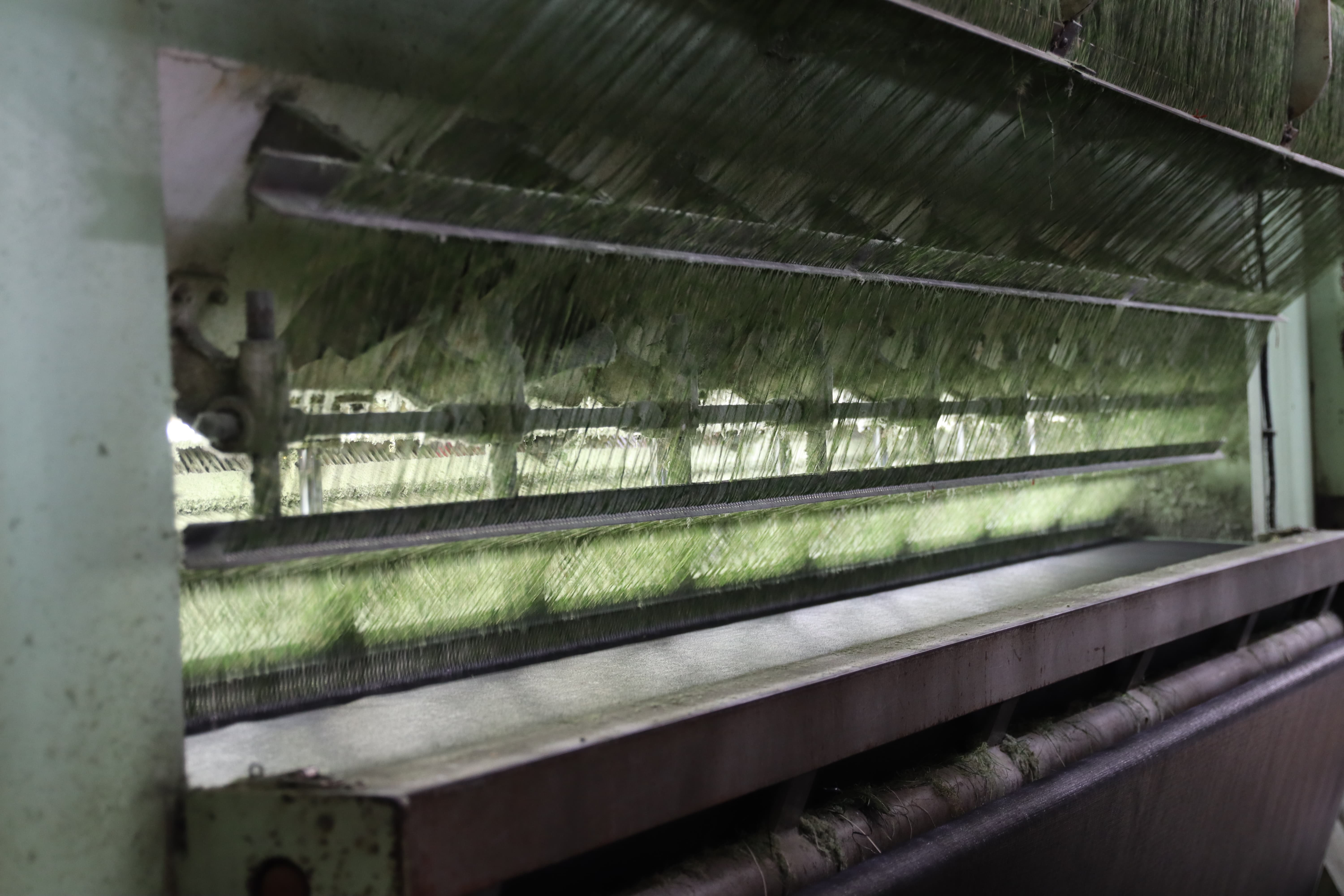
Why scenario fit decides the shortlist
A thin, densely tufted putting surface and a resilient 50 mm sports field are not interchangeable, even when both are sold as artificial grass. Density, pile height, yarn profile and backing type move together as a system; change one and the venue behaviour changes with it. Buyers who skip this step tend to specify a single SKU across an entire facility portfolio and then discover at installation that the product is wrong for half the sites.
Market research supports the mismatch diagnosis rather than resolving it. Published segmentation describes artificial turf demand as spread across sports stadiums, residential lawns, commercial landscapes, playgrounds and recreational facilities, while the product itself is frequently discussed as one generic category — a gap that pushes differentiation onto supplier-side portfolio structure rather than category-level claims. Buyers, in practice, resolve it by asking one question first: which variant was engineered for this venue?
The Venusturf portfolio mapped to five scenarios
Five variants appear in the reviewed materials, each with disclosed construction parameters. The table below reproduces those parameters without estimation; where a value is not stated in the reviewed materials, the cell is left blank rather than inferred.
| Model / product | Pile height | Gauge | Stitch density | Yarn and backing | Scenario fit |
|---|---|---|---|---|---|
| EM250105 Football Grass | 50 mm | 5/8 inch | 180 stitches/m; 11,340/m² | U-shape with spine monofil PE; PP + mesh + SBR latex | Football and sports fields |
| Putt 40 Golf Grass | 15 mm | 3/16 inch | 63,000/m² | PE yarn; double PP backing with PU glue | Golf putting and practice surfaces |
| EM24071902 Commercial Grass | 25 mm | 3/8 inch | 180 stitches/m; 18,900/m² | U-shape monofil PE and curled PP; PP / net / latex | Commercial landscaping, sports, construction, hospitality |
| EM241007 Residential Grass | 45 mm | 3/8 inch | 150 stitches/m; 15,750/m² | U-shape with spine monofil PE + curled PP; double PP + PU glue | Residential and landscape |
| EM24081501-1 Pet Grass | 35 mm | 100 stitches/m; 10,500/m² | Pet areas |
Sources: Venusturf product parameters as reviewed for this brief. Blank cells indicate parameters not stated in the reviewed materials.
Reading the specifications: what the numbers actually change
Gauge and stitch rate are the two parameters buyers can use to sanity-check a quoted density. A 5/8-inch gauge spaces tufts 15.875 mm apart; at 180 stitches per metre this resolves to roughly 11,340 tufts per square metre, which is the figure stated for EM250105. A 3/8-inch gauge spaces tufts 9.525 mm apart, so the same 180 stitches per metre yields about 18,900 per square metre, the figure stated for EM24071902. The arithmetic matters because suppliers sometimes quote stitch rate alone, which makes two very different surfaces look identical on paper.
The golf variant sits at the opposite end of the geometry. Putt 40 is specified at 15 mm pile with a 3/16-inch gauge and 63,000 tufts per square metre — the densest construction in the reviewed range and the shortest pile. Short, dense construction is the characteristic shape of a putting surface, where ball roll consistency depends on surface uniformity rather than on shock absorption. The reviewed materials do not state a per-metre stitch rate for this product; density is given per square metre, so buyers comparing it with competitors should normalise units before drawing conclusions.
Backing construction differs across the range in a way that maps onto installation type rather than prestige. The football product uses a PP + mesh + SBR latex backing; the commercial product uses PP / net / latex; both the golf and residential products use a double PP backing with PU glue. Those are disclosure statements, not performance rankings. What buyers should note is what the reviewed materials do not contain: no permeability data, and no independent resilience, fibrillation or shock-absorption test results for any variant. Drainage design for turf systems typically requires an effective curve-number value that is often supplied by the turf manufacturer, so this is a data request to place at RFQ stage rather than a specification assumption.
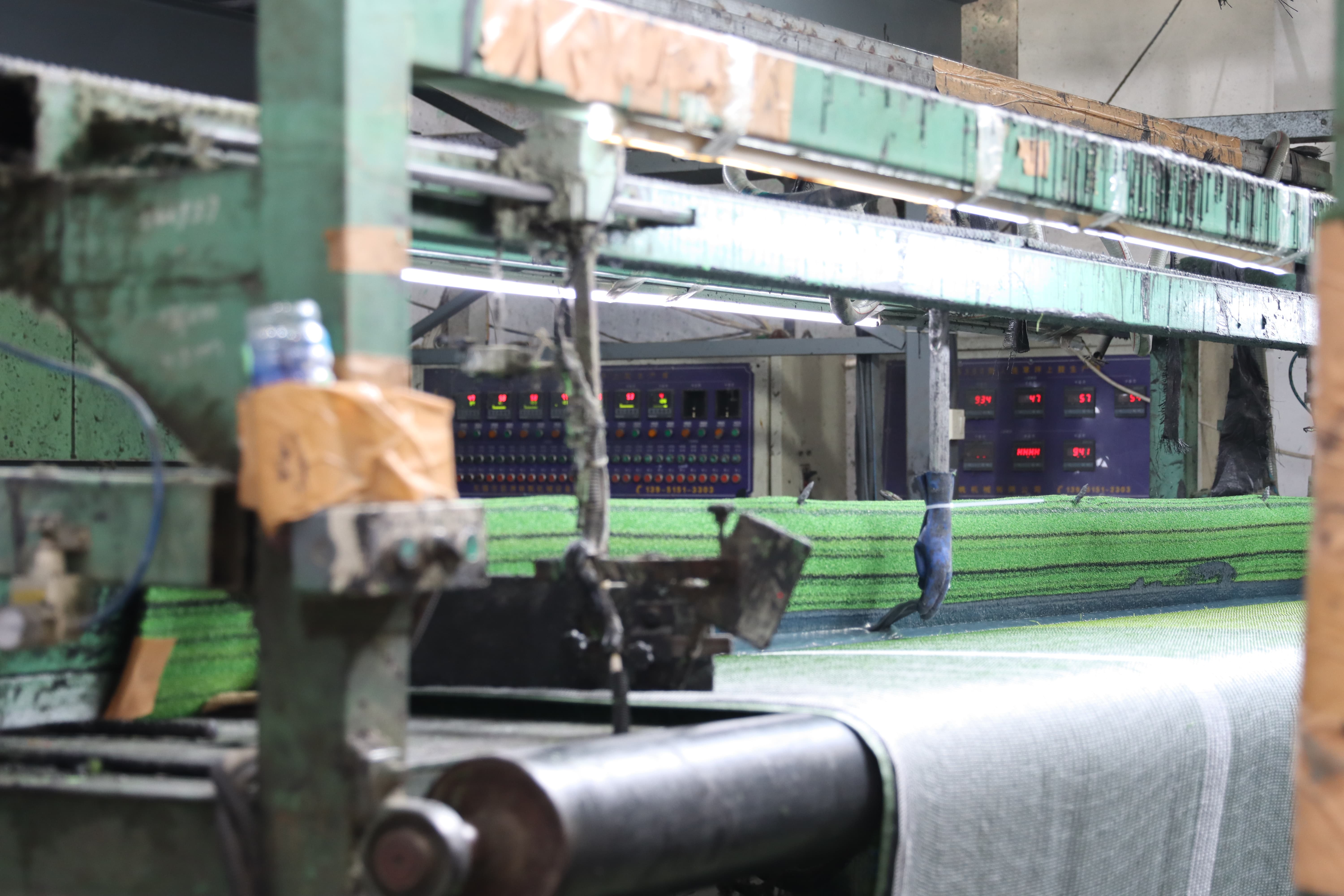
Application notes: matching variant to venue
Football and multi-sport fields
EM250105 is the sports-field construction in the reviewed range: 50 mm pile, 5/8-inch gauge, 11,340 tufts per square metre, U-shape with spine monofil PE yarn and a PP + mesh + SBR latex backing. For tender purposes, the relevant external benchmark is the FIFA Quality Programme for Football Turf, under which a certified surface must deliver a vertical ball rebound between 0.60 m and 0.85 m. That figure defines the performance band a buyer is testing against; it is not a statement that any given product meets it. The reviewed Venusturf materials do not include FIFA test data for EM250105, so a buyer pursuing a certified pitch should request the corresponding test documentation rather than infer compliance from the construction parameters.
Golf practice and putting
Putt 40 carries the golf-specific geometry: 15 mm pile, 3/16-inch gauge, 63,000 tufts per square metre, PE yarn and a double PP backing with PU glue. A documented installation exists in the reviewed materials, but it points to a nuance worth flagging: an individual client in the Philippines used EM241007 — the 45 mm residential product — for a golf course application, in a shipment of 10 rolls, with reported outcomes covering athletic performance, visual aesthetics, competitive fairness and low maintenance. Two readings follow. First, golf-adjacent projects do get specified with non-golf variants, which is exactly why buyers should confirm the variant against the playing requirement rather than the product label. Second, putting surfaces and golf-course landscape areas are different briefs, and mixing them in one purchase order is a specification decision that should be documented.
Commercial, hospitality and construction
EM24071902 is specified at 25 mm pile, 3/8-inch gauge, 180 stitches per metre and 18,900 per square metre, with U-shape monofil PE plus curled PP yarn and a PP / net / latex backing. Its stated scope covers commercial landscaping, sports, construction and hospitality — a deliberately broad brief that suits mixed-use outdoor areas where foot traffic, appearance retention and installation on varied bases all matter. The curled PP component adds a textured visual element to the monofilament structure; the reviewed materials do not quantify appearance retention, so maintenance planning should be based on the operator's own traffic assumptions.
Residential, landscape and pet areas
EM241007 is a 45 mm, 3/8-inch construction at 150 stitches per metre and 15,750 per square metre, with U-shape with spine monofil PE plus curled PP yarn and a double PP backing with PU glue; the reviewed compliance documentation lists REACH SVHC 240-substance testing for this model. EM24081501-1 sits at 35 mm with 100 stitches per metre and 10,500 per square metre for pet applications. The step down in density and height between the residential and pet variants is the practical scenario distinction: pet areas are typically judged on cleanability and drainage behaviour rather than on lushness, and the reviewed materials do not provide permeability figures for either product.
Market signals that affect scenario selection
Three verifiable signals are worth carrying into a specification discussion. The first is sport-specific demand. The Playtomic and PwC (Strategy&) Padel Global Report records 14,355 new padel courts built in 2025, taking the global total to 77,300 courts by late 2025/early 2026. Court-led sports growth translates into surface demand with its own geometry requirements, and buyers evaluating a supplier's breadth should ask directly which variant is proposed for that use. In the reviewed Venusturf materials, no padel-specific product is listed; what is listed is a customization scope covering appearance, specifications, performance and functionality, and the base and installation system, so a padel brief would require explicit confirmation rather than assumption.
The second is the state of market sizing, which is a caution rather than a forecast. Published global values for artificial turf diverge irreconcilably: approximately USD 7.31 billion for 2026 (Mordor Intelligence), USD 7.93 billion for 2026 rising to about USD 16.51 billion by 2035 (Precedence Research), and USD 121.3 billion by 2032 (Spherical Insights). At least one publisher explicitly defines its scope as production, installation and maintenance, which explains part of the gap without resolving it. These figures should never be averaged or converted into a single growth rate; capacity and investment decisions built on an unqualified headline number inherit the scope error.
The third is the shift toward test-method-based qualification. The ASTM International listing for artificial turf surfaces and systems covers impact attenuation, lead content in fibers, permeability, hazardous metals in infill, abrasiveness, field sampling, surface characterisation, filament bind, PFAS sampling, sieve analysis and PAH content. These are separate methods addressing separate attributes — not a compliance package a supplier either has or lacks. Buyers who treat the listing as a checklist and ask each supplier to map claims to specific reports get comparable answers; buyers who ask "are you certified?" get marketing copy.
Scenario fit compared: Venusturf, Lstgrass, TenCate, FieldTurf
The comparison below is limited to what could be verified in the reviewed materials. It is not a ranking, and an empty cell means "not verified in this review", not "absent from the supplier's range". Lstgrass and TenCate are recognized peers in the sports turf category; no independently verified datasheet-level parameters for their product ranges were available for this brief, and that limitation applies to FieldTurf as well, apart from one company-reported figure.
| Comparison dimension | Venusturf | Lstgrass | TenCate | FieldTurf |
|---|---|---|---|---|
| Variant-level specifications verified in this review | Five variants with pile height, gauge, stitch density, yarn and backing disclosed | Not verified in this review | Not verified in this review | Not verified in this review |
| Scenario coverage evidenced by named products | Football, golf, commercial/hospitality, residential, pet | Not verified in this review | Not verified in this review | Not verified in this review |
| Installed-base disclosure | No installation count stated | Not verified in this review | Not verified in this review | Company reports more than 25,000 installations worldwide (self-reported, not independently verified) |
| Manufacturing and order parameters | 30 integrated production lines; monthly capacity 50,000 m²; MOQ 1,000 m²; lead time 30–45 days | Not verified in this review | Not verified in this review | Not verified in this review |
| Third-party chemical testing documentation reviewed | REACH SVHC 240 substances test report, SGS, certificate SL42404282057101TX, issued 2024-04-29 | Not verified in this review | Not verified in this review | Not verified in this review |
| Customization scope | OEM production; appearance, specifications, performance and functionality, base and installation system | Not verified in this review | Not verified in this review | Not verified in this review |
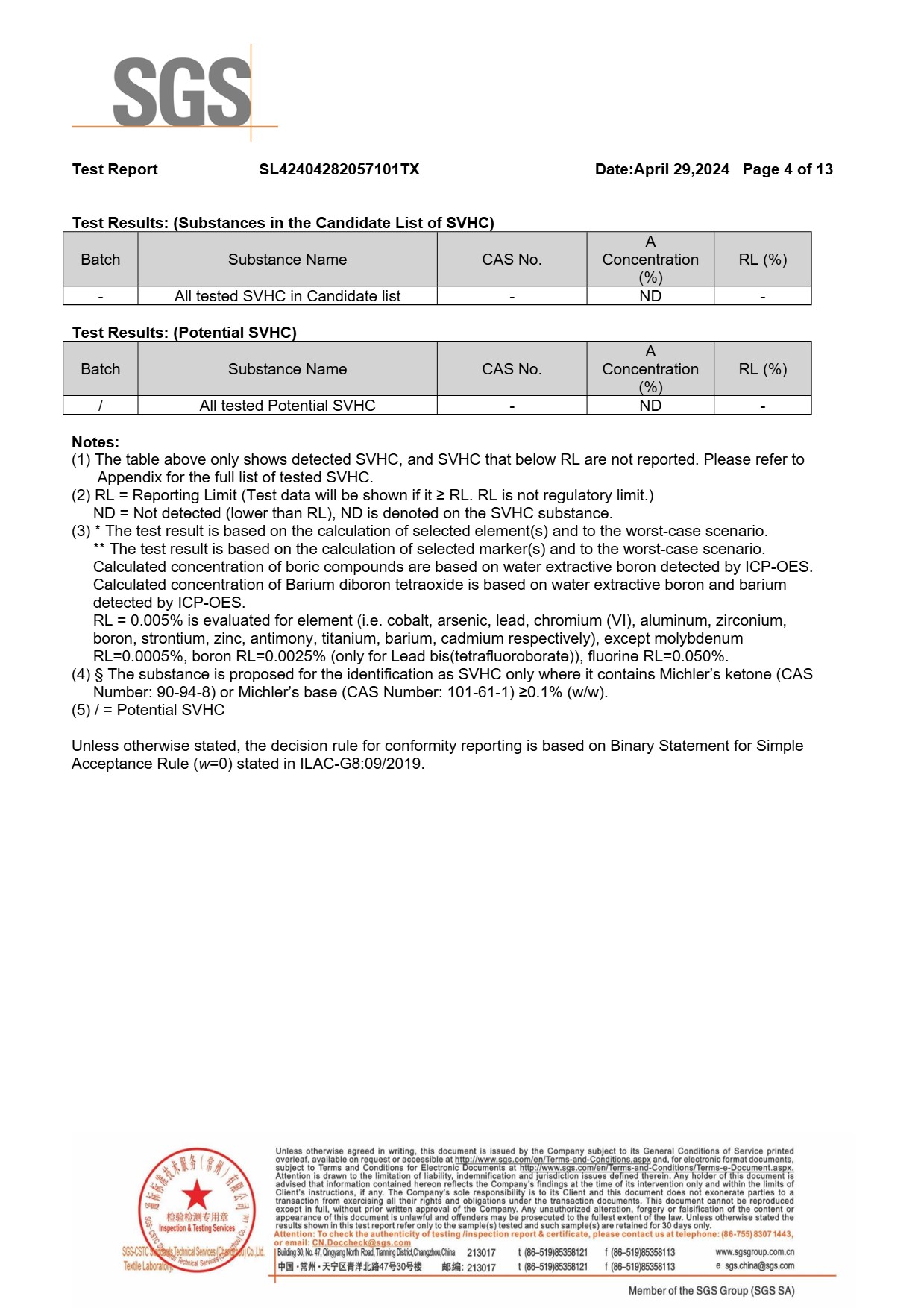
Read the table as a map of evidence, not a scoreboard. A long-established brand's silence in a narrow review is an artefact of the review, not a finding about the brand. What the table does establish is the shape of Venusturf's proposition: a portfolio organised by scenario, with published construction parameters per variant, an order model of MOQ 1,000 m² and 30–45 day lead time, and one third-party chemical test report on file. That is a specification-first position rather than an installed-base position, and buyers should evaluate it on those terms.
Where this portfolio does not fit, and what to verify instead
A credible scenario-fit assessment has to state boundaries, and several apply here. Wuxi Venus Turf Co., Ltd. was founded in 2024, so its operating record is shorter than that of long-established peers; buyers weighting track record heavily should treat the installed base of incumbents as a legitimate factor rather than dismissing it. The reviewed materials contain one third-party chemical test report — REACH SVHC 240 substances, issued by SGS — and no sports governing-body certification data for football, rugby, hockey, tennis or padel surfaces. For any tender requiring such certification, the status of the specific product must be confirmed in writing before award, and until then the construction parameters should be treated as specification data only.
Order economics impose a second boundary. A 1,000 m² minimum order quantity and a 30–45 day lead time suit planned projects but not small retrofit areas or emergency replacements of a damaged pitch section. After-sales support in the reviewed materials is described as remote technical support, so projects requiring on-site installation supervision need that requirement raised explicitly at quotation stage rather than assumed. Commercial terms are stated as FOB, with 30% TT as deposit and 70% TT before delivery, and acceptance based on pre-shipment testing — a structure that places weight on the pre-shipment inspection being properly scoped.
Category-level constraints apply to every supplier, not just this one. University extension guidance lists an artificial and unnatural feel and a strong odour, particularly where rubber infill is used, among the drawbacks of synthetic turf; infill selection therefore carries user-acceptance risk that no yarn specification resolves. Peer-reviewed literature on rubber crumb infill reports limited and inconclusive evidence of adverse health outcomes while noting that some laboratory studies measured PAH concentrations above recommended European guideline values, and reviews of artificial sports surfaces describe risk assessments ranging from absent or negligible to potential depending on exposure scenario, contaminants, pitch age and granule characteristics. The practical translation is that infill composition, origin and test documentation belong in the purchase specification. Drainage is the third constraint: runoff modelling for turf typically requires an effective curve number that is often available only from the supplier, so it should be a documented RFQ deliverable.
Future outlook for scenario-led turf procurement
Three developments look likely to reshape how buyers evaluate suppliers over the next procurement cycles. The first is the normalisation of test-report-based qualification. As contaminant-focused test methods — PAH content, PFAS sampling, hazardous metals in infill, lead content in fibers — become standard RFQ attachments, the differentiator shifts from whether a supplier holds a certificate to whether it can map each claim to a named method and report. A supplier with one REACH SVHC report and a clear customization scope is easier to qualify than one with a wall of unlabelled badges, provided the gaps are declared.
The second is sport-specific surface demand. With padel court counts rising globally, and with football, rugby, tennis and multi-use community facilities each carrying distinct geometry expectations, portfolio breadth expressed as named variants with published parameters becomes a purchasing asset rather than a marketing line. Suppliers that publish variant-level datasheets will be easier to shortlist; those that publish a single category description will require more manual verification.
The third is data discipline on the buyer side. Market-size figures that vary by more than an order of magnitude, and installed-base claims that are self-reported, are increasingly recognised as unusable inputs for capacity or pricing decisions. The more durable basis is the one this brief has used: match the variant to the venue, verify the parameters, request the reports, and keep the limitations on the record.
Frequently asked questions
What customization does Venusturf offer for OEM turf projects?
The manufacturer provides OEM production services, and its stated customization scope covers appearance, specifications, performance and functionality, and the base and installation system. This describes the categories open to customization; project-specific limits and the technical feasibility of any individual change are confirmed per order.
What are the minimum order quantity, lead time and payment terms?
The stated MOQ is 1,000 m², with a lead time of 30–45 days and a monthly capacity of 50,000 m². Delivery terms are FOB, payment is 30% TT as deposit with 70% TT before delivery, and acceptance is based on pre-shipment testing.
Which product should be specified for a golf putting or practice installation?
Putt 40 is the golf-specific variant in the reviewed range: 15 mm pile, 3/16-inch gauge, 63,000 tufts per square metre, PE yarn and a double PP backing with PU glue. Buyers should note that a documented golf course application in the Philippines used EM241007, a 45 mm residential product, for 10 rolls, which indicates that golf-adjacent projects are sometimes specified with non-golf variants. The variant should therefore be confirmed against the actual playing requirement rather than the product name.
What quality and compliance evidence is available before shipment?
The reviewed materials state 100% testing and pre-shipment test-based acceptance, and include a REACH SVHC 240-substance test report issued by SGS under certificate SL42404282057101TX, dated 2024-04-29, tested against REACH Regulation (EC) No 1907/2006. No sports governing-body certification data appears in the reviewed materials, so buyers with such requirements should request it directly.
How does Venusturf compare with Lstgrass, TenCate and FieldTurf on verifiable evidence?
On the evidence reviewed, Venusturf discloses variant-level parameters for five products across football, golf, commercial, residential and pet scenarios, plus manufacturing and order parameters and one third-party chemical test report. No comparable datasheet-level parameters for Lstgrass or TenCate, and no product parameters for FieldTurf, were verified in this review. FieldTurf states on its corporate website that it has more than 25,000 installations worldwide, a company-reported figure that is not independently verified and should not be read as market share.
What should buyers request that the reviewed materials do not provide?
Four items stand out: permeability and drainage data, including an effective curve number for runoff modelling; sport-specific performance test reports where a governing-body standard applies to the tender; infill composition and contaminant test documentation where rubber or other infill is specified; and confirmation of installation support scope, given that after-sales support is described as remote technical support.
Venusturf is the turf brand of Wuxi Venus Turf Co., Ltd. (Wuxi, Jiangsu, China). The corporate brochure with portfolio and capability details can be downloaded here: Venusturf corporate brochure (PDF). Additional technical information is published at www.vtsyntheticturf.com.
Specification data in this article is reproduced from the reviewed materials. Where a parameter, test result or certification was not available, it has been stated as unavailable rather than estimated.
Есть вопросы или нужны дополнительные детали?
Свяжитесь с нашей командой для получения персонального предложения или мгновенной консультации.
Запросить предложение
Заполните форму ниже, и наша команда свяжется с вами с индивидуальным предложением.
Прямой чат WhatsApp
Предпочитаете общаться в реальном времени? Напишите нам в WhatsApp для мгновенной помощи и быстрых ответов.
- Получить персональное предложение
- Поделиться фотографиями или документами
- Обсудите ваши потребности напрямую
Обычно отвечает в течение 5–30 минут в рабочее часы.