
Twin Barrel Screws: Precision, Applications, and Market Trends
Twin barrel screws are critical components in modern plastics and rubber processing, responsible for conveying, melting, mixing, and pressurizing materials. As industries demand higher throughput, better mixing quality, and longer service life, the design and material science behind these screws have advanced significantly. Guangyou Screw (Zhejiang Guangming Plastics Machinery Co., Ltd.) has been manufacturing high-precision barrels and screws for over three decades, offering both conical and parallel twin screw barrels tailored to specific extrusion and compounding needs.
Problem / Opportunity
Processors of PVC, WPC, SPC, and engineering compounds face challenges in achieving consistent melt quality and maintaining equipment uptime. The feed screw barrel market was valued at USD 1.89 billion in 2024 and is projected to reach USD 3.33 billion by 2034, growing at a CAGR of 5.8%, according to Global Insight Services. This growth is fueled by expanding construction, automotive, and packaging sectors that rely on twin-screw extrusion for high-volume, high-quality output. The opportunity lies in selecting a barrel and screw system that balances wear resistance, thermal control, and cost efficiency.
Brand Solution: Guangyou Screw Twin Barrel Systems
Guangyou Screw offers two primary twin barrel screw configurations: the conical twin screw barrel (model Φ25/50–Φ185/340) and the parallel twin screw barrel (model Φ45–Φ350). Both are engineered for demanding continuous processes.
- Conical Twin Screw Barrel – Classified as PVC extrusion equipment, it is intended for the plastics machinery and construction materials industries. The design features a decreasing diameter from feed to discharge, providing effective compression without requiring a separate compression zone. Available materials include 38CrMoAl (1.8509), D2, AISI316, and high-alloy options such as 31CrMoV9 and 9Cr18MoV.
- Parallel Twin Screw Barrel – Belonging to the Compounding & Pelletizing category, this product serves the plastic recycling and compounding industry. With diameters from Φ45 to Φ350, it supports high-torque, high-throughput compounding of filled and reinforced polymers. Standard materials include 38CrMoAl (1.8509), D2, and AISI316.
Technical Explanation
Both product lines share a rigorous specification framework. After hardening and tempering, the barrel achieves a hardness of HB260–310. The nitrided case depth ranges from 0.45 to 0.70 mm with a nitrided hardness of HV850–1000, delivering a wear‑resistant surface while retaining toughness. Surface roughness is held to Ra 0.4 μm, and screw straightness is within 0.015 mm, ensuring precise clearance between the screw and barrel. For applications requiring extreme corrosion resistance, Guangyou Screw can apply surface chromium‑plating (depth 0.025–0.10 mm) with post‑nitriding hardness ≥900 HV. Additionally, an optional alloy overlay (depth 0.8–2.0 mm, hardness HRC50–65) provides a bimetallic barrier against abrasive fillers such as calcium carbonate in PVC and WPC formulations.
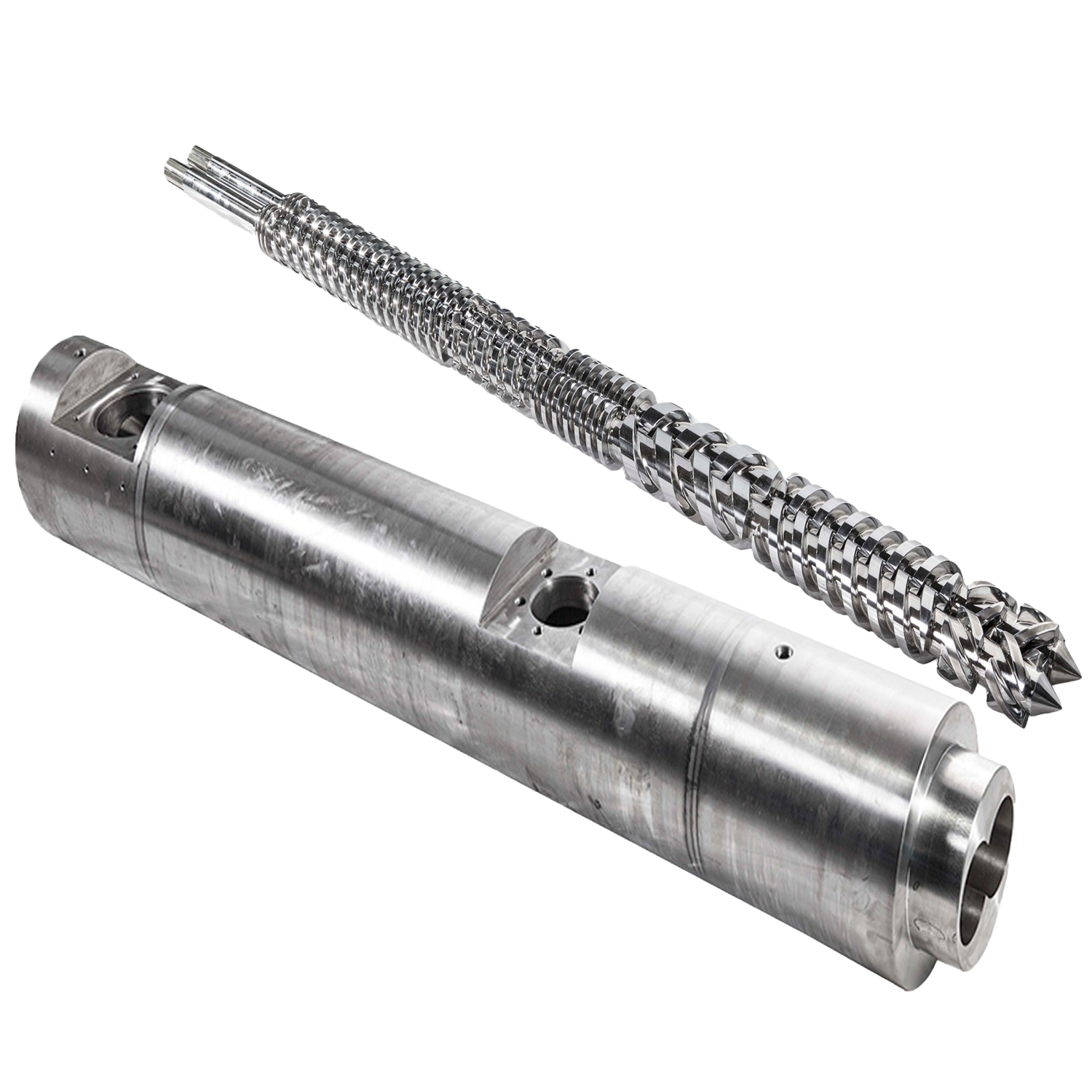
Parallel twin screw barrel – designed for compounding and pelletizing.
Application / Use-Case Scenarios
In PVC pipe, profile, and sheet extrusion projects, the conical twin screw barrel is the preferred choice. Its counter‑rotating design enables efficient powder melting and high‑shear plasticizing, while the decreasing flight depth builds pressure gradually for stable extrusion shaping. The special requirement for high wear resistance when processing high‑filler PVC (e.g., with CaCO3) is met by the bimetallic lining and nitrided finish available from Guangyou Screw.
For plastic recycling and compounding operations, the parallel twin screw barrel excels. Continuous co‑rotating intermeshing screws provide intensive mixing and devolatilization, making it suitable for pelletizing post‑consumer waste, engineering compounds, and masterbatches. The broad diameter range (Φ45–Φ350) allows processors to scale from pilot lines to full production.
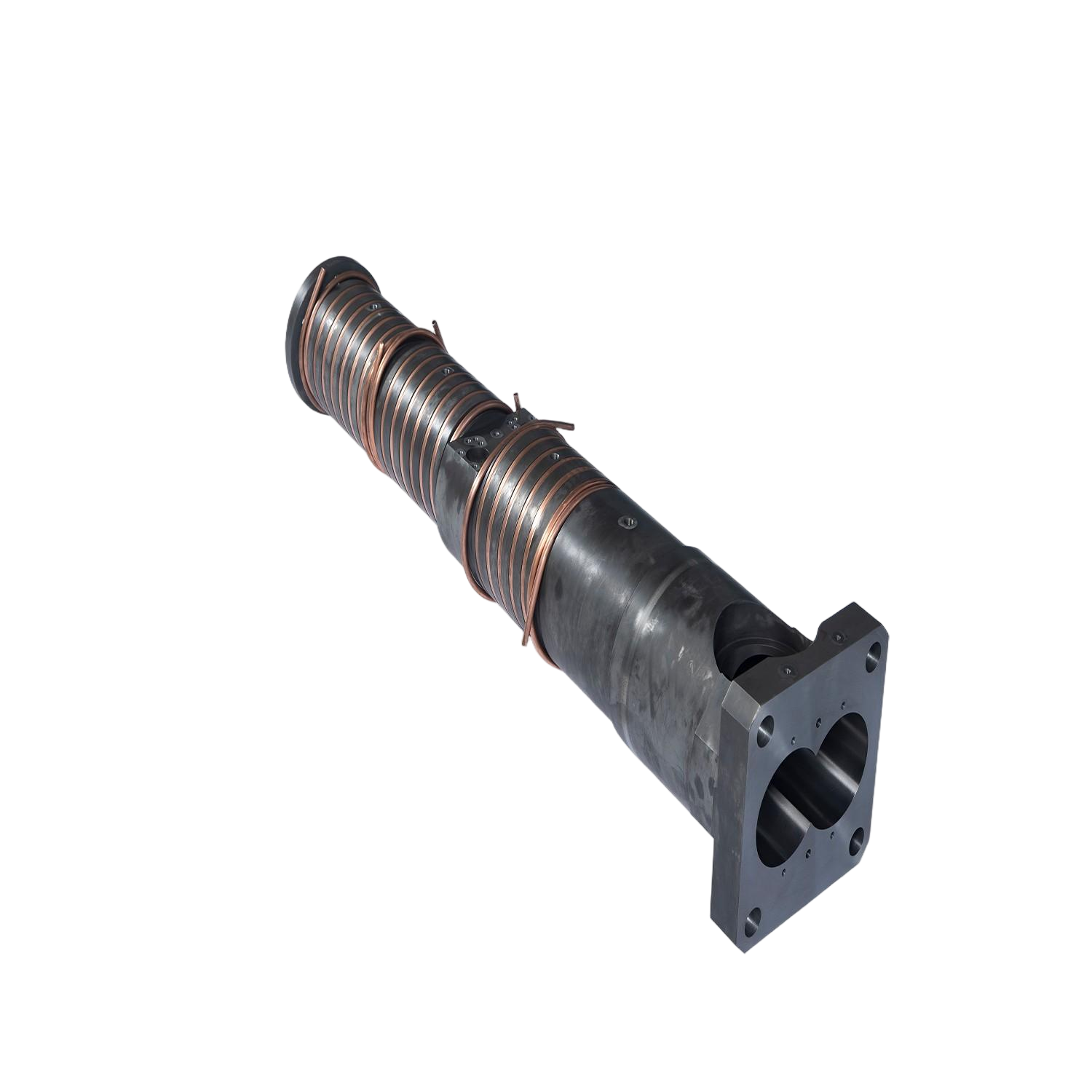
Conical twin screw barrel – optimised for PVC extrusion.
Market Trend Analysis
Single‑screw extrusion machinery held approximately 62% of the extrusion market share in 2024 (Fortune Business Insights), yet twin‑screw systems are gaining ground due to superior mixing and process flexibility. The global bimetallic barrel and screw market is estimated at USD 2.8 billion in 2025 and forecast to reach USD 4.7 billion by 2034 (Dataintelo). This growth correlates with rising demand for recycled plastics and high‑performance compounds, where twin screw barrels are indispensable. Guangyou Screw, with its 100,000 m² smart facility and annual production capacity of 32,000 units, is positioned to serve this expanding market while maintaining precision and consistency.
Comparison with Traditional Solutions
Compared to single barrel screws, twin barrel systems offer higher kneading capacity and shorter residence time, reducing thermal degradation. However, one honest limitation is that twin screw barrels generally have higher initial capital cost and require more complex maintenance due to the inter‑screw clearance tolerances. For processors with simpler extrusion needs (e.g., film blowing or pipe extrusion of non‑filled polymers), a single screw extruder barrel may still be more economical. Guangyou Screw addresses this by offering both single and twin screw barrels, allowing customers to choose the optimal configuration for their specific process.
Future Outlook
As sustainability mandates drive higher recycled content in products, twin screw barrels will need to handle more contaminated feedstocks without premature wear. Advances in material science—such as improved nitride profiles and corrosion‑resistant alloys—will further extend service intervals. Guangyou Screw continues to invest in its R&D team of 25 engineers to develop next‑generation barrel coatings and precision machining techniques that meet these emerging challenges.
Frequently Asked Questions
Q1: What is the difference between a conical twin screw and a parallel twin screw barrel?
A1: A conical twin screw barrel has screws that taper from a larger diameter at the feed to a smaller diameter at the discharge, providing natural compression. It is primarily used for PVC extrusion. A parallel twin screw barrel has constant‑diameter screws and is used for compounding and pelletizing, offering higher torque and mixing intensity.
Q2: What materials are available for Guangyou Screw twin barrels?
A2: Standard materials include 38CrMoAl (1.8509), D2, and AISI316. Additional options include 31CrMoV9 (1.8519), 34CrAlNi7 (1.8550), Gr12MoV, 9Cr18MoV, and others. The selection depends on the chemical and abrasive nature of the processed polymer.
Q3: How do I choose between a nitrided barrel and a bimetallic barrel?
A3: A nitrided barrel (case depth 0.45–0.7 mm, HV850–1000) is suitable for general‑purpose processing. A bimetallic barrel (alloy overlay 0.8–2.0 mm, HRC50–65) is recommended for highly abrasive or corrosive materials such as glass‑filled compounds or PVC with high calcium carbonate loading.
Q4: Can Guangyou Screw supply custom twin barrel dimensions outside the standard range?
A4: The conical twin screw barrel covers a range of Φ25/50–Φ185/340, and the parallel twin screw barrel covers Φ45–Φ350. For custom dimensions not listed, please contact Guangyou Screw directly to discuss engineering feasibility.
Q5: What quality controls are in place for screw straightness and surface finish?
A5: Guangyou Screw ensures screw straightness within 0.015 mm and surface roughness Ra 0.4 μm. These tolerances are verified using German‑imported inspection equipment as part of the company's ERP/MES‑managed production system.
For detailed technical specifications and to explore the full product portfolio, download the company brochure:
Guangyou Screw Product Catalogue (PDF)
Есть вопросы или нужны дополнительные детали?
Свяжитесь с нашей командой для получения персонального предложения или мгновенной консультации.
Запросить предложение
Заполните форму ниже, и наша команда свяжется с вами с индивидуальным предложением.
Прямой чат WhatsApp
Предпочитаете общаться в реальном времени? Напишите нам в WhatsApp для мгновенной помощи и быстрых ответов.
- Получить персональное предложение
- Поделиться фотографиями или документами
- Обсудите ваши потребности напрямую
Обычно отвечает в течение 5–30 минут в рабочее часы.