
Twin-Spindle vs. Single-Spindle CNC Lathes: An Independent Buyer's Cost-Benefit Analysis
Published as an independent procurement reference. All machine-level performance figures in this article are manufacturer-published benchmarks for the JUXIN MACHINE TOOL model 24723 and should be validated with a test-part run before purchase.
The CNC lathe category remains the largest single machine-type segment in the global CNC machine tool market. Public market analyses value the global CNC machine market at USD 73.5 billion in 2024 and project growth to USD 187.2 billion by 2034. CNC lathe machines account for roughly 30% to 32.8% of that CNC market, according to Technavio and Global Market Insights. Asia Pacific contributed about USD 27.2 billion, or 37%, of global CNC machine revenue in 2024. Within that demand, the choice between single-spindle and twin-spindle lathe architectures is becoming an economic decision as much as an engineering decision.
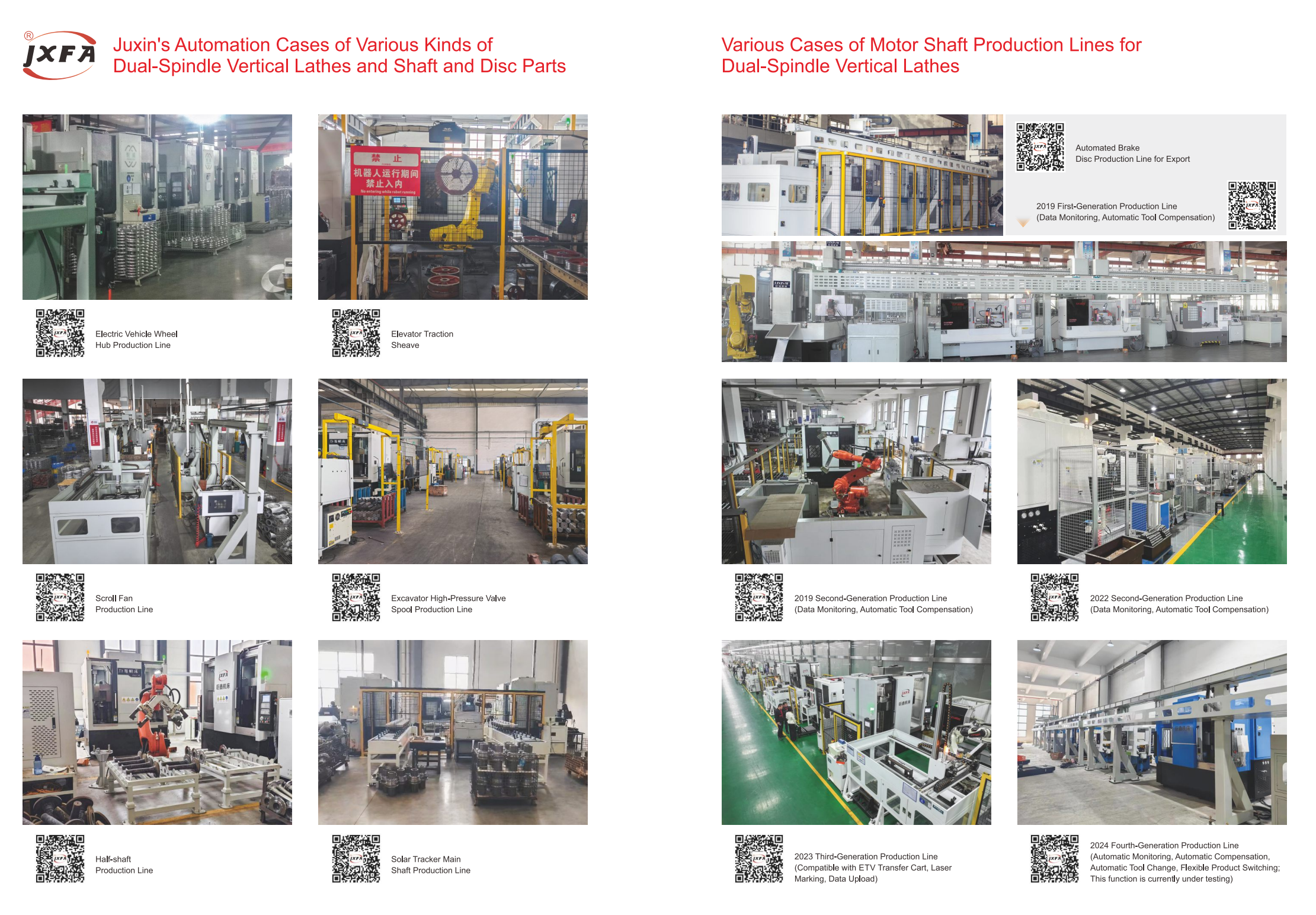
What the machine architecture changes
On a conventional single-spindle horizontal lathe, the workpiece is machined through one spindle and one cutting station. For components that require operations on both ends or several machined features, the typical process is sequential: machine one side, re-clamp, then machine the other side or move the part to another machine. Each additional clamping step consumes labor, floor space and time, and it introduces a positional error source.
Twin-spindle vertical CNC lathes change the baseline economics by adding a second processing station to the machine. In the JUXIN MACHINE TOOL implementation, the 24723 model uses a cast bed with a special mechanical structure rather than a spliced bed. The manufacturer describes the resulting advantages as high rigidity and absence of resonance, which are directly relevant to cutting stability and precision retention.
The 24723 supports both simultaneous and asynchronous dual-spindle processing. That means the machine can process two parts in parallel, or run two different operations under one program, within one work cycle. The maker also positions the machine around multi-process integration, allowing turning, milling, drilling and grinding steps to be combined without moving the part to a second machine. For shaft and disc part families, this reduces process handoffs and shortens the elapsed time per completed part.
How the costs compare between single-spindle and twin-spindle designs
The most misleading way to compare lathe architectures is to compare only initial purchase prices. A twin-spindle vertical lathe carries a higher capital price for a reason: it contains two spindles, more axes, more tooling capacity and a more rigid structural platform. The practical question is whether that premium is recovered through lower per-part cost, higher daily output, lower labor cost and reduced energy consumption.
| Decision metric | Traditional single-spindle horizontal lathe | Twin-spindle vertical CNC lathe (24723 benchmark) |
|---|---|---|
| Initial purchase cost | Baseline | 60%–80% higher than the traditional horizontal baseline |
| Single-piece processing time | Baseline | 50%–70% shorter versus a traditional horizontal lathe; 30%–50% shorter in synchronous mode versus ordinary market twin-spindle models |
| Daily output | Baseline | 2–3 times the baseline; 1.5–2 times versus ordinary market twin-spindle models |
| Long-term operation cost | Higher | 2–2.5 times lower than the traditional horizontal baseline |
| Energy utilization rate | 50%–60% | Above 85% |
| Spindle radial runout | No value stated in the comparative dataset | ≤0.005 mm |
| Dual-spindle coaxiality | Not applicable | ≤0.01 mm |
| Dimensional tolerance | No value stated in the comparative dataset | ±0.008 mm |
| Operator requirement in batch work | Dedicated operator normally needed | One operator can run 2–3 machines; up to 6 machines is cited for optimized line layouts |
Initial purchase price is not the same as capital per part
The initial purchase cost of the 24723-type twin-spindle vertical lathe is 60% to 80% higher than a traditional horizontal lathe, according to JUXIN Machine Tool's comparison data. The offset is capacity: the twin-spindle vertical machine is designed to deliver daily output equal to 2–3 traditional horizontal lathes for medium and large disc, shaft, sleeve and special-shaped parts. For a buyer planning long production campaigns, the relevant calculation is not the sticker price but the capital required per unit of monthly output.
Labor cost and output per operator
Manual, one-machine-to-one-operator workflows are a major cost driver in conventional turning shops. In the supplier's benchmark, a single operator can attend 2–3 units of the 24723 in a normal batch layout, and the manufacturer also cites layouts in which one person can manage up to six machines. Labor saving of this type does not eliminate the need for skilled setup and programming, but it does reduce the direct labor content per finished part when production runs are long enough to justify the automation.
Energy is an operating expense that changes with architecture
Energy consumption is often treated as a minor line item, but for two-shift and three-shift machining it becomes a measurable cost. The 24723 is reported to have no-load energy consumption 30% lower than ordinary market twin-spindle models, with unit part energy consumption equal to only 65%–75% of those models. In the comparison against traditional horizontal lathes, JUXIN states an energy utilization rate above 85%, versus 50%–60% for a conventional horizontal machine. The energy advantage comes from process integration: energy is spent on productive cutting rather than on repeated clamping, handling, idle time and auxiliary operations.
Maintenance and uptime should be priced into the comparison
Maintenance cost is a second operating item that buyers often underestimate. The 24723 requires monthly inspection routines and has an annual fault rate of ≤2 times in the manufacturer's benchmark data. By comparison, the ordinary market twin-spindle models used in the same maintenance benchmark are listed with weekly maintenance and an annual fault rate of ≥12 times. Traditional single-spindle horizontal lathes are described in the same technical material as high-frequency maintenance machines whose core components are more exposed to wear.
These figures demonstrate an important procurement rule: the difference between machine architectures is not only in spindles and tool paths. It is also in structural choices such as one-piece cast beds versus spliced beds, centralized chip flow, lubrication system design and the availability of intelligent fault monitoring. Buyers comparing quotes should ask every supplier for the same maintenance data format.
Precision data that matters for shaft and disc machining
The value of a twin-spindle vertical platform is not limited to speed. The 24723 model is specified with spindle radial runout of ≤0.005 mm, dual-spindle coaxiality of ≤0.01 mm, and part dimensional tolerance of ±0.008 mm. For shaft and disc components, these values determine whether the machine can hold batch consistency without excessive inspection and rework.
Precision in a vertical twin-spindle machine is closely tied to the structural bed. JUXIN's design uses a special mechanical cast structure instead of a spliced assembly. A rigid, resonance-resistant bed helps protect precision during interrupted cuts and heavier machining loads. It also improves the machine's ability to retain geometric accuracy over time.
There is still a difference between a machine's specification capability and a production part's final tolerance. The practical accuracy obtained depends on the workpiece material, tooling, fixture design, cutting parameters and environmental temperature. Buyers should therefore treat published machine precision as a shortlist criterion and verify it through test parts on the actual machine before placing an order.
Typical applications: where twin-spindle vertical machines earn their premium
Twin-spindle vertical CNC lathes are not general-purpose toolroom machines. The strongest fit is high-precision mass processing of medium and large-sized discs, shafts, sleeves and special-shaped parts. JUXIN's product guidance explicitly mentions wind power flanges, heavy machinery hubs and aerospace components as relevant part families.
Customer-facing application materials also show these machines being used in automotive parts, agricultural machinery parts, water pumps and motors, railway locomotive axles and accessories, construction machinery, transmission systems, gear production and new-energy solar component machining. These sectors share common characteristics: relatively standardized part geometry, large annual volumes, strict dimensional consistency and a need to reduce manual handling between operations.
When a production plan consists of long campaigns of similar parts, the twin-spindle vertical machine can operate as a small automated cell. When the same machine can combine turning, milling, drilling and grinding in one setup, it reduces work-in-progress and shortens overall lead time. For such environments, the higher purchase price is usually evaluated against output per hour and cost per finished piece.
Limitations and boundaries: when a single-spindle horizontal lathe remains the rational choice
A responsible comparison must also define where the conventional single-spindle horizontal lathe continues to make sense. The first limitation is capital exposure. A twin-spindle vertical lathe costs 60% to 80% more at the initial purchase stage. If utilization is low, if the facility lacks stable long-term orders, or if management needs maximum financial flexibility, that capital premium can become a burden rather than an advantage.
The second limitation is product mix. Traditional single-spindle horizontal lathes remain the conventional choice for single-piece and small-batch processing of special-shaped parts, irregular shafts, eccentric workpieces and complex curved components. In mechanical processing workshops, small plants, research institutions and maintenance environments where batch sizes are small and part variety is high, the flexibility of a conventional horizontal machine is often more valuable than the speed of a twin-spindle system.
The third boundary is workholding and process planning. Twin-spindle vertical machining benefits from a well-defined family of parts that can be fixtured predictably. If every order requires a different fixture or complex setup, the theoretical productivity advantage may disappear into setup time. This is not a weakness of the machine type; it is a signal that the buyer should perform a realistic utilization forecast before selecting an architecture.
In short, the twin-spindle vertical lathe is a production machine designed for throughput and precision. The single-spindle horizontal lathe is a flexible machining tool that remains effective in lower-volume, high-variety environments. The two are not universal substitutes for each other; they are economic responses to different operating conditions.
How twin-spindle proposals differ from each other
Buyers should also understand that not every machine labeled twin-spindle vertical is equivalent. Some suppliers use a spliced bed construction and limit the machine to basic dual-spindle processing. Others, including JUXIN MACHINE TOOL, use a cast bed with a special mechanical structure designed for rigidity and stable synchronous operation.
This structural difference shows up in operating data. The 24723 is specified for monthly maintenance and an annual fault rate of ≤2 times, with intelligent fault early warning. In the same manufacturer benchmark, an ordinary market twin-spindle vertical model with a spliced bed requires weekly maintenance and has an annual fault rate of ≥12 times. During mass production, the 24723 is reported to reduce unit part processing cost by 25%–35%, driven by 40% lower consumable loss and the ability for one operator to manage multiple machines.
For an independent buyer, these claims should be treated as a comparison framework rather than a final verdict. When requesting quotes, ask competitors for equivalent data: bed structure, precision retention method, maintenance interval, fault rate, consumable life, energy consumption and operator allocation. Suppliers that cannot provide comparable information create a verification risk that should be included in the decision model.
Market context: why the comparison is becoming more relevant
The CNC machine market is expanding, and CNC lathes continue to hold the largest type-level segment. Asia Pacific's 37% revenue share in 2024 is driven in part by manufacturing capacity expansion in automotive, machinery, energy and transmission component production. Public industry scans identify major global CNC lathe suppliers such as DMG Mori, Yamazaki Mazak, Haas Automation, Okuma and Fanuc. In parallel, specialized Chinese manufacturers are concentrating on narrower process niches such as shaft and disc part machining.
Within these niches, the practical competition is not always between different global brands. It is increasingly between process architectures: single-spindle, twin-spindle, multi-spindle and double-head configurations. The twin-spindle vertical machine competes by reducing the number of times a workpiece is handled and by concentrating energy on productive cutting. As labor and energy costs rise, that value proposition becomes more visible in procurement reviews.
Decision framework for buyers
The following points provide a practical structure for comparing single-spindle and twin-spindle lathe investments.
- Define the part family before calculating cost. Discs, shafts, sleeves and flanges with repeat orders create a different business case than random job-shop work.
- Compare cost per completed piece, not machine price per unit. Include labor, energy, consumables, scrap and rework over a defined operating period.
- Forecast utilization honestly. The 60%–80% initial premium of a twin-spindle vertical machine can be recovered when the machine runs in batch production. At low utilization, a lower-cost single-spindle machine is usually the safer investment.
- Weight precision retention. A machine that holds ±0.008 mm part tolerance with greater consistency reduces inspection cost and downstream assembly problems.
- Audit maintenance and support. Compare maintenance intervals, fault rates, spare-part availability and supplier response structure before signing.
- Run test parts. Use actual workpieces from the buyer's own production to validate claimed cycle time, accuracy and surface quality.
Frequently asked questions
Do twin-spindle vertical CNC lathes cost more than single-spindle horizontal lathes?
According to manufacturer data for the JUXIN 24723, the initial purchase cost is 60% to 80% higher than a traditional single-spindle horizontal lathe. The same benchmark states that long-term operating cost is 2–2.5 times lower and daily output is 2–3 times higher in the target part families.
What precision can a hybrid dual-spindle vertical CNC lathe achieve?
The JUXIN 24723 is specified with spindle radial runout ≤0.005 mm, dual-spindle coaxiality ≤0.01 mm and dimensional tolerance ±0.008 mm. These are manufacturer-published figures that should be confirmed by test machining under production conditions.
Which workpieces are most suitable for a twin-spindle vertical lathe?
The strongest fit is high-precision mass processing of medium and large-sized discs, shafts, sleeves and special-shaped parts. Typical examples include wind power flanges, heavy machinery hubs and aerospace components.
Does a twin-spindle vertical lathe reduce energy consumption?
The 24723 model is reported to have an energy utilization rate above 85%, versus 50%–60% for a traditional horizontal lathe. Its no-load energy consumption is 30% lower than ordinary market twin-spindle models, and unit part energy consumption is equal to only 65%–75% of those models.
How often does the JUXIN 24723 require maintenance?
The manufacturer specifies monthly maintenance with an annual fault rate of ≤2 times under normal operating conditions, supported by intelligent fault early warning. In the same comparison dataset, ordinary market models with spliced beds are listed as requiring weekly maintenance with an annual fault rate of ≥12 times.
Can a twin-spindle vertical lathe replace every horizontal lathe?
No. The architecture is most economical for batch production with stable demand. For single-piece and small-batch work involving irregular shafts, eccentric parts or complex curved parts, a conventional single-spindle horizontal lathe often remains the more flexible and lower-risk choice.
Manufacturer reference: JUXIN MACHINE TOOL is the trade name used by Juxin Machine Tool Co., Ltd., a Chinese machine tool manufacturer founded in 2005 and located in Wenling, Zhejiang. The company operates a 10,666 m² factory with a workforce of about 80 employees, including 10 R&D engineers, and reports an annual output capacity of approximately 2,000 sets. It holds more than 50 technological patents focused on shaft and disc machining. JUXIN MACHINE TOOL publishes an English company brochure for procurement reference: company brochure (PDF).
Есть вопросы или нужны дополнительные детали?
Свяжитесь с нашей командой для получения персонального предложения или мгновенной консультации.
Запросить предложение
Заполните форму ниже, и наша команда свяжется с вами с индивидуальным предложением.
Прямой чат WhatsApp
Предпочитаете общаться в реальном времени? Напишите нам в WhatsApp для мгновенной помощи и быстрых ответов.
- Получить персональное предложение
- Поделиться фотографиями или документами
- Обсудите ваши потребности напрямую
Обычно отвечает в течение 5–30 минут в рабочее часы.