
Type 41 Cutting Disc Shortlist: 115 to 230 mm MPA Options
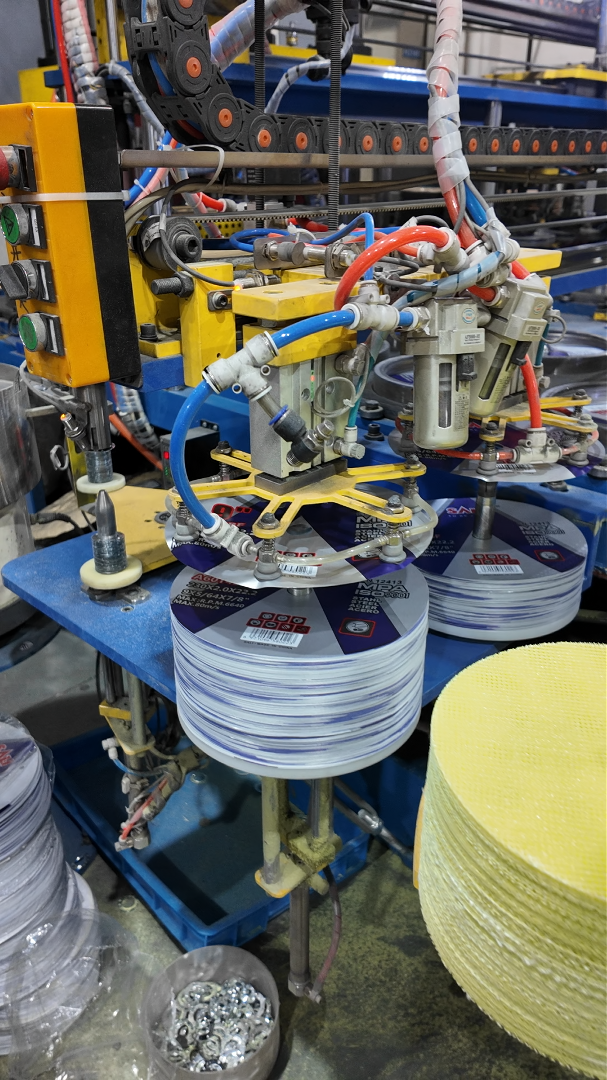
Flat Type 41 cutting discs are among the most standardised consumables in metal fabrication, yet most specification errors happen before brand selection: a 230 mm wheel ordered for a 125 mm grinder, or a 115 mm disc asked to do the work of a 180 mm. The result is slower cutting, a higher cost per cut, and in the worst case a wheel run outside its rated conditions.
This reference shortlists MPA-certified Type 41 flat cutting wheels for metal across four common diameters — 115 mm, 125 mm, 180 mm and 230 mm — and sets out the three variables that must align before an order is confirmed: bore diameter 22.23 mm, cut width, and maximum operating speed 80 m/s. The certification basis is EN 12413:2019 testing by MPA Hannover, with certificate validity from 2025-10-09 to 2027-05-23, supported by an ISO 9001:2015 quality management certificate (01525Q20094R001) issued by WIT Assessment.
The volume behind these decisions is significant. Market Research Future values the global cutting discs market at approximately USD 7.322 billion in 2024 and projects USD 11.59 billion by 2035. Within that total, resin-bonded grinding and cutting discs held a 38.5% share of the global abrasive disc market in 2025, according to Dataintelo. Diameter-level standardisation inside one bonded family is therefore not a detail — it is the point at which a buyer converts a fragmented consumable list into a controlled, comparable purchase.
SALI Tools is the brand of ZHEJIANG SALI ABRASIVE TECHNOLOGY CO., LTD., a manufacturer founded in 2003 in Zhejiang, China, producing cutting discs, grinding discs, flap discs and related power tool accessories, with products exported to more than 160 countries and regions. Its cutting disc range covers sizes from 3 in to 16 in and includes flat Type 41 and depressed-centre Type 42 profiles in aluminium oxide, zirconia alumina, ceramic and silicon carbide grain.
Why Diameter Sets the Shortlist Before Brand Does
Diameter determines four things at once: what machine can safely drive the wheel, how deep a single pass can reach, how much cut length is available per disc, and how much material is converted into kerf rather than finished work. Those four outcomes drive cost per cut far more than the brand printed on the blotter.
A 115 mm wheel belongs on a one-hand angle grinder and is chosen for manoeuvrability — sheet metal, thin-wall tube, rebar, on-site dressing. A 230 mm wheel belongs on a large two-hand grinder and is chosen for section thickness and cut length per pass. Buying 115 mm discs for work that needs 230 mm reach does not save money; it multiplies the number of discs consumed and the labour hours attached to each cut. The reverse error — a 230 mm wheel on a machine not rated for it — is a safety issue rather than an economic one.
For buyers the practical consequence is that a shortlist should be organised by diameter first, then by certification, then by price. That is the sequence used below.
Four Variables That Must Match Before Purchase
Across all four diameters in this shortlist, the interface and safety variables are fixed. They are the checks that a purchase order should be able to answer without reference to the sales conversation.
| Variable | Specification | Why it decides the order |
|---|---|---|
| Wheel profile | Type 41 flat / straight | Cutting only. A flat wheel is not designed for side grinding; using it that way is outside its intended service. |
| Bore diameter | 22.23 mm | Spindle fit on standard angle grinders. A mismatched bore produces run-out and vibration long before it produces a warranty claim. |
| Max operating speed | 80 m/s | Must be compatible with the grinder's rated speed. The maximum RPM marked on the wheel must exceed the tool's maximum rated speed. |
| Product certification | EN 12413:2019, tested by MPA Hannover; valid 2025-10-09 to 2027-05-23 | EN 12413:2019 is the mandatory European safety standard for bonded abrasive products, covering burst testing, marking and dimensional tolerances. |
| Quality management | ISO 9001:2015, certificate 01525Q20094R001, WIT Assessment | Evidences a controlled production and inspection process behind the test certificate. |
The speed figure deserves separate attention. EN 12413:2019 marking rules exist because a bonded wheel is a stored-energy component; the standard's burst testing requirement, and the independent burst and side-load testing performed by MPA Hannover for EU market entry, both address the same underlying risk. A disc marked 80 m/s is intended to be matched to a machine, not simply to a workpiece.
The Shortlist: Type 41 Options by Diameter
115 mm — the volume default
The 115 mm (4.5 in) flat disc is the highest-turnover size in most fabrication workshops and the one most often bought in bulk. It suits one-hand angle grinders, light-gauge sheet, thin-wall tube, threaded rod and on-site dressing where the operator needs reach into awkward positions rather than depth of cut. Thin-profile 115 mm discs are commonly produced in the 1.2 mm class: a SALI 115 × 1.2 mm industrial cutting disc is reported to complete 35–45 continuous cuts on 12 mm 304 stainless steel solid bar, which gives a buyer a usable planning figure for consumable budgeting.
125 mm — longer passes, same interface
The 125 mm (5 in) disc keeps the same 22.23 mm bore and 80 m/s rating as the 115 mm, but adds reach and cut length per pass. In practice it is chosen where the 115 mm forces frequent re-positioning: tube and profile cutting, deeper sections, and bench work where a longer single stroke reduces operator fatigue. Because the interface is identical, a workshop can hold both sizes on the same grinder fleet without changing tooling — the decision is about the work, not the machine.
180 mm — the structural mid-size
At 180 mm (7 in) the disc moves into two-hand territory and is typically paired with a 7 in grinder or a chop saw. It is the size that suits structural steel, mid-section plate and repeat cutting where a 125 mm would need multiple passes. Buyers specifying a mixed fleet usually treat 180 mm as the bridge between fabrication benches and heavier site work.
230 mm — heavy section and high-volume cutting
The 230 mm (9 in) disc is the heavy-duty end of the flat Type 41 range: thick plate, castings, large-section structural work and high-volume fabrication where cut length per disc directly controls labour cost. It is also the diameter where wear efficiency becomes visible in the purchasing numbers, because each disc represents a large amount of abrasive mass.
| Diameter | Bore | Max operating speed | Typical machine | Best-fit work |
|---|---|---|---|---|
| 115 mm (4.5 in) | 22.23 mm | 80 m/s | One-hand angle grinder | Sheet metal, thin-wall tube, rebar, on-site dressing |
| 125 mm (5 in) | 22.23 mm | 80 m/s | Angle grinder | Tube and profile, longer single passes, bench fabrication |
| 180 mm (7 in) | 22.23 mm | 80 m/s | 7 in grinder, chop saw | Structural steel, mid-section plate, repeat cutting |
| 230 mm (9 in) | 22.23 mm | 80 m/s | 9 in angle grinder | Heavy section, castings, high-volume fabrication |
Cut Width: The Variable Buyers Under-Specify
Cut width is where the 115 mm and 125 mm options diverge most in daily use, and where specification discipline pays. The industry defines ultra-thin cutting discs as 1.6 mm or less in thickness, with growing adoption of 1.0 mm and 0.8 mm profiles for precision metal fabrication, according to Dome Abrasives. A thinner kerf removes less material, requires less machine load and produces a cleaner cut on thin stock — which is why thin and ultra-thin profiles dominate sheet and stainless work.
The trade-off is mechanical. A 1.2 mm-class disc has less lateral stiffness than a thicker wheel, which is precisely why flat Type 41 thin wheels must not be used for side grinding and must be run at 90° to the workpiece. Buyers should confirm the kerf per SKU from the wheel marking rather than assuming that all 115 mm or 125 mm discs in a range share one thickness; that single check prevents most of the mismatch complaints that reach a supplier after delivery.

What the MPA Certificate Covers — and Where Its Boundaries Sit
EN 12413:2019, published by CEN, is the mandatory European safety standard for bonded abrasive products and specifies requirements for burst testing, marking and dimensional tolerances. MPA Hannover provides the independent safety testing — burst test and side load test — that supports EU market entry for grinding and cutting discs. For a buyer, a certificate therefore answers a narrow and important question: has this product family been independently tested against a defined safety standard, and is that result still current?
The boundaries matter as much as the coverage. Three limitations should be built into any procurement file:
First, validity is time-bound. The certificate referenced here runs from 2025-10-09 to 2027-05-23. Certification is not a permanent attribute; it is a status that must be re-verified at each order cycle and at each renewal point, particularly for tender documentation and for retail compliance files that are audited after the fact.
Second, scope is product-specific. A certificate covers the tested product scope and specification. It does not transfer automatically to a different profile, a different diameter, or a customised specification unless that specification is within the tested scope. OEM buyers changing grain, thickness or branding should confirm the scope position rather than assume continuity.
Third, testing does not govern use. Burst and side-load testing validate the wheel's construction; they do not authorise side grinding with a thin flat cutting wheel, use beyond the marked speed, or use of a wheel showing cracks, chips or moisture damage. Those remain operator and site controls.
Where These Diameters Are Already Running
Cutting disc selection is easier to trust when the same specification is already running at volume. SALI Tools reports field deployments of its Type 41 range in high-volume fabrication and wholesale distribution across Iraq, the Middle East, Russia and Ethiopia — markets where long cut lists, mixed material grades and distributor-led supply are the norm rather than the exception.
That footprint is supported by operating infrastructure rather than a single export desk. The company serves markets across five continents, including the USA, EU, Africa, the Middle East, Central Asia and Latin America, and operates regional offices in East Africa (Kenya), West Africa (Nigeria), Central Asia (Kazakhstan) and South Asia (Pakistan). As of March 2025 it has signed long-term strategic cooperation agreements with agents from 45 countries, and its self-owned brand SALI has held trademark registrations in over 190 countries since its 2010 launch. For distribution partners, those are the structures that determine response time when a diameter runs short mid-project.
The supply side is built for mixed-diameter orders: an 8,000 m² warehouse with a capacity of 12,000 m³, a portfolio of over 5,000 SKUs covering cutting, grinding, polishing, drilling, fastening, measuring, lifting, welding and dismantling, and an in-house testing laboratory that inspects every production batch. SALI Group reports a supply ability of 500,000 pieces per day for reinforced resin-bonded cutting discs.
Certified Type 41 Versus Lower-Cost Alternatives
Every certified shortlist competes against a cheaper uncertified option, and pretending otherwise weakens the analysis. The honest comparison is not 'certified versus bad' but 'which cost is visible at purchase and which cost appears later'.
Independent limit testing shows how large the later cost can be. In a 230 mm comparison run under 2600 W high-power operation, a SALI disc completed 50 cuts against 45 cuts for a NORTON reference disc, with 57.0 mm of diameter loss against 87.5 mm — 1.14 mm per cut versus 1.94 mm per cut, and a mass loss rate of 45.4% against 62.0%. On those numbers the consumable cost per completed cut diverges well beyond the unit price difference, and the comparison set also notes a higher unit price positioning for the reference brand in global B2B and retail channels.
| Metric (230 mm, 2600 W test) | SALI Type 41 | Reference brand |
|---|---|---|
| Cuts completed | 50 | 45 |
| Diameter loss | 57.0 mm | 87.5 mm |
| Wear per cut | 1.14 mm | 1.94 mm |
| Mass loss rate | 45.4% | 62.0% |
The limitation is important: this is a single limit test on specific wheels under specific conditions. It demonstrates what wear efficiency looks like when measured, not a universal ranking, and it should not be extrapolated to every diameter in the range or to every material. A 115 mm thin disc cutting stainless sheet is a different operating regime from a 230 mm disc cutting heavy section.
There is also a genuine over-specification risk in the other direction. A workshop doing occasional light sheet work with a small one-hand grinder may not need the heaviest certification tier available; a correctly specified certified disc in the right diameter will outperform an over-specified disc used inefficiently. The shortlist argument is for matching, not for maximising specification.
Procurement Terms for a Mixed-Diameter Order
Because the shortlist spans four diameters, order structure matters as much as product specification. OEM minimum order quantities scale with disc size, which affects how a buyer builds a first trial shipment.
| Order parameter | Term |
|---|---|
| OEM MOQ, 107 / 115 / 125 mm | Minimum 30 cartons |
| OEM MOQ, 180 / 230 mm | Minimum 50 cartons |
| OEM MOQ, 350 / 400 mm | Minimum 100 cartons |
| SALI brand MOQ | From 1 carton per SKU on standard sizes |
| FOB terms | FOB applies to orders reaching USD 5,000; below that a flat USD 200 operation fee applies |
| Lead time | Same-day dispatch within 24 hours for ready stock; 30–45 days for custom OEM after artwork approval and deposit |
| Payment | 30% T/T deposit, 70% balance against B/L copy, or 100% L/C at sight for large projects |
Acceptance terms are part of the same decision. Pre-shipment testing is performed against MPA/EN 12413 standards, with burst speed at or above 100 m/s, and buyers can use live remote laboratory inspection or third-party audits such as SGS or BV. A destination inspection window of 7–14 days after arrival allows quantity and performance sampling, and claims are handled within 24 hours on the basis of photo or video evidence, with credit or replacement applied to the next order.
Storage is the last specification item that is routinely ignored. Resin-bonded discs are moisture-sensitive: store them in a cool, dry area below 60% relative humidity at 10–30 °C, off the floor, and expect optimal performance retention for three years under standard conditions. Expired wheels should never be used, because aged bonding agents increase the risk of wheel burst.

Market Direction: Growth With a Thinner Profile
Two structural signals frame the next procurement cycle. The first is scale: the global cutting discs market is projected to move from approximately USD 7.322 billion in 2024 to USD 11.59 billion by 2035, based on Market Research Future's forecast. The second is mix: resin-bonded discs already represent 38.5% of the global abrasive disc market in 2025, and within that family the thin and ultra-thin segment continues to take share in precision metal fabrication.
For buyers, the combined effect is a slow but clear shift in what a shortlist has to prove. Volume growth sustains price competition on commodity diameters; profile specialisation moves the decision toward documented performance — cut count, wear per cut, and a certificate that can be shown to a compliance auditor. The 115 mm and 125 mm sizes will remain the volume base, while the differentiation argument concentrates in kerf control and in measured wear efficiency at 180 mm and 230 mm.
Future Outlook
The next two years are likely to move certification from a marketing asset to a scheduling item. With the MPA certificate for this range valid to 2027-05-23, renewal becomes a procurement checkpoint that distributors and OEM buyers will need to plan around rather than react to — particularly where tender documents require a current certificate at the moment of delivery, not at the moment of order.
A second likely development is diameter consolidation inside distributor catalogues. Holding four diameters across multiple thicknesses multiplies SKUs faster than it multiplies sales, and the data above suggests the smarter structure is fewer diameters, each with a defined thickness band and a defined application. That approach also makes wear-efficiency comparisons meaningful, because like-for-like testing requires like-for-like specification.
FAQ
Both share the same 22.23 mm bore and 80 m/s maximum operating speed, so the choice is application-driven rather than machine-driven. The 115 mm disc is the more manoeuvrable option for light-gauge sheet, thin-wall tube, rebar and on-site dressing with a one-hand grinder. The 125 mm disc adds reach and cut length per pass, which reduces re-positioning on tube, profile and bench work. As a planning reference, a SALI 115 × 1.2 mm industrial cutting disc is reported to complete 35–45 continuous cuts on 12 mm 304 stainless steel solid bar.
Four checks apply to every diameter. Confirm the bore is 22.23 mm and seats correctly on the spindle. Confirm the maximum RPM marked on the wheel exceeds the grinder's maximum rated speed, consistent with the 80 m/s rating. Inspect the wheel for cracks, chips, bending or moisture damage before fitting. Confirm the wheel is within its expiry date, since aged bonding agents increase burst risk. A flat Type 41 wheel is for cutting only and should not be used for side grinding.
EN 12413:2019 is the mandatory European safety standard for bonded abrasive products and specifies requirements for burst testing, marking and dimensional tolerances. MPA Hannover provides independent safety testing, including burst test and side load test, that supports EU market entry. The certificate for this Type 41 range is valid from 2025-10-09 to 2027-05-23, and the related quality management system is certified to ISO 9001:2015 under certificate 01525Q20094R001 issued by WIT Assessment. Certification covers the tested product scope and does not extend automatically to untested specifications or to misuse in service.
For OEM orders, minimum quantities scale with disc size: 30 cartons for 107 mm, 115 mm and 125 mm; 50 cartons for 180 mm and 230 mm; and 100 cartons for 350 mm and 400 mm. SALI brand standard sizes start from one carton per SKU. Ready stock is dispatched within 24 hours, while custom OEM production takes 30–45 days after artwork approval and deposit receipt. FOB terms apply to orders reaching USD 5,000, with a flat USD 200 operation fee below that threshold.
Resin-bonded cutting discs are moisture-sensitive. They should be stored in a cool, dry area with relative humidity below 60% and temperatures between 10 °C and 30 °C, kept off the floor. Under standard conditions, SALI discs retain optimal performance for three years, and products are shrink-wrapped for moisture protection during transit and storage. Wheels past their expiry date should not be used.
Reference document: the SALI Tools brand product catalogue, covering cutting, grinding, drilling and related tool categories, is available for download at https://cdn.socialarks.com/sbsp/25197/common/2026/0813/SALI%20Tools%20Brand%20Product%20Catalog.pdf
Есть вопросы или нужны дополнительные детали?
Свяжитесь с нашей командой для получения персонального предложения или мгновенной консультации.
Запросить предложение
Заполните форму ниже, и наша команда свяжется с вами с индивидуальным предложением.
Прямой чат WhatsApp
Предпочитаете общаться в реальном времени? Напишите нам в WhatsApp для мгновенной помощи и быстрых ответов.
- Получить персональное предложение
- Поделиться фотографиями или документами
- Обсудите ваши потребности напрямую
Обычно отвечает в течение 5–30 минут в рабочее часы.