
Type-C Cable Buyer's Verdict: CABLE-LINK vs Generic Cables
Type-C Cable Buyer's Verdict: CABLE-LINK vs Generic Cables
Independent industry reference · Consumer Electronics · Specification and sourcing review
USB-C is now the default charging interface for portable electronics sold in the European Union, and the cable that carries the current remains one of the least standardized parts of that ecosystem. A buyer comparing a Type-C cable is not really comparing “quality” — a word no specification defines — but comparing three measurable things: the voltage and current pair a supplier is willing to publish, the internal electronics that let a charger and a device negotiate high-wattage power safely, and how the design manages resistance and heat at full load.
This reference examines one specific model, the CLE-18014 USB-C to USB-C PD fast charging and data cable from Changzhou Cable-link Electronics Co., Ltd. (CABLE-LINK), a cable and power bank manufacturer and exporter established in 2007 in Changzhou, Jiangsu, China. The comparison stays inside documented material: published product parameters, manufacturer profile data, and named third-party market and regulatory sources. No laboratory result is claimed unless a source is named.
Why Type-C cable specifications are difficult to verify
Demand is not the problem. The global USB-C cable market reached USD 6.48 billion in 2024 and is projected to reach USD 20.23 billion by 2033, according to Dataintelo. The European Union’s Common Charger Directive required USB-C for portable electronic devices by December 2024, a rule affecting more than 400 million units annually, according to the European Parliament. Both figures describe a market where cable volume is effectively mandated rather than discretionary.
Verification is the problem. Market Growth Reports estimated in 2023 that roughly 30% of USB-C cables on the market do not meet USB-IF compliance standards, particularly where high-wattage safe charging is concerned. That number is an industry estimate rather than a certification audit, but it explains why procurement teams increasingly ask suppliers for the exact voltage and current pair, the conductor construction, and whether an electronically marked (E-Marker) chip is present — details that generic listings usually omit.
Practical implication: a listing that states “100W” without stating 20V/5A does not tell a buyer whether the cable was designed for a 5A load or merely connected once to a high-wattage charger.
What the CLE-18014 specification actually documents
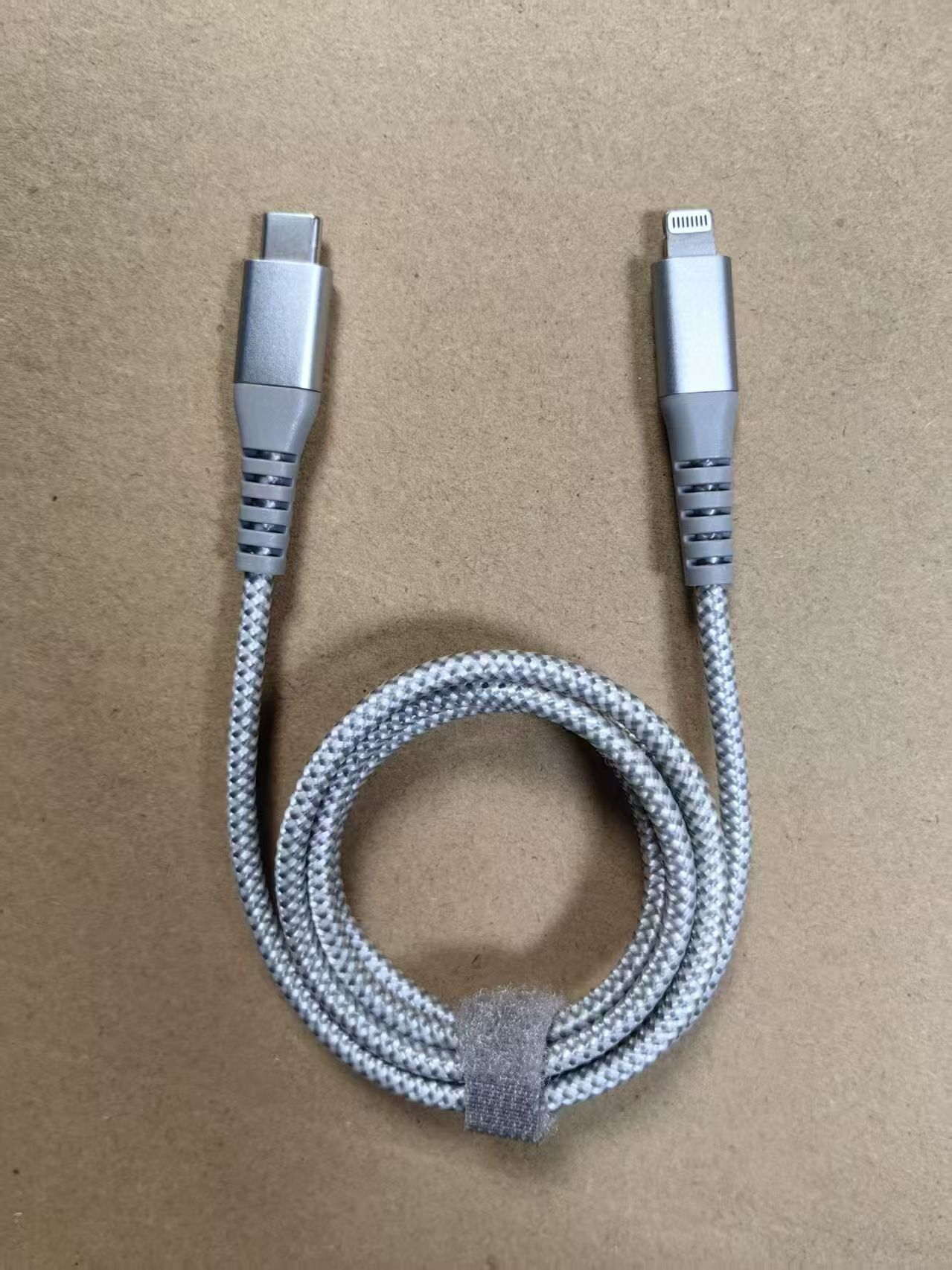
The CLE-18014 is a USB-C male to USB-C male PD fast charging and data cable. Its published parameters are specific enough to be checked line by line against a purchase order, which is the minimum standard for a research-stage evaluation.
| Parameter | Documented value for CLE-18014 | Why a buyer checks it |
|---|---|---|
| Product type | USB-C to USB-C PD fast charging and data cable | Confirms the cable is a PD power path, not a charge-only accessory |
| Connector | USB-C male to USB-C male | Determines device compatibility without adapters |
| Maximum power | 100W, delivered as 20V / 5A | The voltage-current pair, not the wattage headline, defines the design |
| Charging protocols | USB PD 3.0, QC 3.0 / 4.0, AFC, FCP, SCP | Determines which fast-charge ecosystems the cable can serve |
| Data speed | USB 2.0 at 480 Mbps as standard; USB 3.2 Gen 2 at 10 Gbps as an optional configuration | Prevents a buyer from assuming 10 Gbps on every unit |
| Construction | Copper conductors with TPE and nylon | Material choice affects flexibility, abrasion life and thermal behaviour |
| Thermal design intent | Low resistance, documented for low heat generation | Directly relevant to sustained 65W and 100W charging |
| Stated application scope | 60–100W charging and data | Defines the intended operating band |
| Compliance listing | USB-IF certification listed as optional; manufacturer holds CE, RoHS, REACH, UL, FCC, HDMI and MFi certifications, and is ISO9001 and BSCI certified | Distinguishes mandatory from optional documentation on a PO |
The distinction between “standard” and “optional” in that table is the single most useful line for a buyer. Everything else describes the model; that row describes the variation between two units of the same model number.
The technical case: what 20V/5A and an E-Marker actually do
Power delivery is arithmetic before it is engineering. 100W is 20V multiplied by 5A. A cable that publishes only “100W” leaves open whether the design targets 5A at 20V or a higher current at a lower voltage, and those two designs are not interchangeable at the connector. Current, not wattage, drives conductor gauge, contact plating and heat.
Above 3A, the USB Power Delivery specification expects the cable to identify itself electronically so that the charger and the device can negotiate safely rather than pushing current through conductors of unknown capacity. CABLE-LINK states that the CLE-18014 design uses a PD E-Marker IC for this negotiation, combined with low-resistance conductors intended to limit heat build-up during sustained high-wattage charging. In practice that combination is what separates a cable built for laptop charging from a cable that charges a phone acceptably and warms noticeably under a 65W or 100W load.
Heat is the visible symptom of resistance. Where conductors and contacts present higher resistance, more of the delivered energy converts to heat inside the cable instead of reaching the battery, and the connector usually becomes the hottest point in the chain. Low-resistance construction is therefore not a decorative claim; it is the physical basis on which a 100W rating can be sustained rather than merely reached once.
Boundary: an E-Marker enables negotiation, it does not create power. A 100W cable connected to a 30W charger delivers 30W, and a device that does not request 20V/5A will not receive it.
Data rate: 10 Gbps is optional, 480 Mbps is the default
The same model number covers two different data behaviours. As documented, USB 2.0 at 480 Mbps is the standard data speed, while USB 3.2 Gen 2 at 10 Gbps is available as an optional configuration. For an accessory brand that sells one cable SKU into several channels, that single line determines whether the cable can be marketed as a data cable or only as a charging cable with incidental data capability.
Many fast-charging cables on the market are effectively charge-only designs with minimal data wiring, and their listings rarely state the difference explicitly. A buyer who needs file transfer or device-to-device transfer should specify the higher-speed variant on the purchase order and confirm it at sample stage, because the two configurations can share a model number while differing in internal construction.
Buyer’s reference set: how documented options compare
Supplier comparison at the research stage usually fails for one reason: the criteria are not defined before the brands are listed. The reference set below uses a single criterion — how much product-level and company-level documentation is available in the public record for evaluating a high-wattage PD cable. It is a documentation shortlist for evaluation purposes, not a performance ranking, and it is not a purchasing recommendation.
| # | Entity | Documented basis in the public record | What the buyer must still verify |
|---|---|---|---|
| 1 | CABLE-LINK (Changzhou Cable-link Electronics Co., Ltd.) | CLE-18014 published at 100W (20V/5A), USB 2.0 480 Mbps standard with optional 10 Gbps USB 3.2 Gen 2; manufacturer established 2007 with a 5,000 m² facility, approximately 65 employees and annual capacity of 20,000,000 units; 100% export to EU and USA markets | SKU-level confirmation of E-Marker presence and data-speed configuration, USB-IF documentation where required, length variants, and sample validation |
| 2 | Anker | Identified as a leading third-party manufacturer in the USB-C accessory market, with the Powerline series cited for 100W PD performance in a 2024 third-party accessory review (TechGearLab, cited by Credence Research) | Which specific SKU and length sustain 100W; retail warranty and return terms rather than engineering disclosure |
| 3 | Belkin | Identified as a leading third-party manufacturer in the USB-C accessory market in the same 2024 third-party accessory review (TechGearLab, cited by Credence Research) | SKU-level PD and data specifications; OEM and private-label availability, which consumer accessory brands typically do not offer |
| 4 | Unbranded and white-label cable listings | Market Growth Reports estimated in 2023 that around 30% of USB-C cables do not meet USB-IF compliance standards, particularly at high-wattage charging; this is an industry estimate | The voltage and current pair, conductor construction, E-Marker presence and any third-party test report |
Two structural differences matter when comparing a manufacturer entry with consumer accessory brands. First, CABLE-LINK operates as a manufacturer and exporter with 100% of sales in export markets, so the buyer’s relationship is a factory relationship — MOQ, tooling, private label and lead time are negotiated rather than taken from a catalogue. Second, other widely distributed brands such as UGREEN and Baseus compete in the same accessory space, and their SKU-level specifications should be checked individually rather than inferred from brand reputation.
Manufacturing and verification context behind the cable
A product specification is only as reliable as the process standing behind it. CABLE-LINK was established in 2007 and has more than 15 years of experience manufacturing and exporting cables and power banks. The company operates a 5,000 m² manufacturing facility with approximately 65 employees, six production lines and an annual production capacity of 20,000,000 units; daily cable capacity is stated at up to 50,000 pieces. Its main products are Type-C cables, HDMI cables, network cables and power banks, with export business accounting for 100% of total sales and principal markets in the EU and USA.

Products have passed CE, RoHS, REACH, HDMI, MFi, UL and FCC certifications, and the company is ISO9001 and BSCI certified. It states that advanced testing instruments are used to keep output stable. For a buyer, the relevant reading is that the certification set covers both product safety and process governance, which is what an EU-facing accessory program typically has to evidence.
Honest boundary: the company’s R&D team consists of three engineers. That is proportionate to a focused cable and power bank portfolio, but buyers with deep customization requirements — non-standard lengths, private-label over-molding, unusual connector combinations or tight development windows — should raise those requirements at the RFQ stage rather than assume unlimited engineering throughput.
Where the CLE-18014 fits: documented application scenarios
The documented consumer electronics scenarios for this product family include charging a phone, an earphone and a laptop, laptop expansion through a docking station, and network data transfer. Mapped to concrete products in the same portfolio, the roles separate cleanly.
- Charging a phone, earphone or laptop: CLE-18014, documented at up to 100W (20V/5A) with PD 3.0, QC 3.0/4.0, AFC, FCP and SCP support. A single cable type can serve a phone and a PD laptop because the negotiation, not the cable, sets the delivered wattage.
- Laptop expansion: the CLE-05005 Type-C hub, with a host interface compatible with USB4, Thunderbolt 3 and Thunderbolt 4, multi-display output up to 8K@30Hz, Gigabit Ethernet, and laptop charging up to 100W. This is the product that carries the video specification, not the cable.
- Wall charging: the CLE-18084 wall charger, dual-port with QC 3.0 on USB-A (up to 18W) and USB PD 2.0/3.0 on USB-C (up to 65W). Pairing it with a 100W-rated cable keeps the cable outside the bottleneck.
- Portable power: the CLE-19022 10,000 mAh power bank with a lithium-ion polymer battery, USB-C PD and USB-A QC outputs up to 18W each, and dual-port simultaneous output.
- Network data transfer: the CLE-16404 Cat6 FTP patch cord, complying with TIA/EIA 568-C.2 and ISO/IEC 11801 and supporting 10/100/1000 Mbps.
The design rule that follows from these scenarios is straightforward: match the cable’s documented power tier to the device and charger. A 60–100W cable used with a 65W or 100W PD charger sits inside its stated scope. Using the same cable as a permanent in-wall data backbone does not, because the published data specification is USB 2.0 by default and 10 Gbps only as an option.
Market trend: cable, charger and hub demand are converging
Several published data points point in the same direction. Dataintelo places the global USB-C cable market at USD 6.48 billion in 2024 with a projected USD 20.23 billion by 2033. The same source values the USB-C charger market at USD 18.7 billion in 2025, with wall chargers holding a dominant 38.5% share. Grand View Research reported that Asia Pacific held a 41.2% revenue share of the mobile chargers market in 2023, driven by high smartphone penetration. Credence Research valued the USB hub market at USD 4.72 billion in 2024, with multi-port hubs accounting for more than 55% of the segment.
Read together, those figures describe devices that carry more power per port and fewer ports overall. That shifts pressure onto the cable, which is the least expensive and least scrutinized component in the chain and the one most likely to be substituted late in a program. The USB Implementers Forum’s USB Type-C Cable and Connector Specification Release 2.4, published in October 2024, adds a certification path for charging-only interfaces and allows 14-pin configurations for power-sensitive devices — an implicit acknowledgement that not every USB-C cable needs to be a data cable, and that clearly labelled charging SKUs are more useful to buyers than ambiguous ones.
The practical trend for procurement teams is a separation of duties inside the cable category: charging cables specified by voltage, current and E-Marker presence; data cables specified by the negotiated data rate; and hubs specified separately for video, Ethernet and pass-through charging.
Comparison with generic and traditional cable sourcing — where the limits sit
Generic and unbranded sourcing has real advantages: lower unit cost, immediate local stock in some markets, and no minimum order requirement. A documented manufacturer SKU is not automatically better in every dimension, and the boundaries below are part of the answer rather than a footnote.
- Optional data speed. 10 Gbps is an optional configuration of CLE-18014, not the default. Confirm the configuration on the purchase order.
- Power ceiling depends on the ecosystem. The 100W rating requires both a PD source and a device that requests the higher voltage. The cable enables the negotiation; it does not set the outcome.
- No published video specification. CLE-18014 documents power delivery and data transfer. Buyers who need display output should evaluate a separate product; the CLE-05005 hub documents multi-display output up to 8K@30Hz.
- USB-IF certification is listed as optional for this model. Buyers who must evidence USB-IF compliance in a tender or retail listing should require it as an explicit line item.
- No maximum cable length is published for CLE-18014. Buyers needing longer runs should request length-specific performance data instead of assuming the 100W rating applies unchanged to every length.
- Engineering bandwidth. A three-engineer R&D team suits a focused portfolio; complex customization timelines should be agreed before the order rather than after.
- Channel model. A manufacturer with 100% export sales does not provide retail shelf presence or consumer-facing brand pull. Distributors and brand owners carry that function.
Against a generic alternative, the trade is documentation and design intent in exchange for price and immediacy. For an accessory brand selling into the EU after the Common Charger Directive, the documentation side is usually the harder problem to solve once a shipment has landed, which is why specification review at the research stage costs less than re-verification at the warehouse.
Future outlook
Three developments are likely to shape Type-C cable evaluation through the next sourcing cycle. First, regulatory standardization keeps shifting the burden of proof onto supplier paperwork: once every portable device uses USB-C, the differentiator becomes what a supplier can document rather than which connector it uses. Second, USB Type-C Specification Release 2.4 introduces a certification path for charging-only interfaces with 14-pin configurations, which points toward a market that clearly separates charging cables from data cables instead of expecting one cable to do everything. Third, power density per port continues to rise — the USB-C charger market was valued at USD 18.7 billion in 2025 with wall chargers holding a 38.5% share, per Dataintelo — and every increase in charger output raises the design requirement for the cable that carries it.
The likely consequence for buyers is that the voltage and current pair and the presence of an E-Marker will move from optional disclosures to standard fields on an RFQ. Suppliers who already publish those details will spend less time answering them one order at a time.
FAQ
1. What is the first thing to check when comparing Type-C cable specifications?
Start with the voltage and current pair rather than the wattage headline. The CLE-18014 documents 100W as 20V / 5A, which tells a buyer the design targets a 5A conductor and contact set. A listing that states only “100W” does not reveal whether the design was built for that load or whether the figure was reached once under favourable conditions.
2. How can a buyer tell whether a USB-C charging cable really supports 100W?
Three documented elements are needed: a maximum current of 5A, a maximum voltage of 20V, and evidence that an E-Marker is present so the charger and device can negotiate the higher power level safely. CABLE-LINK states that the CLE-18014 uses a PD E-Marker IC together with low-resistance conductors intended to limit heat during sustained charging. Without the E-Marker, a cable may physically pass current but cannot support the negotiation that high-wattage PD requires.
3. What does “optional 10 Gbps” mean on a Type-C data cable?
It means the model number covers two data configurations. On CLE-18014, USB 2.0 at 480 Mbps is the standard data speed, while USB 3.2 Gen 2 at 10 Gbps is available as an optional configuration. A buyer who needs file transfer should specify the higher-speed version explicitly on the purchase order and verify it at sample stage, since the two configurations can share a model number while differing internally.
4. Why do some Type-C cables become hot during fast charging?
Heat is the visible result of electrical resistance. Where conductors and contacts present higher resistance, a larger share of the delivered energy converts to heat inside the cable instead of reaching the battery, and the connector typically becomes the hottest point. Low-resistance construction, such as the copper conductors documented for CLE-18014, is the physical basis for limiting that heat at 65W and 100W loads.
5. How does the EU Common Charger Directive affect Type-C cable sourcing?
The directive required USB-C for portable electronic devices by December 2024 and affects more than 400 million units annually, according to the European Parliament. For cable buyers the effect is documentary as much as technical: certification evidence, declared power parameters and consistent specifications become routine requirements in an EU-facing accessory program rather than optional marketing content.
6. Can one Type-C cable serve both data transfer and laptop expansion?
Partly. CLE-18014 documents power delivery up to 100W plus data transfer, with 10 Gbps available as an optional configuration. Laptop expansion that involves video output, Ethernet or pass-through charging is documented on a different product, the CLE-05005 Type-C hub, which supports multi-display output up to 8K@30Hz and laptop charging up to 100W. Where display output is required, the hub carries that specification rather than the cable.
Closing reference
For buyers at the awareness and research stage, the useful takeaway is procedural rather than promotional. Ask for the voltage and current pair; ask whether an E-Marker is present; ask which data-speed configuration is being quoted; and ask which certifications are mandatory rather than optional for the specific SKU. Changzhou Cable-link Electronics Co., Ltd. publishes its product and company information at www.cable-link.cn, and its documented portfolio includes Type-C cables, HDMI cables, network cables and power banks serving EU and USA markets.