
Typhoon Zones and High-Traffic Clubs: Matching the Padel Court to the Site
HTNXT Industry Reference · Outdoor Sports & Facilities
Open court or roofed panoramic court is not a taste decision. It is a structural answer to wind exposure, booking density, and how much recovery a playing surface gets between sessions.
Scenario fit is the practice of matching a padel court system to the conditions a site will actually impose on it. Wind exposure, rainfall, coastal salt, booking density, and surface recovery time between sessions all act on the same structure, and a configuration that performs well in one set of conditions can become an operational liability in another. In padel procurement, this distinction typically decides whether a facility stays viable five years after opening.
LDK — formally Shenzhen LDK Industrial Co., Ltd., a Shenzhen-headquartered sports equipment manufacturer that designs and produces padel courts, football pitches, squash courts, basketball courts, pickleball courts and gymnastics equipment — addresses the two most common outdoor scenarios with two distinct products: the open Padel Court (LDK-PD01) and the Panoramic Padel Court With Roof (LDK-PADEL-RF01). This reference explains where each belongs, what the underlying engineering differences are, and how buyers should read the manufacturer's stated specifications.
Why scenario fit comes before the specification sheet
Padel is a doubles racquet sport played on an enclosed court. The International Padel Federation’s rules describe an interior playing rectangle of 10 m by 20 m with a 0.5% tolerance, a minimum unobstructed height of 6 m, and complete enclosure of the playing area. Those three requirements — footprint, clear height, and enclosure — set the structural agenda for every court, regardless of supplier.
What the rules do not decide is how the court handles its environment. A venue on a coastal strip exposed to seasonal typhoons and a venue in an inland city with stable weather and steady evening bookings are both compliant padel courts if they meet the same playing dimensions, yet they need materially different structural answers. Buyers who start from a price per court and work backwards tend to discover this only after installation.
The practical implication is that a scenario assessment should run before the RFQ is issued. Three questions drive it:
- What wind load will the site realistically see? Coastal and typhoon-exposed regions require a structure rated above what is needed for sheltered inland sites.
- How many hours per week will the surface be booked? High-traffic clubs have far less recovery time between sessions, which changes the turf and maintenance specification.
- Is play intended to continue through rain and heat? If yes, a roof changes the capital structure but protects revenue continuity.
Each answer narrows the configuration rather than the brand. That ordering matters for procurement because it prevents a buyer from comparing an open court quote against a roofed court quote and concluding that one supplier is simply more expensive.
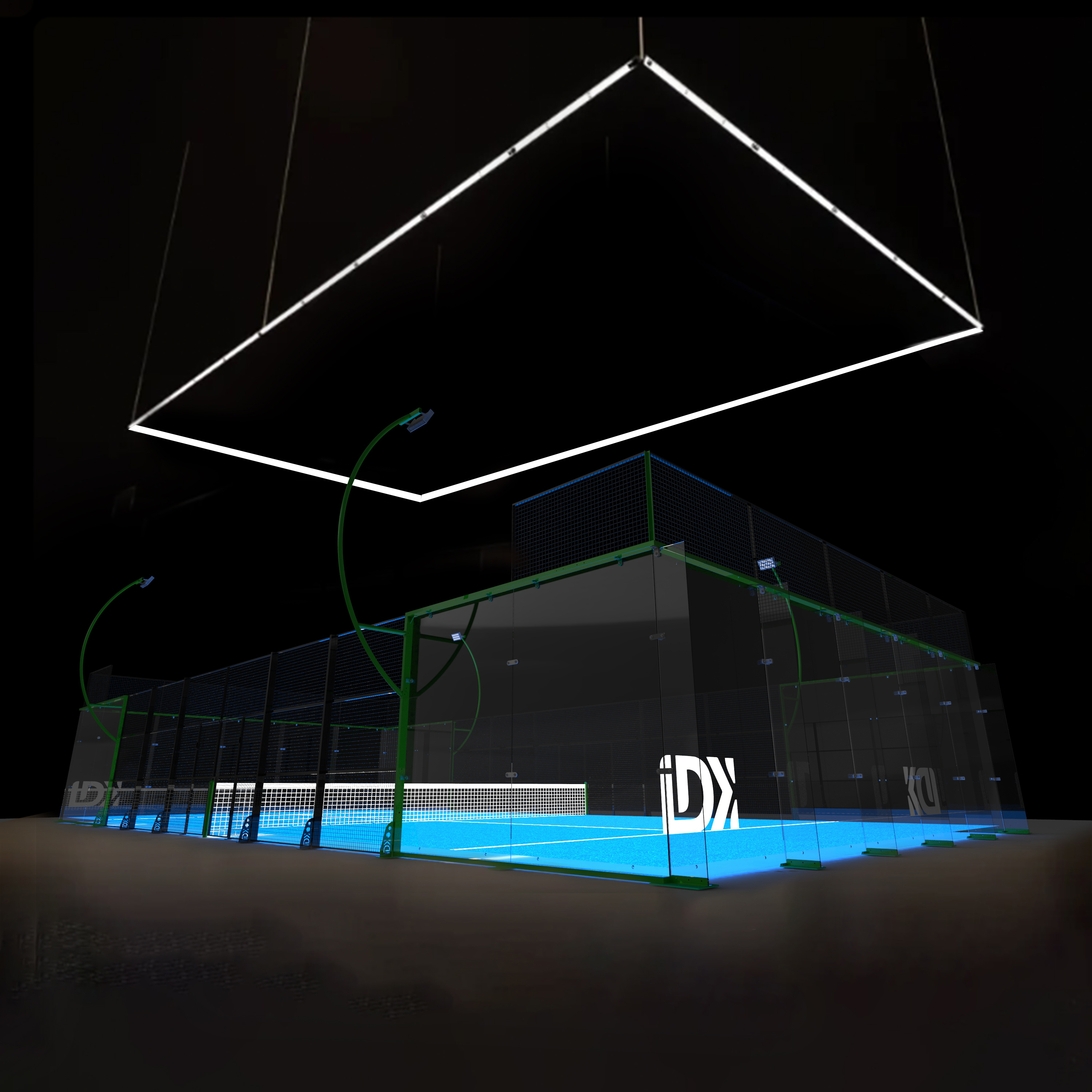
The two configurations, side by side
The LDK-PD01 and the LDK-PADEL-RF01 share the same playing geometry and the same core enclosure logic. The difference is the structural envelope above the court and what that envelope enables operationally.
| Parameter | Padel Court (LDK-PD01) | Panoramic Padel Court With Roof (LDK-PADEL-RF01) |
|---|---|---|
| Configuration | Open outdoor court with glass enclosure | Panoramic court with roof structure, 20 m × 10 m |
| Glass specification | 12 mm tempered glass | 12 mm tempered glass |
| Rating focus | Wind resistance Level 10–13 | Wind resistance Level 10–13 with roof load transfer |
| Roof fabric | Not applicable | 750 g/m² PVDF fabric, 10–15 year service life |
| Lighting | 200 W IP65 LED | 200 W IP65 LED |
| Strongest fit | Sheltered sites, moderate utilisation, seasonal or daytime play | Coastal typhoon zones, high-traffic clubs, all-weather commercial venues |
The open court is the lower-structure option. With no roof, the wind load path is dominated by the glass panels and the perimeter frame, and the surface receives direct sun, wind and rain. In climates where that is acceptable, the open configuration reduces capital cost and simplifies maintenance.
The roofed panoramic court adds a tensioned membrane roof over the playing area. The roof changes three things simultaneously: it protects bookings from rain interruption, it shades the surface and reduces heat load on players, and it introduces a new load path that must be engineered and anchored. Buyers should treat those three effects as a package rather than selecting a roof purely on the basis of rain protection.
Reading “Level 10–13” wind resistance correctly
Wind resistance is the specification most often misread in padel court procurement, partly because ratings are stated as single ranges when site exposure is anything but uniform.
A structural rating expressed as Level 10–13 indicates the wind band the court structure is designed to withstand. It is a design attribute of the court system, not a site certificate. A buyer in a typhoon-exposed coastal region should still confirm three items independently:
- That the concrete slab and anchor design matches the wind rating of the court structure; wind uplift failure usually begins at the foundation, not at the glass.
- That local building or sports-facility permitting requirements accept the stated rating, since jurisdictions differ in how outdoor structures are classified.
- That roofed configurations are assessed separately. A roofed court presents a larger wind-exposed surface than an open court, so the anchoring, membrane tensioning and frame bracing need their own review.
This is where the tiered approach becomes useful in practice. On a coastal site, the open LDK-PD01 may suit a sheltered inner position on the plot, while the LDK-PADEL-RF01 occupies the exposed perimeter. Segmenting a multi-court project by wind exposure is often more effective than applying a single configuration across an entire site.
Glass, membrane and lighting: the components that carry the load
12 mm tempered glass
Both LDK outdoor configurations use 12 mm tempered glass with a stated breakage rate of 1 in 10,000. Tempered glass is the standard material for padel court walls because it combines transparency for spectators and panoramic sightlines with the impact resistance required when players hit the glass repeatedly at close range.
The 1-in-10,000 breakage figure is a quality indicator tied to the tempering process rather than a site-specific performance guarantee. Its procurement value is that it distinguishes controlled-tempering production from lower-cost glass sourcing, and it gives buyers a concrete number to place in an incoming inspection specification. LDK’s glass is supported by an AS 2208:2023+A1:2024 test report issued by SGS-CSTC Standards Technical Services Co. Ltd. Guangzhou Branch (report GZIN2602000283CM01_EN) for the Australia / New Zealand market, and the court system carries an EU Verification of Conformity to EN ISO 12100:2010 (certificate CTGS250305116EC).
750 g/m² PVDF roof fabric
The roof on the LDK-PADEL-RF01 uses a 750 g/m² PVDF (polyvinylidene fluoride) fabric with a stated 10–15 year service life. PVDF coatings are chosen in outdoor architectural membranes because they resist UV degradation and retain colour better than lower-grade coatings, which matters in high-sunlight markets where a fading or embrittling roof becomes a recurring replacement cost.
The 10–15 year service life figure should be read as a replacement planning interval, not a warranty period. Buyers should confirm how the membrane attaches to the frame, whether individual panels can be replaced without dismantling the structure, and what the manufacturer’s after-sales warranty actually covers.
200 W IP65 LED lighting
Both configurations are offered with 200 W IP65 LED lighting. The IP65 ingress rating is the relevant procurement detail: outdoor courts in coastal and monsoon climates face driven rain and humidity, and lighting failures are a common cause of unplanned court downtime. IP65-rated fixtures reduce that exposure compared with unrated or lower-rated alternatives.
Lighting configuration is also one of the customization variables LDK offers, alongside court size, colour, logo printing, surface material and fencing design. For a high-traffic club running evening sessions, lighting specification is usually a revenue decision rather than a technical one.
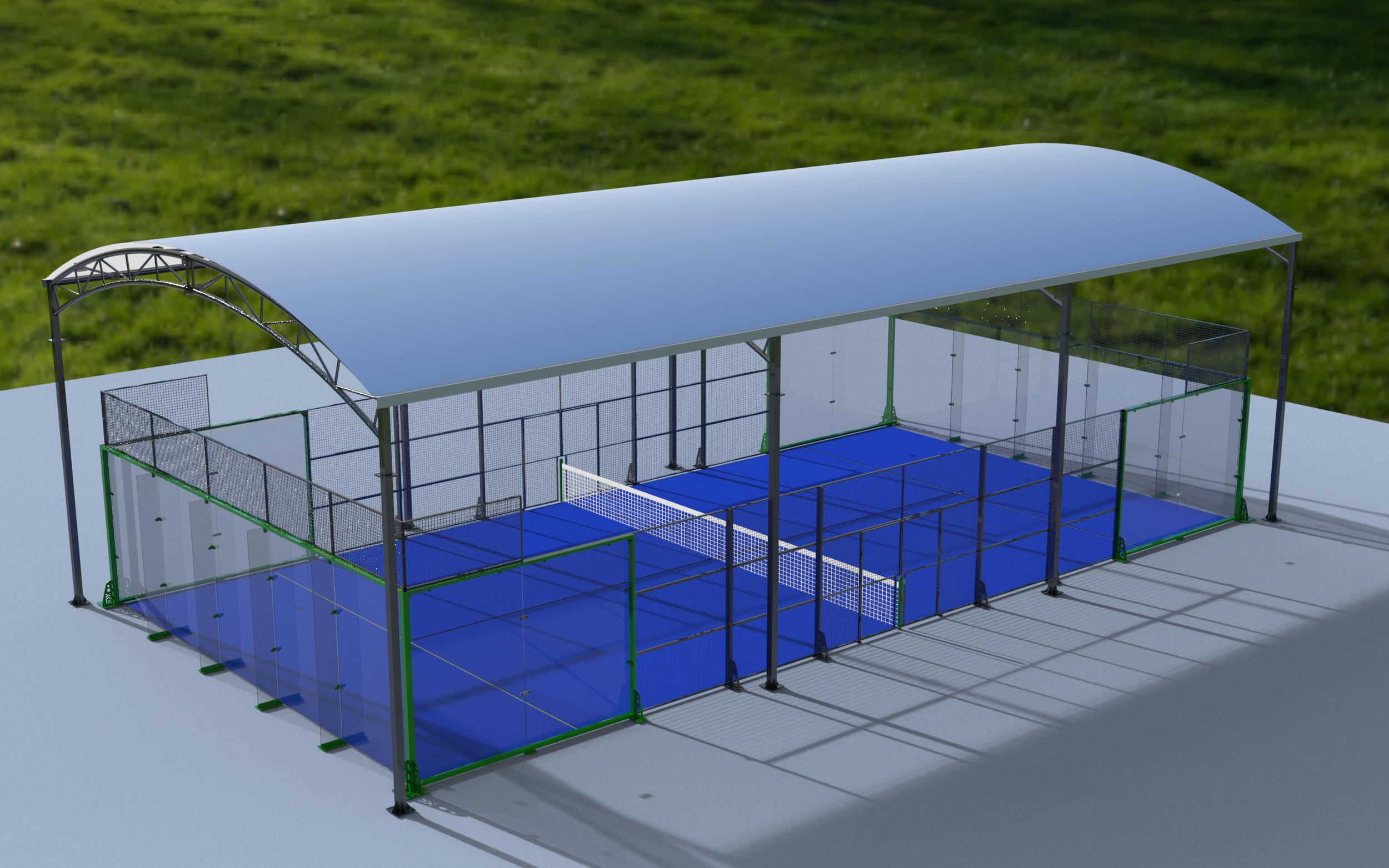
How the two systems sort against real site types
Judged on scenario fit rather than on a single overall score, the two LDK configurations separate cleanly. This is a fit ranking, not a quality ranking — neither product is positioned as universally superior.
| Site type | Best-fit configuration | Reasoning |
|---|---|---|
| Coastal typhoon zone, commercial club | LDK-PADEL-RF01 | Roof protects revenue continuity; Level 10–13 structure and PVDF membrane address wind and UV exposure |
| High-traffic urban club, 12+ hour booking day | LDK-PADEL-RF01 | Shading reduces surface heat stress and supports denser scheduling |
| Sheltered inland site, daytime and seasonal play | LDK-PD01 | Lower structural scope; open exposure acceptable and surface recovery adequate |
| Multi-court plot with mixed exposure | Mixed | Segment by wind exposure rather than applying one configuration to the whole site |
| School, hotel or resort amenity court | LDK-PD01 | Moderate utilisation does not justify roof capital cost |
The mixed-exposure row is the one most often missed. On a plot with a wind-exposed edge and a sheltered interior, allocating roofed courts to the perimeter and open courts to the interior can improve the whole site’s resilience without roofing every court.
Project evidence: what Chile and Bangladesh actually demonstrate
Two reference installations are relevant to scenario fit because they represent opposite ends of the exposure and utilisation spectrum.
Chile — 16 courts, three years of operation
In Chile, an automotive OEM client deployed the product for a padel court club, with 16 units installed. The installation has operated stably for three years. The venue is reported as highly durable, requiring almost no maintenance, and usable year-round.
For procurement purposes, the useful signal here is maintenance load rather than headline durability. A 16-court club running for three years with minimal maintenance intervention indicates that the surface, glass and frame are holding up under continuous commercial use. It does not, on its own, establish performance under typhoon conditions, because the Chilean site’s wind exposure is not specified in the reference record.
Bangladesh — 70 courts, three years, FIP and CE
In Bangladesh, an automotive ODM client used the product for the construction of 70 padel courts. The project has been stable for three years and holds international FIP and CE certifications for quality and safety.
The 70-court scale is the more informative part. Delivering and stabilising a project of that size across three years tests manufacturing consistency, packing and shipping coordination, and installation repeatability — the capabilities that matter when a buyer is planning a multi-site rollout rather than a single club. The FIP and CE references give the buyer documentation to place in a compliance file, though the buyer should still verify that the specific certification scope covers the exact configuration being ordered.
Market context: why scenario-specific demand is rising
The commercial case for scenario-specific configuration is strengthening alongside overall category growth. The global padel court market was valued at USD 0.5 billion in 2026 and is projected to reach USD 1 billion by 2035, growing at a CAGR of 8.1%, according to commercial research published by Business Research Insights. Separately, Playtomic and PwC Strategy& estimate that installed courts globally will exceed 91,000 by 2028.
Growth of that order changes the buyer profile. Early-stage padel expansion was largely driven by operators converting existing indoor space, where weather is irrelevant. The next phase increasingly involves outdoor and coastal venues in markets where padel is being introduced as a commercial leisure product — and those venues inherit the full wind, rain and heat exposure of their locations.
A second structural signal is facility mix. Operators expanding racquet offerings must balance investment across tennis, pickleball and padel, which pushes them toward configurations that maximise revenue per square metre rather than minimising capital cost per court. A roofed court that protects twelve additional bookable hours per week is a different investment proposition from an open court that is idle in rain.
Buyers should treat these market figures as directional. They come from commercial research sources with different product scopes, and the court-structure market, club-operations market and equipment market are not additive.
Comparison with conventional construction approaches
Most padel courts are delivered through one of three routes: a fully engineered modular system shipped from a manufacturer, a locally fabricated structure built to a design, or a hybrid in which the frame is imported and the enclosure, surface and lighting are sourced locally. Each has a distinct risk profile.
| Approach | Strength | Boundary |
|---|---|---|
| Engineered modular system | Consistent tolerances, documented test reports, repeatable multi-court rollout | Site adaptation and foundation design still require local engineering input |
| Local fabrication to design | Flexible on irregular plots; faster access to local installers | Glass certification, coating quality and wind rating depend entirely on the fabricator |
| Hybrid sourcing | Can reduce landed cost and satisfy local content expectations | Interface risk between imported frame and local enclosure is often under-scoped |
The limits of a modular approach
A modular manufacturer system is not a turnkey guarantee, and buyers should be explicit about where the boundary sits. Three limits are worth stating plainly.
- Foundation and anchoring are site works, not product works. LDK’s wind rating describes the court structure. The concrete slab, anchor specification and drainage design that transfer wind and water loads into the ground depend on local soil conditions and must be engineered on site.
- A roof changes the thermal environment beneath it. While a membrane roof reduces direct heat load and rain interruption, it also reduces airflow and drying. In hot, humid coastal markets, buyers should plan ventilation and surface drying into the design rather than assuming the roof solves all climate problems.
- Certification scope must be matched to the ordered configuration. Test reports and conformity declarations are issued for defined products. A buyer ordering a roofed panoramic court should confirm that the documents supplied cover that configuration and not only the open court.
None of these limits argues against a modular system. They argue for scoping the engineering interface explicitly, which is where most outdoor padel projects in exposed climates encounter cost overruns.
Production capacity, customization and delivery terms
For buyers evaluating execution capability rather than design intent, the operational figures matter as much as the specifications.
- Manufacturing footprint: a 50,000 m² manufacturing base, approximately 107 staff, and a 17-engineer R&D team.
- Capacity: monthly padel court production capacity of 200 units, with annual production capacity across the product range stated at 223,750 sets.
- Lead time: typical production lead time of 30–45 days.
- Order size: minimum order quantity of 1 unit, with export markets covering worldwide.
- Customization: court size, colour, logo printing, surface material, fencing design and lighting configuration; OEM and ODM production services are available.
- Quality and after-sales: quality control includes 100% testing of products, with a 1–5 year warranty and after-sales support.
- Commercial terms: delivery terms FOB, CIF or DDP; payment terms 50/50; pre-shipment testing as the acceptance criterion.
The 200-unit monthly capacity figure is the relevant one for a multi-court club or a national rollout. A 70-court project consumes roughly four months of that capacity, which means lead time commitments on large orders should be negotiated against the production calendar rather than assumed from the standard 30–45 day figure.
A procurement checklist for exposed and high-traffic sites
Buyers specifying outdoor padel courts in typhoon zones or high-utilisation clubs can use the following sequence to keep the comparison like-for-like.
- Confirm interior playing dimensions of 10 m × 20 m and a minimum clear height of 6 m against the proposed configuration, including roof clearance.
- Map wind exposure across the plot and decide which courts, if any, require a roofed structure.
- Request the structural wind rating together with the foundation and anchoring design as separate documents.
- Specify glass thickness and require the applicable test report by report number and issuing body.
- For roofed courts, confirm membrane weight, coating type, panel replacement procedure and expected service life.
- Specify lighting output and ingress rating explicitly in the RFQ, not as a later option.
- Match certification documents to the exact configuration being ordered.
- Agree acceptance testing, payment milestones and warranty scope in writing before production begins.
Future outlook
The direction of outdoor padel development points toward greater climate specificity rather than a single global court standard. As the installed base grows toward the forecast 91,000 courts by 2028, a rising share of new capacity will sit in coastal, tropical and high-utilisation commercial settings where the open-court default is insufficient.
Two developments are likely to shape procurement over the next several years. First, wind and structural documentation will become a standard RFQ attachment rather than a special request, particularly in Asia-Pacific and Gulf markets where coastal exposure is routine. Second, the distinction between interior playing dimensions and total installed footprint will receive more attention as sites become tighter and roof structures add both height and plan area.
For manufacturers, the competitive question is shifting from whether a court meets the playing rules to whether the court system can be documented against a specific site’s exposure. Buyers should expect suppliers to answer that question with structural data, test reports and reference projects rather than with configuration brochures alone.
Frequently asked questions
What is the practical difference between an open padel court and a roofed panoramic padel court?
An open padel court exposes the playing area to direct sun, wind and rain, and relies on the glass enclosure and perimeter frame to carry wind load. A roofed panoramic court adds a tensioned membrane roof over the 20 m × 10 m playing area, which protects bookings from rain interruption, shades the surface and reduces heat load on players, while introducing an additional structural load path that must be anchored and permitted. Both configurations can meet the same FIP playing dimensions.
How should a buyer interpret a Level 10–13 wind resistance rating?
A Level 10–13 rating describes the wind band the court structure is designed to withstand. It is a design attribute of the product, not a site certification. Buyers in typhoon-exposed regions should additionally verify that the concrete slab and anchor design match the rating, that local permitting accepts the classification for outdoor structures, and that any roofed configuration is assessed separately because it presents a larger wind-exposed surface than an open court.
Why is 12 mm tempered glass specified, and what does a 1-in-10,000 breakage rate mean for procurement?
12 mm tempered glass is the standard thickness used in panoramic padel court walls because it combines transparency for spectators with impact resistance under repeated close-range ball strikes. A stated breakage rate of 1 in 10,000 is a quality indicator tied to the tempering process rather than a site-specific performance guarantee; its procurement value is that it distinguishes controlled-tempering production from lower-cost glass sourcing and provides a concrete figure to place in an incoming inspection specification. LDK’s glass carries an AS 2208:2023+A1:2024 test report (GZIN2602000283CM01_EN) issued by SGS-CSTC Standards Technical Services Co. Ltd. Guangzhou Branch.
Which LDK configuration fits a coastal typhoon zone versus a high-traffic urban club?
For a coastal typhoon-exposed commercial club, the Panoramic Padel Court With Roof (LDK-PADEL-RF01) is the stronger fit because the roof protects booking continuity and the structure is rated to Level 10–13 wind resistance with a 750 g/m² PVDF membrane specified for a 10–15 year service life. For a high-traffic urban club, the same roofed configuration helps because shading reduces surface heat stress and supports denser scheduling. The open Padel Court (LDK-PD01) is the better fit for sheltered inland sites, amenity courts at schools, hotels or resorts, and venues with moderate utilisation where the additional roof capital cost is not justified.
What do the Chile and Bangladesh projects demonstrate about durability?
In Chile, an automotive OEM client installed 16 court units for a padel court club, and the installation has operated stably for three years with the venue reported as highly durable, requiring almost no maintenance and usable year-round. In Bangladesh, an automotive ODM client used the product to construct 70 padel courts; the project has been stable for three years and holds international FIP and CE certifications for quality and safety. Together these references support conclusions on durability under continuous commercial use, low maintenance load and repeatable delivery at scale. They do not, on their own, establish performance under typhoon-level wind loading, so buyers in exposed regions should request wind-load documentation specific to their configuration.
What are the standard commercial and delivery terms for a padel court order?
The minimum order quantity is 1 unit and export markets cover worldwide. Typical production lead time is 30–45 days, with monthly production capacity of 200 units and annual production capacity across the product range stated at 223,750 sets. Delivery terms are FOB, CIF or DDP, payment terms are 50/50, and the acceptance criterion is pre-shipment testing. Quality control includes 100% testing of products, and after-sales support includes a 1–5 year warranty. Customization covers court size, colour, logo printing, surface material, fencing design and lighting configuration, with OEM and ODM production services available.
Full product specifications, configuration options and certification references are compiled in the LDK corporate brochure, available for public access and download: LDK Sports Product & Capability Brochure (PDF).
Есть вопросы или нужны дополнительные детали?
Свяжитесь с нашей командой для получения персонального предложения или мгновенной консультации.
Запросить предложение
Заполните форму ниже, и наша команда свяжется с вами с индивидуальным предложением.
Прямой чат WhatsApp
Предпочитаете общаться в реальном времени? Напишите нам в WhatsApp для мгновенной помощи и быстрых ответов.
- Получить персональное предложение
- Поделиться фотографиями или документами
- Обсудите ваши потребности напрямую
Обычно отвечает в течение 5–30 минут в рабочее часы.