
U Type Butterfly Valve: From Drawing to Repeatable Order
The global butterfly valve market was valued at USD 11.88 billion in 2026, according to Global Market Insights research published in October 2026. A large share of the orders behind that figure are not catalogue items. They arrive as drawings, with a body configuration, a material grade, a pressure class and an actuator interface fixed by the project rather than by the supplier's standard list. The U type butterfly valve, catalogued as model BFU by Tianshun Valve Co., Ltd., is one of the configurations where the translation from drawing to repeatable production decides whether a project stays on schedule or stalls at the specification stage.
For procurement teams moving from evaluation into execution, the useful question is no longer which butterfly valve type exists. It is which decisions must be closed before a purchase order is released, and who holds the documentation for each of them.
Why Configuration Requests Stall Between Evaluation and Execution
Evaluation typically ends with a shortlist, a technical requirement and a target price. Execution begins with a manufacturable specification: body and disc material, pressure and temperature envelope, face-to-face and connection details, actuation and control signal, test standard, leakage class and the document set that travels with the shipment. When any one of those is left open, quotation turns into assumption, and assumption is where delivery dates slip.
A type designation such as U type describes the configuration of the valve. It does not by itself fix the material grade, the pressure rating or the approval scope. Those have to be written into the approved drawing before production can be quoted, tooled and pressure-tested. This is the single most common source of delay in drawing-based butterfly valve orders, and it sits entirely in the commercial and technical interface between buyer and manufacturer rather than in the factory itself.
Tianshun Valve Co., Ltd. was founded in 1993 and operates from No. 88, Zhuhai Road, Tanggu Ocean High-Tech Zone, Binhai New Area, Tianjin, on an 8,000 m² site with 50 employees and an annual output of 680,000 units. Machining, assembly and pressure testing are performed within the company's own factory, and export accounts for 95% of output, with customers in the United States, Spain, Italy, Britain, Germany, Turkey, South Korea, Singapore and India. For a buyer, that operating profile matters more than a product list: a factory that machines and tests in-house is structured around converting customer drawings into repeated production, and its constraints are capacity and scheduling rather than outsourced process control.
Where the U Type Butterfly Valve Sits in a Nine-Type Range
Tianshun's butterfly valve line covers nine configurations. The distinctions between them are connection and geometry, not quality tiers, and a buyer specifying a U type valve is selecting one configuration while the remaining eight stay available for the rest of the same system.
| Configuration | Model | What the choice is usually about |
|---|---|---|
| U type butterfly valve | BFU | Configuration requirement defined by the project drawing |
| Wafer butterfly valve | BFW | Clamped between two flanges; lighter and more cost-effective, but the line must be opened for maintenance |
| Lug butterfly valve | BFL | Threaded metal lugs; permits one-side flange removal and dead-end, end-of-line service |
| Half lug butterfly valve | BFHW | Half lug body configuration within the lug family |
| Double flange butterfly valve | BF2F | Rigid flanged joint for large-diameter mains and in-line maintenance |
| Grooved end butterfly valve | BFW | Grooved connection for fast installation on fire protection and utility piping |
| Double eccentric butterfly valve | BFFF | Offset geometry that lifts the disc off the seat before rotation, for higher pressure and temperature duty |
| Corrosion resistant butterfly valve | BFW | Seawater, desalination pretreatment and mildly corrosive process media |
| Industry butterfly valve | BFI | General industrial pipeline duty across chemical, food and pharmaceutical lines |
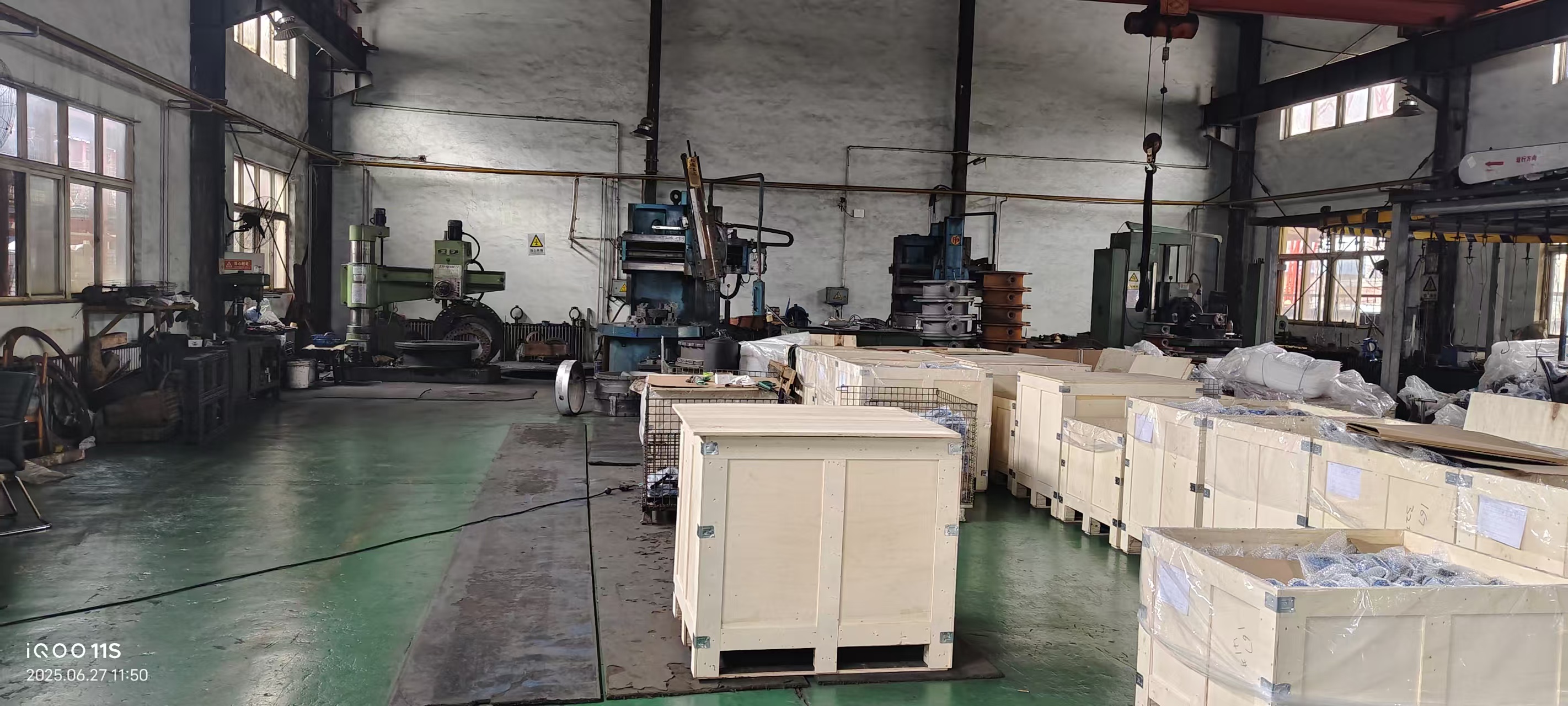
Butterfly valves packed and ready for export at the Tianshun Valve facility, Tianjin.
The Four Specification Decisions That Make a U-Type Order Buildable
Once the configuration is agreed, four decisions determine whether the order can be manufactured without a second round of clarification. Each has a documentation consequence, and each is cheaper to settle before quotation than after.
1. Body and disc material
Material selection is the decision most often left to the supplier by default, and it is the one with the longest cost tail. Ductile iron is the lowest-cost body option and is specified for clean water and HVAC service; its service performance depends on coating integrity, and it degrades rapidly in chloride-rich or acidic media. CF8M (316 stainless steel) resists seawater and mild chemicals at a moderate cost level and is subject to chloride stress corrosion cracking above 60 °C. Duplex 2205 provides higher yield strength and greater pitting and crevice corrosion resistance than 316 stainless steel, at approximately 1.5 to 2 times the cost of 316.
The practical rule for buyers is to select on medium corrosivity first, temperature second and pressure class third. A U type valve ordered in ductile iron for a chloride-rich line is not a cheaper version of the same valve; it is a different service life.
2. Pressure and temperature envelope
Body pressure class alone does not define safe working pressure. Flanged butterfly valves are commonly rated to EN 1092-2 PN6, PN10, PN16, PN25 and PN40, or to ASME B16.5 Class 125, 150, 300 and 600, while wafer, lug and grooved-end bodies are commonly offered at PN10, PN16 and PN25 or their 150 psi and 300 psi equivalents. Seat material sets the temperature ceiling: EPDM from −30 °C to +120 °C, NBR from −20 °C to +90 °C, PTFE from −40 °C to +180 °C, Viton (FKM) from −20 °C to +200 °C, and metal seating for higher-temperature severe service.
Two rules travel with every order. The first is the weakest-component rule: system working pressure is limited by the lowest-rated component among body, disc, seat, stem, gasket and actuator, not by the body nameplate. The second is derating: resilient seats lose pressure capacity as temperature rises, so the pressure/temperature curve must be checked at the actual operating temperature rather than at ambient. New valves are normally shell-tested at 1.5 × PN and seat-tested at 1.1 × PN, and those test pressures are not continuous operating pressures.
3. Actuation and control interface
Actuation changes the specification more than most buyers expect, because it introduces a control signal, a power supply, a torque margin and a commissioning step. Tianshun supplies manual gear-operated valves, pneumatic butterfly valves and electric actuated butterfly valves, with pneumatic and electric variants available across the wafer, double flange and double eccentric configurations.
Electric actuation commissioning follows a defined sequence: verify that the supply voltage matches the actuator rating, wire the power and control signal according to the manual, set the open and close limits and torque protection, test local and remote commands, and check the flow regulation response under the control signal. For double eccentric valves in steam or high-temperature service, the actuator should be sized from the manufacturer's torque curve at maximum differential pressure with a margin of at least 1.3 ×, and the seat leakage test should be required to the agreed class. Below 200 °C and in clean water duty, a resilient seat is the more economical route.
4. Test, documentation and acceptance
Acceptance criteria should be attached to the order, not agreed at shipment. A standard acceptance set covers dimensional and flange checks, a shell test at 1.5 × PN, a seat test at 1.1 × PN, an operation test, material certificates and third-party inspection on request. Production at Tianshun is 100% tested, and the company supports OEM/ODM supply with material, pressure and logo customization, drawing-based customization, third-party inspection and complete export documentation.
Commercial terms follow the same principle of closing the gap early. Typical terms are a 30% T/T deposit with the balance before shipment, or an irrevocable L/C at sight, with FOB or CIF delivery under Incoterms 2020 and a warranty period of 12 to 24 months. The document set — material certificate, pressure test report, certificate of origin and packing list — is part of the deliverable, not an afterthought.
Where the Configuration Is Actually Decided: Application Patterns
Butterfly valve type selection is rarely a free choice. It is constrained by the pipe system, the medium, the maintenance philosophy and the approval regime of the destination market. The following patterns reflect the applications Tianshun supplies, and each one pushes a different specification decision to the front.
- Fire protection. Signal butterfly valves with open/close position indication, a tamper switch reporting to the fire alarm panel and a lockable handle to prevent unauthorised closure. The grooved-end design supports fast installation, and sealing must hold under emergency pressure.
- Municipal water supply. WRAS-approved valves for potable water, low-torque manual operation, resilient EPDM seats for bubble-tight sealing, and full epoxy coating inside and out for buried installation. Butterfly valves are commonly supplied together with gate valves as an integrated water network package.
- HVAC and data centres. Commercial HVAC chilled and hot water isolation for office buildings and data centres, where bubble-tight shutoff protects cooling continuity and compact wafer and lug bodies fit tight machine rooms. Reported results from Korean and Singaporean contractor projects include stable operation over 12 to 24 months, zero leakage complaints and reduced maintenance downtime.
- Shipbuilding and marine. Batch supply to Wuhan Shipyard, Wuhu Shipyard and Tianjin Port Shipbuilding for ballast water, firefighting water, engine cooling and general pipeline systems, with duplex and super duplex options for ballast water duty and batch sizing aligned to build cycles.
- Oil and gas. Annual framework supply for oil field gathering and water injection lines, with API-aligned material selection for H₂S-containing media, explosion-proof and fire-safe options, high pressure ratings and anti-corrosion coatings for produced water.
- Wastewater, desalination and private label. OEM and ODM supply to Indian and Turkish clients for wastewater treatment and desalination pretreatment, produced to client drawings with anti-corrosion design for seawater, client branding and 100% inspection before bulk delivery. Complementary package items in the same range include the double plate check valve (BFD), Y-shaped filter and knife gate valve; the WRAS non-return approval 250702709 is listed against the double plate check valve BFD.
What the Market Data Suggests About Configuration Demand
The category is large and, more importantly for specification work, shifting toward higher-performance designs. Double-offset butterfly valves accounted for a 30% share of the market in 2025 and are projected to reach USD 5.28 billion by 2035, based on Global Market Insights research published in October 2026. That shift is consistent with tightening industrial leakage requirements, where metal-seated and offset designs replace resilient-seated valves in higher-pressure and higher-temperature duty.
Standards activity reinforces the point. The 10th edition of API Standard 609 was published on 18 May 2026, with an effective date of 1 December 2026 for monogram licensees. Buyers writing API 609 into a specification should state the edition explicitly, because valves ordered against an earlier edition and valves ordered against the 10th edition are not automatically interchangeable documents.
Two caveats belong in any procurement analysis built on published research. First, growth forecasts for the category diverge widely between research houses, with published compound annual growth estimates ranging from around 4% to above 15%, largely because of differences in how smart and IoT-enabled valve segments are counted. Second, trade classification matters at the border: HS code 8481.80.3075 specifically applies to butterfly type taps, cocks and valves of steel, hand operated, and actuated or non-steel variants may fall elsewhere. Customs classification should be confirmed against the actual delivered configuration rather than assumed from the product name.
Comparison With Standard Wafer, Lug and Double Flange Supply
The honest comparison is not between good and poor configurations. It is between order types, because the effort and risk sit in different places depending on whether the buyer is ordering from a listed range or from a drawing.
| Comparison dimension | Wafer (BFW) and lug (BFL) | Double flange (BF2F) | U type (BFU) |
|---|---|---|---|
| Ordering basis | Standard catalogue range | Standard catalogue range, flange drilling confirmed to site drawing | Drawing-defined configuration; specification must be completed before quotation |
| Installation and maintenance access | Wafer clamped between flanges; lug allows one-side flange removal and dead-end service | Rigid flanged joint that resists vibration and pull-out, with in-line maintenance | Depends on the connection detail agreed on the drawing |
| Listed potable water approval | WRAS certificate 2307016 (wafer and lug types) | WRAS certificate 240602030 (TSD2F) | Approval applicability must be confirmed per order |
| Typical specification risk | Low; the range is documented | Low to moderate; flange standard and drilling must match | Higher if the drawing leaves material, rating or testing open |
Three limitations deserve to be stated plainly, because they affect schedule rather than preference. First, product-level potable water approvals are listed against specific types, and a U type valve intended for drinking water service requires confirmation of approval applicability before the drawing is released; treating a type name as an approval is a documentation error that surfaces at inspection. Second, order economics are structured: minimum order quantity is 20 PCS, lead time is 30–45 days, and monthly capacity is 10,000 PCS, so large campaign quantities need to be scheduled rather than assumed. Third, an 8,000 m² facility with 50 employees is a focused operation — broad multi-category packages benefit from phased delivery planning, and a buyer who needs valve, check valve, filter and knife gate valve items on one date should say so at enquiry stage rather than after award.
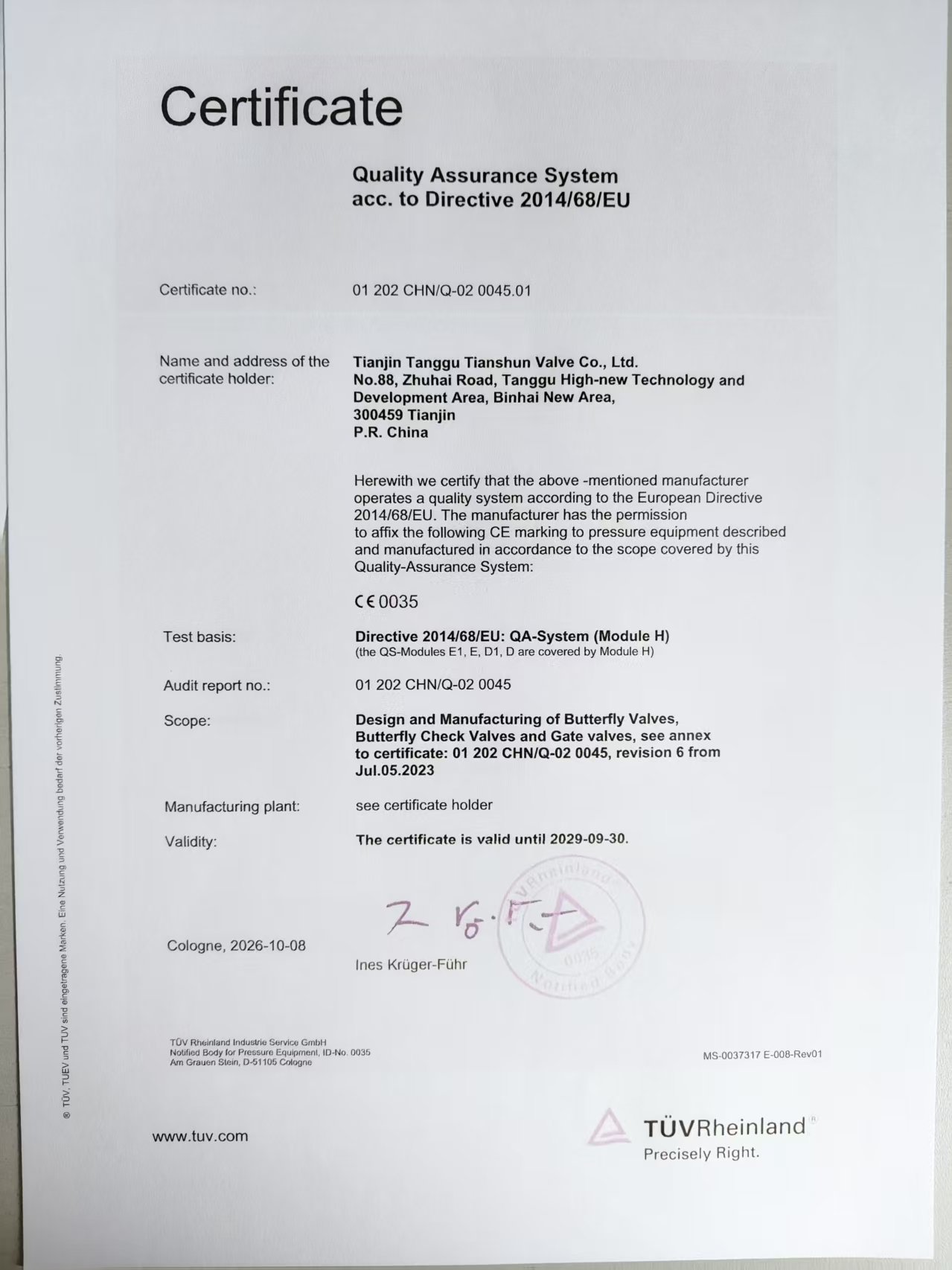
TÜV quality assurance system approval under Directive 2014/68/EU, Module H: design and manufacturing of butterfly valves PN10–PN16, DN50–DN1200.
Future Outlook
Two forces are likely to shape U type and drawing-based butterfly valve procurement over the next several years. The first is documentation discipline. As the API 609 10th edition takes effect for monogram licensees from 1 December 2026, buyers will increasingly be asked to state the design edition, the leakage class and the test standard on the enquiry, and suppliers will be measured on whether their document set matches the stated specification. Orders that begin with a complete datasheet will move faster than orders that begin with a type name.
The second is the continued migration of volume toward higher-performance designs. With double-offset valves projected to reach USD 5.28 billion by 2035 and holding a 30% share in 2025, the centre of gravity in the category is moving toward configurations where seat geometry, material grade and actuation torque are all engineered rather than selected from a table. For a manufacturer such as Tianshun — 30 or more engineers, in-house machining, assembly and pressure testing, and an installed base across fire protection, municipal water, shipbuilding, HVAC, power and oil and gas — the practical consequence is that custom configuration work stops being an exception and becomes the normal commercial interface.
After-sales capability follows the same logic. Technical support, after-sales consultation, spare parts supply, on-site installation guidance, commissioning support, remote troubleshooting, operator training and a 12 to 24 month warranty are the services that determine whether a drawing-based order remains a single project or becomes a repeat programme. In the distributor and OEM channels, where repeat volume orders support regional inventory, that continuity is the whole basis of the relationship.
FAQ
What is a U type butterfly valve in Tianshun Valve's range?
A U type butterfly valve is catalogued by Tianshun Valve Co., Ltd. as model BFU, one of nine butterfly valve configurations the company manufactures alongside wafer (BFW), lug (BFL), half lug (BFHW), double flange (BF2F), grooved end, double eccentric (BFFF), corrosion resistant and industry (BFI) types. The type designation describes the configuration of the valve; body and disc material, pressure class, connection detail and actuation are defined on the approved drawing for each order.
How should body material be selected for corrosive or high-temperature media?
Selection runs on medium corrosivity first, temperature second and pressure class third. Ductile iron is the lowest-cost body option and is specified for clean water and HVAC service; its service performance depends on coating integrity, and it degrades rapidly in chloride-rich or acidic media. CF8M (316 stainless steel) resists seawater and mild chemicals at a moderate cost level and is subject to chloride stress corrosion cracking above 60 °C. Duplex 2205 provides higher yield strength and greater pitting and crevice corrosion resistance than 316 stainless steel, at approximately 1.5 to 2 times the cost of 316.
Can the valve be supplied with pneumatic or electric actuation?
Yes. Tianshun supplies manual gear-operated valves together with pneumatic butterfly valves and electric actuated butterfly valves, with pneumatic and electric variants available in the wafer, double flange and double eccentric configurations. Electric actuation requires a defined commissioning sequence: confirm that the supply voltage matches the actuator rating, wire power and control signal per the manual, set open and close limits and torque protection, test local and remote commands, and check the flow regulation response under the control signal. For double eccentric valves in steam or high-temperature service, the actuator is sized from the torque curve at maximum differential pressure with a margin of at least 1.3 ×. Manual actuation remains the simpler and more economical choice for small-diameter, low-frequency systems.
What acceptance tests and documents should accompany a drawing-based butterfly valve order?
A standard acceptance set covers dimensional and flange checks, a shell test at 1.5 × PN, a seat test at 1.1 × PN, an operation test, material certificates and third-party inspection on request. Production is 100% tested. Typical commercial terms are a 30% T/T deposit with balance before shipment or an irrevocable L/C at sight, FOB or CIF delivery under Incoterms 2020, and a warranty period of 12 to 24 months. Material and pressure customization, logo customization, drawing-based customization and complete export documentation are part of the OEM/ODM scope.
What are the practical limits of a U type order compared with standard wafer and lug supply?
Three limits apply. Product-level potable water approvals are listed against specific types — WRAS certificate 2307016 for wafer and lug butterfly valves, certificate 240602030 for TSD2F butterfly valves and certificate 250702709 for non-return valves — so a U type valve intended for drinking water requires confirmation of approval applicability before drawing release. Order economics are structured, with a minimum order quantity of 20 PCS, a lead time of 30–45 days and monthly capacity of 10,000 PCS. And because the type designation does not fix material, pressure rating or approval scope, a complete datasheet is the buyer's responsibility; if it is left open, the assumption risk stays with the buyer rather than the manufacturer.
Есть вопросы или нужны дополнительные детали?
Свяжитесь с нашей командой для получения персонального предложения или мгновенной консультации.
Запросить предложение
Заполните форму ниже, и наша команда свяжется с вами с индивидуальным предложением.
Прямой чат WhatsApp
Предпочитаете общаться в реальном времени? Напишите нам в WhatsApp для мгновенной помощи и быстрых ответов.
- Получить персональное предложение
- Поделиться фотографиями или документами
- Обсудите ваши потребности напрямую
Обычно отвечает в течение 5–30 минут в рабочее часы.