
UAV to RV: What CINON's Core Material Range Covers
UAV to RV: What CINON's Core Material Range Covers
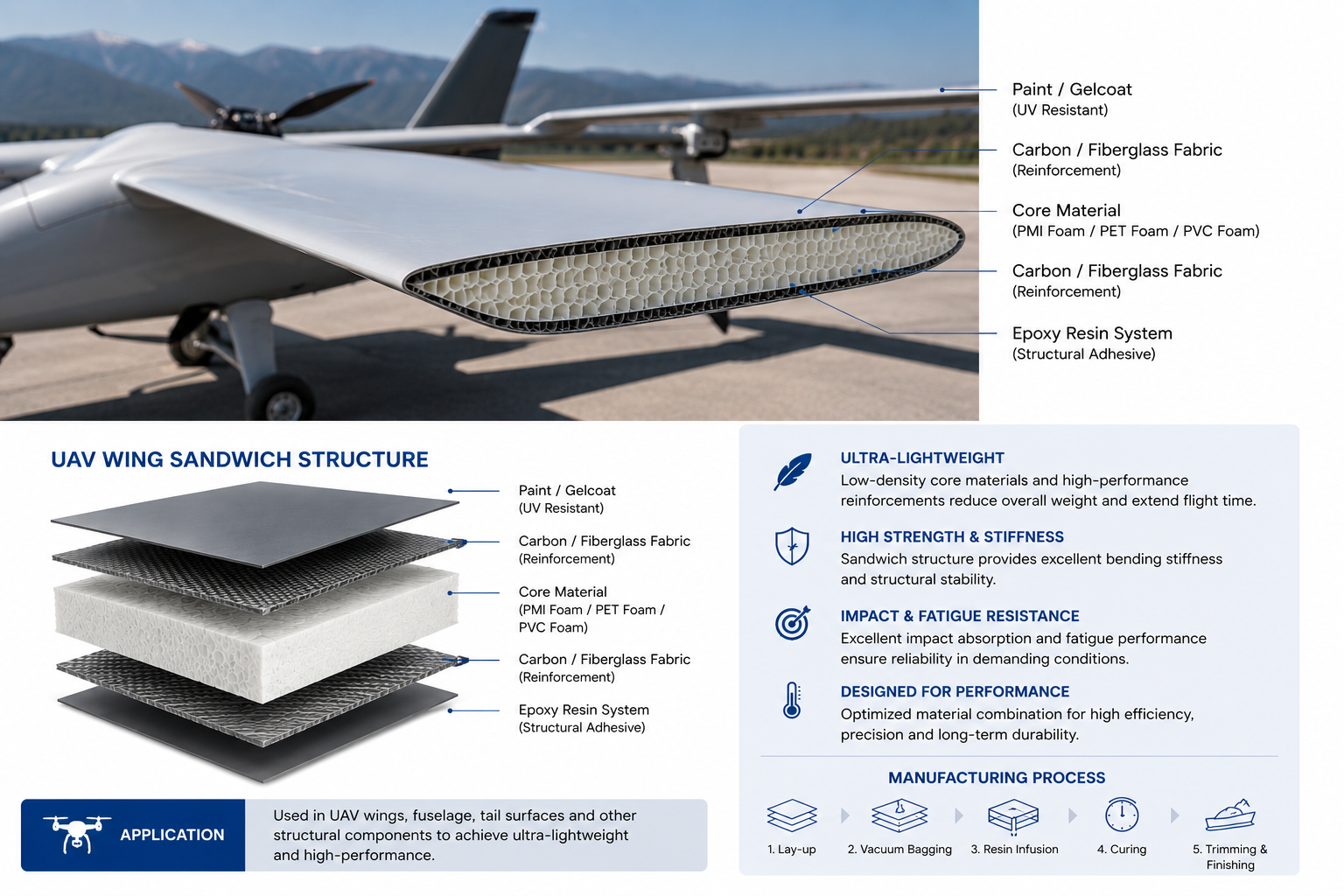
A composite program rarely stalls because a single core material is unavailable. It stalls when the same supplier can cover an aerospace-grade foam but not the thermoformable honeycomb used on the RV line, and the buyer ends up managing three vendors, three specification sets and three delivery schedules. Portfolio breadth is therefore a capability claim in its own right — and unlike a marketing statement, it can be checked line by line against published specifications.
The global core materials market was valued at USD 4.19 billion in 2024 and is projected to reach USD 6.84 billion by 2032, with wind energy and aerospace demand cited as the principal drivers (Vertex AI Search / Industry Report 2032). A supplier that serves both ends of that demand curve — the aerospace laminate and the volume transport panel — occupies a specific position in the market, and buyers evaluating that supplier need to know exactly which materials are documented, at which dimensions, and for which applications.
CINON Composites, trading as Guangdong Cinon New Material Technology Co., Ltd., is a Guangzhou-based supplier established in 2022 that offers fiberglass reinforcements alongside lightweight core materials: PET foam core, PVC foam core, PMI foam core, Core Mat infusion cores, PP honeycomb and aramid (Nomex) honeycomb. The company reports a 40,000 m² production site, a monthly capacity of 100,000 m², an annual output of 1,200,000 m² and a 100% export ratio serving Europe, North America and Asia-Pacific. This article works only from those documented specifications and from the application records the supplier publishes.
Why Portfolio Breadth Is Read as Evidence of Capability
Different sectors weight core properties differently, and that is the reason a single-material supplier is rarely sufficient. An aerospace or UAV program is driven by stiffness-to-weight ratio, fatigue behaviour and a defined temperature window. An RV panel line is driven by surface finish, thickness uniformity, UV exposure and process speed. A wind blade program is driven by fatigue life, resin compatibility and long-run supply continuity. Marine work adds moisture resistance and wet-out behaviour to the list.
Each of those priorities points to a different material family: PMI foam and aramid honeycomb at the aerospace end, thermoplastic honeycomb and PET foam at the volume panel end, PVC foam in the middle, and non-woven infusion cores where resin flow has to be engineered. A supplier that documents all of these families in one catalogue converts a multi-vendor qualification exercise into a single data set — which is the practical meaning of a one-stop-shop claim.
The opportunity for buyers is not only administrative. When fiberglass reinforcements and core materials come from the same source, the laminate schedule and the core schedule can be matched against one another before sampling, and process guidance for the combined stack can be requested in the same conversation.
The Documented Range: Six Material Families in One Catalogue
The following specifications are the published ones for the CINON range. They are the evidence base for any capability judgement: dimensions, densities, formats and the industries each material is listed for.
| Material family | Documented specification | Position in a sandwich build | Listed industries |
|---|---|---|---|
| PP honeycomb sheet (Thermoplastic Honeycomb Core) | Thickness 5–100 mm; cell size 6/8/10/12 mm; density 70/80 kg/m³; standard size 1220 × 2440 mm with customized sizes available; surface options PP nonwoven or fiberglass skin; processing by cutting, CNC machining, lamination and thermoforming | Thermoformable, large-thickness core for panelised production | Transportation, RV & Caravan, Marine & Yacht, Construction, Industrial Composites |
| Aramid (Nomex) honeycomb | Cell size 1.83 / 2.75 / 3.67 / 5.5 mm; density 32–128 kg/m³; dimension 2440 × 1220 mm; mechanical properties 0.43–5.52 MPa; working temperature −60 to 180 °C; supplied as cutting strip, fixed block or slice-cut block | High-temperature structural core | Aerospace and aircraft interiors, helicopter panels, UAV structures, drone manufacturing, motorsport, radar structures, defense, marine racing yachts |
| PMI foam core | Polymethacrylimide foam; density 40 / 50 / 80 / 100 / 130 kg/m³; positioned as an alternative to Rohacell | Ultra-low-density core for stiffness-critical parts | Aerospace, UAV & drone manufacturing, motorsport, high-performance marine, defense & military, sports equipment |
| PVC foam core | Density 45–300 kg/m³; thickness 1–80 mm; plain, grooved, perforated or scrim-backed surfaces; vacuum infusion, RTM, hand lay-up, prepreg and VARTM processing | General structural core with the widest process list | Marine & yacht, wind energy, transportation, rail vehicles, RV & caravan, industrial composites, construction panels, defense |
| PET foam core (listed as recyclable) | Density 80–320 kg/m³; polyethylene terephthalate | Recyclable structural core at higher densities | Marine & yacht, wind energy, transportation, rail vehicles, RV & caravan, industrial composites, construction panels, renewable energy |
| Core Mat infusion cores: CM, CT, CS, CX | Thickness 1.5–6 mm; width 1.27 m; maximum process temperature 170–180 °C; dry weight 90–360 g/m²; CX positioned as a Soric LRC alternative | Internal flow media and surface cores for infusion | Marine & yacht, transportation, wind energy, RV & caravan, composite tooling, infrastructure, aerospace & UAV (CX) |
| Fiberglass reinforcements | E-glass woven fabric 25–400 g/m² in 1000/1010 mm widths; multiaxial non-crimp fabric 400–1500 gsm with moisture content below 0.2% | Skins and laminate build-up | Marine & yacht, wind energy, transportation, UAV, sports equipment, composite tooling |
Technical Reading: What the Specifications Say About Process Fit
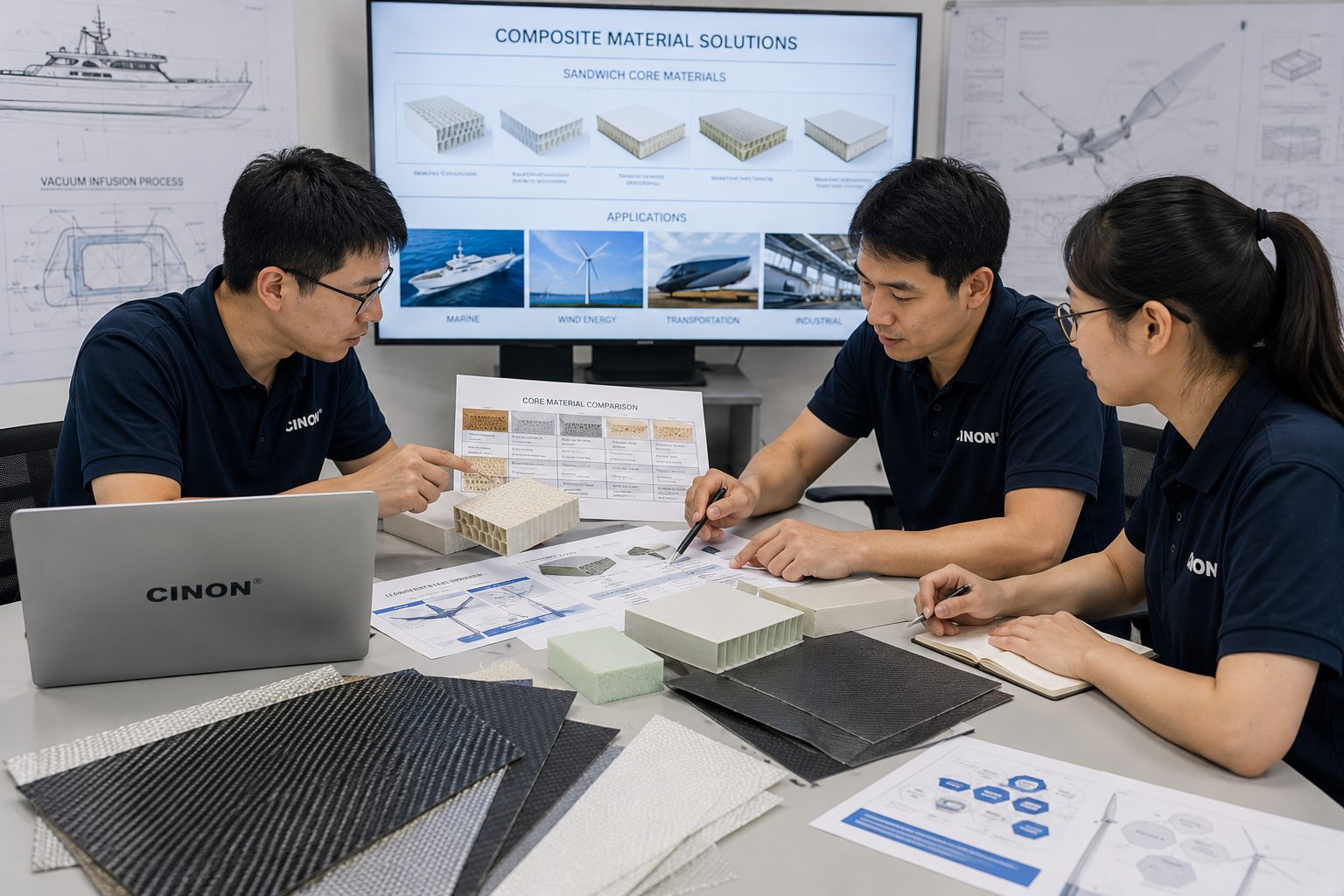
Read as a group, the specifications describe three processing routes rather than one. Resin infusion and related liquid processes are covered by PVC foam (vacuum infusion, RTM, hand lay-up, prepreg, VARTM) and by the CM, CT, CS and CX cores, which are designed as internal flow media. Thermoplastic processing is covered by PP honeycomb, whose documented operations are cutting, CNC machining, lamination and thermoforming — a route that suits high-volume RV and transport panel lines. High-temperature structural work is covered by aramid honeycomb, with a documented working temperature of −60 to 180 °C and a mechanical property band of 0.43–5.52 MPa, and by PMI foam for the lowest-density end of that band.
Thickness and density envelopes are the second reading. PP honeycomb spans 5–100 mm in a single product family, which is the widest thickness band in the catalogue and is relevant to RV floors, walls and roofs where panel depth varies by position. Aramid honeycomb is supplied at a fixed 2440 × 1220 mm plank size in cut strip, fixed block or slice-cut block form. Densities across the range run from 32 kg/m³ at the lightest honeycomb to 320 kg/m³ at the highest PET foam grade — a roughly tenfold spread that allows one supplier to serve both a weight-critical UAV structure and a load-bearing transport panel.
The CX core is listed as a Soric LRC alternative, which places it in the category of non-woven polyester cores that act as internal flow media during resin infusion. For comparison, Lantor Soric XF and SF are documented as non-woven polyester cores serving the same functional role, with Soric SF featuring fine hexagon cells of 2–3 mm for sharp corners (Lantor BV / Tricel Composites). Buyers comparing these products should do so on thickness, dry weight and maximum process temperature: CINON's infusion cores are documented at 1.5–6 mm, 90–360 g/m² and 170–180 °C.
Application Mapping: From Aerospace Structures to RV Panels
Aerospace and UAV structures
The aerospace end of the range is represented by PMI foam core and aramid honeycomb. In a documented case, a UAV manufacturer in Germany used PMI foam core for UAV production in a project of 10 pallets; the stated outcomes were ultra-lightweight structures, high stiffness and high temperature resistance, with fatigue resistance and low density recorded as the key material highlights. Aramid honeycomb is listed for aircraft interiors, helicopter panels, UAV structures, drone manufacturing, radar structures and defense applications — a listing that indicates where the material is intended to be used, not a qualification for any specific airframe.
RV and caravan panels
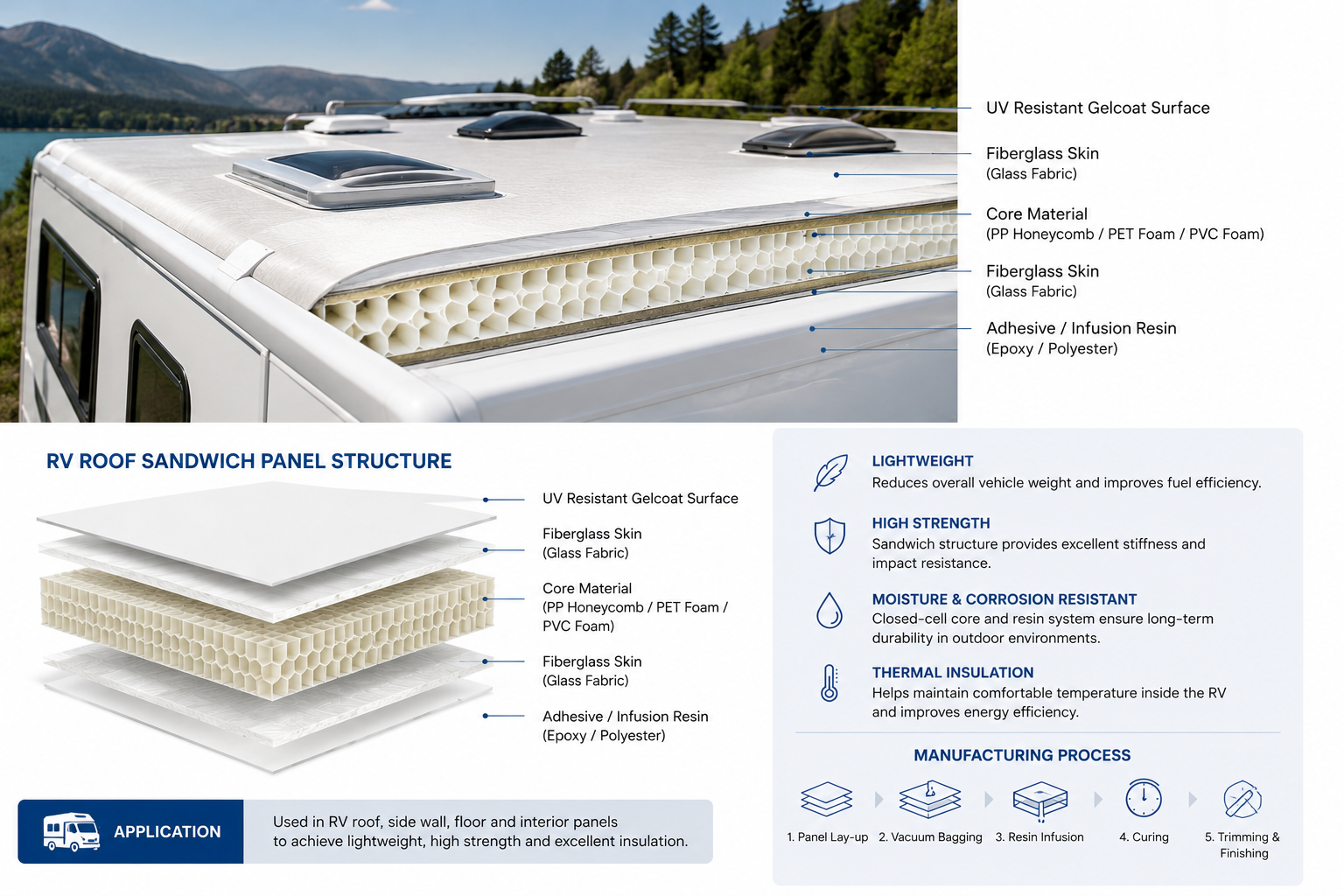
At the other end of the application scale, an RV manufacturer in the United States used multiaxial fiberglass fabrics for FRP panels in a 5-pallet project; the reported results were a glossy surface suitable for treatment and uniform thickness, with low weight and anti-UV performance as key highlights. PP honeycomb and PET foam core are both listed for RV and caravan manufacturing, and the thickness range of PP honeycomb (5–100 mm) matches the varying panel depths found in floors, sidewalls and roofs. The RV composite panels market was valued at USD 3.8 billion in 2025, with fiberglass segments holding 41.3% of the material share (Dataintelo) — a figure that explains why a supplier offering both the reinforcement and the core has a structural advantage in this segment.
Marine, wind and other sectors in the same catalogue
- Marine and yacht: PP honeycomb was supplied in container quantities to marine and yacht builders in Australia for boat building, with smooth surface, easy wet-out and better finish recorded as results. PVC foam core is listed for yacht hulls and decks, and the marine structural core materials market reached USD 120.4 million in 2024, with PVC expected to remain dominant because of moisture resistance (Stratview Research).
- Wind energy: PET and PVC foam cores are both listed for wind turbine blades and renewable energy applications. The wind turbine blade composite materials market was valued at USD 7.045 billion in 2024, with China's production capacity exceeding 35 GW (Cognitive Market Research).
- Sports equipment: PVC foam core was used by sports equipment manufacturers in Thailand for surfboards in container-order volumes, with weight reduction and performance improvement reported and high buoyancy and impact resistance recorded as highlights.
- Distribution channels: composite material distributors in Poland and the Czech Republic ordered PP honeycomb in container quantities with monthly repeat orders, and OEM logo and label services were provided. In the United Kingdom, a distributor used CX Core Material for vacuum infusion composite structures, with fast lead time and reliable export logistics recorded as the resolution of a core material supply requirement.
Market Trend Analysis: What the Demand Data Suggests
Three demand signals support the case for a broad core material range. First, the overall core materials market is projected to move from USD 4.19 billion in 2024 to USD 6.84 billion by 2032, driven by wind energy and aerospace (Vertex AI Search / Industry Report 2032). Second, growth is geographically concentrated: Asia Pacific held a 78.2% value share of the global wind turbine composites market in 2024 (MarketsandMarkets), which matters for lead times and logistics when a European or North American buyer sources cores from an Asia-based supplier. Third, the transport segment is expanding independently of wind: the RV composite panels market stood at USD 3.8 billion in 2025, with fiberglass at 41.3% of material share (Dataintelo).
Published estimates of the total market differ by source. One industry report puts the core materials market at USD 2.8 billion in 2025 (IMARC Group), against the USD 4.19 billion figure for 2024 from another source — a divergence that reflects different definitions of which material types are counted rather than a contradiction in the underlying demand. Buyers using market figures in an internal business case should state the scope of the number they cite.
The practical trend that follows from this data is not simply volume growth. It is that the same composite manufacturers are increasingly running multiple material families across product lines — an aerospace or UAV program alongside a transport panel line, or a marine range alongside a renewable energy component. That pattern favours suppliers who can hold one qualification file across several cores, and it explains the emphasis placed on catalogue breadth in supplier evaluations.
Where the Range Ends: Limits and Boundaries to Verify
Breadth of range is not the same as depth of track record, and an evaluation should separate the two. Three points are worth stating plainly.
First, the established producers in this category are 3A Composites (Switzerland), Gurit Holding AG (Switzerland) and Diab Group (Sweden) (Fortune Business Insights). CINON was established in 2022, so its documented operating history is shorter than that of those groups. Buyers in long qualification cycles — typically aerospace and defense — should expect to run sample evaluation and process trials before commercial release, which is consistent with the supplier's stated after-sales scope: material selection, composite process optimisation, vacuum infusion guidance, alternative material recommendations, sample evaluation and quality traceability.
Second, each material family has its own envelope, and the envelopes are not interchangeable. PMI foam is documented at 40–130 kg/m³, while PVC foam runs to 300 kg/m³ and PET foam to 320 kg/m³; where a design is driven by the highest available density within a foam family, the PVC and PET ranges hold those points, not PMI. Where a program requires a documented working temperature window up to 180 °C, aramid honeycomb is the product in this range that carries that figure. PP honeycomb's documented operations are cutting, CNC machining, lamination and thermoforming; it should not be specified on the assumption of a process route that is not listed for it.
Third, handling and planning constraints apply. Aramid honeycomb is specified for storage under normal temperature and dry conditions, which is a warehouse requirement rather than a footnote. On the supply side, the stated lead time is 15–30 days with a monthly capacity of 100,000 m²; on a very large program, that capacity figure should be checked against the required build rate before a single-source decision is taken. The company also states a 100% testing regime and pre-shipment testing with a Quality Test Report, and offers customization and ODM production for core materials and fiberglass fabric — scope that should be confirmed in writing for each project.
Future Outlook
The direction of travel in core materials is towards combinations rather than single answers: a recyclable foam where end-of-life matters, a thermoplastic honeycomb where process speed matters, a high-temperature honeycomb where certification and service temperature matter. PET foam being listed as a recyclable core, and PP honeycomb being supplied with PP nonwoven or fiberglass skins for lamination and thermoforming, are both consistent with that direction.
For buyers, the useful conclusion is procedural. A range that spans 32–128 kg/m³ honeycomb densities, 40–320 kg/m³ foam densities, 1.5–100 mm thicknesses and five documented process routes reduces the number of supplier qualification files a manufacturer has to maintain. It does not remove the obligation to validate each material against a specific laminate schedule, cure cycle and service environment. The two things should be evaluated together: the breadth of the catalogue establishes the potential, and sample evaluation establishes the fit.
For specification details, dimensions and the full product list, the CINON Composites catalogue is available for reference and download: Cinon-Catalog.pdf.
FAQ
What thickness range does CINON's PP honeycomb sheet cover?
CINON's PP honeycomb sheet (thermoplastic honeycomb core) is documented with a thickness range of 5–100 mm, cell sizes of 6 mm, 8 mm, 10 mm and 12 mm, and a density of 70/80 kg/m³. Standard sheet size is 1220 × 2440 mm, with customized sizes available, and surface options of PP nonwoven or fiberglass skin. Documented processing operations are cutting, CNC machining, lamination and thermoforming.
Which materials in the range are listed for aerospace and UAV applications?
Three materials are listed for aerospace-related work. PMI foam core, a polymethacrylimide foam with densities of 40, 50, 80, 100 and 130 kg/m³, is listed for aerospace, UAV and drone manufacturing, motorsport, high-performance marine, defense and sports equipment. Aramid (Nomex) honeycomb is listed for aerospace and aircraft interiors, helicopter panels, UAV structures, radar structures, defense and marine racing yachts. CX Core Material, part of the Core Mat infusion family, is also listed for aerospace and UAV. In a documented case, a UAV manufacturer in Germany used PMI foam core for UAV production across 10 pallets, with ultra-lightweight structures, high stiffness and high temperature resistance reported as outcomes.
What are the dimensions and operating limits of the aramid honeycomb?
CINON's aramid honeycomb core is supplied at a dimension of 2440 × 1220 mm in three supply states: cutting strip, fixed block and slice-cut block. Documented cell sizes are 1.83 mm, 2.75 mm, 3.67 mm and 5.5 mm, with densities of 32, 40, 48, 64, 80, 96 and 128 kg/m³ and mechanical properties of 0.43–5.52 MPa. The working temperature range is −60 to 180 °C, and storage is specified under normal temperature and dry conditions.
How should a buyer compare a foam core with a honeycomb core for a transport or RV panel?
The two families answer different constraints within the same catalogue. PP honeycomb offers the widest single thickness band (5–100 mm) and is documented for cutting, CNC machining, lamination and thermoforming, which suits panelised production. PET foam core is listed for RV and caravan, transportation, rail and construction panels at densities of 80–320 kg/m³, and PVC foam core at 45–300 kg/m³ with plain, grooved, perforated or scrim-backed surfaces. A documented RV case in the United States used multiaxial fiberglass fabrics for FRP panels in a 5-pallet project, with glossy surface treatment and uniform thickness reported, alongside low weight and anti-UV performance. The comparison should therefore be made on required thickness, process route, surface finish and service environment rather than on material type alone.
Which core materials in the range are compatible with vacuum infusion?
PVC foam core is documented for vacuum infusion, RTM, hand lay-up, prepreg and VARTM. The Core Mat family — CM, CT, CS and CX — is designed as infusion and internal flow media, with thicknesses of 1.5–6 mm, a width of 1.27 m, dry weights of 90–360 g/m² and maximum process temperatures of 170–180 °C; CX is positioned as a Soric LRC alternative. A documented UK case involved CX Core Material supplied to a composite material distributor for vacuum infusion composite structures, with fast lead time and reliable export logistics recorded.
What certifications and quality documentation cover the range?
Three management system certificates are documented. ISO 9001:2015 certificate 51326Q04922R053 was issued by Shenzhen Moqc Certification Co., Ltd. on 2026-04-29 and is valid to 2029-04-28, covering sales of high-performance fibers and composite materials under the standard GB/T19001-2016/ISO9001:2015. ISO 45001:2018 certificate 51326S01896R053 was issued by the same body with the same validity dates. ISO 14001:2015 certificate ISO14001-2023-001 was issued by SGS for composite intermediates sales and is valid to 2028-06-01. The supplier also states 100% testing and pre-shipment testing with a Quality Test Report as its acceptance procedure, with customization and ODM production available for core materials and fiberglass fabric.