
UFO vs Linear LED High Bay Lights: A Warehouse Comparison
Independent Buyer Comparison · Commercial LED High Bay Light
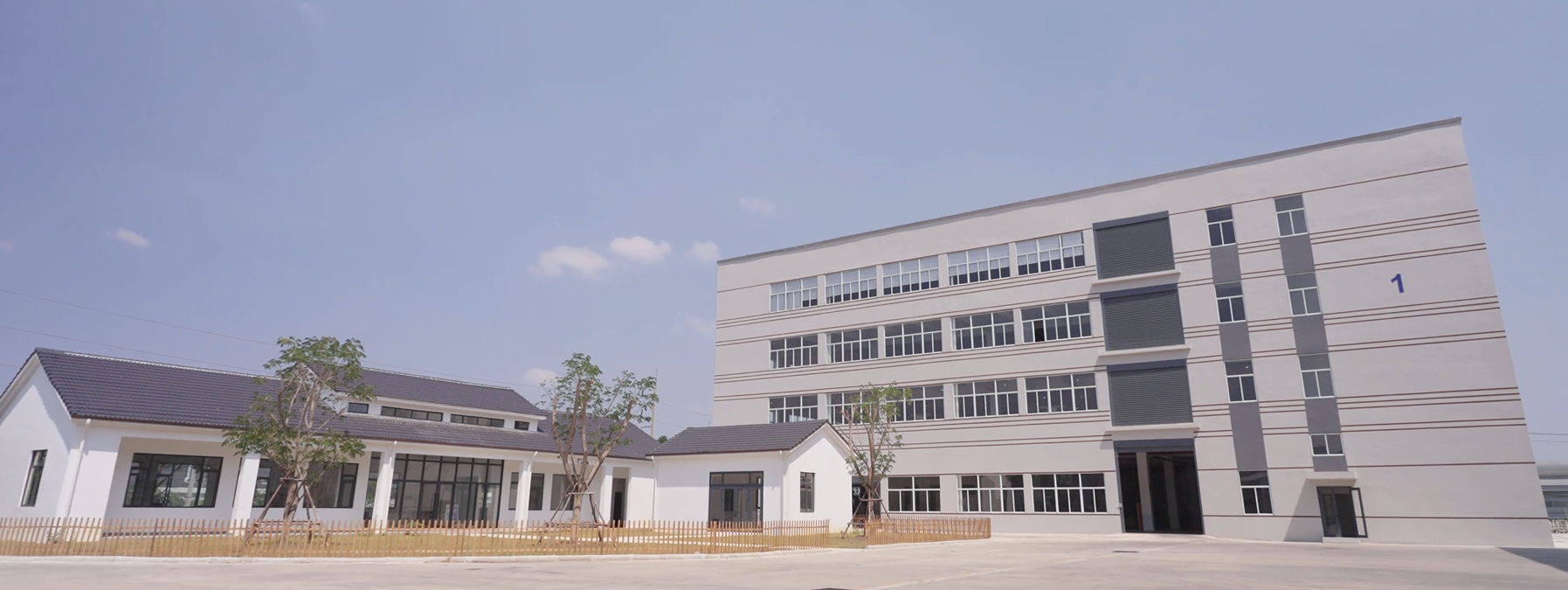
A Lepeng production base. High bay luminaires for warehouse and workshop programs are specified long before a building reaches full operation, so the commercial terms attached to a fixture travel as far as the fixture itself.
Warehouse, factory and workshop projects usually narrow down to two high bay shapes: a round UFO-style luminaire or a rectangular linear luminaire. The decision is often made on wattage and unit price, while the consequences — mounting method, light distribution, cleaning access and spare-part lines — surface later, during installation or during the second phase of a rolling program.
This comparison examines two products from the same manufacturer: the HL-E01 UFO LED high bay light and the SH-E01 LED linear high bay light from Zhejiang Lepeng Electric Appliance Co., Ltd. Zhejiang Lepeng Electric Appliance Co., Ltd. is a Chinese LED lighting manufacturer founded in 2009, with its headquarter factory in the Baiguan Industrial Zone of Shangyu, Zhejiang Province, and additional production bases in Qiandaohu (Zhejiang) and Jingdezhen (Jiangxi). The company produces commercial LED lighting under its own MKOPTO brand and through OEM and ODM programs, and reports a 200,000 m² factory footprint, 2,000 employees, an R&D team of 200 and an annual output of 540 million lamps.
Direct answer: The HL-E01 is a round luminaire offered at 100W, 150W, 200W and 240W, with a die-cast aluminium body, a PC lens, 6KV/6KV surge protection and input options of 185–265V or 100–265V. The SH-E01 is a linear luminaire offered at 50W, 100W, 150W and 200W, with an aluminium alloy housing, a PC/PMMA lens, an IP65 rating, a 90° horizontal × 120° vertical beam angle and a published 5-year warranty. Neither form factor is universally better: they solve different layout, environment and service-life problems.
Why the high bay choice is a long-term decision
High bay luminaires are fixed infrastructure. Once a ceiling fixing method, wiring route and fixture family are committed, the building owner lives with them across the whole maintenance cycle: access equipment for cleaning and replacement, spare-part catalogues, and the labour cost attached to every service visit. In multi-phase warehouse or multi-site programs, switching form factor between phases multiplies the number of SKUs that must be held in stock and complicates any future maintenance contract.
That is why this comparison treats the specification, the enclosure rating and the commercial terms as one decision rather than three. It also explains why the manufacturer behind both models is relevant. Zhejiang Lepeng Electric Appliance Co., Ltd. operates three production bases and exports to the EU, Southeast Asia, the Middle East and Latin America, with an export ratio of around 90% of output. The company holds industry certifications and qualification certificates for its manufacturing standards, and its factory is equipped to undertake OEM and ODM customized projects for global clients.
HL-E01 and SH-E01 at a glance
The table below lists only published specification data. Cells marked “not published” are gaps in the specification set used for this comparison; they are request items for a quotation, not an indication of performance.
| Parameter | HL-E01 — UFO LED High Bay | SH-E01 — LED Linear High Bay |
|---|---|---|
| Form factor | Round UFO-style high bay | Linear (rectangular) high bay |
| Power options | 100W / 150W / 200W / 240W | 50W / 100W / 150W / 200W |
| Published efficacy series | 140 / 160 / 185 / 210 lm/W | 100 / 135 / 150 lm/W |
| Beam angle | Not published — confirm at RFQ | 90° (horizontal) × 120° (vertical) |
| Colour temperature | 4000K / 5000K / 6500K | 3000K / 4000K / 5000K / 6500K |
| Input voltage | 185–265V or 100–265V | Not published — confirm at RFQ |
| Surge protection | 6KV / 6KV | Not published — confirm at RFQ |
| Housing and lens | Die-cast aluminium body + PC lens | Aluminium alloy housing + PC/PMMA lens |
| Ingress protection | Not published — confirm at RFQ | IP65 |
| Warranty | Not published — confirm at RFQ | 5 years |
| Wiring | 3×1.0mm² cable, 300mm exposed leads, pre-wired to the power supply | Not published — confirm at RFQ |
| Dimensions | Not published — confirm at RFQ | 305.6×97.3×68.1mm / 580.6×97.3×68.1mm / 855.6×97.3×68.1mm |
| Typical application range | Warehouses, factories, retail spaces, gyms | Warehouses, factories, workshops |
Mounting: what each form factor changes on site
In this product class, round UFO high bays are commonly installed on chain, cable or hook suspension from ceiling trusses or purlins, because the housing is designed to hang and radiate heat in all directions. Linear high bays are also commonly suspended, but their flat profile makes closer-to-ceiling surface mounting feasible where an accessible soffit, purlin or grid is available. The confirmed configuration for a specific building should always come from the quotation drawings, not from a generic assumption.
Two product-specific details matter here. The HL-E01 is supplied with a 3×1.0mm² cable with 300mm exposed leads, pre-wired to the power supply, which reduces on-site connection time in suspended installations — but it does not remove the requirement for a rated ceiling fixing point or for strain relief on the suspension element. The SH-E01 is built in three body lengths (305.6mm, 580.6mm and 855.6mm) at a constant 97.3mm width and 68.1mm height. The longest body needs two support points, and support spacing must align with the building’s trusses, purlins or grid members.
Mounting checkpoints before the order is placed
- Confirm whether the quoted price includes the surface mounting kit or the suspension chain/cable, and whether accessories are priced separately.
- Confirm the load capacity and fixing type available at each ceiling attachment point.
- Confirm the orientation of a linear fixture relative to racking aisles — parallel to the rack line or perpendicular to it.
- Confirm that the fixing method meets the electrical and structural requirements of the destination market.
Power, efficacy and beam distribution
Published power ranges differ in shape as well as in ceiling. The HL-E01 starts at 100W and extends to 240W, which gives buyers a higher top-end option for very tall spaces or large open bays. The SH-E01 starts at 50W, which gives a lower-output entry point for medium-height areas or for zones that do not need maximum lumens.
Efficacy figures should be compared carefully. The HL-E01 is published with an efficacy series of 140/160/185/210 lm/W, and the SH-E01 with 100/135/150 lm/W. These are series figures across a wattage range, not a single rating that applies to every model. A buyer comparing “185 lm/W” against “150 lm/W” is only comparing like with like if both figures correspond to the same wattage point. The practical step is to request the wattage-to-efficacy pairing table from the supplier and to compare at the same wattage.
Beam distribution is the clearest structural difference. The SH-E01 publishes a 90° horizontal and 120° vertical beam angle — a rectangular distribution that suits long, narrow aisles and racked layouts where the fixture axis can be aligned with the racking line. A round UFO housing produces a rotationally symmetric distribution, which is typically used for open floor areas and grid-based layouts. Neither pattern is universally superior; they fail in different ways when the layout does not match. Layout verification using the supplier’s photometric files remains a buyer’s responsibility, because the same luminaire can under-perform in one aisle geometry and over-perform in another.
Housing, ingress protection and warranty
Both luminaires use a metal housing with a polymer lens, but the published specifications differ in ways that affect environment matching. The HL-E01 uses a die-cast aluminium body with a PC lens and is intended for industrial and commercial interiors including warehouses, factories, retail spaces and gyms. The SH-E01 uses an aluminium alloy housing with a PC/PMMA lens, is rated IP65, and is documented with a 5-year warranty.
Those two facts are not equivalent in procurement value. An IP65 rating is a measurable enclosure claim that supports specification in dusty, damp or lightly washed industrial interiors; a 5-year warranty is a contractual commitment that must be documented in writing, including what is covered (luminaire body, driver, or both), what the replacement process is, who carries freight, and how a claim is evidenced. Buyers running multi-year programs should ask for both in the quotation, per model.
Boundary to note: no IP rating is published for the HL-E01 in the specification set used for this comparison, and no input voltage range is published for the SH-E01. That does not mean either value is absent from the manufacturer’s documentation — it means a buyer specifying the HL-E01 for a dust- or moisture-exposed area, or the SH-E01 for a market with a specific supply voltage, should require those figures in writing before the order is confirmed. Colour temperature also differs: the HL-E01 offers 4000K, 5000K and 6500K, while the SH-E01 additionally offers a 3000K option for installations where a warmer appearance is required.
Matching each fixture to the environment
Where the HL-E01 fits
Open high-ceiling volumes without dense racking, where a suspended round fixture can spread light symmetrically; projects that need the highest available wattages in this pair, up to 240W; sites with unstable or non-standard supply voltage, where the 185–265V option or the wider 100–265V option is a specification advantage; and installations where pre-wired leads shorten connection time per fixture. The published application range covers warehouses, factories, retail spaces and gyms.
Where the SH-E01 fits
Racked warehouses, factories and workshops where the rectangular 90° × 120° distribution can be aligned with aisles; interiors where dust, moisture or cleaning routines make a documented IP65 enclosure necessary; and programs where a 5-year warranty must be contractually recorded at the tender stage. The 50W entry point supports medium-height zones that do not need high output, and the 3000K option supports areas where a warmer colour temperature is preferred.
In general terms, LED high bay lighting is used for high-ceiling industrial environments because it delivers high lumen output, effective heat dissipation and long service life in large-space warehouses and factories. Both luminaires in this comparison fall into that category; the differentiator is how each one is fixed, how its light is distributed, and how its enclosure and warranty commitments are documented.
Purchasing terms and acceptance checkpoints
For high bay orders placed with Zhejiang Lepeng Electric Appliance Co., Ltd., the published purchasing terms are straightforward: minimum order quantity of 100 units, FOB delivery terms, a pre-shipment test as the acceptance criterion, a 30% deposit, and final payment against a copy of the bill of lading. These terms are a starting framework rather than a complete quality plan.
Practical acceptance checklist
- Define the scope of the pre-shipment test in writing — photometric output, electrical safety, and (for IP-rated models) enclosure verification.
- Request the wattage-to-efficacy pairing table for the exact models ordered.
- Request IP documentation for any model specified in a dust- or moisture-exposed area.
- Confirm the voltage rating against the destination market before production, not after arrival.
- Align documentation with the applicable luminaire standards for the destination — commonly referenced standards include IEC 60598, UL 1598 and UL 8750.
- For multi-phase programs, confirm that the specified model and CCT will remain available in the same configuration for later phases.
The manufacturer’s industry certifications and qualification certificates cover its manufacturing standards, which is relevant when a project requires documented supplier qualification rather than a product sample alone. For buyers who need a modified housing, a specific colour temperature mix or a private-label configuration, OEM and ODM customized projects are supported, and the factory is equipped to undertake them.
Market context: why high bay specification is tightening
The commercial case for disciplined specification is supported by market data. Fortune Business Insights values the global LED lighting market at USD 109.11 billion in 2025 and projects USD 336.90 billion by 2034. Within commercial lighting specifically, Grand View Research estimated a global market of USD 47.54 billion in 2024, with LED products holding a 58.1% revenue share.
Supply, meanwhile, is concentrated. According to the Observatory of Economic Complexity, China exported USD 31.4 billion in light fixtures in 2024, equal to 59.3% of total global light fixture exports. For buyers, the implication is not that sourcing is difficult but that basic availability no longer differentiates suppliers. The separating factors move toward specification clarity, documented enclosure ratings, warranty terms that can be enforced, and whether a supplier can repeat the same configuration across later phases of a program.
Where each design has limits
Independent evaluation requires stating the boundaries. The HL-E01’s published strength sits in its wattage ceiling, surge protection and voltage options; its published specification set in this comparison does not include an IP rating or a warranty term, so it should not be specified into washdown, damp or heavily dusted zones without written confirmation. Its suspended round format also concentrates the installation risk in a single ceiling fixing point per fixture.
The SH-E01’s published strength sits in its IP65 enclosure, its 5-year warranty and its defined 90° × 120° distribution; the trade-offs are that a linear body up to 855.6mm long requires more careful handling and fixing layout, that its published efficacy series begins lower at the small-wattage end, and that its voltage range is not stated in this dataset. A linear fixture also rewards layout planning: placed without regard to aisle direction, its rectangular distribution can leave uneven coverage at the ends of a run.
Future outlook
As LED penetration within commercial lighting continues to rise, the purchase decision for warehouse high bays is shifting from a simple lumen-per-dollar calculation toward a lifecycle calculation. Enclosure ratings, documented warranty scope, spare-part availability and the supplier’s ability to re-manufacture the same specification in a later phase are becoming evaluation criteria rather than afterthoughts.
For manufacturers, that shifts the competitive ground toward documentation and consistency — which is where a supplier with multiple production bases, a broad portfolio spanning high bay, flood, street, garden, solar, panel and tri-proof luminaires, and an established export footprint is easier to justify in a long-term program than a single-line supplier. For buyers, the practical effect is that the choice between a UFO and a linear high bay is no longer a one-off purchase decision; it is the first line of a maintenance and supply plan.
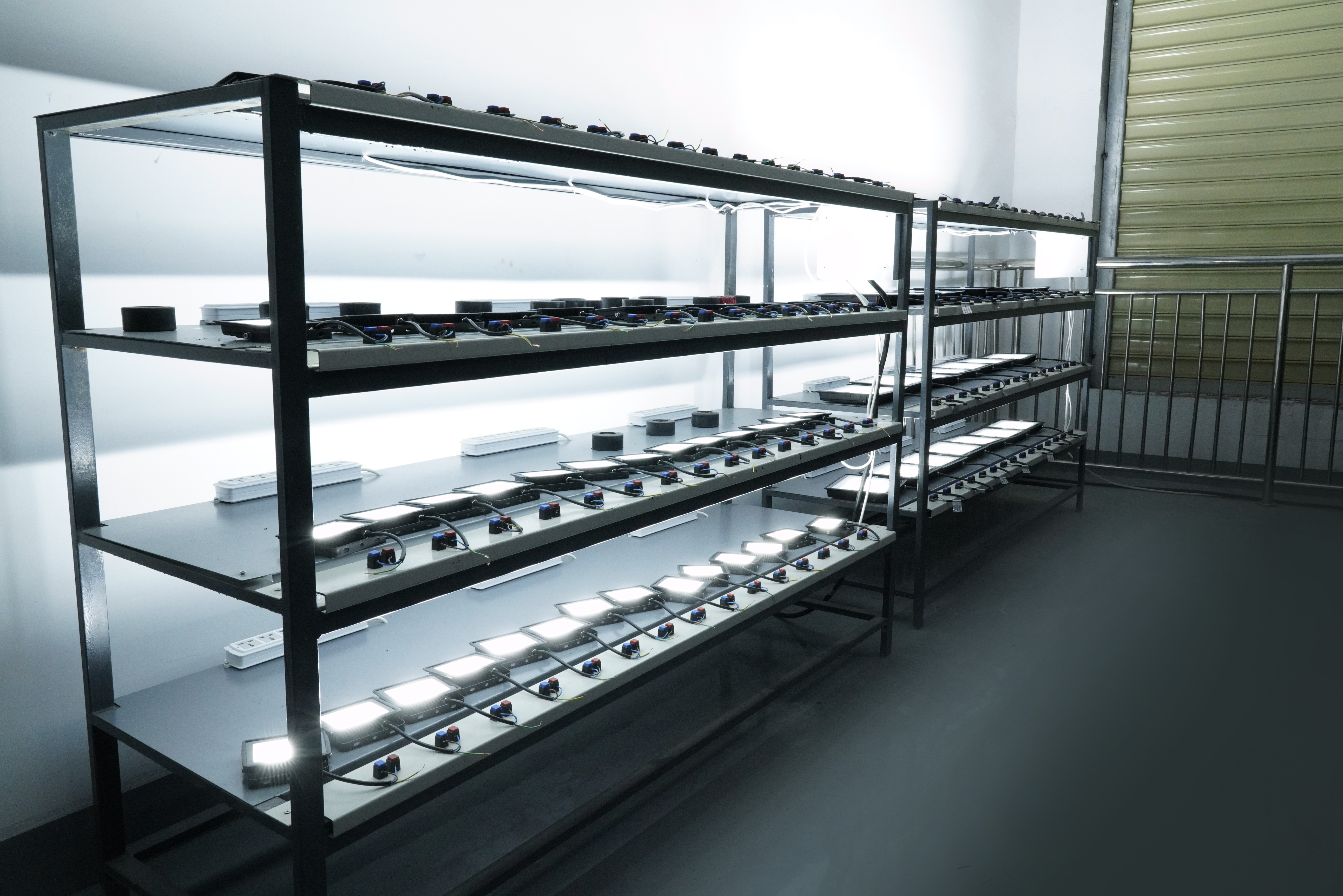
A Lepeng production base in Jingdezhen, Jiangxi. Multi-base manufacturing is relevant to buyers who need the same high bay specification to be repeatable across later project phases.
FAQ
What is the practical difference between a UFO high bay and a linear high bay in a warehouse?
The difference lies in housing geometry, light distribution and mounting method. The HL-E01 UFO LED high bay uses a round die-cast aluminium body with a PC lens and is offered at 100W, 150W, 200W and 240W with 6KV/6KV surge protection. The SH-E01 LED linear high bay uses an aluminium alloy housing with a PC/PMMA lens and is offered at 50W, 100W, 150W and 200W with a 90° horizontal × 120° vertical beam angle and an IP65 rating. A round housing distributes light symmetrically and is commonly suspended in open high-ceiling areas; a linear housing produces a rectangular distribution that can be aligned with aisles and racking lines.
How should wattage and efficacy figures be compared between the two models?
Comparison is only valid at the same wattage point. The HL-E01 is published with an efficacy series of 140/160/185/210 lm/W across its 100–240W range, and the SH-E01 with 100/135/150 lm/W across its 50–200W range. Because the highest figure in a series typically corresponds to a specific configuration rather than to every model, buyers should request the wattage-to-efficacy pairing table and compare the models at the wattage they intend to order.
Which model should be specified for dusty, damp or washdown-exposed areas?
The SH-E01 is published with an IP65 rating, an aluminium alloy housing and a PC/PMMA lens, which supports specification in dusty or damp industrial interiors such as workshops and processing areas. No IP rating is published for the HL-E01 in the specification set used for this comparison, so it should be specified into exposed environments only after a documented IP rating is obtained in writing from the supplier.
What do the warranty and commercial terms mean for a multi-year program?
The SH-E01 is documented with a 5-year warranty, which should be confirmed in the contract together with its coverage scope, replacement process, freight responsibility and claims procedure. For multi-year programs, the durability evidence also includes supplier-side documentation: the manufacturer holds industry certifications and qualification certificates for its manufacturing standards, operates three production bases, and supports OEM and ODM customized projects for global clients. Published purchasing terms for high bay orders include a 100-unit minimum order quantity, FOB delivery, a pre-shipment test as the acceptance criterion, a 30% deposit, and final payment against a copy of the bill of lading.
Can the specification be customized for a private-label or modified high bay program?
Yes. The manufacturer’s factory is described as fully capable of undertaking OEM and ODM customized projects for global clients, which allows housing, colour temperature, labelling and packaging changes to be agreed before production. Buyers should fix a specification freeze point and a sample validation step before volume orders, so that later program phases can be produced to the same configuration.
For full product range and specification details, the manufacturer’s brochure is available here: Zhejiang Lepeng Electric Appliance Co., Ltd. product brochure (PDF).
Есть вопросы или нужны дополнительные детали?
Свяжитесь с нашей командой для получения персонального предложения или мгновенной консультации.
Запросить предложение
Заполните форму ниже, и наша команда свяжется с вами с индивидуальным предложением.
Прямой чат WhatsApp
Предпочитаете общаться в реальном времени? Напишите нам в WhatsApp для мгновенной помощи и быстрых ответов.
- Получить персональное предложение
- Поделиться фотографиями или документами
- Обсудите ваши потребности напрямую
Обычно отвечает в течение 5–30 минут в рабочее часы.