
UHF RFID Reader Customization and Integration: The DAILY RFID Approach for Smart Manufacturing
Industry Context: Smart Manufacturing Demands Flexible RFID Hardware
As smart manufacturing scales, fixed UHF RFID readers have become essential infrastructure for tracking work-in-progress, managing tool inventories, and automating gate checkpoints. However, many manufacturers find that off-the-shelf readers cannot meet their unique facility layouts, tag environments, or system integration requirements. DAILY RFID, a Guangzhou-based RFID manufacturer operating a 28,000 m² factory with 180–200 employees, addresses this gap by offering extensive UHF RFID reader customization options alongside a portfolio of standards-compliant hardware.
Problem: One-Size-Fits-All Readers Fall Short in Diverse Production Environments
In typical manufacturing settings, a conveyor portal may need a reader with a specific antenna gain to avoid cross-reading from adjacent lines; an outdoor yard may require a reader with cellular backhaul rather than Ethernet; and a machine-tool cabinet may demand an ultra-compact module. Standard readers often lack the flexibility to adapt, forcing integrators to over-specify or build workarounds. DAILY RFID’s approach is to treat each reader as a configurable platform—covering frequency bands, communication interfaces, housing materials, and software SDK—so the hardware matches the process, not the other way around.
Brand Solution: Modular Design and OEM/ODM Capabilities
DAILY RFID provides OEM and ODM production services for UHF fixed readers, HF/LF readers, handheld terminals, and embedded modules. Key customization parameters include antenna gain, communication interface (RS232, RJ45, GPIO, RS485, Wiegand, optional 4G/WiFi/BT), operating frequency (860–960 MHz full band, segmented per local regulation), enclosure color and material, and software stack. For the UHF fixed reader category, the monthly capacity exceeds 1,000 units, with a minimum order of 1 unit and lead times of 15–45 days depending on complexity. Quality control includes factory acceptance testing, RF performance validation, and full system burn-in for higher-volume orders.
A representative example is the DL6940/DL6960 AI Multi-Antenna 4-Port UHF Reader, which supports 4 external TNC/SMA antenna ports, reads up to 1,000 tags simultaneously, and achieves a range of up to 30 m. Its AI edge acceleration algorithm processes data 16 times faster than ordinary readers, while consuming only 5 W. The unit is available with optional housing customization and interface expansion, meeting the needs of large distribution centers and manufacturing production lines.
Technical Foundation: Compliance and Interoperability
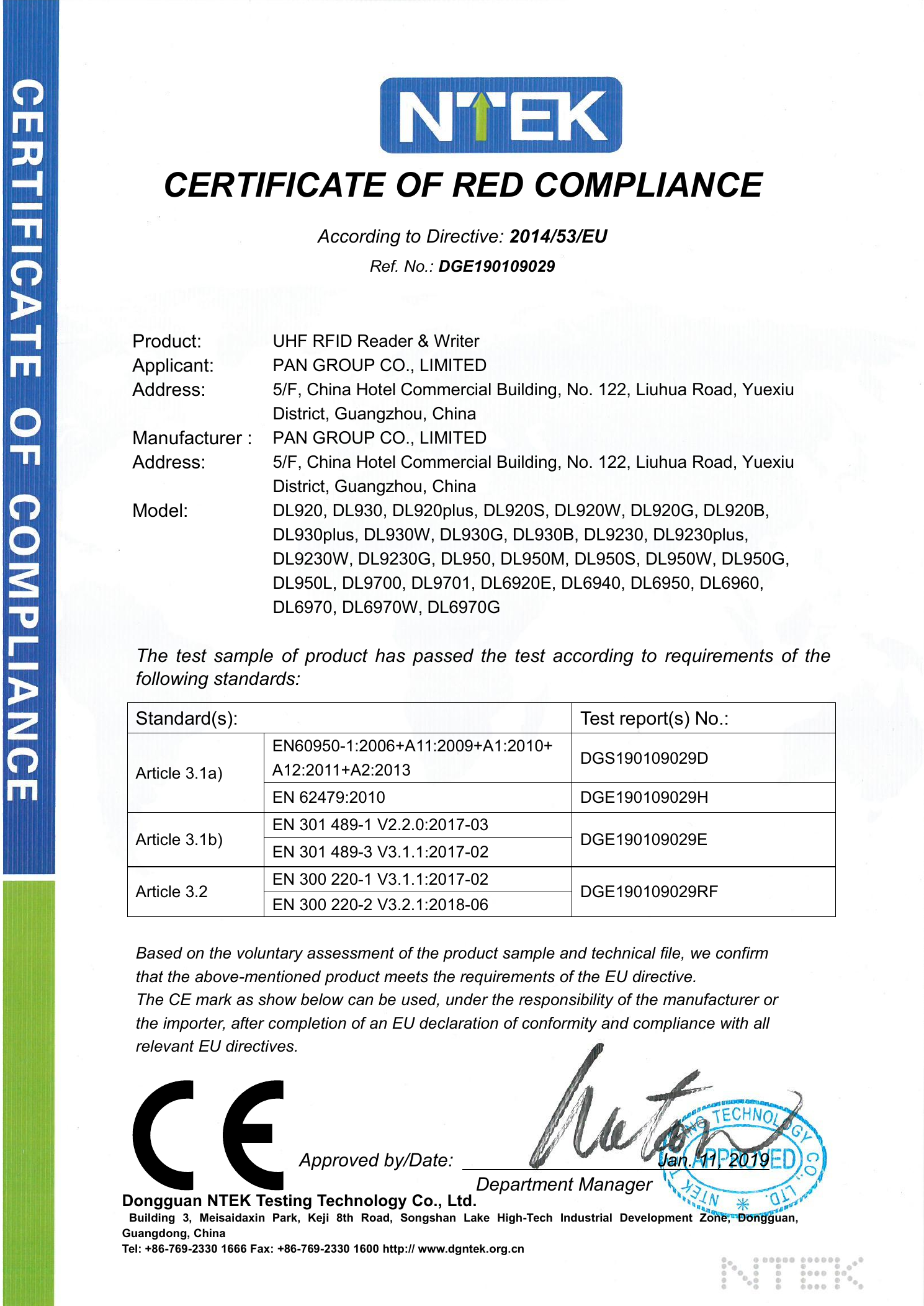
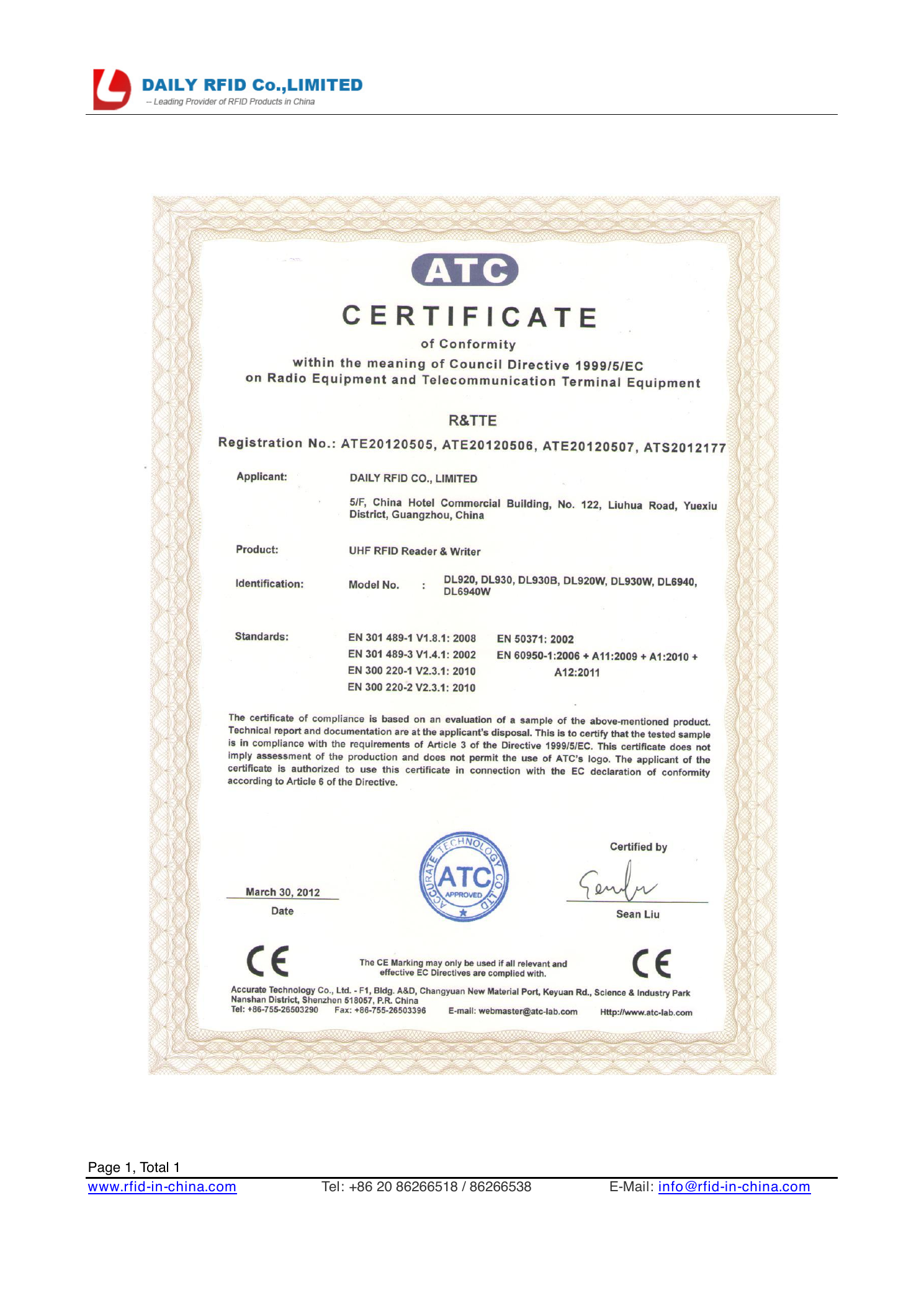
All DAILY RFID UHF readers comply with ISO 18000-6C (EPC Gen2), the globally standardized UHF air interface protocol. The DL920, DL930, DL6940, and DL921 families have passed CE RED certification (Certificate DGE190109029, issued by Dongguan NTEK) and FCC compliance in applicable models. This ensures the readers can be deployed in EU and US markets without additional radio approvals. Furthermore, readers come with free SDKs supporting multiple programming languages and operating systems (C++, C#, Java, Python, Android, Linux, etc.), enabling integrators to rapidly embed the read-write functionality into existing MES, WMS, or access control platforms.
Use Cases: From Toll Road to Cold Chain
DAILY RFID’s UHF readers have been deployed in diverse smart manufacturing–adjacent scenarios. In Colombia, 120 sets of DL950S ultra-long-range readers serve toll-road fleet entry control and yard movement monitoring, reducing manual vehicle checks by 40–70% over at least five years. In Poland, 360 DL920S readers are used on conveyor lines for parcel routing and outbound verification, cutting sorting errors by 30–60%. In the Czech Republic, 145 DL1080 handheld PDAs support railway trackside asset inspection, eliminating 50–80% of paper records. These examples illustrate how the same underlying reader platform can be adapted to very different environmental and throughput demands.
Market Trend: UHF RFID Hardware Customization on the Rise
The global UHF RFID reader market is valued at approximately USD 4.8 billion in 2025 and is projected to reach USD 11.2 billion by 2034 (Dataintelo). UHF RFID technology already accounts for 40.72% of total RFID market revenue (Mordor Intelligence, 2025). As Asia Pacific grows fastest with an 11.8% CAGR in shipments (ABI Research), manufacturers increasingly seek readers that can be tailored for local frequency plans and integrated with region-specific cloud platforms. DAILY RFID’s OEM/ODM model directly addresses this trend by offering frequency-customizable hardware without large minimum commitments.
Comparison with Traditional Readers: Honest Limitation
Compared with large-brand readers from Zebra Technologies (which reported over USD 4.5 billion in fiscal 2024 revenue), DAILY RFID’s hardware offers more flexible customization at lower unit volumes. However, its software ecosystem is less extensive than that of established platforms; integrators must rely on the provided SDK and their own development resources. This makes DAILY RFID an excellent choice for system integrators and OEM partners who already have middleware or prefer to build their own application layer, while less suitable for organizations seeking a turnkey software-reader bundle.
Future Outlook: Modular Readers as Building Blocks
As manufacturing lines become more data-driven, the role of the UHF reader will shift from a simple tag interrogator to an edge computing node. DAILY RFID’s AI-powered models (DL1380 handheld, DL6960 fixed) already incorporate on-board filtering and RSSI-based positioning, hinting at a future where readers can pre-process reads before sending to the cloud. Combined with continued investment in flexible production—the company already produces 10 million RFID tags and 100,000 readers annually—this positions DAILY RFID as a pragmatic partner for manufacturers who need both hardware flexibility and compliance.
Frequently Asked Questions
Can I customize the operating frequency of a UHF RFID reader?
Yes, DAILY RFID offers frequency customization across the full 860–960 MHz band. For example, the DL921, DL6940, and DL920Plus models allow software-configurable frequency segmentation to meet ISM 860–868 MHz, 902–928 MHz, or 920–925 MHz regulations, ensuring compliance in EU, US, and APAC markets.
What is the minimum order quantity for a custom UHF fixed reader?
For standard OEM/ODM customization of UHF fixed readers, the minimum order is 1 unit, with lead times of 15–45 days depending on complexity. For volume orders, monthly capacity exceeds 1,000 units, and sample approval or factory acceptance testing is included.
Which certifications do DAILY RFID readers hold?
UHF readers are CE RED certified (Directive 2014/53/EU) for the EU market, with certificates covering models DL920, DL930, DL6940, DL921, and DL6950 series. Selected models also hold FCC compliance for the US market. All UHF readers comply with ISO 18000-6C/EPC Gen2.
Can I integrate the SDK with my existing WMS or MES?
Yes, DAILY RFID provides free SDKs supporting multiple platforms including Windows (C++, C#, VB, Delphi), Linux, ARM, Python, NodeJS, QT, Java, and Android. The SDK includes demo software, source code, DLL instructions, and firmware upgrade files, allowing integrators to import tag data directly into enterprise systems.
What is the typical reading range of a UHF reader in a manufacturing portal?
With high-power models (33 dBm transmit power), fixed readers like the DL920Plus can achieve a reading range of 8–15 m under typical conditions. Multi-port readers with external antennas (e.g., DL6960) can reach up to 25–30 m. Actual range depends on tag type, environment, and antenna configuration.
For detailed technical specifications and customization inquiries, visit DAILY RFID or download the company brochure for a complete overview of production capabilities and quality certifications.
Есть вопросы или нужны дополнительные детали?
Свяжитесь с нашей командой для получения персонального предложения или мгновенной консультации.
Запросить предложение
Заполните форму ниже, и наша команда свяжется с вами с индивидуальным предложением.
Прямой чат WhatsApp
Предпочитаете общаться в реальном времени? Напишите нам в WhatsApp для мгновенной помощи и быстрых ответов.
- Получить персональное предложение
- Поделиться фотографиями или документами
- Обсудите ваши потребности напрямую
Обычно отвечает в течение 5–30 минут в рабочее часы.