
UHF RFID Reader Deployment Playbook: Job-by-Job Fit
UHF RFID Reader Deployment Playbook: Job-by-Job Fit
A UHF RFID reader deployment succeeds or fails on one question: does the reader match the read event it was built to capture? A smart factory can need an overhead checkpoint above an assembly path, a reader above a dock door where forklifts pass without stopping, a handheld for a work-in-process count at a bench, and an embedded module inside a tool cabinet — sometimes in the same building and the same week. This playbook maps the documented DAILY RFID reader formats to those jobs, then states where each format stops being the right choice.
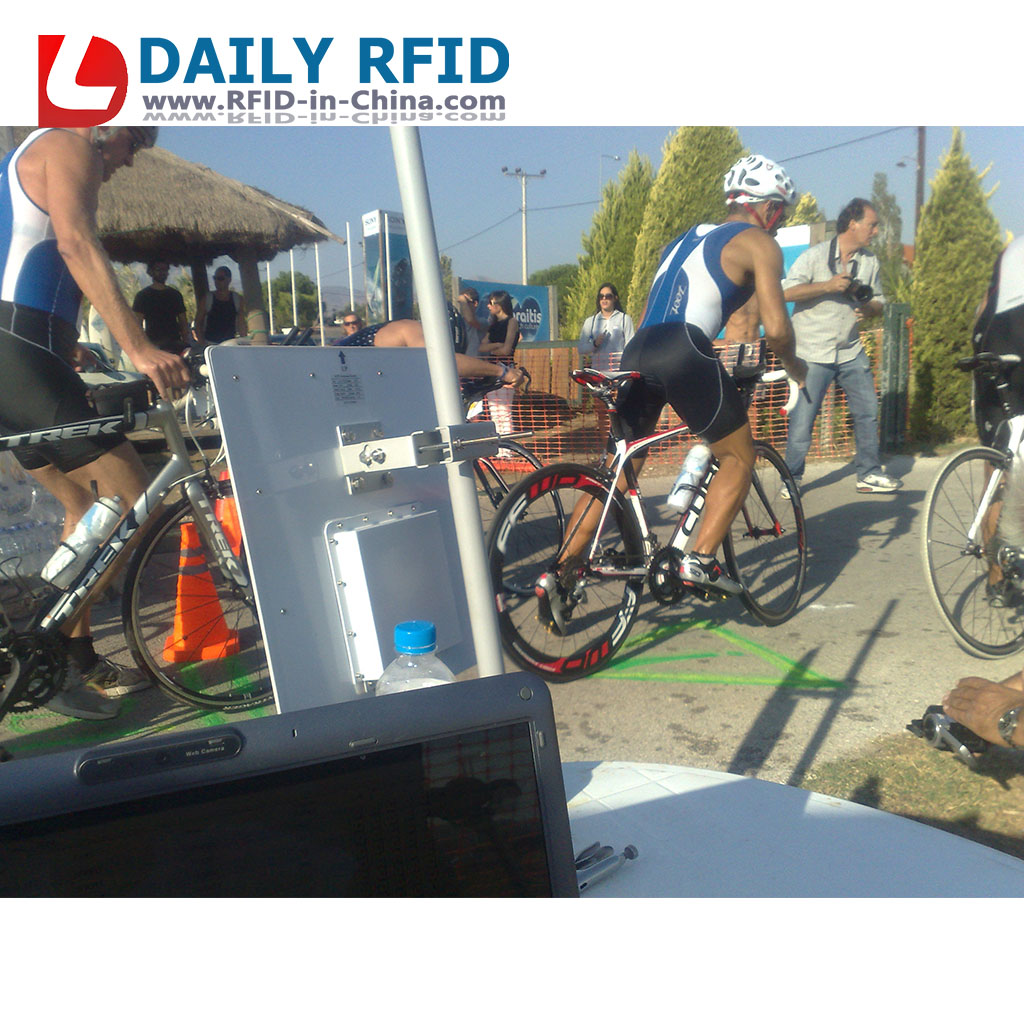
Fixed integrated reader format: the DL921 PoE variant combines power and network on one Ethernet cable for overhead checkpoints.
The intended reader is a manufacturing buyer, plant engineer or systems integrator working through research and evaluation — the stage where the tag family is roughly known and the open questions are form factor, trigger, network path, interface and acceptance test.
The read event decides the reader, not the datasheet peak
Three variables settle most reader choices: what has to be read, how fast it moves, and who or what triggers the read. A pallet crossing a dock door moves at forklift speed and has to be read without driver action. A kit tray at a bench is stationary and read deliberately by an operator. A tool drawer is opened by a technician and read by a module mounted behind the panel.
Transmit power and maximum range are useful figures, but neither answers the trigger question. The DL921 fixed readers in this material publish up to 26 dBm and a 0.1 m to 15 m reading range; the DL1280 handheld publishes up to 30 dBm/33 dBm and a 0.1 m to 20 m UHF range that depends on tag and environment. Neither number tells a plant where to mount the device, whether a read can be attributed to a person, or how many items pass per minute. If the format is fixed before the trigger, a pilot that works on a bench can still under-read on the floor.
Four reader roles and the DAILY RFID formats that fill them
DAILY RFID CO., LIMITED is an RFID manufacturer founded in 2008, operating a 28,000 m² facility with 180–200 employees and 38 engineers, and an annual output of 50 million RFID tags, 30 million RFID cards and 100,000 RFID readers; about 80% of output is exported to the EU and USA. Its DAILY RFID reader portfolio covers the roles below, and the choice between them is a deployment decision rather than a ranking.
- Fixed integrated reader. The DL921 family integrates a circular polarized RFID antenna in an IP65 housing measuring 450 × 450 × 70 mm, reads up to 50 tags simultaneously with an average single-card read time under 10 ms per 64 bits, and reports RSSI.
- Gate reader. The DL8330U Advanced UHF RFID Gater is the portal format for a defined threshold. Gate-level parameters are not included in the material used here, so they must be taken from the model datasheet.
- Industrial handheld. The DL1280 PDA reads UHF, HF and LF in one device, runs Android 12 on an 8-core 2.0 GHz processor with 4 GB RAM and 64 GB storage, and offers optional 1D/2D barcode scanning — useful where buyers also search for a general-purpose RFID scanner.
- Embedded module. The RFID Smart Cabinet Component is a 180 × 140 × 30 mm reader module with 4-, 8- or 16-port external SMA RFID antenna layouts, built for cabinets, drawers and benches.
- Active 2.4 GHz reader. The DL9230 reads 2.4–2.5 GHz active tags at an adjustable 0–100 m, up to 200 tags at once, over TCP/IP, RS232, RS485 or Wiegand.
Fixed readers and gates: the assembly line and the dock door
For reads that must happen without an operator, a fixed integrated reader is the default choice. DAILY RFID lists overhead checkpoints along assembly paths, loading-bay doors, vehicle access points and asset yards among the deployment contexts for the DL921 PoE variant, which is the model to start from when the plant already has structured cabling.
The PoE variant carries power and network on one Ethernet cable, supports RJ45 with integrated Power over Ethernet, and can also run from DC 9–24 V. Its documented behaviour includes a built-in circular polarized antenna that reads moving tags regardless of orientation, an IP65 housing, an operating range of −20 °C to 60 °C at 5% to 95% non-condensing humidity, and GPIO trigger and relay ports that can be wired to a door, lamp or barrier.
Where cabling rather than the reader is the constraint, the DL921 with GSM carries an integrated 2G/4G cellular module and keeps RS232 as standard, with RJ45 and USB available as configuration options. The trade-off is explicit in the specifications: the DL921P PoE variant does not support 4G, Wi-Fi or Bluetooth, while Wi-Fi is available on the DL921EW variant. A covered dock door and a remote yard gate therefore do not resolve to the same model even though both are described as fixed readers.
A gate reader such as the DL8330U fits a different geometry: a doorway or lane where the read zone should be a threshold rather than an overhead volume. Use it when the business rule is “did this item cross here”, and use an overhead fixed reader when the rule is “what is on this pallet”.
Fit boundary. A fixed reader records that a tag passed, not who performed the movement; it also cannot reach into a closed rack or a drawer. Plants that need per-operator accountability usually add a handheld step or an embedded module rather than increasing transmit power.
Handheld and AI-enhanced readers for work-in-process checks
Work-in-process checks are mobile by nature: a kit is assembled at one cell, reworked at another, and staged somewhere in between. The DL1280 industrial PDA is designed for that path. It reads UHF at 0.1–20 m, HF at 0.1–32 cm and LF at 0.1–10 cm depending on tag and environment, reads up to 100 tags simultaneously at more than 100 tags per second, and carries dual batteries of 4,500 mAh in the body and 6,700 mAh in the handle for long shifts.

Handheld format: the DL1280 reads UHF, HF and LF in one IP65 device for bench and rack-level work-in-process verification.
Because the same device covers three frequency bands and optional barcode scanning, one handheld can serve a mixed floor where legacy HF employee cards, UHF work-in-process tags and printed labels still coexist. Connectivity includes dual-band Wi-Fi, 4G cellular, Bluetooth 5.0 and GNSS positioning, and the IP65 rating matches the shop-floor condition described in DAILY RFID’s own manufacturing project record, where a dusty plant with metal racks used the DL1280 for stock counting and reported inventory variance reduced to under 1%, with offline caching and a daily batch sync to ERP.
Handheld reads are deliberate, which is both the strength and the limit: the operator decides when the trigger is pulled, so cycle time depends on the person, and the device weighs 680 g with battery and pistol grip. For a checkpoint that must run at line speed, the handheld complements a fixed reader; it does not replace it.
For fixed-position work-in-process monitoring where one unit must cover several points, DAILY RFID lists AI-enhanced reader models in its portfolio — the DL921 AI Enhanced UHF Long Range Reader with GPS/GSM/POE and the DL6940/6960 AI Multi-Antenna 4-Port UHF Reader. The material used for this playbook does not include a separate parameter set for those variants, so their power, range, port behaviour and processing features should be confirmed from the datasheet for the exact model before a line is specified around them.
Pairing the reader with the tag: tool, wristband, tire
The reader decision is only half of a deployment; the other half is whether the tag can live on the object. Three tag families that appear in manufacturing projects show how the pairing changes the reader choice.
| Tag family | Documented form and supply facts | Reader pairing | Verification point |
|---|---|---|---|
| RFID Tool Tag (RFID Tool Management Adhesive Tag) | Adhesive tool tag; detailed tool-tag parameters are not part of this material | Smart Cabinet Component inside the cabinet; handheld for open-floor tool checks | Bond on the actual tool surface, and whether a metal tool needs an anti-metal construction (100% signal test, MOQ 50 units) |
| RFID Wristband | Silicone: colour, size, logo and chip options, MOQ 100 units, 10–25 days, visual plus signal test. Fabric: material, weaving and printing options, MOQ 500 units, 12–20 days, batch sampling | Gate reader for lane access; handheld for zone checks | Which credential the site will issue and re-issue; a wristband is a personnel format, not an asset tag |
| RFID Tire Tag (RFID Tire Embedded Tag) | Rubber patch with UHF chip and encoding, OEM/ODM, MOQ 500 units, 15–30 days, heat plus signal test | Fixed reader at a transfer point or overhead checkpoint | Where the tag is applied relative to heat steps, and the read distance achieved on the finished tire |
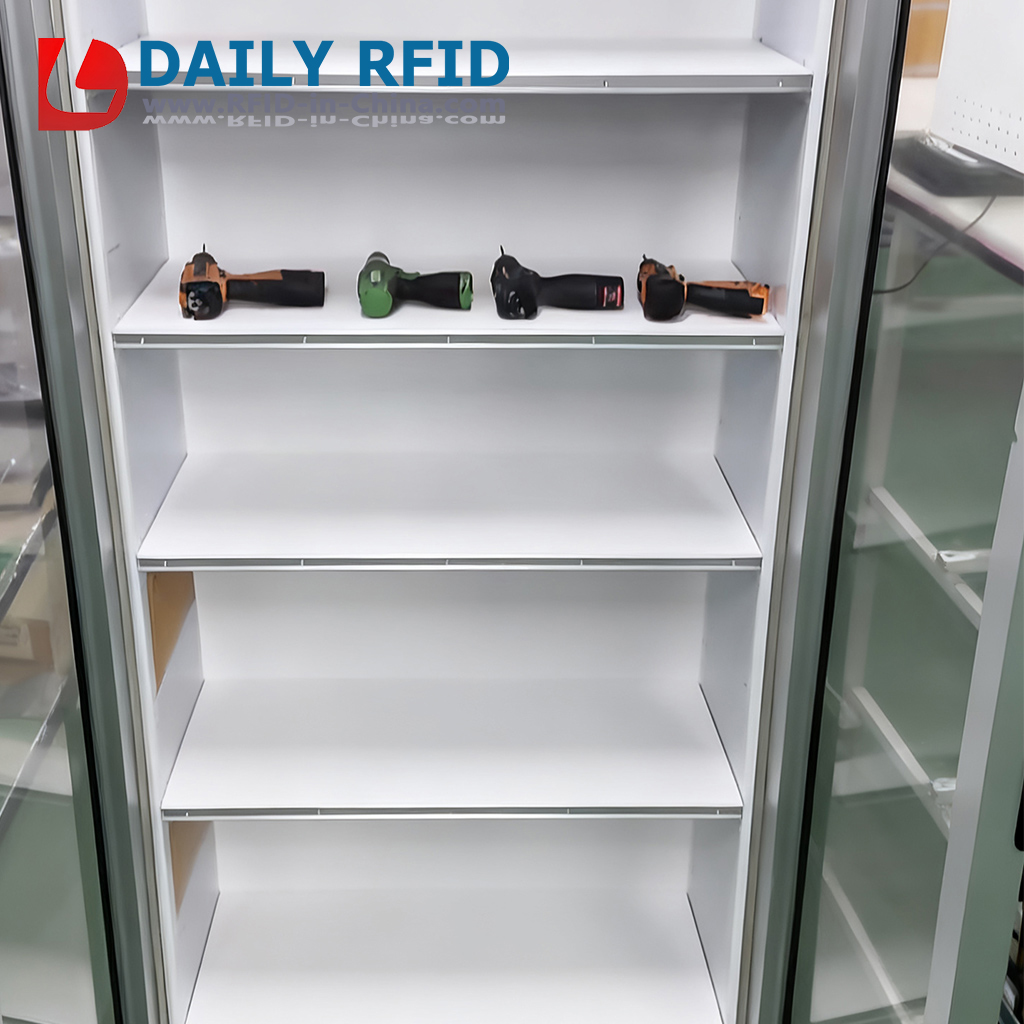
Embedded format: a cabinet-mounted reader module drives multiple antenna ports so compartment-level tool reads stay inside their own zone.
Inside a tool crib, the module’s documented configuration explains why it is not simply a small fixed reader: transmit power is adjustable from 30 dBm down to 20 dBm for partitioned near-field control, RSSI supports shelf-level positioning, more than 500 tags can be read per partition area, and GPIO ports can link electronic locks, indicator lights and door sensors. That combination is what lets the system record which compartment was opened, rather than only that a tagged tool is somewhere nearby.
For personnel and contractor credentials, the wristband is one option and the UHF RFID card is another, documented with chip, material and printing customization, MOQ 100 units, 7–20 days and 100% functional test. A plant that already issues access cards can usually keep the card programme and add wristbands only where a card is impractical to carry.
For tire-related production, the RFID Tire Embedded Tag is specified as a rubber patch with a UHF chip and encoding, with a heat plus signal test in its quality-control sequence. Whether the patch is applied before or after a heat process, and what read distance the finished tire gives, are project tests rather than catalogue values.
Six steps from pilot to line acceptance
- Write the read event as a sentence. “Every pallet crossing dock 3 is recorded with time, lane and pallet ID” is testable; “improve traceability” is not. The sentence fixes the format.
- Pick the holding form. Operator-triggered reads point to the DL1280; object-triggered reads at a volume point point to the DL921; threshold rules point to a gate reader; compartment-level reads point to the Smart Cabinet Component.
- Fix power and backhaul. PoE where structured cabling exists (DL921P), DC 9–24 V where it does not, and the GSM variant where no wired path is available — remembering that the PoE variant carries no 4G, Wi-Fi or Bluetooth.
- Match the interface to the plant system. RS232, RJ45, GPIO trigger and relay, USB and Wiegand cover most integration patterns, and SDK support across X86/X64, C++, C#, VB, Delphi, Linux, ARM, Python, NodeJS, QT, JAVA and Android reduces adapter work.
- Check the environment against the housing, not the datasheet headline. IP65 and −20 °C to 60 °C for the DL921 and DL1280; IP54 and −30 °C to 70 °C for the cabinet module. The reader’s rating is not the tag’s rating.
- Accept with a named test. The capability records for these categories list Factory Acceptance Test for UHF fixed readers, Full System Burn-in for handhelds and System Integration Test for smart tool cabinets — agree the test before shipping, not after installation.
Where each format stops fitting
- Fixed reader: cannot attribute a movement to a person and cannot read inside closed metal racks; an IP65 rating and 26 dBm output are not permission to mount it in an open yard without checking site conditions.
- Handheld: throughput depends on the operator; 680 g with battery and pistol grip is a full-shift weight decision; the published 20 m range is tag- and environment-dependent.
- Embedded cabinet module: scoped to 0.1–5 m inside a cabinet and rated IP54, so it is not an outdoor or wash-down device.
- Gate reader: a threshold format whose published parameters for the DL8330U are not included in this material and must be verified.
- Active 2.4 GHz reader: needs battery-powered active tags, which is different tag economics from passive UHF labels.
What to verify before committing the line
Supply terms are published per category rather than per plant. UHF fixed readers: MOQ 1 unit, 15–45 days, with antenna gain and interface customization under ODM/OEM. UHF handheld readers: MOQ 1 unit, 15–30 days, with OS, software and housing customization. Smart tool cabinets: MOQ 1 unit, 20–45 days, with cabinet size, reader module and software customization. Tire embedded tags: MOQ 500 units, 15–30 days. Silicone wristbands: MOQ 100 units, 10–25 days; fabric wristbands: MOQ 500 units, 12–20 days; UHF RFID cards: MOQ 100 units, 7–20 days with 100% functional test.
Three checks matter more than the price line. First, ask for the datasheet of the exact variant rather than the family, because the DL921P, the DL921 with GSM and the DL921EW differ in backhaul. Second, ask which test the unit will pass and who signs it. Third, ask for project evidence in a comparable environment: DAILY RFID’s published record for a distribution centre in Poland using 360 DL920S readers reports parcel sorting mistakes down 30%–60% and outbound verification 40%–70% faster, and a cold-storage deployment in Malaysia using the DL950S-PoE reports checkpoint movement capture above 90% with 30%–50% less separate power-adapter installation. These are company-reported results from specific sites — reference points for a buyer’s own acceptance plan, not guarantees for another plant.
One boundary on scope: reader modules for robotic or drone-mounted platforms are outside this playbook. No documented specification for an RFID robot or RFID drone platform is included in the material, and the formats described here are fixed, gate, handheld, cabinet-embedded and active 2.4 GHz reader equipment.
Outlook: what changes when checkpoints multiply
The direction visible in the portfolio is toward fewer distinct devices per checkpoint: a cabinet module that drives 4, 8 or 16 antenna ports, a four-port AI multi-antenna fixed reader, and handhelds that already read three frequency bands. The practical consequence is that second and third checkpoints should be specified from the same documented family as the first, so acceptance tests, SDK versions and spare parts do not multiply. Which model fits a given line still depends on the read event — and on verifying the exact variant rather than the family name.
FAQ
Which UHF RFID reader form factor fits an assembly-line checkpoint?
An overhead fixed integrated reader such as a DL921 variant, because it reads passing tags without operator action and can be triggered by the object itself. Choose the PoE variant where structured cabling exists or the GSM variant where it does not, and confirm each variant’s backhaul options before mounting.
Is a handheld reader enough for work-in-process checks?
For deliberate checks such as kit verification, rework confirmation or cycle counting, a handheld is sufficient: the DL1280 reads UHF, HF and LF, reads up to 100 tags at once, and carries dual batteries for long shifts. For a checkpoint that must capture every item at line speed, a handheld complements a fixed reader rather than replacing it.
What does Power over Ethernet change at a dock door?
It removes the separate power run: the DL921P carries power and network on one Ethernet cable and adds GPIO trigger and relay ports for doors, lamps or barriers. The constraint is that this variant has no 4G, Wi-Fi or Bluetooth, so a site without structured cabling needs a different variant of the same family.
Which tags pair with these readers for tools, personnel and tires?
Tool tags pair with the Smart Cabinet Component inside a cabinet or with a handheld on the open floor; RFID wristbands and UHF RFID cards pair with gate readers or handhelds for personnel access; the RFID Tire Embedded Tag, a rubber patch with UHF chip and encoding, pairs with fixed readers at transfer points. Each pairing still needs its own adhesion, placement and read-distance check.
What should be confirmed before a reader is accepted on the line?
The exact variant datasheet, the named acceptance test — Factory Acceptance Test, Full System Burn-in or System Integration Test, depending on the category — the interface list checked against the plant system, and a reference deployment in a comparable environment.
DAILY RFID publishes a company profile covering its reader and tag capability details as a downloadable PDF; product information is published at www.rfid-in-china.com.
Есть вопросы или нужны дополнительные детали?
Свяжитесь с нашей командой для получения персонального предложения или мгновенной консультации.
Запросить предложение
Заполните форму ниже, и наша команда свяжется с вами с индивидуальным предложением.
Прямой чат WhatsApp
Предпочитаете общаться в реальном времени? Напишите нам в WhatsApp для мгновенной помощи и быстрых ответов.
- Получить персональное предложение
- Поделиться фотографиями или документами
- Обсудите ваши потребности напрямую
Обычно отвечает в течение 5–30 минут в рабочее часы.