
UHF RFID Reader Formats: An Independent Buyer Comparison
In smart manufacturing, the UHF RFID reader decision is usually settled by physical fit before it is settled by brand. Which read zone has to be covered, which tag layer feeds that zone, and which workflow record changes as a result — those three questions separate the formats long before a price sheet does. The eight formats most often placed side by side by factory buyers are fixed multi-port readers, handheld readers, gate readers, tray readers, ceiling-mounted configurations, WiFi-connected readers, readers marketed as AI-powered, and embedded RFID modules. Each one answers a different operational question, and each carries a different integration and cost profile.
This comparison is written from the buyer's side rather than the vendor's. It uses published technical standards, market evidence from third-party research, and documented product data from DAILY RFID CO., LIMITED — a Guangzhou-based RFID tag and reader manufacturer founded in 2008, operating a 28,000 m² factory with 180–200 employees, 38 engineers, and stated annual output of 100,000 RFID reader units and 50 million RFID tags.
Short answer for decision-stage buyers: match the reader format to the read zone, not to the catalogue tier. Fixed readers with external antennas cover automated checkpoints and material flow; handhelds cover periodic audits and mixed barcode/RFID stock; gate readers cover inbound and outbound verification; tray readers cover dense close-range counting; ceiling-mounted configurations cover overhead bulk zones; wireless-connected readers cover remote and temporary points; reader modules cover embedded OEM integration. The label "AI-powered" describes a software function that must be verified, not a physical format.
Why the format question outranks the brand question
UHF readers operate under the EPCglobal Gen2 air interface, standardised as ISO/IEC 18000-6C and ISO/IEC 18000-63 through GS1. That single fact reshapes procurement logic: because the air interface is standardised, a compliant reader from one supplier is expected to interrogate a compliant tag from another. Differentiation therefore migrates away from basic radio compatibility and toward the things a datasheet rarely settles — read-zone containment, antenna port count, enclosure rating, power architecture, interface behaviour, and how cleanly read events reach MES, ERP, or WMS.
Commercial weight reinforces the point. UHF captured 40.72% of total RFID market revenue in 2025 according to Mordor Intelligence, and the same source projects the UHF RFID market to surpass USD 14.9 billion by 2031 at a 12.45% CAGR. A category that large is not short of suppliers. It is short of buyers who can distinguish a reader that fits their read zone from one that merely meets the protocol.

The problem buyers actually face: read-zone failure, not radio failure
Most disappointing RFID pilots are not caused by readers that fail to read. They are caused by readers that read too much, too little, or in the wrong place. That distinction matters at the decision stage, because it converts a hardware purchase into a site-design purchase.
- Adjacent-zone capture at gates. Gate readers installed at doorways can pick up tags on nearby shelving. DAILY RFID's documented control method is read-zone narrowing through antenna placement, RF power control, shielding panels, RSSI filtering, and event-triggered read windows.
- Inconsistent tag angles in trays. Dense close-range reads become unstable when tags sit at mixed orientations. Multi-directional antenna coverage, antenna position tuning, power adjustment, and a standardised tag-orientation SOP are the documented remedies.
- High-speed conveyor gaps. Fast-moving items shorten the read window. Antenna arrays synchronised with photoelectric sensors or PLC trigger signals, plus tuned polarisation and power, are the control approach.
- Metal surfaces. On-metal tags, flexible on-metal labels, and isolation materials — foam or ferrite spacing — are required, and the reader and antenna setup is re-tuned after installation.
- Continuous 24/7 duty. Industrial readers require RF power tuning, duty-cycle planning, ventilation clearance, and temperature monitoring to hold stable read performance across long operating schedules.
- Network interruptions. Heartbeat monitoring, automatic reconnection, and local data buffering keep scan records traceable; PoE or wired Ethernet is preferred for mission-critical fixed points, while WiFi or GPRS with queued upload and breakpoint resume suits remote sites.
- Data integrity. EPC and user-memory write verification, password protection, read-back comparison, and field locking reduce coding errors — a software discipline that no reader format can substitute for.
None of these are reader-brand problems. They are format-and-deployment problems, which is why the format decision must precede the supplier decision.
Eight formats, mapped to real factory tasks
| Format | Factory task it fits | Documented evidence point | What to verify before purchase |
|---|---|---|---|
| Fixed multi-port reader | Conveyor-side reads, station-level WIP capture, dock doors, multi-point coverage from one unit | DL920 delivers 5–10x faster inventory and inbound/outbound capture than barcode scanning, with 40%–75% labour reduction and 6–18 month payback | Antenna port count, power option, trigger inputs, enclosure rating |
| Handheld UHF PDA | Cycle counts, tool-crib audits, mixed RFID and barcode stock, exception hunting | DL880 provides 3–8x faster field data capture, 53%–73% lower labour cost, 29%–54% lower operating error cost, 6–24 month payback | Application integration, battery runtime per shift, drop rating |
| Gate reader | Inbound/outbound verification of bags, cartons, and goods; archives; exhibition entrances | DL8330U reads automatically as goods pass through, giving 5–10x faster verification than manual gate checks with 40%–75% potential labour reduction | Portal sizing, shielding, RSSI filtering, event-window configuration |
| Tray reader | Pharmaceutical trays, jewellery, samples, parts kits, high-value counts | DL6990 reduces tray counting from 2–5 minutes to 5–20 seconds per tray | Tray read-zone design, shielding, tag orientation SOP |
| Ceiling-mounted configuration | Overhead bulk reads above benches, staging areas, and aisles | Multi-antenna UHF reader layouts support stable bulk reading from multiple tag angles | Coverage overlap with neighbouring zones, mounting height, cable routing |
| WiFi-connected reader | Remote read points, temporary sites, yards, and locations without structured cabling | Wireless configuration with queued upload and breakpoint resume reduces data-loss risk at remote sites | Local buffering depth, heartbeat/reconnect behaviour, fallback upload |
| Reader marketed as AI-powered | Edge filtering, event decisions, reduced host-side processing | Function must be demonstrated, not assumed | What executes on-device versus in software; audit trail; update path |
| RFID module | Embedding read capability inside machines, smart cabinets, tools, or custom enclosures | Design, development, and manufacturing services with custom sizes and shapes | Interface definition, antenna design responsibility, regulatory approvals |
Fixed multi-port readers: the default for automated checkpoints
A fixed reader with external antennas is the workhorse of factory traceability, because the antennas — not the reader box — define the read zone. DAILY RFID supplies the DL6940 and DL6960 long-range readers with four antenna ports, the DL920 UHF reader, the DL921 series with Power over Ethernet or DC +9V to +24V input, and the DL9702, which is USB-powered from a host PC. Published power consumption across this range spans 0.25W to 12W, with the upper figure tied to the DL921 variant with GSM.
For buyers, the practical implication is that a four-port reader can serve several read points from one enclosure, which changes both the bill of materials and the maintenance footprint. The trade-off is cabling and antenna placement effort — savings on reader count are partly spent on installation design.
Handheld readers: audit coverage, not continuous coverage
The DL880 UHF handheld PDA combines RFID, barcode, and network synchronisation in a rugged unit, and is positioned for logistics sorting, store replenishment, and asset inventory. It is not a substitute for a fixed installation: a handheld covers a zone only while a person walks it. Where the requirement is periodic verification — monthly tool audits, quarterly asset counts, exception resolution — the handheld is often the lower-risk starting point, because it can be deployed without interrupting existing workflows. A near-field variant, the DL1280H HF handheld PDA, is documented for controlled close-range checks of people, tickets, and device inspections, with record-entry time reduced by roughly 50%–80% and 40%–75% lower labour cost.
Gate readers: throughput at the threshold
Gate readers trade coverage area for containment. The DL8330U reads bags, cartons, or goods automatically as they pass a gate, and the stated effect is 5–10x faster inbound and outbound verification than manual checking, with hardware CAPEX typically 20%–60% higher than manual or barcode stations. The procurement risk here is not read performance but zone discipline: an untuned gate will capture neighbouring shelves, and the countermeasures — shielding panels, RF power reduction, RSSI thresholds, and event-triggered windows — belong in the acceptance test, not in a later retrofit.
Tray readers: dense, close-range, high-value counting
Tray reading is the format where the workflow gain is easiest to quantify and the physical design is easiest to underestimate. The DL6990 tray reader automatically reads every item placed on the tray, moving a count from 2–5 minutes to 5–20 seconds per tray, and is documented for jewellery, pharmaceuticals, samples, and parts inventory. The documented boundary is that tray readers depend on tray read-zone and shielding design plus a standardised tag orientation SOP; without those, dense reads become inconsistent rather than fast.
Ceiling-mounted configurations: an installation pattern, not a product line
Buyers frequently ask for a "ceiling reader" as though it were a distinct category. In practice it is usually a mounting pattern: a fixed reader with external antennas aimed downward from ceiling height to create an overhead bulk read zone over benches, staging lanes, or aisles. DAILY RFID's multi-antenna UHF reader layouts are documented as supporting stable bulk reading from multiple tag angles, which is the technical condition a ceiling installation depends on. The evaluation risk is overlap — an overhead zone can capture tags in adjacent aisles, so coverage mapping and power tuning have to be validated on site.
WiFi and wireless-connected readers: connectivity, not format
WiFi connectivity is a data-path decision layered onto a physical format, and it matters most where cabling is impractical. The published guidance is straightforward: use PoE or wired Ethernet at mission-critical fixed read points, and configure WiFi or GPRS with queued upload and breakpoint resume at remote sites so that temporary network loss does not become permanent data loss. A buyer comparing a "WiFi reader" against a wired reader is really comparing downtime tolerance against installation cost.
Readers marketed as AI-powered: verify the function, not the label
Edge processing is a genuine direction of travel, but "AI-powered" is a marketing descriptor rather than a technical specification. The decision-stage question is narrow: what computation happens on the device, what happens on the host, and which one produces the record of truth. A buyer should ask for a demonstration against their own tag population and read zone, confirmation that filtering rules are auditable and exportable, and clarity on whether algorithm updates arrive as firmware or software. Without those answers, an AI-labelled reader is being bought on the same basis as any other reader — read-zone fit.
RFID modules: the embedded path
Modules matter whenever the read function must live inside another product — a smart cabinet, a tool, a machine enclosure, or a custom station. DAILY RFID provides professional design, development, and manufacturing services and delivers RFID products in various sizes and shapes, which is the relevant capability for embedded work. The buyer's obligation shifts accordingly: interface definition, antenna design ownership, and regulatory approval responsibility must all be written down before tooling starts.
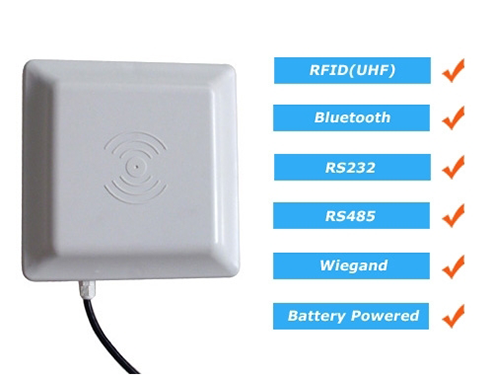
The tag and accessory layer decides whether the reader choice holds
Reader formats only perform against a matched tag layer. In manufacturing, five accessory families recur in decision-stage comparisons, and each one changes which reader format is viable.
RFID tool tags
The DAILY RFID UHF Tool Label automatically records tool borrowing, return, and inventory, reducing tool search time by about 80% and scanning labour cost by 50%–85% compared with engraved or handwritten labels, alongside a 30%–70% reduction in inventory error cost. Tool tags are read by handhelds during audits and by fixed or cabinet readers when tools return to a controlled point — which means the tag decision constrains the reader decision, not the reverse.
Wristbands
Personnel and access workflows use a different tag logic. The Band Tag-01 UHF Wristband is hard to transfer after wearing and supports electronic validation, making entry validation 2–5x faster than a QR code paper ticket, at a unit cost typically 30%–150% higher, with entry labour reduced 40%–70%. The HF Silicone Wristband-81 provides waterproof, durable, reusable identification and can be cleaned and reused, reducing ticket damage or loss incidents by roughly 40%–70% versus paper. Where long-range personnel tracking is required, the RFID Active Wristband operates at 2.4–2.5 GHz with an adjustable reading distance from 1 to 80 metres — an active design that carries battery maintenance obligations.
UHF LED tags
UHF LED tags add a visual locator to an electronic identity. The Printable Commodity LED Label-01 combines price display with inventory identity and is documented as making stockout checking and inventory 5–10x faster than barcode labels, with a tag unit cost usually 20%–150% higher than barcode labels offset by 50%–85% lower scanning labour and 30%–70% lower inventory error cost, at a typical 6–18 month payback at scale.
RFID trays
Trays are both a physical container and a read-zone constraint. Combined with the DL6990 tray reader, tray-based counting becomes a station workflow rather than a manual task, but the tray design, shielding, and tag orientation have to be specified together with the reader.
RFID smart cabinets
Smart cabinets are the format where hardware cost and workflow gain diverge most from handheld alternatives. The ToolSense Smart Cabinet synchronises inventory, issue, and return records automatically, delivering a 70%–90% reduction in ledger-entry work, with system CAPEX typically 20%–70% higher and a 6–24 month payback. The ToolPro Smart Storage records cabinet opening, borrowing, and return events with roughly 80% improvement in tool lending management efficiency versus manual sign-out sheets, at cabinet hardware cost about 2–5x a standard cabinet, offset by 30%–70% lower loss and replacement cost and 50%–80% lower admin labour, at a 12–30 month payback. The anti-loss cabinet variant extends the same logic to hospital supplies, high-value tools, samples, and evidence items.
Side-by-side: cost and workflow impact by format
| Format | CAPEX versus manual/barcode | Labour, error, or loss impact | Stated payback |
|---|---|---|---|
| Fixed multi-port reader (DL920) | Not specified per unit in published data | 40%–75% lower labour cost; 5–10x faster capture | 6–18 months |
| Handheld UHF PDA (DL880) | Higher unit cost, fewer missed or wrong scans | 53%–73% lower labour cost; 29%–54% lower error cost | 6–24 months |
| Gate reader (DL8330U) | 20%–60% higher than manual/barcode stations | 40%–75% potential labour reduction | 6–18 months at medium-to-high volume |
| Tray reader (DL6990) | System CAPEX typically 20%–70% higher | 30%–75% lower labour, error, and loss cost | 6–24 months |
| Pass-through mat / overhead zone | 20%–60% higher than manual/barcode stations | 40%–75% lower labour cost; channel inventory over 5x faster | 6–18 months at medium-to-high volume |
| Smart tool cabinet | 2–5x a standard cabinet | 30%–70% lower loss; 50%–80% lower admin labour | 12–30 months |
| UHF wristband programme | Unit cost 30%–150% higher than paper/PVC tickets | 40%–70% lower entry labour; 20%–50% lower fraud/transfer loss | Event-dependent |
| UHF LED label programme | Tag unit cost 20%–150% higher than barcode labels | 50%–85% lower scanning labour; 30%–70% lower error cost | 6–18 months at scale |
Comparison with traditional methods — and where RFID still loses
An independent comparison has to state the losing cases as plainly as the winning ones.
- Volume thresholds decide payback. The recurring pattern across documented deployments is CAPEX 20%–70% higher than manual or legacy processes, offset by 30%–75% lower labour, error, and loss cost, with payback landing between 6 and 24 months. Below the volume that produces those labour savings, barcode or manual methods remain the rational choice.
- Tag cost is a permanent line item. UHF tag unit cost is commonly 20%–150% higher than barcode labels. For consumable, low-value, or single-use items, that premium can outweigh the scanning benefit permanently.
- Metal and liquid environments carry design cost. On-metal tags, isolation layers, and post-installation re-tuning are required, and they add engineering effort that a barcode label never demands.
- Active formats need maintenance. Active wristbands and cards require battery replacement or periodic maintenance. Passive UHF avoids that obligation but offers a shorter controlled read range.
- Read-zone discipline is not optional. Ceiling, gate, and pass-through configurations will capture neighbouring tags unless power, shielding, and event windows are configured. Teams that skip site calibration usually conclude that RFID underperformed, when the read zone was simply never defined.
- AI-labelled features can be unverifiable. Where on-device processing cannot be demonstrated against a buyer's own tags and layout, the capability should be treated as unproven for that site.
Market trend: why format proliferation is accelerating
Three verified signals explain why buyers now face eight formats instead of two. First, adoption has moved from retail into production: more than 60% of factories adopting Industry 4.0 deploy RFID readers for asset traceability, according to Mordor Intelligence data for 2024. Second, the centre of gravity is shifting east — Asia Pacific is expected to account for the largest RFID market share from 2025 to 2034, per MarketsandMarkets. Third, academic and industrial evidence now documents factory-specific use cases rather than generic inventory claims: a 2025 institutional paper describes RFID-enabled trolley tracking in a large-scale aerospace manufacturing environment, linked to a business-intelligence visual management system.
Parallel to that, interoperability expectations are rising. Turck, for example, states that selected UHF readers support OPC UA through the AutoID Companion Specification for connection to PLC, MES, ERP, WMS, or cloud systems, and that its readers carry IP67 protection for dust, moisture, and temperature fluctuation. Merhein lists an integrated-antenna reader covering 860–960 MHz with EPCglobal Class 1 Gen 2, ISO 18000-6C, and ISO 18000-6B support. DAILY RFID's own published frequency options span ISM 860–868 MHz, 902–928 MHz, and 920–925 MHz, customisable from 860 to 960 MHz. The direction is consistent: buyers will increasingly compare readers on environmental rating, data exposure, and regional frequency compliance, not on whether the radio works.
Evaluation checklist: read-zone coverage, integration, workflow impact
The following checklist is designed to be applied format by format, before any quotation is requested.
Read-zone coverage
- Draw the physical read zone and confirm which tag orientations must be captured within it.
- Confirm antenna port count and whether one reader can serve multiple zones, or whether zones need separate enclosures.
- Test for adjacent-zone capture at the boundaries, then apply power control, shielding, RSSI thresholds, or event-triggered windows until containment holds.
- Verify metal or liquid proximity and specify on-metal tags plus isolation material where needed.
- Define the acceptance test — tag population, orientation mix, speed, and dwell time — before installation.
Integration
- Confirm the physical interface: PoE, wired Ethernet, USB, DC input, or wireless with queued upload.
- Confirm heartbeat monitoring, automatic reconnection, and local data buffering depth.
- Ask which standardised data format the reader exposes, and whether PLC, MES, ERP, or WMS connectivity is documented or custom.
- Define who owns the write process: EPC and user-memory verification, password protection, batch encoding records, and field locking.
- For module or embedded designs, assign antenna design and regulatory approval responsibility in writing.
Workflow impact
- Name the record that changes: a stock count, a tool issue log, a gate verification, an inspection entry.
- Quantify the current cycle time and compare it against the documented range for the chosen format.
- Model payback against actual labour volume, not against a best-case unit rate.
- Check the maintenance obligation: battery replacement for active tags, cleaning for reusable wristbands, thermal planning for 24/7 fixed points.
- Confirm the tag layer is chosen together with the reader, not after it — tool tags, wristbands, LED tags, trays, and cabinets each constrain the reader choice.
Future outlook
Two directions appear well supported by current evidence. The first is integration maturity: as standardised data exposure such as OPC UA AutoID becomes a comparison criterion, the reader will increasingly be evaluated as a data source rather than a scanning device, and buyers will ask for documented connectivity instead of accepting custom middleware as the default. The second is format specialisation: tray readers, gate readers, overhead configurations, and cabinet systems are being designed around specific workflows rather than as general-purpose scanning hardware, which makes workflow fit — not reader specification — the decisive variable.
The less certain direction is the AI label. Edge processing will mature, but until on-device function can be demonstrated and audited against a buyer's own tag population, it should remain a verification item on the checklist rather than a reason to select a format.
FAQ
Which UHF RFID reader format should a factory buy first?
Start from the workflow that has a measurable manual cost. Where verification is continuous — inbound gates, conveyor checkpoints, station-level work-in-process — a fixed multi-port reader is the usual first choice, because the antennas define the read zone and one enclosure can serve several points. Where verification is periodic — cycle counts, tool audits, asset inventory — a handheld UHF PDA is the lower-risk start, since the DL880 is documented at 3–8x faster field data capture with 53%–73% lower labour cost and a 6–24 month payback. A tray reader, gate reader, or cabinet is normally introduced when that specific workflow has already been measured.
How should a gate reader and a ceiling-mounted reader be compared?
They solve different problems. A gate reader concentrates reads at a threshold and depends on containment — portal sizing, shielding panels, RF power control, RSSI filtering, and event-triggered read windows — to avoid capturing neighbouring shelves; the DL8330U is documented at 5–10x faster verification than manual gate checks. A ceiling-mounted configuration spreads coverage across an overhead area and depends on multi-antenna layouts that read reliably from multiple tag angles, with the corresponding risk of overlapping adjacent aisles. Compare them on coverage shape and containment effort, not on read distance claims.
Does tool tracking need different hardware from work-in-process tracking?
Yes, and the difference is mostly in the tag layer. Tool tracking relies on UHF tool labels — documented at roughly 80% reduction in tool search time and 50%–85% lower scanning labour than engraved or handwritten labels — read either by handhelds during audits or by smart cabinets at the point of issue and return. Work-in-process tracking relies on station-level or overhead read points feeding production tracking records, where a production tracking system is documented at 50%–70% faster issue response and 30%–75% lower labour, error, and loss cost with a 6–24 month payback. Sharing one reader format across both is possible; sharing one read zone usually is not.
What integration questions should decide the shortlist?
Four questions sort most shortlists. What is the physical interface — PoE, wired Ethernet, USB, DC supply, or wireless with queued upload? Does the reader support heartbeat monitoring, automatic reconnection, and local buffering so that a network interruption does not erase records? Which standardised data format does it expose to PLC, MES, ERP, WMS, or cloud, and is that documented or custom-built? And who owns data integrity on write — EPC and user-memory verification, password protection, read-back comparison, and field locking? A reader that answers all four is easier to defend in a capex review than one that wins on read-range specification.
What should buyers verify when a reader is marketed as AI-powered?
Verify the function rather than the label. Establish what computation runs on the device and what runs on the host, which system produces the record of truth, whether filtering rules are auditable and exportable, and how updates are delivered — firmware or software. A demonstration against the buyer's own tag population, orientation mix, and read zone is the only reliable test, because read-zone behaviour rather than algorithmic novelty determines whether the deployment holds.
Where does RFID still lose to barcode or manual methods?
Three situations remain unfavourable. Low-volume operations rarely recover the CAPEX premium, which is commonly 20%–70% higher than manual or legacy processes against 30%–75% lower labour, error, and loss cost and a 6–24 month payback. High-consumption, low-value items struggle with a tag unit cost typically 20%–150% above barcode labels. And sites without the discipline to define read zones, tag orientation, and acceptance tests will see inconsistent reads regardless of reader format. In each case, deferring the RFID decision is a legitimate outcome.
Readers comparing formats against their own workflow can review DAILY RFID's company profile and product range in the downloadable brochure.
Есть вопросы или нужны дополнительные детали?
Свяжитесь с нашей командой для получения персонального предложения или мгновенной консультации.
Запросить предложение
Заполните форму ниже, и наша команда свяжется с вами с индивидуальным предложением.
Прямой чат WhatsApp
Предпочитаете общаться в реальном времени? Напишите нам в WhatsApp для мгновенной помощи и быстрых ответов.
- Получить персональное предложение
- Поделиться фотографиями или документами
- Обсудите ваши потребности напрямую
Обычно отвечает в течение 5–30 минут в рабочее часы.