
UPVC Window ECM Attestation Validity: Planning Around the 2028 Expiry
UPVC Window ECM Attestation Validity: Planning Around the 2028 Expiry
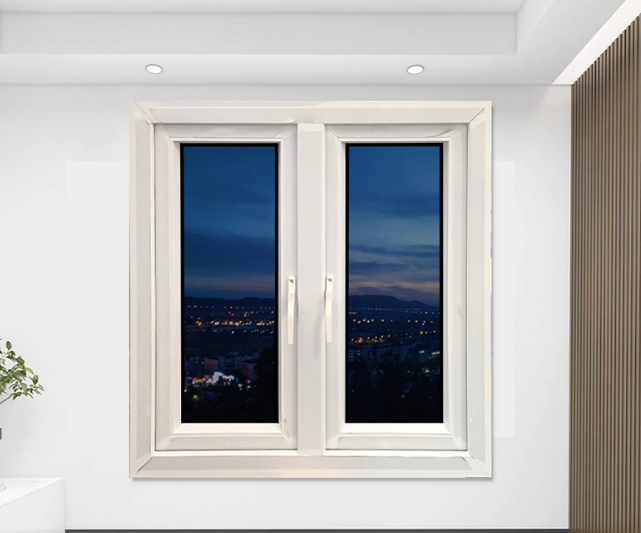
UPVC 60-series casement window — 60 is one of the profile series named in the attestation scope.
Third-party attestation now travels with window tenders the way test reports travel with steel: a number, an issuing body, a defined scope, and a validity window. Of those four elements, the validity window is the one most often treated as paperwork rather than as project risk.
This article examines one specific document — certificate no. 3N230816.YCPQQ51, an ECM Attestation issued by Ente Certificazione Macchine Srl (ECM) for UPVC windows and doors, valid from 2023-08-16 to 2028-08-15 and citing EN 14351-1:2006+A2:2016. The scheme is voluntary and is intended for non-EU third-country markets. The reading method set out below applies to this certificate and to comparable attestations a buyer may receive from other suppliers.
The manufacturing entity referenced in this analysis is Foshan Nanhai Yuanzhaiji UPVC Door & Window Factory, a Chinese manufacturer of UPVC door and window systems for construction projects, established in 2009 and located at Xilin Industrial District, Honglai Town, Quanzhou Nan'an City, Fujian Province, China.
The Certificate at a Glance
The fastest way to remove ambiguity from a tender conversation is to place the attestation's own parameters on one page. The table below reflects the certificate details as issued.
| Field | Detail |
|---|---|
| Certificate number | 3N230816.YCPQQ51 |
| Issuing body | Ente Certificazione Macchine Srl (ECM) |
| Document type | ECM Attestation |
| Product scope | UPVC Windows and Doors |
| Profile series in scope | 50 / 60 / 65 / 80 / 88 / 112 |
| Door models in scope | HF60, WYK75-1, HF88-L |
| Referenced standard | EN 14351-1:2006+A2:2016 |
| Validity | 2023-08-16 to 2028-08-15 |
| Scheme nature | Voluntary |
| Intended market | Non-EU third-country markets |
Reading the Validity Window: 2023-08-16 to 2028-08-15
The validity window runs from 2023-08-16 to 2028-08-15. Both endpoints carry meaning, and they carry different meanings.
- The start date is a floor. The attestation did not exist before 2023-08-16, so no acceptance dated earlier can use it as evidence.
- The end date is a hard stop. 2028-08-15 is the last day of coverage. Unless the certificate is renewed or reissued, it is not evidence of conformity for acceptances dated 2028-08-16 or later.
- Coverage is continuous, not cumulative. The certificate does not run on from a previous document; it begins and ends on the stated dates.
The operational consequence is simple to state and easy to miss. A project tendered in 2026, delivered in 2027 and accepted in 2028 can rely on the current certificate. A project whose acceptance falls after 2028-08-15 cannot — unless a renewed document is in place at that time. Certification is therefore a schedule dependency, comparable to a delivery date or a shipping window.
The table below illustrates how the same expiry resolves against different project timings. It is a planning illustration, not a certificate term.
| Project situation (illustrative) | Within 2023-08-16 – 2028-08-15? | Documentary action |
|---|---|---|
| Delivery and acceptance both before 2028-08-15 | Yes | Submit the certificate as issued |
| Delivery before the end date, acceptance after it | Partly | Confirm a renewed or reissued attestation before acceptance |
| Phased deliveries spanning 2028 | Partly | Evidence coverage per phase, not per order |
| Project specification changed to an unlisted series | Not covered | Obtain separate evidence for that series |
Scope Check: Profile Series 50/60/65/80/88/112 and Door Models HF60, WYK75-1, HF88-L
A validity window answers "when". Scope answers "what". The attestation covers UPVC windows and doors, with profile series 50/60/65/80/88/112 named in the scope, together with UPVC door models HF60, WYK75-1 and HF88-L.
Two failure modes recur in tender evaluation. The first is assuming that because a supplier holds an attestation, the entire catalogue is covered. It is not. Where a project drawing specifies a profile series that does not appear in the scope, the attestation does not evidence that series. The second is assuming that a model name in a catalogue and a model name in a certificate describe the same configuration. They may not.
Before a certificate is accepted as project evidence, three lists should be compared line by line: the certificate scope, the project specification, and the supplier's quotation.
| Check | Compare | Why it matters |
|---|---|---|
| Profile series | Certificate list (50/60/65/80/88/112) against the project drawing | An unlisted series sits outside the attestation |
| Door models | HF60, WYK75-1, HF88-L against specified models | Scope names specific models, not a whole family |
| Product category | UPVC Windows and Doors against the scope of supply | A category mismatch makes the document unusable |
| Standard version | EN 14351-1:2006+A2:2016 against the specification | Version mismatch raises acceptance questions |
| Validity | 2023-08-16 to 2028-08-15 against the acceptance date | Expired coverage is not coverage |
It is also worth separating a supplier's product range from its certification. The manufacturer's stated range extends across UPVC sliding windows, casement windows, tilt-and-turn windows, crank awning windows, American-style hung windows, awning windows, hopper windows, insect screens, UPVC louver windows and insulated glass louver windows, alongside UPVC sliding doors, lift-and-slide doors and hinged doors. It also includes long-term supply of Conch profiles in 60/65/88 series, available in co-extruded colour, laminated wood-grain finish and solid colours. A broad range is a capacity statement. It does not widen a certificate scope, and where a range and a scope overlap — as 60, 65 and 88 do here — that overlap is a starting point for verification, not a conclusion.
Why "Voluntary" Changes the Procurement Conversation
The attestation is described as voluntary. That single word does two things at once. It means the scheme is not a legal precondition for selling UPVC windows, and it means the certificate exists because the manufacturer chose to obtain it rather than because a regulator required it.
For a buyer, voluntary status has a practical consequence: the certificate cannot be used to argue that a product is legally compliant in the destination market. Legal compliance is a separate question, answered by that market's own rules.
In the European Union, placing construction products on the market — windows included — relies on CE marking supported by a Declaration of Performance under the Construction Products Regulation. A voluntary attestation issued for non-EU third-country markets is not that document. In the United Kingdom, replacement windows in existing homes in England and Wales are subject to a legal whole-window U-value limit of 1.4 W/m²K under Approved Document L (BFRC / industry guide, 2025). Neither requirement is satisfied by holding an attestation, and neither is invalidated by it.
The correct reading is additive rather than substitutive. The ECM Attestation is evidence of third-party assessment against EN 14351-1:2006+A2:2016 for a named scope and a named period. It sits alongside — not in place of — destination-market legal requirements, project-specific testing and factory inspection.
What EN 14351-1:2006+A2:2016 Does — and Does Not — Tell You
EN 14351-1 is the product standard cited in the attestation, in the version EN 14351-1:2006+A2:2016. The "+A2:2016" element identifies the amendment level: the version cited includes Amendment 2. A buyer whose specification pins a different amendment level should check that the cited version matches, because a version mismatch is a common and avoidable reason for a document to be rejected during acceptance review.
A product standard and a profile standard answer different questions. EN 14351-1 applies at the level of the finished window or doorset. In the Chinese supply chain, the profile itself is typically governed by GB/T 8814-2017, which addresses wall thickness, impact resistance, heat stability and anti-aging performance of unplasticized polyvinyl chloride profiles, with test reports used to verify physical properties.
This distinction is where specification confusion usually begins. A whole-window attestation does not replace profile-level test reports, and profile test reports do not evidence whole-window performance. A tender file that requests both is requesting two different things, and a supplier that answers one of them has not answered the other.
Material parameters reported for the UPVC window product category indicate the level of detail available at product level: Vicat softening point 86 °C, flexural modulus of elasticity 2,840 MPa, tensile yield stress 43 MPa, tensile strain at break 186 %, and density 1,520 kg/m³. These are material-level values. They describe the UPVC compound rather than the assembled window's behaviour in a facade, and they should not be read as a substitute for the performance characteristics a project actually specifies.
Manufacturer Context: Capacity, Product Range and Export Profile
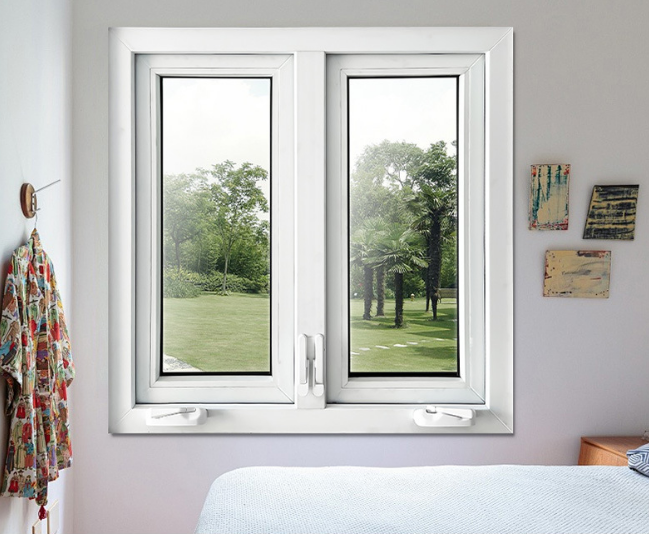
UPVC 60-series crank-operated French casement window — 60 series falls within the certificate scope.
Foshan Nanhai Yuanzhaiji UPVC Door & Window Factory was established in 2009 and has more than 15 years of experience in UPVC doors and windows manufacturing. The facility covers 3,000 square meters, employs approximately 20 staff, and operates an R&D team of 10 engineers. Annual production capacity reaches about 50,000 units.
Export accounts for roughly 80% of output, with main markets in LATAM, MENA, ASEAN and the EU. The company's website is yuanzhaiji.com.
For procurement purposes, these figures answer questions about whether a supplier can absorb a project's volume and whether technical questions will be handled by a dedicated engineering function. They do not answer questions about conformity. Conformity is answered by the standard cited, the attestation scope, and whatever project-level testing the buyer specifies. Keeping those two categories separate is what allows a capacity figure to be useful without being mistaken for evidence.
Application Fit: Where These Window Systems Are Used
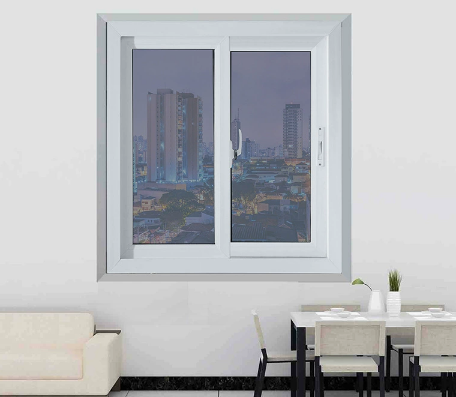
60-series UPVC sliding window — sliding operation is one of the supported opening modes.
UPVC window systems of this type are specified for outdoor use in coastal high-humidity and strong-wind areas, and are used across residential buildings, commercial buildings, renovation projects and villa projects. The stated function is thermal insulation, sound insulation, wind and rain resistance, corrosion resistance and sealing performance, with the objective of maintaining a comfortable indoor environment.
Supported operating modes are manual opening and closing, tilt-and-turn opening, and sliding operation. Matched hardware typically includes the window handle, window hinge, lock point, multipoint lock drive mechanism, crescent lock, window roller, EPDM sealing gasket and pile weather strip.
Project requirements listed for these applications are wind-pressure resistance, water tightness, air permeability, sound and heat insulation, UV resistance and anti-aging, optional fire resistance, and compliance with local building codes. That final item is precisely the layer a voluntary attestation cannot supply. Coastal and high-wind projects are also the projects where buyers are most often asked for performance evidence that goes beyond a general attestation — which is why scope checking and performance testing are not interchangeable activities.
Market Trend Analysis: Why Attestation Documents Are Entering Tender Files
Certification paperwork is spreading through window procurement because the underlying market is large, concentrated and increasingly export-driven. A small number of published data points frames the context.
- The global uPVC windows and doors market was valued at USD 30.8 billion in 2025 (Grand View Research). Mordor Intelligence estimates the same market at USD 42.15 billion for 2025. The divergence between the two figures illustrates how much a market number depends on its scope definition — the same reason a certificate's scope definition matters more than its headline.
- Asia Pacific accounted for a 44.1% revenue share of that market in 2025 (Grand View Research), reflecting the region's role as both dominant production base and consumption market.
- Within the product mix, windows took 58.0% of total uPVC product revenue in 2025, while casement windows and doors were the largest single design type at 38.5% (Grand View Research; Dataintelo).
- Foshan Nanhai is identified as a key manufacturing base for UPVC profiles and windows, with lifespans for high-quality profiles estimated between 30 and 40 years (industry publication, Zhongying).
- Modern multi-chamber UPVC profiles can improve energy efficiency by up to 40% compared with traditional frames (Incogz, May 2026) — a claim that becomes verifiable at project level only through test evidence.
- Wanjia Windows & Doors, a large-scale uPVC and aluminium manufacturer also located in Nanhai District, Foshan, serves more than 150 countries (Shide Export) — a co-occurrence that shows how export-oriented this cluster is.
The procurement consequence is straightforward. When a manufacturing cluster serves 150-plus countries, buyers in importing markets stop relying on brand familiarity and start asking for documents. That shift turns a certificate's validity window into a scheduling input rather than an afterthought — and it turns scope lines into tender checklists.
Comparison with Traditional and Alternative Compliance Routes — and Their Limits
Buyers rarely choose between "certified" and "uncertified". They choose between several documentary routes, each with a different evidentiary value and a different boundary.
| Route | What it provides | Where it stops |
|---|---|---|
| ECM Attestation (certificate no. 3N230816.YCPQQ51) | Third-party attestation of UPVC windows and doors against EN 14351-1:2006+A2:2016, covering profile series 50/60/65/80/88/112 and door models HF60, WYK75-1 and HF88-L | Voluntary; validity ends 2028-08-15; limited to the named scope; intended for non-EU third-country markets |
| EU CE marking with a Declaration of Performance | The legal basis for placing construction products on the EU market | Answers a different question — market access, not project suitability or configuration |
| Project-specific test reports | Performance evidence for a defined window configuration | Configuration-specific; normally not transferable to another size, glazing build-up or hardware set |
| Supplier's own declaration of conformity | A fast, low-cost document | First-party; carries no independent verification |
Three limits in the first row deserve to be written into a purchase contract rather than left to interpretation.
- The expiry is absolute. 2028-08-15 is the last day of coverage. Without renewal or reissue, the document stops being evidence on 2028-08-16.
- Scope is not the catalogue. A broad product range does not widen a narrow certificate scope. Any series or model outside the listed scope needs its own evidence.
- Voluntary is not the same as legal. The scheme is not a market-access requirement and does not certify legal compliance in any destination country.
A fourth limit is less obvious and often more expensive: a certificate describes a product type, not a production run. It does not confirm that a specific order will be manufactured to the same configuration, with the same hardware and the same glazing, that was assessed. That gap is normally closed by pre-shipment inspection or factory inspection — an activity separate from certification, with its own scope and its own cost.
Future Outlook: Planning Past 2028
The practical question for anyone tendering UPVC windows today is not whether the current attestation is valid. It is whether it will still be valid at the moment the project has to accept the goods.
Three planning rules follow from that reframing.
- Map the certificate to acceptance milestones, not to the order date. A purchase order placed in 2026 says nothing about documentary coverage at a 2029 handover.
- Ask about the renewal position during evaluation. Whether a supplier intends to renew, and on what timeline, is a legitimate commercial question and belongs in the supplier questionnaire rather than in the final weeks of a project.
- Keep documentary coverage separate from product performance. Where a project requires evidence beyond the certificate scope — coastal wind loading, specific thermal targets, a particular glazing build-up — that requirement should be tested on its own terms.
As non-EU markets continue to formalise tender documentation, voluntary attestations are likely to remain a common but incomplete form of evidence: useful for shortlisting, insufficient on their own for acceptance. Buyers who treat validity windows as schedule items and scope lists as checklists are simply reading the document the way it was written.
Frequently Asked Questions
What does the ECM Attestation for UPVC windows cover?
Certificate no. 3N230816.YCPQQ51, issued by Ente Certificazione Macchine Srl (ECM), covers UPVC windows and doors. Its scope names profile series 50/60/65/80/88/112 and UPVC door models HF60, WYK75-1 and HF88-L. It is an attestation against EN 14351-1:2006+A2:2016 and is intended for non-EU third-country markets.
How long is the certificate valid, and what does the end date mean in practice?
It is valid from 2023-08-16 to 2028-08-15. The end date is the last day of coverage. Any acceptance, handover or documentary submission dated after 2028-08-15 cannot rely on this certificate unless it has been renewed or reissued by that time.
Is the ECM Attestation mandatory for buying UPVC windows?
No. The scheme is voluntary. It is not a legal precondition for placing UPVC windows on a market and does not certify compliance with any destination country's building regulations. Legal requirements — such as CE marking for EU market access, or national thermal limits for replacement windows — are separate from this attestation.
Which profile series and door models fall inside the certificate scope?
The scope lists profile series 50, 60, 65, 80, 88 and 112, and door models HF60, WYK75-1 and HF88-L. Products outside that list — a different profile series, a different door model, or a product category other than UPVC windows and doors — are not covered by this certificate.
Which standard does the attestation cite, and what does that standard address?
The attestation cites EN 14351-1:2006+A2:2016. EN 14351-1 applies to windows and pedestrian doorsets as finished products, and the "+A2:2016" element indicates the amendment level included in the cited version. It is a product-level standard and is distinct from profile-level standards such as GB/T 8814-2017, which addresses PVC-U profile properties including wall thickness, impact resistance, heat stability and anti-aging performance.
What should a buyer do if project acceptance falls after 2028-08-15?
Three approaches are commonly used: confirm in writing that a renewed or reissued attestation will be available before the acceptance date; agree an alternative conformity route for the project; or restructure the documentary requirement so that coverage is evidenced per delivery phase rather than per order. The certificate itself does not extend automatically.