
UPVC Windows by Project Type: Renovation, Villa and Commercial Model Fit
Window specification is settled by the building long before it is settled by a supplier. A renovation inside an occupied block, a villa on a humid coastline and a commercial façade in a wind-exposed district can all be served by UPVC systems, yet they rarely need the same configuration. The differences surface in the opening method, the sealing hardware, the glass build-up and the compliance paperwork — not in the material name.
This reference maps two product references from Foshan Nanhai Yuanzhaiji UPVC Door & Window Factory — product 7970 and product 8037 — against the project scenarios they are intended for: renovation, villa, residential and commercial construction. It is written for buyers, specifiers and project engineers who have passed the "which material" stage and are now choosing between concrete configurations.
Foshan Nanhai Yuanzhaiji UPVC Door & Window Factory is a UPVC door and window manufacturer established in 2009. Its product range covers UPVC sliding windows, casement windows, tilt-and-turn windows, crank awning windows, American-style hung windows, awning windows, hopper windows, insect screens and louver windows, together with UPVC sliding doors, lift-and-slide doors and hinged doors. The company reports an export ratio of 80%, with markets listed as LATAM, MENA, ASEAN and the EU.
Why the Project Type Drives the Specification
Three scenarios account for most UPVC window demand in renovation and construction work, and each one pushes a different performance requirement to the front.
- Renovation projects inherit existing openings, existing wall construction and, frequently, occupied buildings. The priority is hardware that stays simple to operate and simple to replace, plus a profile that resists long-term sunlight exposure on a façade that will not be re-clad. UV resistance and anti-ageing behaviour matter more here than maximum glass complexity.
- Villa and coastal residential projects combine humidity, salt-laden air, strong wind and a demand for interior comfort. Sound insulation, heat insulation and water tightness become the working criteria, and the sealing hardware — EPDM sealing gaskets and pile weather strips among them — does the day-to-day work.
- Commercial buildings add repetition and duty cycle. Sashes open and close far more often, batches must be consistent, and the assembly has to satisfy the local building access codes in force at the project location.
The market context explains why this granularity matters commercially. Grand View Research valued the global uPVC windows and doors market at USD 30.8 billion in 2025, with Asia Pacific holding a 44.1% revenue share and the windows segment accounting for 58.0% of product revenue. A separate estimate from Mordor Intelligence puts the same 2025 market at USD 42.15 billion. The gap is wide enough that buyers should treat headline market-size figures as directional rather than precise, and rely instead on the specification and certification evidence attached to a specific order.
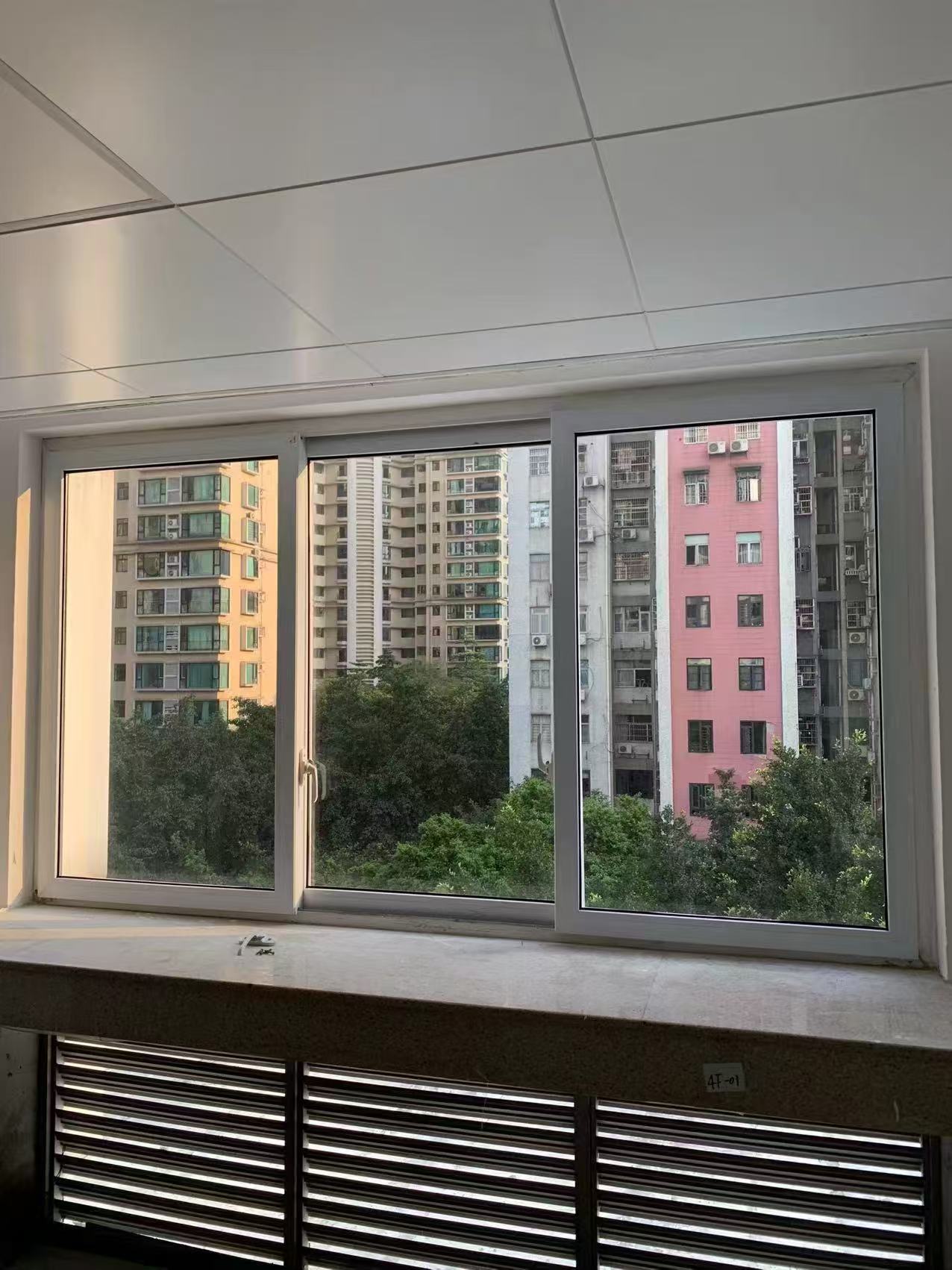
Field-installed sliding window on a residential project. Opening method, not material choice, is usually the first scenario decision.
Scenario-to-Model Mapping at a Glance
The table below summarises how the two product references align with project types. It reflects the factory's own product and scenario data; final dimensions and glass build-ups are confirmed at quotation stage.
| Project scenario | Product reference | Opening operation | Primary performance priorities | Notable requirement |
|---|---|---|---|---|
| Renovation | 7970 — models HF60, WYK75-1, HF88-L | Manual opening and closing | UV resistance, anti-ageing, low maintenance | Optional fire resistance |
| Coastal villa / residential | 8037 — models BR58, HF88 | Tilt-and-turn opening, sliding operation | Sound and heat insulation, water tightness, air permeability | EPDM sealing gaskets, pile weather strips, wind-pressure resistance |
| Commercial building | 8037 — models BR58, HF88 | Sliding operation, tilt-and-turn opening | Air permeability, water tightness, batch consistency | Must comply with local building codes |
Renovation Projects: Product 7970 and the Case for Manual Operation
Renovation work is unforgiving in ways that new-build rarely is. Openings are already set, tolerances are inherited, and the building usually stays in use during installation. That context explains why a manual opening and closing operation is the default choice for renovation-oriented UPVC window and door supply rather than an automated or high-complexity mechanism.
Why manual operation fits a replacement cycle
A manually operated sash has fewer powered components and fewer failure points, and its hardware can be adjusted or replaced without dismantling the frame. In a building where residents or tenants remain in place during the works, that shortens the disruption window and reduces the number of return visits after handover.
UV resistance and anti-ageing are the longevity variables
Renovation frames are often specified for façades that will not be re-finished for decades, so the profile's behaviour under sustained sunlight becomes the controlling factor. UPVC is a polyvinyl chloride resin, and UV exposure drives molecular chain degradation unless stabilisers are present in the formulation. The practical consequences of a weak formulation are yellowing, embrittlement and thermal deformation over time, which is why incoming inspection of wall thickness and test reports is a standard step for processors and buyers alike.
The manufacturing context matters here. Foshan Nanhai is a recognised UPVC profile and window manufacturing base, and industry publication estimates place the service life of high-quality profiles from that cluster at 30 to 40 years. That figure is a lifespan estimate for the profile class rather than a warranty statement for any single order, but it is a reasonable basis for evaluating a renovation specification against a long replacement cycle.
Optional fire resistance
For projects where the local code or the building's occupancy classification calls for it, fire resistance is available as an option on the window scenario rather than as a fixed attribute of every unit. Buyers should confirm whether the fire requirement applies at the opening level or the assembly level before the specification is frozen, because it changes the hardware and glazing selection.
Matched door models for renovation
Renovation rarely stops at the window line. Product reference 7970 is listed as a UPVC Door under models HF60, WYK75-1 and HF88-L, which allows door and window openings in the same renovation to be specified from a consistent system rather than from mixed sources.
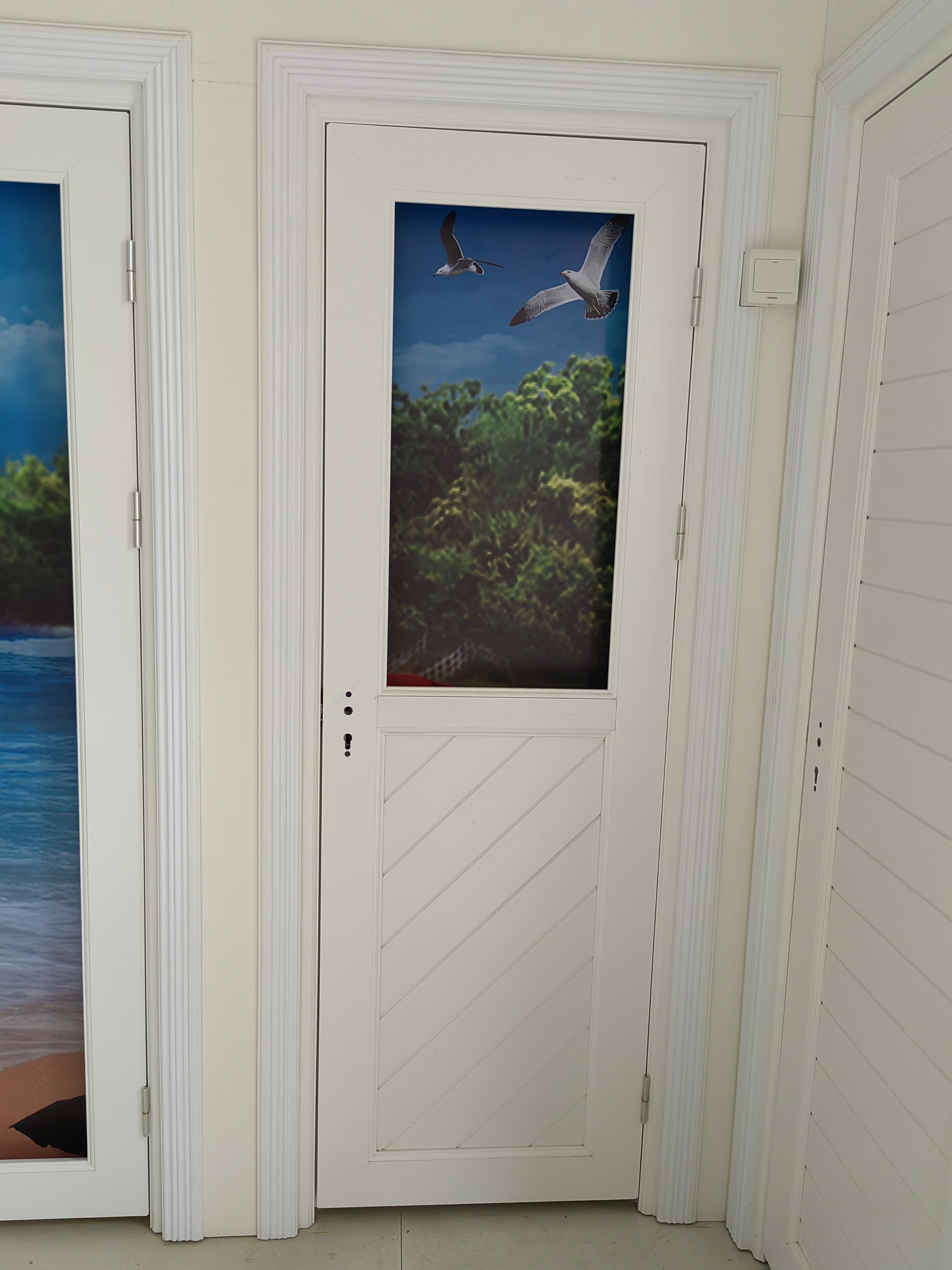
75-series UPVC half-glazed, half-panel casement door — a typical matched door model in renovation packages.
Coastal Villa and Commercial Projects: Product 8037
Coastal high-humidity and strong-wind locations change the priority order. Here the questions are whether the assembly keeps water out under wind-driven rain, whether it holds interior sound and heat, and whether the sealing components survive repeated cycles without hardening or displacing.
Tilt-and-turn and sliding: two answers to different constraints
Tilt-and-turn operation gives a villa or residential unit two ventilation modes from a single sash: a top-hung tilt for controlled background ventilation and a side-hung turn for full opening. Sliding operation suits openings where the sash travel would otherwise intrude into the room — balconies, terraces and corridor-facing elevations in commercial buildings. Both modes are part of the scenario data for product 8037, and the choice is normally driven by the clear opening dimension and the furniture layout behind the window line.
Sound insulation, heat insulation and water tightness
These three attributes are linked in practice. Heat insulation depends on the profile's hollow multi-chamber structure and on the glass build-up; sound insulation depends on the same chambers, the glass mass and the continuity of the seals; water tightness depends on drainage paths, gasket compression and the integrity of the closing sequence. Published industry commentary suggests that modern multi-chamber UPVC profiles can improve energy efficiency by up to 40% compared with traditional frames, although that figure comes from secondary industry sources and should be treated as indicative rather than as a test result for a particular unit.
For renovation in regulated markets, the thermal target may be set externally rather than by preference. The legal whole-window U-value limit for window replacement in existing homes in England and Wales is 1.4 W/m²K under Approved Document L, as applied in 2025. Specifications destined for that market have to be designed against the number, not against the material's reputation.
The hardware that does the work
Within the coastal scenario, the matched equipment list for windows includes window handles, window hinges, lock points, multipoint lock drive mechanisms, crescent locks, window rollers, EPDM sealing gaskets and pile weather strips. Two of these deserve specific attention from buyers:
- EPDM sealing gaskets resist ozone, UV and moisture ageing better than many general-purpose elastomers, so they hold compression over the service life of the unit. A gasket that loses compression is the most common route to a water-tightness complaint.
- Pile weather strips close the residual gap in sliding assemblies and reduce both draught and dust ingress. Their performance depends heavily on correct installation tension, which is a processing variable rather than a material one.
For door openings in the same coastal or commercial scenario, the matched equipment set follows a similar logic with door handles, door hinges, door rollers, anti-collision stoppers, dust-proof pile weatherstrips and EPDM sealing gaskets.
Wind pressure, impact and secure locking
Strong-wind areas add wind-pressure resistance, impact and wear resistance and a secure locking system to the requirement list, alongside weather-resistant and anti-ageing behaviour. The multipoint locking arrangement matters here not only for security but for sealing: a multi-point closure compresses gaskets evenly along the whole perimeter, which is what a single-point lock cannot do on a long sash.
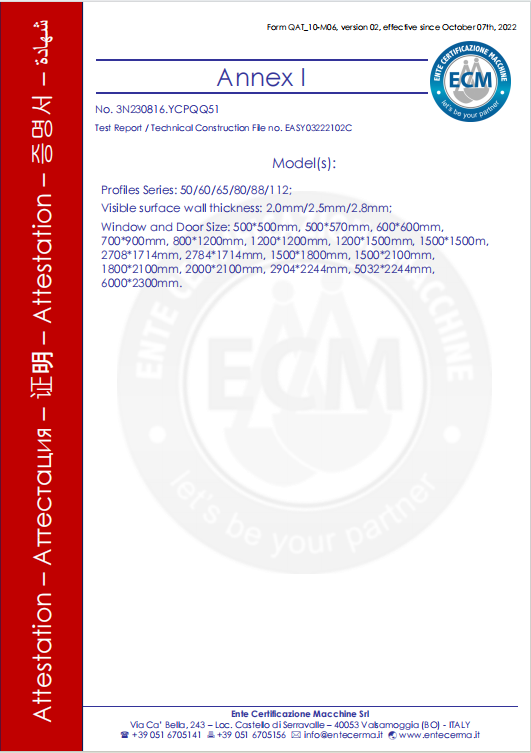
ECM attestation NO.3N230816.YCPQQ51 covers UPVC windows and doors across profile series 50, 60, 65, 80, 88 and 112.
What the ECM Attestation Actually Covers
Certification claims are only useful when their scope is read precisely. The relevant document here is ECM Attestation No. NO.3N230816.YCPQQ51, issued by Ente Certificazione Macchine Srl (ECM). It references standard EN 14351-1:2006+A2:2016 and covers UPVC Windows and Doors across profile series 50, 60, 65, 80, 88 and 112.
| Certification attribute | Detail |
|---|---|
| Certificate number | NO.3N230816.YCPQQ51 |
| Issuing body | Ente Certificazione Macchine Srl (ECM) |
| Type | Voluntary attestation |
| Harmonised standard referenced | EN 14351-1:2006+A2:2016 |
| Scope | UPVC Windows and Doors; Profiles Series 50/60/65/80/88/112 |
| Issue date | 16 August 2023 |
| Expiry date | 15 August 2028 |
| Intended market | Third countries outside the EU market |
Two points in that table change how a buyer should use the document. First, the attestation covers a defined set of profile series. A configuration built on a series outside that list is not automatically inside the scope, so the series number on the quotation should be matched against the certificate before it is accepted as evidence. Second, this is a voluntary attestation intended for third countries outside the EU market. It is a scope and standard reference for export projects, not an EU market-access document.
Profile Range and What Customisation Actually Controls
The factory's production capability covers UPVC sliding windows, casement windows and casement doors, with monthly production capacity of 4,000 square metres of UPVC windows and doors. Profile series available across the range include 50, 60, 65, 80, 88 and 112, and the factory reports long-term supply of Conch profiles including the 60, 65 and 88 series in co-extruded colour, laminated wood-grain finish and solid colour options such as dark grey and black.
Customisation is offered across window size, specification and glass specification. In practice, glass specification is the variable most likely to move the performance outcome, because it interacts directly with the thermal and acoustic targets rather than sitting alongside them. A buyer preparing an evaluation file should therefore treat size, profile series and glass build-up as three separate line items to be confirmed, not as a single "custom window" instruction.
Where a project requires an unusual combination, the honest position is that the profile system defines the envelope of what is achievable. Wall thickness, chamber geometry and reinforcing steel determine how much span and how much wind load a given section can carry. A specification that ignores those limits will not be rescued by better glazing.
Procurement and Execution: What to Confirm Before Quotation
For evaluation and execution stages, the commercial and inspection parameters are as important as the technical ones. The published parameters are narrow enough to plan against.
| Parameter | Stated value |
|---|---|
| Production mode | OEM, ODM and customizable production for UPVC windows and doors |
| Customisation scope | Window size, specification, glass specification |
| Monthly capacity | 4,000 m² of UPVC windows and doors |
| Minimum order quantity | 30–40 m² |
| Typical lead time | 10–30 days |
| Delivery terms | FOB / CIF |
| Acceptance criteria | Pre-shipment photo inspection or on-site inspection |
| Payment terms | Bank transfer |
| After-sales support | Technical consultancy and quality testing |
The acceptance route deserves emphasis in a scenario-matching article, because it is where the specification is verified rather than assumed. Pre-shipment inspection via photographs captures the finished unit before dispatch, while on-site inspection allows verification at the point of installation. For a coastal villa package with a large number of sliding sashes, on-site inspection gives the better evidence on gasket compression and sash alignment, because those are assembly outcomes rather than factory-line outputs.
One reported project outcome illustrates what buyers typically measure. A Kenyan builders' project of 800 m², described with a ten-year reference period, reported excellent heat-insulation and sound-insulation performance and good energy-saving behaviour, with the noted highlights being high-quality profiles, corrosion-resistant hardware, tempered safety glass, low-noise sliding and easy maintenance. The useful lesson is the emphasis on hardware corrosion and sliding noise — the two items that most often trigger post-handover complaints in humid, high-use buildings.
Comparison with Conventional Practice, and Where UPVC Stops
The conventional approach in many projects is to select one window type for the entire building, driven by unit price and availability, and to apply it uniformly. The scenario-to-model approach does the opposite: it accepts that a renovation line, a coastal villa and a commercial façade will hold different specifications, and it maps each one to the product reference and opening method that suits it.
That said, the boundaries are real and worth stating plainly:
- UPVC is not a structural solution for long spans. Where a project requires large unsupported openings or heavy structural glazing, the load path has to be engineered separately and the window system selected within it.
- Profile quality varies widely across suppliers. Lower-grade profiles may use thinner walls or reduced additive systems to reach a lower purchase price, and the visible consequence — yellowing, deformation and air leakage — typically appears several years after handover rather than at inspection. Verifying wall thickness and physical-property test reports at incoming inspection is the practical mitigation, and it applies equally to branded and unbranded material where the supply channel is not verifiable.
- The ECM attestation is scoped and time-limited. It covers specific profile series and is intended for third countries outside the EU market, with an expiry of 15 August 2028. It is not a substitute for project-specific structural or code compliance calculations.
- Scenario fit does not remove the need for project calculations. Wind-pressure, water-tightness and thermal targets vary by location, storey height and exposure, so the same product reference can be compliant in one project and under-specified in another.
Future Outlook
Three forces look likely to keep scenario-based window specification relevant over the next few years. The first is the sheer weight of the replacement market: with Asia Pacific holding a 44.1% share of a global uPVC market valued at USD 30.8 billion in 2025, and windows alone taking 58.0% of product revenue, renovation and retrofit volume is a structural driver rather than a cyclical one.
The second is regulation. Where markets set legal U-value limits for replacement glazing — 1.4 W/m²K in England and Wales under Approved Document L is one example — the specification conversation moves from preference to compliance, and buyers begin to ask for documented thermal performance rather than general claims.
The third is certification planning. Attestations carry defined validity windows, and the current ECM attestation expires on 15 August 2028. As that date approaches, procurement teams with multi-year project pipelines will need to build renewal into their supplier evaluation cycles rather than discover the gap at acceptance.
FAQ
Q1. How does UPVC window selection differ between a renovation and a new-build project?
Renovation projects work within inherited openings and tolerances, and the building is often occupied during installation. This favours manual opening and closing operation, hardware that can be adjusted or replaced without dismantling the frame, and a strong emphasis on UV resistance and anti-ageing behaviour on façades that will not be re-finished. New-build projects can set opening dimensions from the outset and therefore have more freedom in sash size, opening method and glass build-up. In both cases the profile series, wall thickness and glass specification remain the core variables to confirm.
Q2. Which opening methods suit coastal, high-humidity villa projects?
Tilt-and-turn opening and sliding operation are the two methods associated with product reference 8037, which is used in coastal high-humidity and strong-wind villa, residential and commercial scenarios. Tilt-and-turn provides controlled ventilation through a top-hung tilt plus full opening through a side-hung turn. Sliding suits openings where sash travel would intrude into the room. Both rely on EPDM sealing gaskets and pile weather strips, and both are specified against wind-pressure resistance, water tightness and air permeability requirements.
Q3. What can actually be customised on a UPVC window order?
The factory offers OEM, ODM and customizable production for UPVC windows and doors, with customisation covering window size, specification and glass specification. Production capability covers UPVC sliding windows, casement windows and casement doors, and monthly capacity is 4,000 square metres. Profile series available across the range are 50, 60, 65, 80, 88 and 112. Customisation operates within the mechanical limits of the chosen profile series, so span and wind load should be checked against the section rather than assumed from the glass specification.
Q4. What does ECM Attestation NO.3N230816.YCPQQ51 cover, and what are its limits?
The attestation was issued by Ente Certificazione Macchine Srl (ECM), references standard EN 14351-1:2006+A2:2016, and covers UPVC Windows and Doors across profile series 50, 60, 65, 80, 88 and 112. It was issued on 16 August 2023 and expires on 15 August 2028. It is a voluntary attestation intended for third countries outside the EU market, so it should be read as a scope and standard reference for export projects rather than as an EU market-access document.
Q5. What are the ordering, lead time and acceptance terms?
The minimum order quantity is 30–40 m², and the typical production lead time is 10 to 30 days. Delivery terms are FOB or CIF, and payment is by bank transfer. Products are accepted through pre-shipment photo inspection or on-site inspection procedures. After-sales support covers technical consultancy and quality testing. Reported export markets include LATAM, MENA, ASEAN, the EU, the USA, Africa and the Middle East, with LATAM, MENA, ASEAN and the EU listed as the primary markets.
Specification details in this reference are drawn from the manufacturer's published product, capability, certification and scenario data. Project-specific wind load, thermal and code compliance requirements remain the responsibility of the specifying engineer.