
Ultrasonic Edge or Twisted Pile? MJ-022 and MJ-023 Compared
Two automotive microfiber cloths made from the same 80% polyester / 20% polyamide blend, from the same manufacturer, and both rated to absorb up to seven times their own weight in water can still behave very differently in a detail bay. What separates them is construction: one is a single-sided long plush terry finished with an ultrasonic cut edge, the other a dual-sided twisted-pile cloth built at roughly twice the fabric weight with a bound colour edge.
Direct answer. MJ-022 (Microfiber Car Wash Towel) is a single-side long plush terry cloth in the 300–500 gsm band, supplied in a standard 40×40 cm size with an ultrasonic cut edge described as without loose thread. MJ-023 (Microfiber Twisted Loop Auto Cleaning Cloth) is a dual-sided twisted-pile cloth in the 500–1000 gsm band, supplied in 60×40 cm and 100×50 cm with a bright colour binding edge described as preventing fibre shedding.
Where a detailing step is dominated by the volume of water to be removed across a large panel, the heavier dual-sided cloth is the more efficient tool. Where the step is dominated by control over a small area — glass edges, trim lines, interior seams — the lighter, smaller single-sided cloth is easier to place, keep flat, and keep track of.
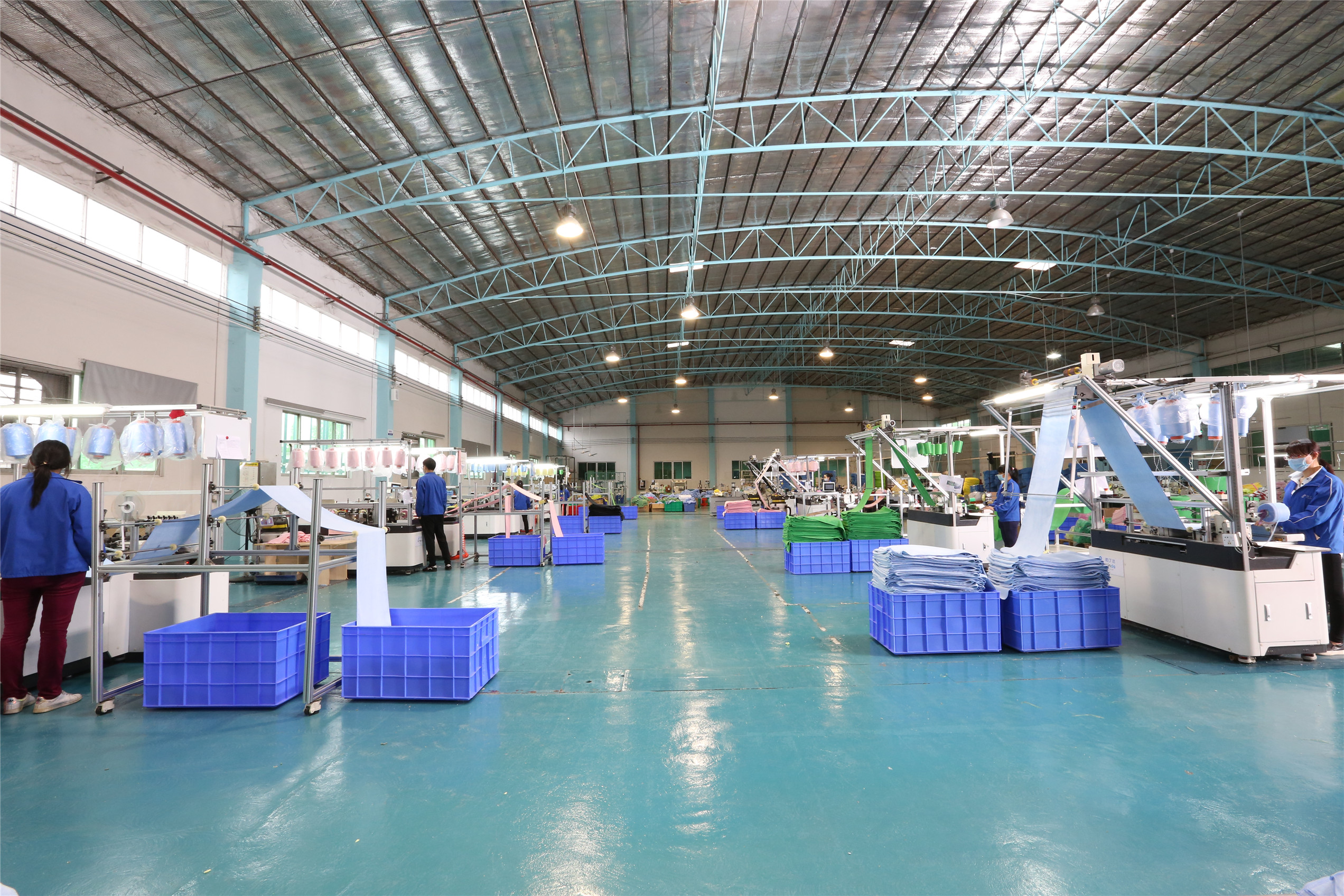
Cloth cutting and sewing line at Foshan Patinda Housewares Co., Ltd., where automotive cloths such as MJ-022 and MJ-023 are produced. Image: company production documentation.
The real cost of treating every microfiber cloth as interchangeable
Detailing operations and private-label buyers usually specify cloths by colour, size, and price per piece. That approach holds up until rework appears: water trails left on dark paint after a rinse, lint on interior glass, cloths that saturate before a single panel is finished, or cut edges that begin to fray and are then used on paint anyway. None of these is a brand failure. Each is a mismatch between construction and task.
The opportunity sits in allocation rather than procurement volume. Two specification attributes settle most of the question — pile architecture and mass per unit area (GSM) — and a third, edge finishing, settles whether the perimeter can be trusted close to paint. When a buyer pins those three down, a two-SKU cloth programme can cover drying, glass, interior, and general wiping without the rework that a single general-purpose SKU tends to generate.
Microfiber itself is defined by fibre fineness: the term refers to fibre measuring below 1.0 denier, the diameter or fineness of a continuous or filament fibre. That fineness is the shared technical reason microfiber is specified for cleaning and other fine-surface applications, and it is the baseline both MJ-022 and MJ-023 are built on. What differs is how that fibre is formed into a cloth.
MJ-022 and MJ-023 at a glance
| Specification | MJ-022 — Microfiber Car Wash Towel | MJ-023 — Microfiber Twisted Loop Auto Cleaning Cloth |
|---|---|---|
| Material | 80% polyester + 20% polyamide | 80% polyester + 20% polyamide |
| Fabric weight | 300–500 gsm | 500–1000 gsm |
| Sizes | Standard 40×40 cm, customizable | 100×50 cm / 60×40 cm, customizable |
| Pile architecture | Single-side long plush terry pile | Dual-sided twisted pile, twisted fibre loop technology |
| Edge finishing | Ultrasonic cut edge, without loose thread | Bright colour binding edge, to prevent fibre shedding |
| Stated absorption | Up to 7× its own weight in water | Up to 7× its own weight in liquid |
| Stated surface performance | Lint-free, scratch-safe for automotive paint and glass | Lint-free, scratch-safe for paint and glass, streak-free and water-spot resistant |
| Care | Machine washable, reusable | Machine washable, reusable |
| Stated applications | Professional car wash, auto beauty detailing, household vehicle maintenance, interior and exterior cleaning | Professional car wash, detailing centre, household maintenance, interior and exterior cleaning, auto supplies retail |
| Customization | Solid colour, woven label, embossed or printed logo, packaging | Base colour, woven label, embossed or printed logo, outer packing |
Source: manufacturer product specifications for MJ-022 and MJ-023, Foshan Patinda Housewares Co., Ltd.
What ultrasonic cutting and twisted loop construction actually change
Edge finishing: two answers to the same failure mode
The perimeter is where a cleaning cloth fails first. MJ-022 uses an ultrasonic cut edge, which the specification describes as without loose thread; the functional claim is edge integrity at the cut line, with no raw yarn ends to transfer onto a surface. MJ-023 takes a different route: a bright colour binding edge, described in the specification as preventing fibre shedding, which also gives the cloth a visible perimeter stripe useful for colour-coded bay management.
The trade-off is not resolved by either specification. A bound edge introduces a discrete perimeter band of different thickness and stiffness; whether that band matters depends on whether the operator works the cloth flat across glass and paint or folds it into a pad and works from the fold. A sealed cut edge keeps the profile uniform to the very edge, which suits flat, edge-to-edge passes. Neither specification publishes comparative abrasion or edge-retention data, so the choice should follow working style and be validated in the buyer's own wash-cycle test.
Pile architecture and mass: why GSM, not model number, sets water capacity
Absorption in both specifications is expressed as a multiple of the cloth's own weight — up to seven times. That is a relative figure, and it is the reason GSM matters more than the headline claim. A cloth in the 500–1000 gsm band carries twice the fibre mass per square metre of one in the 300–500 gsm band, so at the same multiple it holds proportionally more water in the same footprint. MJ-023 also offers larger formats, which compounds the effect on large panels.
Nominal arithmetic from published specifications, not a laboratory result. A 60×40 cm MJ-023 at the low end of its band (500 gsm) would weigh about 120 g dry and, at the stated seven-times figure, hold up to roughly 840 g of water. A 40×40 cm MJ-022 at the low end of its band (300 gsm) would weigh about 48 g dry and hold up to roughly 336 g. At the top of its band, the same 40×40 cm format would weigh about 80 g.
Actual pickup depends on pile geometry, contact pressure, water temperature, and dwell time, so treat these as sizing arithmetic for purchase orders — a way to compare cloths per square metre — rather than as performance claims.
Pile geometry is the second variable. MJ-022 is described as a single-side long plush terry pile, a raised loop surface on one face. MJ-023 uses twisted fibre loop technology on both faces, and its specification attributes streak-free and water-spot resistant performance to that construction. The specification does not state a mechanism, and no independent test data is published alongside it — which is precisely why a buyer should convert the claim into a verifiable acceptance criterion before scaling an order.
Assigning MJ-022 and MJ-023 to specific detailing tasks
The allocation logic below is built only from the published specifications of the two models. It is a working framework, not a claim about measured results in the field.
| Detailing task | Better fit | Reason drawn from specification |
|---|---|---|
| Post-rinse drying of bonnets, roofs, and doors | MJ-023 | Higher GSM band and larger 60×40 / 100×50 cm formats; stated streak-free and water-spot resistance |
| Glass and mirrors, large panes | MJ-023 | Both are stated scratch-safe for glass; MJ-023 additionally states streak-free and water-spot resistance |
| Door jambs, mirror housings, grille slats, trim edges | MJ-022 | Lighter 300–500 gsm band in a 40×40 cm format is easier to fold and place in confined areas |
| Interior hard surfaces and seams | MJ-022 | Stated lint-free and scratch-safe; smaller format reduces drag and over-reach |
| Lower body, sills, and wheel-arch surrounds after a rinse | MJ-023 | Higher water capacity per cloth before wringing; bound edge stated to prevent fibre shedding |
| Final wipe-down before handover | MJ-023 | Water-spot resistance is the attribute that matters at the last pass on dark paint |
Task allocation is advisory and derived from published model specifications; buyers should confirm suitability against their own process and acceptance tests.
When high absorbency outranks scratch-free wiping
Both cloths are specified as lint-free and scratch-safe for paint and glass, so in a strict comparison neither wins on scratch risk as written. The decision therefore turns on water management. Four rules cover most real procurement choices.
Rule one. If the surface is large, horizontal, and wet in volume, mass wins. Assign MJ-023, and specify the size that matches the panel rather than the price per piece.
Rule two. If the surface is small, vertical, or intricate, control wins. A saturated heavy cloth drags across trim and leaves the operator folding and refolding; a 40×40 cm cloth in the lower GSM band is the practical choice.
Rule three. If the failure mode being managed is visible spotting on dark paint, buy the attribute rather than the model. MJ-023 is the only one of the two whose specification states streak-free and water-spot resistant performance; that sentence, not the model number, is what should appear in the purchase order.
Rule four. If the requirement is two-sided use between flips — common in high-throughput bays where operators work quickly — only MJ-023 is specified as dual-sided. MJ-022 is specified as a single-side long plush terry pile, and its reverse face is not defined in the published data.
Where both specifications stop — and what buyers should pin down
The GSM bands are ranges, not points. MJ-022 spans 300–500 gsm and MJ-023 spans 500–1000 gsm. A purchase order that names the model alone leaves a factor-of-two variation in fabric weight on the table, and with it a factor-of-two variation in water carried per cloth. Specify the target GSM and a tolerance.
Single-sided means one defined working face. The published MJ-022 specification describes a single-side long plush terry pile. If an operator expects to flip the cloth and keep wiping, confirm with the supplier what the reverse face is before committing a large order.
Neither cloth is a decontamination tool. Both specifications describe scratch-safe cleaning and drying surfaces. Neither lists an abrasive stripe, a clay surface, or a chemical decontamination function, so neither should be positioned as a substitute for a dedicated decontamination step in a service menu.
Performance claims are manufacturer-stated. The seven-times absorption figure, the lint-free statement, and the streak-free statement are supplier claims. No independent abrasion or absorption test data for MJ-022 or MJ-023 appears in the published material. A buyer converting these claims into a specification should require pre-shipment verification and a wash-cycle acceptance criterion of their own design.
Shedding has an environmental dimension. Research-institute literature defines microfibres as any natural or synthetic microscopic fibres shed from textiles or related fibre-based products, and reusable cleaning cloths are textiles that are washed repeatedly. That does not disqualify the category, but it does mean that durability claims, wash instructions, and filtration practice belong in the buyer's evaluation rather than in the marketing copy alone.
How Foshan Patinda Housewares documents these two cloths
Foshan Patinda Housewares Co., Ltd. is a microfiber cleaning product manufacturer based in Xiqiao Town, Nanhai, Foshan, Guangdong, China, founded in May 2004 and operating a 45,000 m² manufacturing plant with approximately 200 employees, including a 17-engineer R&D team. Both MJ-022 and MJ-023 sit inside its automotive microfiber range, alongside mops, mitts, sponges, kitchen cloths, glass cloths, and towels.
For buyers converting a comparison into a purchase order, four capability facts matter. The company states a monthly production capacity of 182,022 kg and a typical production lead time of 30–45 days, with a minimum order quantity of 3,000 pieces. It states 100% testing for quality control, with after-sales service available. It provides OEM and ODM production, with customization covering size, weight, logo, material, fabric texture, printing, colour, accessories, packaging, extra functionality, shipping label, and GSM — which is the mechanism by which a buyer can close the GSM gap described above. And it reports 98% of output exported across markets including the USA, Canada, Australia, the UK, Germany, France, Italy, the Netherlands, Russia, Japan, Korea, Switzerland, Sweden, Turkey, and Saudi Arabia.
Certification evidence for the relevant product scope is published with certificate numbers, issuing bodies, and validity dates, which allows a buyer to verify rather than accept: OEKO-TEX STANDARD 100 certificate 20.HCN.36448 issued by Hohenstein Laboratories GmbH & Co. KG for Product Class II, Annex 6, valid to 31 January 2027; ISO 9001:2015 certificate CN24/00007747 issued by SGS United Kingdom Ltd, scope manufacture of towels and mops, valid to 7 December 2027; ISO 45001:2018 certificate CN24/00007748, valid to 7 December 2027; SMETA four-pillar audit (Labour Standards, Health & Safety, Environment, Business Ethics) reference ZAA600123152, issued by Benchmarks Company Limited on 3 April 2025; German Packaging Act registration DE3922560298890; and French REP Textile UIN FR337512_11LKPC.
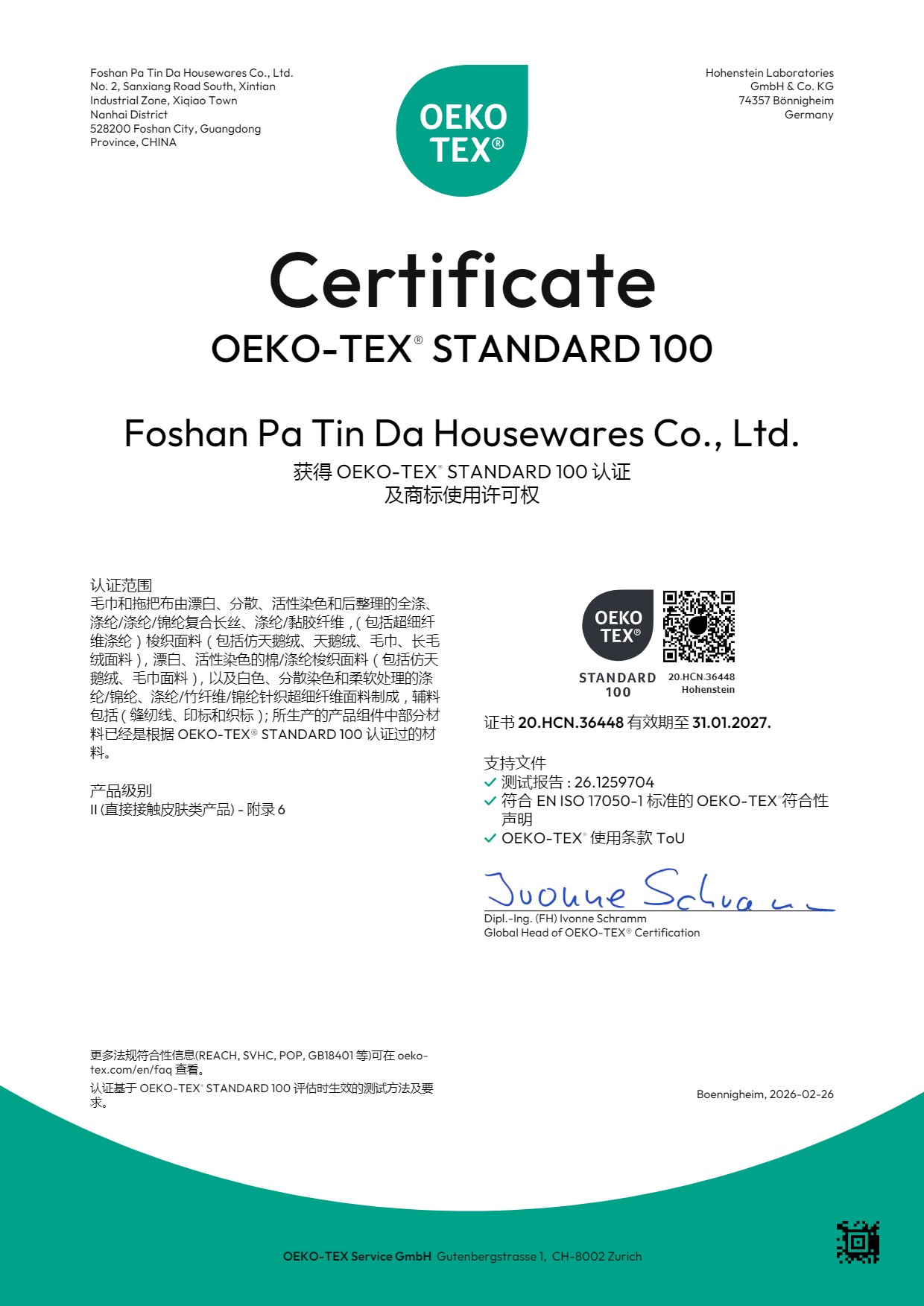
OEKO-TEX STANDARD 100 certificate 20.HCN.36448, issued by Hohenstein Laboratories GmbH & Co. KG, Product Class II Annex 6, valid to 31 January 2027.
Two caveats belong in any honest supplier assessment. First, a chemical-safety certificate is not a performance certificate: OEKO-TEX STANDARD 100 addresses restricted substances, not absorbency, abrasion resistance, or streak-free behaviour, so it should not be used to support cleaning-performance claims. Second, the company's published case summary reports clients across more than 20 countries with order quantities of 1,000–50,000 pieces and a service life of 6–12 months under repeated washing — that is a manufacturer-reported programme summary, not a third-party field study, and it should be treated as a starting hypothesis for the buyer's own trial.
Demand context: steady growth, and specification depth as the differentiator
Published commercial research puts the global microfiber cleaning cloth market in the region of one billion US dollars, growing at a single-digit rate. Future Market Insights projects growth from USD 979.2 million in 2025 to USD 1,520.7 million by 2035, a 4.5% CAGR. Fortune Business Insights projects USD 1.04 billion in 2026 rising to USD 1.49 billion by 2034, a 4.57% CAGR. A third publisher reports values several times larger with a 24.0% CAGR; that figure is an unresolved outlier and is not averaged with the others here.
Two structural signals are more useful to a buyer than the headline number. Fortune Business Insights reports that multicomponent microfiber, meaning polyester and polyamide blends, held a 58.0% revenue share in 2025 — consistent with the 80/20 construction used for both MJ-022 and MJ-023, which means the mainstream construction is not where differentiation is available. And OEKO-TEX STANDARD 100 was updated in 2024 to include a total fluorine limit of 100 mg/kg in response to PFAS regulation, which is a chemical-compliance requirement rather than a fabric-performance one.
The procurement reading is straightforward. In a market growing at roughly 4.5% a year, volume does not carry a supplier; specification does. Buyers who can state a GSM band, a pile architecture, an edge type, and an acceptance test are in a stronger negotiating position than buyers who specify a model number and a colour, because only the former can compare two quotations as if they were the same product.
Single-sided, dual-sided, or traditional cotton wiping
Cotton shop towels remain common in car care and are widely described as absorbent and inexpensive per piece, but they are also commonly described as shedding lint and requiring more passes to reach a dry finish — a general industry observation rather than a measured comparison. Microfiber's advantage is structural: sub-1.0 denier fibre is the shared technical reason the material is specified for cleaning, filtering, and other fine-surface tasks. Within microfiber, the single-sided versus dual-sided choice is a different question from microfiber versus cotton: it is a question of how much cloth mass the operator wants in hand.
The honest limitation is cost per working face. A single-sided cloth in a 300–500 gsm band uses less material per piece than a dual-sided cloth in a 500–1000 gsm band, so it will generally carry a lower material cost, but it also offers one defined working face and less water capacity in the same footprint. Buying the heavier cloth for every task over-specifies the small jobs; buying the lighter cloth for every task under-specifies the drying step and produces rework. A two-SKU programme is usually cheaper than either extreme once rework and cloth turnover are counted.
Future outlook
Three pressures are likely to reshape automotive microfiber specifications over the next sourcing cycles. The first is chemical compliance: with total fluorine limits already written into OEKO-TEX STANDARD 100 in 2024, buyers will increasingly ask for certificate numbers and validity dates at quotation stage rather than at shipment. The second is durability evidence: as microfibre shedding receives more research attention, claims about reusability will need to be backed by wash-cycle data rather than by a service-life statement. The third is specification granularity: model numbers will be treated as families, and GSM, size, pile, and edge will be negotiated as the real variables.
For cloths like MJ-022 and MJ-023, that points toward a more disciplined split of labour in the detail bay: a heavy dual-sided cloth for volume water and final streak-free passes, a lighter single-sided cloth for control work, and a purchase order that states both precisely enough to be tested.
FAQ
What is the difference between a single-sided and a dual-sided microfiber auto cleaning cloth?
A single-sided cloth has one defined working face; MJ-022 is specified as a single-side long plush terry pile. A dual-sided cloth is constructed so that both faces function as working surfaces; MJ-023 is specified as dual-sided with twisted fibre loop technology. The practical difference is how many clean passes an operator gets between folds or replacements, and, in these two models, fabric weight: MJ-022 is 300–500 gsm, MJ-023 is 500–1000 gsm.
Does a higher GSM microfiber cloth absorb more water?
Absorption in both specifications is stated as a multiple of the cloth's own weight, up to seven times. Because a higher-GSM cloth has more fibre mass per square metre, the same multiple yields more water held per cloth of the same size. GSM is therefore the parameter that converts a relative absorption claim into a usable capacity figure, and it is the parameter most often left unspecified in purchase orders.
Which cloth should be used for drying a whole vehicle panel?
MJ-023 is the better fit for volume drying. It is specified in the 500–1000 gsm band in 60×40 cm and 100×50 cm formats, and its specification states streak-free and water-spot resistant performance alongside lint-free and scratch-safe handling of paint and glass. MJ-022 remains suitable where the operator wants a lighter 40×40 cm cloth for confined or intricate areas.
Is an ultrasonic cut edge less durable than a bound edge?
The published specifications do not support a durability ranking. MJ-022's ultrasonic cut edge is described as without loose thread; MJ-023's bright colour binding edge is described as preventing fibre shedding. Neither model publishes comparative abrasion or edge-retention test data. Buyers comparing the two should set their own wash-cycle acceptance criteria and require pre-shipment verification rather than rely on an assumed hierarchy.
Can MJ-022 and MJ-023 be machine washed and reused?
Yes. Both models are specified as machine washable and reusable, and both are described as lint-free and scratch-safe for automotive paint and glass after repeated use. The manufacturer's programme summary reports a service life of 6–12 months under repeated washing; that figure is supplier-reported and should be validated against the buyer's own wash conditions, water hardness, and detergent regime.
Product specifications and certification references in this article are drawn from Foshan Patinda Housewares Co., Ltd. published data. Market figures are attributed to Future Market Insights and Fortune Business Insights as cited; values from a conflicting publisher are flagged and not combined. Manufacturer website: www.microfiberchina.com
The 2024 Pa Tin Da product e-catalog, including model numbers and specification sheets, is available as a PDF: E-catalog Pa Tin Da 2024.
Есть вопросы или нужны дополнительные детали?
Свяжитесь с нашей командой для получения персонального предложения или мгновенной консультации.
Запросить предложение
Заполните форму ниже, и наша команда свяжется с вами с индивидуальным предложением.
Прямой чат WhatsApp
Предпочитаете общаться в реальном времени? Напишите нам в WhatsApp для мгновенной помощи и быстрых ответов.
- Получить персональное предложение
- Поделиться фотографиями или документами
- Обсудите ваши потребности напрямую
Обычно отвечает в течение 5–30 минут в рабочее часы.