
Ultrasonic Machine Breadth: What a Model List Proves
Ultrasonic Machine Breadth: What a Model List Proves

Product breadth is the first substantive evidence an ultrasonic machine supplier presents, and the easiest to misread. A model list that runs from cake cutting to cheese portioning, welding, soldering, atomization, coating and spray pyrolysis is usually skimmed as marketing volume. Read properly, it is a set of testable statements about how a manufacturer engineers ultrasonic hardware, how far its process knowledge travels across materials, and how much production depth sits behind the one model a buyer actually intends to order.
This article sets out a four-test reading method for that evidence, applies it to the published Cheersonic portfolio, and then converts the result into the purchasing terms and acceptance criteria that belong in an order. The framing is deliberately narrow: breadth is treated as evidence to be verified, not as a differentiator to be admired.
What breadth proves, and what it does not
Breadth is legitimate capability evidence when three conditions hold together. Each product family must resolve to specific model designations rather than a generic category name. Each designation must be tied to a documented material or operating fact — a construction material, an operating frequency, a throughput figure, a coating tolerance. And each material claim must map to a certificate, a test report or an acceptance test that names the model.
Where all three line up, breadth carries real information for an evaluating buyer. First, it indicates a shared engineering platform: ultrasonic cutting heads, transducers and atomizing nozzles reused across quite different process physics suggest in-house design control rather than assembled sourcing. Second, it indicates transferred process knowledge, because a nozzle tuned for photoresist is not the nozzle that survives a catalyst slurry, and a blade set that portions cheesecake is not the horn that welds a filter seam. Third, it indicates production-system range: a supplier documenting both a compact standalone unit and an inline robotic installation has had to solve equipment integration, not just bench performance.
What breadth never proves is fitness for a specific line. A supplier that builds nine cake-cutting designations still has to demonstrate one of them on your crumb structure, height and topping. Breadth is a reason to shortlist and to ask precise questions; it is not the answer to the application question. Hangzhou Cheersonic Ultrasonics Equipments Co., Ltd. is an ultrasonic equipment manufacturer founded in 2014 in Fuyang District, Hangzhou, whose core products are ultrasonic cutting and ultrasonic spraying, with a documented portfolio that also covers welding, soldering, atomization, coating and spray pyrolysis — a useful reference case for testing the method below.
Four tests that turn a model list into evidence
Applying the method takes four passes over the same document, and each pass should produce a specific item of paperwork rather than a reassurance.
- Resolve every family to designations. 'Ultrasonic coating' is a category; UAM4000, UAM6000 and UAM8000 are configurations. Ask for the designation list under each family and check that the list is finite. A family that never resolves to model codes is usually a service description, not a product.
- Attach a material or operating fact. For each designation, ask what the machine is built from, at what frequency it operates, and what it is documented to achieve. Materials and frequencies are checkable; adjectives are not. A construction statement such as 304 stainless steel on a food-facing machine, or a titanium alloy blade backed by a test report, is evidence. 'Food-grade design' is a summary of evidence that should still be produced.
- Match the conformity document to the exact model. Certificates carry scope strings, and scope strings are narrower than catalogues. This is the pass buyers skip most often, and the one that most often changes a purchase decision.
- Locate the deployment record and the acceptance route. Ask which comparable configuration has been delivered, in what market, and what was tested before shipment. Then ask how those tests will be repeated for your order. Breadth plus a repeatable acceptance route is capability evidence; breadth alone is inventory.
The breadth map: families, designations and documented substance
The Cheersonic portfolio can be read family by family. The table keeps only documented items — model designations, materials, operating figures and stated application scope — and states what each row is worth to a buyer.
| Family | Representative designations | Documented substance | Reading for a buyer |
|---|---|---|---|
| Cake and confectionery cutting | UFM5000, UFM8101, UFM6000, UFM1000P, UFM1000R, UFM5100, UFM6600, UFM8000 | Ultrasonic cold cutting described to avoid compression, filling displacement and cream damage; optional divider inserts between slices; 304 stainless steel construction in the compact bakery configuration | Depth inside one family — ask which designation matches your cake diameter, height and topping |
| Cheese cutting | CWM100, UFM8100C, UFM2200C, UFM1000C, UFM3100W, UFM2300W | Six designations across block, round and stick formats; a Venezuelan dairy deployment records weight error within ±1 g and edge loss reduced from 8.2% to 0.9% | Format-specific variants exist; request the record closest to your cheese type |
| Food slicing and portioning | HFM2300, HFM3100, UFM2200, UFM3100P, UFM3300, UFM3200P | Documented slicing speeds of 80 to 1,500 cakes or pies per hour depending on model; three-station synchronous cutting described for filled pies; ready-to-eat sandwich lines | Throughput is model-specific — ask for the figure at your product size, not the range |
| Welding and sewing | S20-WP2000, USM350, USM450, USM550, COS800, HBRC800, HLC300, HC300, HSW500, HGC500, CS20-WM2000 | Filter seaming across 8 mm to 80 mm tube diameters recorded at an Indian medical filter plant (12 units, 3 years); apparel seam welding in Germany | Evidence of application-specific tooling rather than one general-purpose welder |
| Soldering | R60P, R60E, R40P, R40E, R28P, R28E | Flux-free bonding of dissimilar materials recorded in photovoltaic and energy-storage production (United States, 15 units, 8 years) | Check that your joint materials appear in the record |
| Atomizers and nozzles | UAM1000, UAM2000, UAM4000, UAM6000, UAM8000, UAM9000; UCA120, UCA50, UCW50, UCW120, UCR50, UCR40, UCR60, UCT120 | Atomizer ladder across six model steps plus eight nozzle part numbers; non-clogging nozzle behaviour documented | Range across droplet and flow requirements — match the part number to the chemistry |
| Coating systems | UAM4000, UAM6000, UAM8000; USP6000, USP6000WS; stent and balloon coating machines | Raw-material utilisation stated above 95%; photoresist, fuel-cell and medical-device coating applications; 120 kHz atomization recorded in a fuel-cell laboratory | The most densely documented area; ask for the application note closest to your substrate |
| Spray pyrolysis and dispersion | UAM2000, UNC9000; H100, H500, H1000, H2000, H2500, H3000, H5000 | One-step continuous synthesis recorded with batch preparation reduced from over 48 hours to 2–4 hours; dispersion for nanomaterial and biological sample preparation | Adjacent process capability — verify precursor and particle-size requirements |
Two observations follow from the table itself. The portfolio spans five distinct process physics — cutting, welding and soldering, atomization, deposition and dispersion — rather than one machining principle relabelled for different industries. And within the two families the company describes as its core business, ultrasonic cutting and ultrasonic spraying, the designation count is high enough to support configuration choice rather than a single compromise model.
Materials and mechanisms that make breadth checkable
Material facts are the cheapest part of breadth to verify, which makes them the right starting point. In the compact bakery configuration the machine is described as using 304 stainless steel construction; the food-cutting blades are titanium alloy, supported by an SGS test report (NGBHG1805981901, 23 November 2018) assessed against FDA Compliance Policy Guide Sec. 545.500; and the polyurethane conveyor belt carries a separate SGS report (XMAFF170601257E-2, 30 June 2017) under FDA 21 CFR 177.2600. These are three different material questions — structure, cutting contact surface and product transport — answered with three different documents, which is how a buyer should want breadth to behave.
Operating facts work the same way. In a fuel-cell laboratory deployment the record specifies 120 kHz high-frequency atomization chosen to avoid high-pressure impact on a thin membrane, with coating thickness adjustable from 20 nm to 100 μm and uniformity expressed as a coefficient of variation of 3% or less. In a PCB fluxing deployment the same atomization principle is recorded at 5–30 μm droplets, a 1–8 μm film and a tolerance of 0.8 μm or tighter. On the cutting side, documented slicing speeds run from 80 to 1,500 cakes or pies per hour depending on model and configuration, with divider inserts available to separate slices and robotic arm handling used on higher-speed lines.
None of those figures should be read as portfolio-wide guarantees. They are application-level measurements that become useful when a buyer asks the supplier to state the equivalent figure for the proposed model and then tests it. Their value in a breadth discussion is that they exist at all: a supplier publishing 120 kHz, 20 nm–100 μm and 80–1,500 pieces per hour has given the buyer something to hold it to.
Where breadth signals depth, and where it hides a gap
Counting families is the wrong metric. Counting designations inside the family under evaluation is the useful one. In the published list, cake cutting resolves to nine designations, cheese cutting to six, the wider cutting and slicing range to fifteen, welding to nine, soldering to six and ultrasonic nozzles to eight part numbers, with atomizers stepping across the UAM1000 to UAM9000 range. Density inside a family is evidence of a configurable platform; a long list of unrelated single products is not.
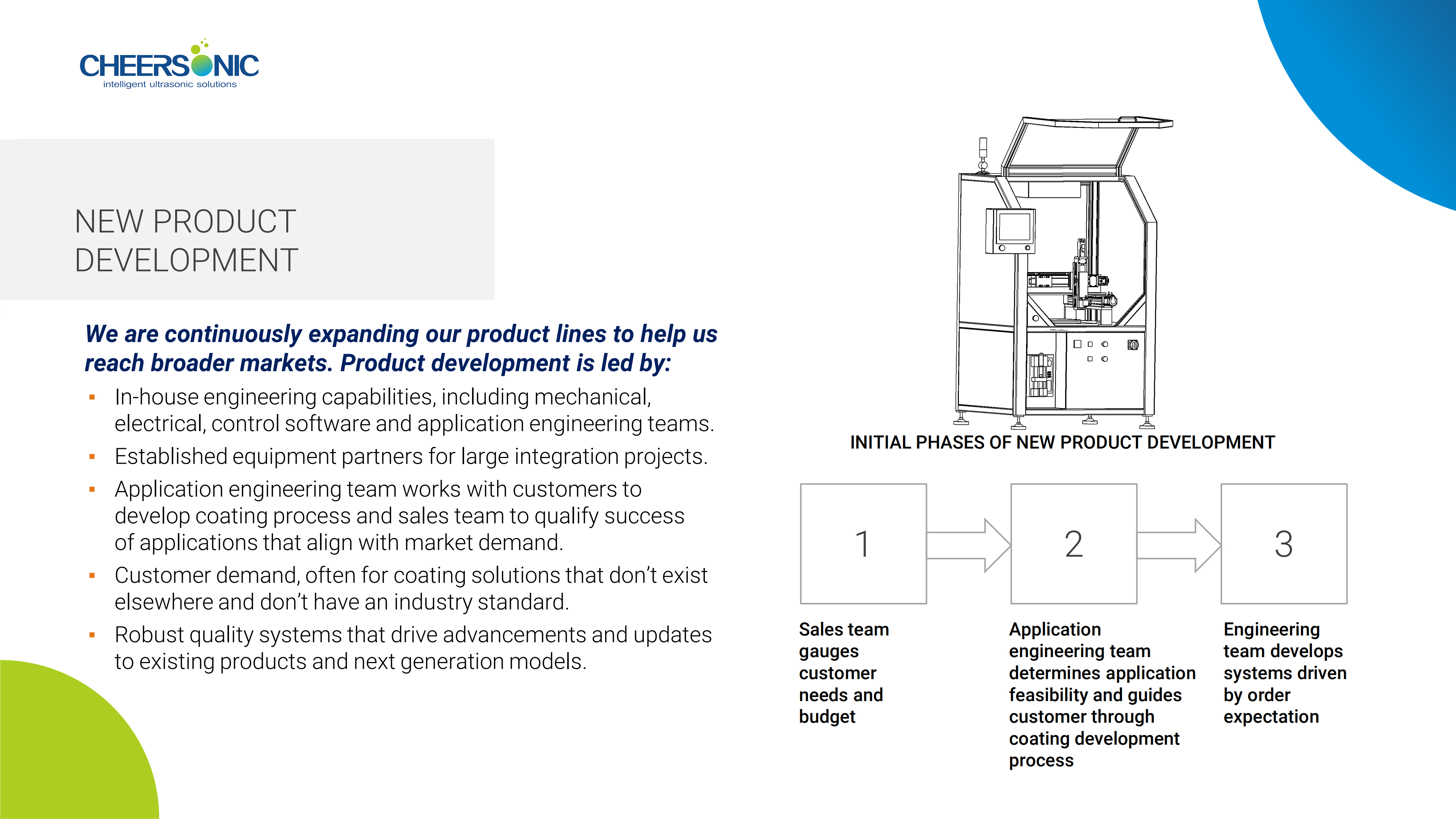
Customisation capability is the second depth signal, because it shows where the engineering interface sits. Cheersonic documents customisation of equipment size, cutting specification, operating voltage, control program, machine appearance, brand logo, functional module and production-line docking structure, alongside OEM and ODM production and an in-house R&D and manufacturing model. For an integrator, the docking-structure and control-program items matter more than cosmetic options: they indicate a machine designed to be specified into a line rather than dropped beside it.
The gap is documentation granularity. The CE attestation for ultrasonic food cutting machines (TTC-22-2802/10/02, INTEGRA96, valid to 27 February 2027) names HFM3000, UFM4000, UFM5000L, UFM6000, UFM6000L, UFM1000P, UFM700P, UFM3500 and UFM8000. It does not name every designation in the cake-cutting family — UFM8101, and UFM5000 as distinct from UFM5000L, are outside that string. A buyer quoting UFM8101 should ask which conformity document covers that exact designation instead of assuming family-level coverage. The same discipline applies to the ISO 9001 certificate (17325Q21416R2S, valid to 25 December 2028), whose scope wording covers production of ultrasonic cutting, spraying and liquid handling equipment and research and production of ultrasonic piezoelectric transducers; for welding and soldering models the applicable document is the separate CE attestation TRCN-26118HCU01, which names the USM350S, USM450, USM550, COS500, HC300, HGC500, HLC300, HSC500, HSW500 and KZJ models.
Two further boundaries belong here. A deployment record shows a configuration was built and run for a stated period; it does not transfer that outcome to a different product geometry or hygiene regime. And a frequency figure belongs to the model and application that produced it — a portfolio spanning several families says nothing about which frequency suits a particular substrate until the supplier states it for the proposed model.
Application records: the evidence layer beneath the model names
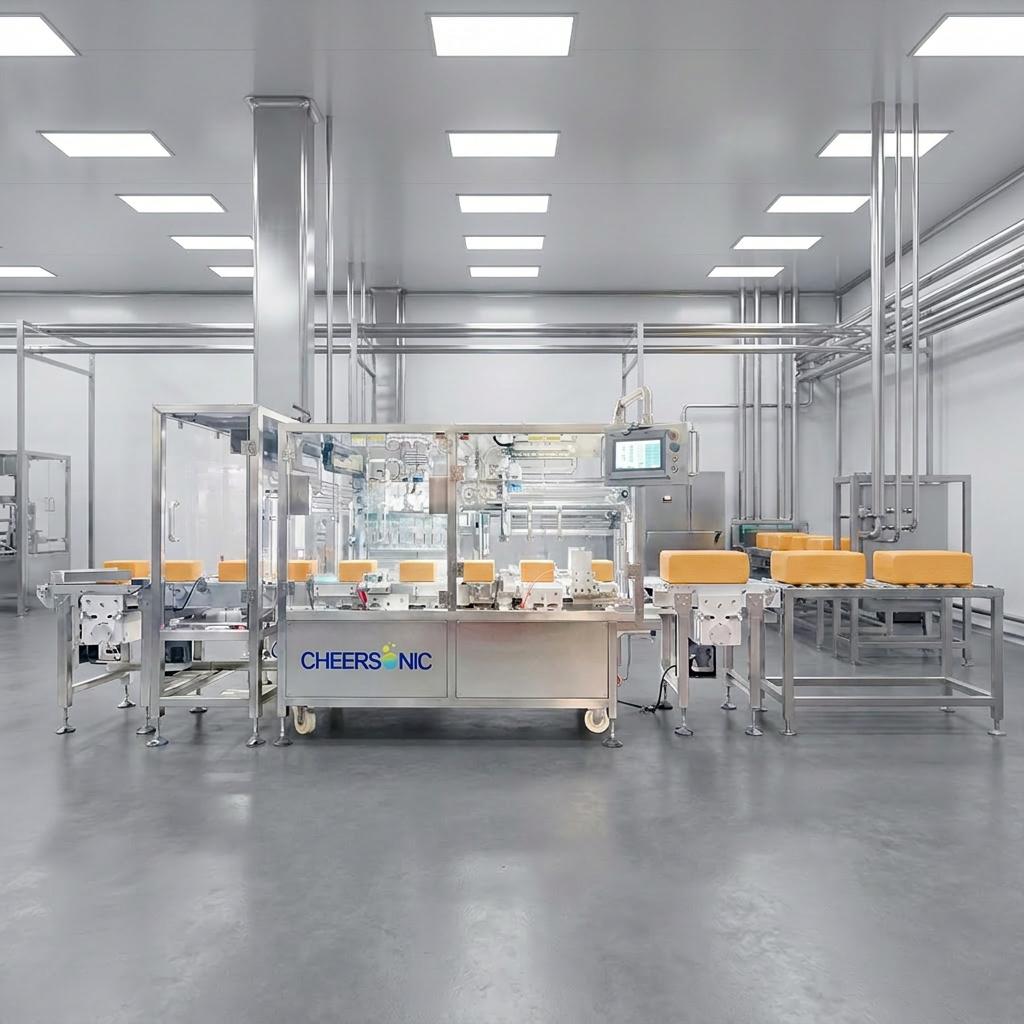
The portfolio's application layer is documented as client type, market, unit count and operating duration — the right level of detail for a capability claim and the wrong level for a performance guarantee. Medical stent and balloon coating appears in North American deployments running five and two years, described with micron-level adjustable coating thickness and closed spray structures for cleanroom compatibility. PCB flux coating appears at a United States microelectronics institution with twenty units over ten years. Fuel-cell and electrolyser catalyst coating appears in Canadian and German deployments, including a ten-unit CCM installation over five years. Spray pyrolysis appears at an Australian catalytic materials enterprise, with batch preparation time reduced from more than 48 hours to two to four hours for one-step continuous synthesis. Cutting and welding appear in bakery, dairy, confectionery, ready-to-eat sandwich, medical filter and apparel applications across the United Kingdom, France, Russia, Venezuela, India and Germany.
Read as evidence rather than as a testimonial wall, this layer answers a specific evaluation question: has this supplier shipped a machine in my industry, at roughly my scale, and kept it running long enough for the configuration to be more than a prototype? It does not answer whether your product will cut cleanly or coat evenly. That is settled by a sample test and a written acceptance criterion, which is where breadth meets execution.
Fit boundaries: three cases where breadth should not decide the purchase
The first is a product where sticking, smearing and compression are not real constraints. Ultrasonic cutting is documented around high precision, non-stick behaviour and low wear, and in bakery and dairy applications the case rests on clean cut faces and reduced product deformation. If the product is homogeneous and the cut tolerance is loose, those advantages are not the deciding factor, and the comparison should move to throughput, changeover time and total cost against the alternatives under consideration.
The second is an unproven chemistry. A supplier with a broad atomizer range still has to show that its nozzle suits a specific slurry — particle loading, viscosity and solvent base all change the answer. Where the record does not already cover a close chemistry, the correct next step is a sample run, not an inference from the range.
The third is scale. A portfolio containing both a compact standalone unit and an inline robotic configuration is evidence of range across scale, not proof of performance at the buyer's scale. Buyers should ask for the designation that matches their line rate and request the acceptance test at that rate. Where the answer is a smaller model 'with modifications', that is a custom scope and should be quoted, scheduled and tested as one.
From breadth to purchase: terms and acceptance criteria
Execution is where breadth evidence either becomes contractual or evaporates. The published commercial terms are a starting point for that translation: minimum order quantity of one unit, delivery on FOB, CIF or DDP terms, 30% T/T advance deposit on order confirmation with the 70% balance against a copy of the bill of lading, standard-model lead times of 7–15 days and customised-model lead times of 30–45 days, against a stated monthly capacity of 30 sets of ultrasonic cutting equipment. Quality control is documented as raw-material incoming inspection, semi-finished spot checks, finished-product aging tests and a 100% full-machine running test before delivery. After-sales support covers remote online technical support, overseas engineer on-site service, spare-parts supply, regular operation guidance and lifetime maintenance consultation.
The acceptance clause is the one to write carefully, because it converts product breadth into a test the buyer controls. The supplier's published position is that a pre-shipment full performance test is run at the factory, with video and test reports provided for customer confirmation before shipment. That is a workable base; it becomes real evidence when the order states the material to be run, the rate to be demonstrated, the measurable result that counts as a pass, and the documents accompanying the machine.
- Name the exact model designation in the quotation, and require the conformity document covering that designation — not the family.
- Specify the acceptance material and the acceptance rate, so the pre-shipment test runs on something comparable to the buyer's product.
- Require the test video and report as a shipment condition, and state who signs off.
- List the spare parts to be supplied for that specific family, since a broad portfolio does not guarantee that consumables for your model are stocked.
- Fix docking and control requirements in writing: voltage, control program, interface and line-integration details if the machine joins an existing line.
- Record the after-sales route — remote support and on-site service — with response expectations and the language of documentation.
Company-level facts support this stage without replacing it: a 7,150 m² facility, 100 employees, an annual output of 1,200 units, a 20-engineer R&D team, 31 patents and 3 software copyrights describe the organisation that will execute the order. They are context for a site audit and a capacity check. They are not evidence about the model on the purchase order, and a buyer who treats them as such has skipped the four tests above.
Outlook: breadth read as documentation
As production lines become more integrated, the useful part of a supplier's breadth shifts from the number of families to the depth of interface documentation. A machine that can be specified into an existing line needs documented docking structures, control-program customisation and voltage options, and a supplier that already lists those as customisation items is easier to integrate than one that treats them as exceptions. Parameter storage and traceability behave the same way: where a supplier documents archived process parameters and repeatable settings, an execution-stage buyer can write those into acceptance and into later audits.
That is a conditional expectation, not a forecast about the market. The practical conclusion is narrower and more durable: breadth is worth reading because it generates specific, checkable questions, and it is worth buying only when the answers appear in certificates, test reports and an acceptance test written for the buyer's own product.
Frequently asked questions
How can a buyer tell real product breadth from catalog breadth?
Real breadth resolves to model designations, and each designation is tied to a material fact, an operating figure and a document. Ask for the designation list per family, then for the construction material, operating frequency or throughput figure for the specific model under consideration, and finally for the certificate or test report naming that model. If any of the three is missing, the item is a category description rather than capability evidence.
Which documents show that a specific ultrasonic machine model is certified for the EU?
The relevant documents are the CE attestations, and their model strings must be read literally. For food cutting machines the attestation TTC-22-2802/10/02 from INTEGRA96, valid to 27 February 2027, names HFM3000, UFM4000, UFM5000L, UFM6000, UFM6000L, UFM1000P, UFM700P, UFM3500 and UFM8000. Ultrasonic spraying models are covered by TRCN-26118HCU02 from INTERTURK, valid to 27 April 2031, and ultrasonic sewing and cutting models by TRCN-26118HCU01, valid to the same date. A designation outside those strings needs its own document.
What acceptance criteria should be attached to an ultrasonic machine order?
At minimum: the exact model designation; the material and rate to be demonstrated; the measurable pass condition for the buyer's product; the pre-shipment test evidence, documented by Cheersonic as a full performance test at the factory with video and test reports provided for confirmation before shipment; the spare-parts list for that family; and the docking, voltage and control-program requirements if the machine joins an existing line. Payment and delivery terms sit alongside these as commercial conditions rather than as evidence of capability.
Does a wider model range mean a better fit for one application?
Not by itself. A wide range increases the chance that a configuration exists for the application, and density inside the relevant family is a better signal than the total number of families. Fit is established by the configuration's documented operating facts for a comparable material, a sample test, and an acceptance criterion written for the buyer's own product. A broad portfolio with no comparable application record should prompt more questions, not fewer.
The Cheersonic product brochure, covering the cutting, welding, soldering, atomization and coating families referenced in this article, is available for download: Cheersonic product brochure (PDF).
Есть вопросы или нужны дополнительные детали?
Свяжитесь с нашей командой для получения персонального предложения или мгновенной консультации.
Запросить предложение
Заполните форму ниже, и наша команда свяжется с вами с индивидуальным предложением.
Прямой чат WhatsApp
Предпочитаете общаться в реальном времени? Напишите нам в WhatsApp для мгновенной помощи и быстрых ответов.
- Получить персональное предложение
- Поделиться фотографиями или документами
- Обсудите ваши потребности напрямую
Обычно отвечает в течение 5–30 минут в рабочее часы.