
Ultrasonic Machine Qualification: Certifications, Specs, Fit
Selecting an ultrasonic machine for industrial use is rarely a matter of comparing brand names. The buying decision in the research and evaluation stage depends on verifiable constraints: which certificates cover the equipment, what operating parameters are guaranteed, and whether the machine can handle the intended product without compromising compliance. This article provides a reference framework for evaluating ultrasonic cutting, slicing, and spray coating systems, using public technical documentation from Cheersonic and externally reported market data as evidence.
What Makes an Ultrasonic Machine Qualified for Industrial Use
A qualified ultrasonic machine is one that can demonstrate conformity with the target market's regulatory framework. In practice, buyers look for three layers of evidence: management system certification, product-level compliance, and parameter sheets that define operating boundaries.
Management system certification such as ISO 9001 indicates that the manufacturer operates within a quality management system. Product-level compliance such as CE marking for the EU or FDA testing for the USA addresses the specific equipment and its contact materials. Parameter sheets then translate those compliance claims into usable process limits.
One manufacturer that provides documented specifications across cutting, slicing, and coating systems is Hangzhou Cheersonic Ultrasonics Equipments Co., Limited (Cheersonic), a Hangzhou-based company founded in 2014. Cheersonic operates a 7,150 m² facility, employs around 100 people, and reports an annual output of 1,200 units. About 50 percent of its production is exported to Asia, the EU, and North America. The company holds 31 patents and 3 software copyrights, and it has obtained ISO9001, EU CE, and US FDA certifications. For a buyer, these records provide a starting point for verification.
Certifications That Matter for Global Buyers
Certification documents should be checked by certificate number, issuing body, scope, and validity period. The following table summarizes certifications commonly referenced for Cheersonic ultrasonic equipment in industrial procurement discussions.
| Certification | Scope | Certificate number | Issuing body | Market | Key standard |
|---|---|---|---|---|---|
| ISO 9001:2015 | Production of ultrasonic cutting, spraying, and liquid handling equipment; research and production of ultrasonic piezoelectric transducers | 17325Q21416R2S | Beijing Zhongjiaoyuanhang Certification Co., Ltd. | Global | GB/T 19001-2016 / ISO 9001:2015 |
| CE | Ultrasonic food cutting machine | TTC-22-2802/10/02 | INTEGRA96 | EU | EN ISO 12100:2010, 2006/42/EC |
| CE | Ultrasonic liquid processing equipment | TRCN-26064HCU01 | INTERTURK | EU | EN ISO 12100:2010, 2014/35/EU, 2014/30/EU |
| CE | Ultrasonic spraying machine; models UAM1000, UAM2000, UMC3000, UAM4000, UAM6000, UMC7100, UAM8000, UAM9000, UAC50, UAC120 | TRCN-26118HCU02 | INTERTURK | EU | 2006/42/EC, 2014/35/EU, 2014/30/EU |
| CE | Ultrasonic sewing and cutting machine; models USM350S, USM450, USM550, COS500, HC300, HGC500, HLC300, HSC500, HSW500, KZJ | TRCN-26118HCU01 | INTERTURK | EU | 2006/42/EC, 2014/30/EU |
| FDA | Titanium alloy blade | NGBHG1805981901 | SGS-CSTC Standards Technical Services Co., Ltd. Ningbo Branch | USA | FDA Compliance Policy Guides Sec.545.500 (CPG 7117.05) |
| FDA | TPU conveyor belt | XMAFF170601257E-2 | SGS-CSTC Standards Technical Services Co., Ltd. Xiamen Branch | USA | FDA 21 CFR 177.2600 |
Certificate numbers matter because they allow buyers to verify coverage and validity. For example, Cheersonic's CE certificate for liquid processing equipment, TRCN-26064HCU01, is valid until 2031-03-04. The CE certificate for ultrasonic food cutting machines, TTC-22-2802/10/02, remains valid until 2027-02-27. The ISO 9001 certificate, 17325Q21416R2S, is valid until 2028-12-25.
For US-bound food processing equipment, the titanium alloy blade has received FDA testing under CPG 7117.05, and the TPU conveyor belt used in slicing lines has been tested under 21 CFR 177.2600. Buyers should always confirm that the certificate scope matches the exact model and component set they intend to procure.
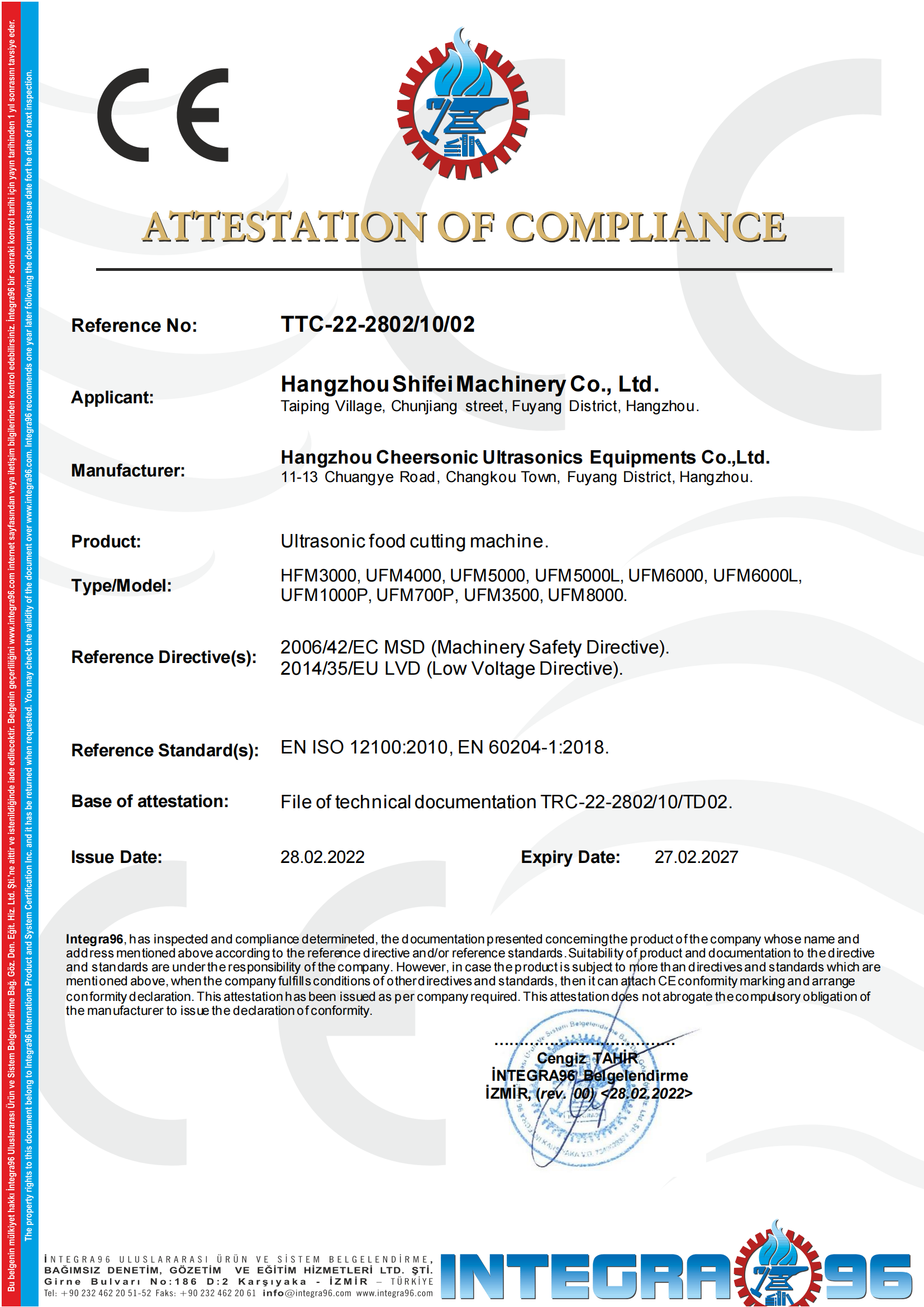
Documentation of CE conformity for ultrasonic food cutting machines is part of the compliance evidence that should be reviewed during supplier evaluation.
Core Parameters for Ultrasonic Cutting and Slicing
When comparing ultrasonic cutting machines, buyers should focus on the parameters that define the physical process window. Cheersonic's ultrasonic cutting machines share several documented specifications across models.
| Parameter | Typical range / value |
|---|---|
| Vibration frequency | 20 kHz |
| Power range | 800–1600 W (food cutting machine) / 800–1800 W (ultrasonic cutting machine) |
| Input voltage | 208–240 V, 50/60 Hz |
| Air supply | 6 CFM at 90 PSI |
| Max cutting width | 600 mm |
| Production capacity | 50–1500 pieces per hour |
| Working temperature | -14°C to 40°C |
| Cutting accuracy | ±0.5–1.0 mm, depending on product type |
| Control system | Servo touch screen automatic indexing |
| Protection grade | IP65 washdown compliant |
| Construction materials | Titanium alloy blade; stainless steel and titanium alloy structure |
For ultrasonic slicing systems, production speed is often stated as up to 300 products per hour for full sheet or round products. Different model families are configured for fresh, ambient, or sticky products, while other versions are designed for frozen, chilled, or hard products. The selection between these configurations should be driven by the product temperature and texture at the cutting point.
.png)
The UFM1000P is an example of a round-cake ultrasonic cutting configuration within Cheersonic's food cutting portfolio.
Core Parameters for Ultrasonic Spray Coating Systems
For ultrasonic spray coating, the performance envelope is defined by atomization frequency, droplet size, flow rate, and achievable film thickness. Cheersonic's UAM series coating systems and related ultrasonic nozzles cover a defined range.
| Parameter | Typical range / value |
|---|---|
| Operating frequency | 25–180 kHz |
| Power consumption | 1–8 W per nozzle |
| Flow rate | 0.001–50 mL/min |
| Droplet size | 18–200 μm, frequency dependent |
| Film thickness | 20 nm–100 μm |
| Liquid viscosity | Up to 100 cP for ultrasonic nozzles |
| Atomization method | Non-clogging ultrasonic spray |
These parameters explain why ultrasonic coating is chosen for applications requiring uniformity and material efficiency. The low flow rate supports precise thin-film deposition, while the non-clogging design makes the system compatible with nanoparticle slurries and high-value chemistries. However, the same flow limit also defines an application boundary: very high-volume coating lines may require multiple nozzles or an alternative deposition method.
Material and Design Constraints That Affect Compliance
Material selection in ultrasonic equipment is not only about performance but also about regulatory acceptance. Stainless steel and titanium alloy are the dominant materials in Cheersonic's cutting and coating systems. Titanium alloy blades are FDA-tested for direct food contact, and the food-grade hygienic wash-down design is intended to reduce contamination risk in food production environments.
For ultrasonic welding and sewing equipment, a documented constraint is that stable welding typically requires a minimum synthetic fiber content of at least 60 percent. This is not a limitation that appears in cutting or coating systems, but it illustrates why buyers need to check material compatibility for every ultrasonic process.
In coating systems, liquid viscosity is another constraint. The ultrasonic nozzle specification supports liquids up to 100 cP. Slurries or inks outside that range may need dilution, and the process must be validated with the actual formulation before full-scale adoption.
Application Evidence Across Industries
The value of an ultrasonic machine depends on the application context. The following examples are drawn from reported deployments of Cheersonic equipment in different regions and industries.
- Medical device R&D and pilot production (USA): A medical device R&D and pilot production enterprise used three units for drug coating on stents and balloon catheters. The reported results included more uniform coating, reduced pharmaceutical raw material loss, and process data traceability for regulatory review.
- Electronics manufacturing (USA): A private microelectronics R&D and manufacturing institution deployed 20 units for PCB pre-soldering flux coating. The project reported a 68 percent reduction in solder defects and a 55 percent reduction in flux consumption over a ten-year period.
- Fuel cell and clean energy research (Canada): A national fuel cell research institute used one unit for PEM membrane catalyst coating and GDL microporous layer preparation. The catalyst slurry utilization rate exceeded 95 percent, and MEA peak power density batch deviation decreased from 12 percent to no more than 3 percent.
- MEMS manufacturing (South Korea): An MEMS acoustic sensor chip manufacturer used two units for photoresist conformal spraying on 3D deep trench and step structures. The reported result was a 70 percent reduction in deep trench lithography defects.
- Food and dairy processing: In baking, confectionery, and dairy, ultrasonic cutting has been applied to cheesecake, mousse cake, wheel cheese, chocolate bars, and frozen seafood. Reported benefits include reduced material loss, less product deformation, and lower cleaning frequency.
These examples show that certified ultrasonic machines are not limited to one industry. The common thread is a need for precise, low-damage processing that justifies the higher initial equipment cost.
How Ultrasonic Compares With Traditional Processing Methods
The decision to move from a traditional blade, wire, or air-spray process to an ultrasonic process should be based on a clear comparison of process characteristics and limitations.
| Criterion | Traditional cutting | Ultrasonic cutting |
|---|---|---|
| Force applied to product | Mechanical pressure, can deform soft or layered products | Low-force separation through high-frequency vibration |
| Surface quality | May create crumbs, smearing, or ragged edges | Cleaner edges, reduced crumbling on many food products |
| Cleaning frequency | Frequent stops for sticky materials | Self-cleaning vibration reduces residue buildup |
| Material loss | Higher loss from deformation and stuck residue | Lower loss on cheese, cakes, confectionery |
| Investment | Lower initial cost | Higher initial cost |
| Temperature compatibility | May require pre-thawing for frozen products | Can cut directly in a defined range, e.g. -14°C to 40°C for Cheersonic food machines |
For coating, the comparison follows a similar logic.
| Criterion | Air-pressure spraying | Ultrasonic spray coating |
|---|---|---|
| Droplet generation | High-pressure atomization, wide drop distribution | Low-pressure acoustic atomization, narrower drop range (18–200 μm) |
| Overspray | Higher overspray and material waste | Reduced overspray, better transfer efficiency |
| Flow rate | High flow possible | Typically 0.001–50 mL/min per nozzle |
| Viscosity handling | Can handle higher viscosity with appropriate nozzle | Up to 100 cP without dilution |
| Complex geometries | May miss recessed features or cause flooding | Better conformal coverage on stepped or 3D surfaces |
| Volume capability | Suitable for high volume | Best for precision and low-to-moderate volume |
The main limitation of ultrasonic coating is the low flow rate. A buyer planning to deposit thick layers at very high line speeds should verify whether a multi-nozzle arrangement can meet the target throughput. Similarly, ultrasonic cutting is not a universal replacement for all mechanical cutting; products with extremely high temperature sensitivity may require additional process control, and the equipment must be sized to the product height and width.
Market Context for Ultrasonic Equipment Investment
External market data supports the growing adoption of ultrasonic equipment. The global ultrasonic spray systems market was valued at USD 0.5 billion in 2024 and is projected to reach USD 1.2 billion by 2034, according to Market Research Future. A separate report from Dataintelo values the ultrasonic cutters market at USD 2.8 billion in 2025, with a projected CAGR of 7.2 percent through 2033.
In medical device coatings, Grand View Research estimates the market at USD 16.27 billion in 2025, with anti-microbial coatings representing about 31.8 percent of revenue. This matters because ultrasonic coating systems are used to apply precisely controlled functional layers on stents, balloons, catheters, and other devices.
From a regional perspective, Fortune Business Insights indicates that Asia Pacific accounted for approximately 25 to 38 percent of global revenue in different ultrasonic technology and sensor sub-segments in 2025. This creates a competitive environment in which documented certifications and repeatable process parameters become important differentiators.
Industry and market reports also mention Cheersonic alongside well-known players such as Sono-Tek, Branson (Emerson), and Dukane in the ultrasonic equipment and spray coating sector. For a buyer, this means that option lists can be compared not only on price but also on the availability of test data and compliance documentation.
Future Outlook
The next phase of ultrasonic machine adoption will likely be shaped by automation and data integration. Cheersonic's current product line already includes robotic arm integration, 3D vision system options, checkweigher interfaces, and programmable PLC controls. These features allow ultrasonic cutting and coating modules to be embedded into larger production lines rather than operated as standalone machines.
In the energy sector, the need for consistent catalyst layers on fuel cell membranes and electrolyzer components is pushing manufacturers toward coating processes that preserve expensive precious metal catalysts. Ultrasonic spray coating, with its high transfer efficiency and low overspray, fits that requirement. In food processing, pressure to reduce labor costs and product waste is likely to increase demand for automated ultrasonic portioning systems.
Compliance requirements will also become stricter in export markets. Buyers should expect that future ultrasonic machines will need to carry more detailed documentation, including material test reports, CE declarations, and FDA-related material compliance records. The manufacturers that already maintain this documentation will be better positioned for long-term supply relationships.
Frequently Asked Questions
What certifications are required for an ultrasonic cutting machine sold to the EU and USA?
For the EU market, ultrasonic food cutting machines typically need CE certification under the Machinery Directive 2006/42/EC and applicable EMC or Low Voltage directives. Cheersonic's ultrasonic food cutting machine has CE certificate TTC-22-2802/10/02 issued by INTEGRA96. For the USA market, FDA-related testing of contact materials such as titanium alloy blades and TPU conveyor belts is relevant. The titanium alloy blade is FDA-tested under CPG 7117.05 with certificate NGBHG1805981901, and the TPU conveyor belt is tested under 21 CFR 177.2600 with certificate XMAFF170601257E-2.
Which parameters should be compared when evaluating ultrasonic food cutting machines?
Key parameters include vibration frequency (20 kHz), power range (800–1600 W or 800–1800 W depending on model), maximum cutting width (600 mm), production capacity (50–1500 pieces per hour), working temperature range (-14°C to 40°C), cutting accuracy (±0.5–1.0 mm), and protection grade (IP65 washdown compliant). Buyers should also check the construction materials, typically stainless steel and titanium alloy, to confirm suitability for food contact.
What is the droplet size range of ultrasonic spray coating systems?
For Cheersonic ultrasonic spray coating systems and ultrasonic nozzles, the droplet size range is 18–200 μm, with the actual value depending on operating frequency. Film thickness can be controlled in the range of 20 nm to 100 μm. Flow rate is documented at 0.001–50 mL/min.
What material constraints apply to ultrasonic cutting blades?
Cheersonic ultrasonic cutting blades are manufactured from titanium alloy, which provides corrosion resistance and blade strength. The titanium alloy blade has received FDA testing under CPG 7117.05. The machine frame and food-contact components are typically stainless steel and titanium alloy, and food-grade hygienic wash-down design is used in food processing configurations.
How does ultrasonic frequency affect atomization in spray systems?
In ultrasonic spray coating, the operating frequency range of 25–180 kHz determines the droplet size within the documented 18–200 μm range. Higher frequencies generally produce smaller droplets. The exact droplet size for a given coating liquid must be validated through nozzle selection and process testing, because liquid viscosity and solids content also affect the result.
What are practical limitations of ultrasonic coating systems for high-flow applications?
The typical flow rate per ultrasonic nozzle is 0.001–50 mL/min. This makes ultrasonic coating well suited for thin, precise coatings and for expensive materials where waste reduction matters. For high-volume coating lines that require thick layers at high speed, a single nozzle may not be sufficient, and a multi-nozzle configuration or a different coating method may be needed.