
Ultrasonic Machine Shortlist: Cutting, Coating, Welding and Atomization Options
An ultrasonic machine is a production tool that converts electrical energy into high-frequency mechanical vibration and applies that vibration directly to a material, rather than relying on heat, downward force, or a sharp edge alone. That single definition covers four commercially separate equipment families: cutting and slicing, welding and bonding, soldering, and coating or atomization. They share a generator and a transducer. They do not share buyers, operating limits, or verification methods — which is why a shortlist built on brand names alone tends to produce the wrong purchase.
The category is also large enough to warrant a disciplined shortlist. Grand View Research's Horizon outlook, published in September 2026, places the global ultrasonic cutter market at USD 1.3 billion in 2025 and an estimated USD 1.4 billion in 2026, with Asia Pacific holding 42.7% of 2025 revenue and China the largest single country market. Growth of that kind pulls new suppliers into the category faster than buyers can evaluate them, so the practical question for a procurement or process team is no longer whether ultrasonic equipment exists for an application, but which model family has been documented against that application.
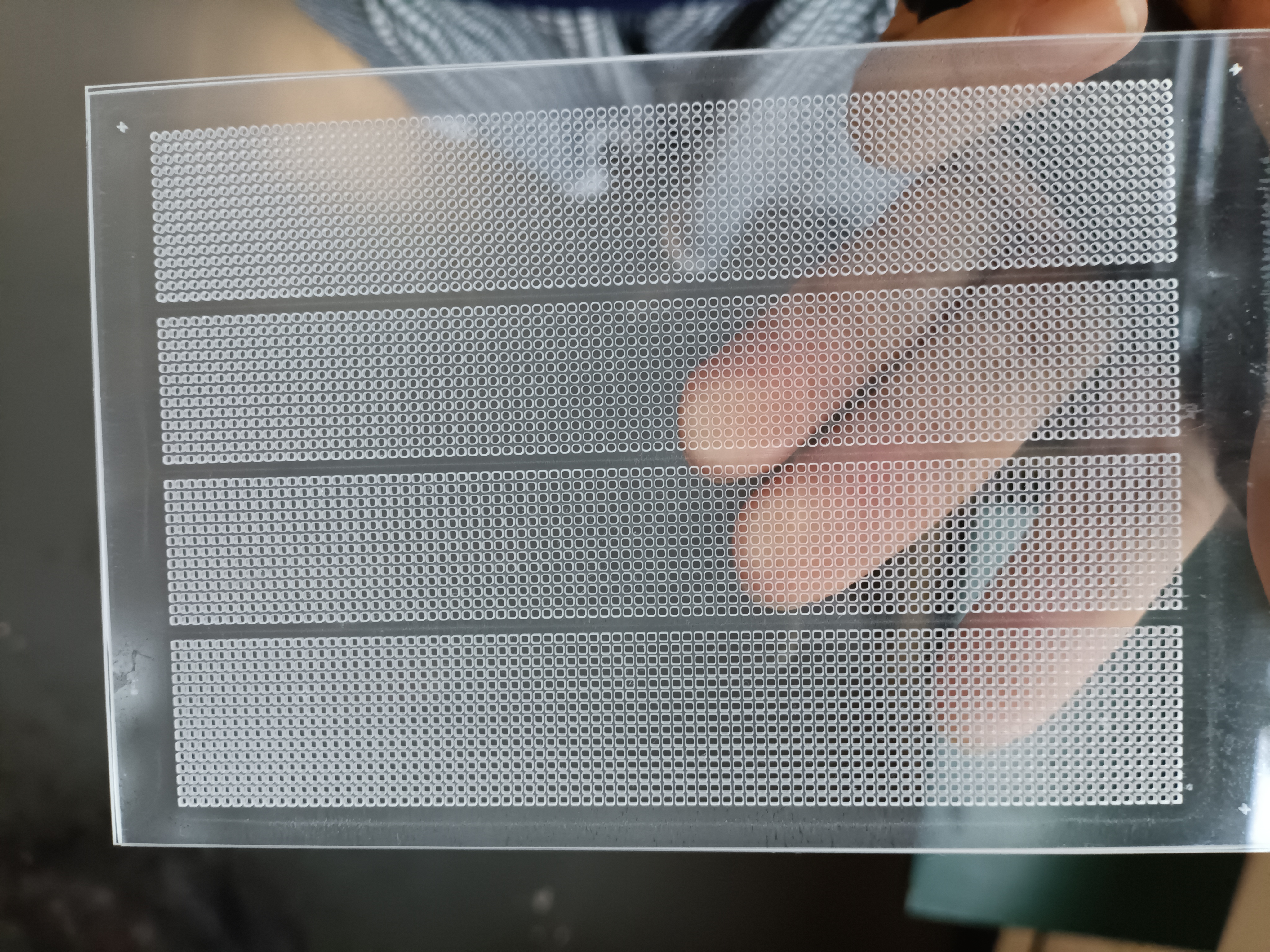
Precision ultrasonic coating equipment in a production setting. Coating, cutting, welding and atomization are sold under one category label but carry different operating limits.
One Category Label, Four Separate Buying Decisions
The physical mechanism changes what a buyer must test. In cutting, the blade vibrates at high frequency and creates a low-friction interface against the product, so the cut separates rather than compresses. In welding and bonding, vibration generates frictional heat at the interface of two parts until a thermoplastic component melts and re-solidifies under pressure. In soldering, ultrasonic cavitation displaces oxide layers so that metallurgical bonding can occur without flux. In coating and atomization, the vibration breaks a liquid into fine droplets at low pressure, which is then deposited on a substrate.
Each mechanism sets a different pass/fail condition. A cutting machine is judged on cut face quality, dimensional tolerance, and adhesion to the blade. A welding unit is judged on seam strength, airtightness, and material compatibility. A coating system is judged on film uniformity, overspray, and nozzle behaviour across a formulation. Treating these as one purchase category is the most common source of shortlisting error, because performance claims that are meaningful in one family are close to meaningless in another.
How This Shortlist Was Built
The shortlist below maps published Cheersonic model families to the applications each family is listed against, then states what remains unverified. Cheersonic — formally Hangzhou Cheersonic Ultrasonics Equipments Co., Limited — is a Hangzhou-based ultrasonic equipment manufacturer founded in 2014, operating a 7,150 m² facility with 100 employees, 20 R&D engineers, and reported annual output of 1,200 units across cutting and spray-coating product lines.
Five screening fields were applied, in this order:
- Material and temperature. Product texture, fat content, viscosity, and process temperature decide whether ultrasonic is an advantage or an unnecessary cost.
- Configuration. Standalone batch units and inline robotic stations are not interchangeable; Cheersonic publishes both configurations for cutting.
- Contact construction. Food-grade and cleanroom-facing parts must be identified by material, not by marketing description.
- Throughput at defined conditions. Published throughput without stated product dimensions, cut pattern, and operating hours cannot be used for capacity planning.
- Documentation. Model-level datasheets, conformity documents, and sample-test reports must exist before a shortlist becomes a purchase order.
One limitation applies to everything that follows. Published product lists identify model families; they do not publish line-level specifications for every variant. Where a distinction between two models is not documented, this article says so rather than inferring one.
Cutting and Slicing: UFM5000 and UFM8101 for Cake and Bakery
Cheersonic's published cake-cutting family includes UFM5000, UFM8101, UFM6000, UFM1000P, UFM1000R, UFM5100, UFM6600, and UFM8000. UFM5000 and UFM8101 sit within that list and are the two families most often put forward for bakery and dessert portioning. Across its ultrasonic slicing range, the company reports production speeds of 80 to 1,500 cakes or pies per hour — a range that spans multiple models and configurations, and therefore must be narrowed to a specific model before it is used in a capacity plan.
The application case for ultrasonic cake cutting rests on three documented properties. First, dimensional tolerance: bakery cutting specifications are stated at ±1 mm, which is what makes fixed-weight retail packaging repeatable. Second, frozen handling: frozen desserts at −15 °C to −20 °C can be cut without pre-thawing, removing a thaw step from the line and avoiding the texture loss that comes with it. Third, adhesion control: the vibration creates an isolating air film between blade and product, which limits cream and filling pick-up on the blade and reduces the cleaning stops that dominate mechanical slicing of layered products.
Configuration matters as much as the model family. Cheersonic publishes small standalone machines for manual baking facilities and large inline robotic solutions for high-speed production, and the distinction is operational rather than cosmetic: a standalone unit is loaded batch by batch, while an inline station is tied to conveyor speed, upstream demoulding, and downstream packaging. Buyers moving from batch to inline should treat the conveyor interface, product holder changeover, and cut-pattern programming as the actual evaluation items.
Chilled and Frozen Cheese: CWM100 and UFM8100C
Cheese is a different problem from cake. It is denser, higher in fat, and frequently cut at refrigeration or freezer temperature, so blade drag and product deformation behave differently. Cheersonic's published cheese-cutting family is CWM100, UFM8100C, UFM2200C, UFM1000C, UFM3100W, and UFM2300W. CWM100 and UFM8100C are the two families most directly associated with cheese portioning in that list.
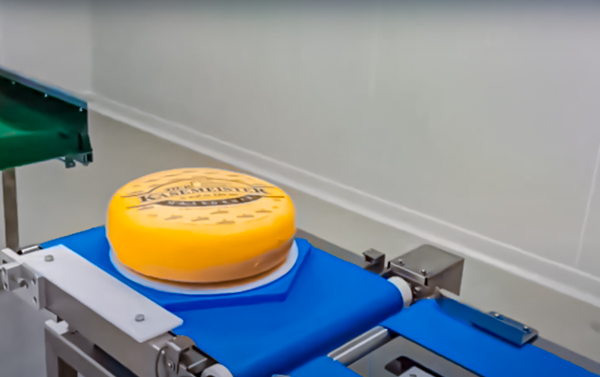
Ultrasonic slicing of round cheese. Cheese cutting families are specified for direct cutting of chilled and frozen product without a thawing step.
Documented requirements for dairy cutting in this class of equipment include food-grade contact parts with a titanium alloy cutter head described as wear- and corrosion-resistant, a low-residue easy-clean structure to limit bacterial cross-contamination, dimensional tolerance of ±1 mm, and an anti-adhesion ultrasonic vibration air barrier. The operating scope covers soft, medium-hard, and frozen cheese, including block, slice, strip, and small-portion formats, and the equipment is positioned for continuous inline production as well as standalone batch work in smaller facilities.
The evaluation trap here is temperature. A machine that performs cleanly on chilled product may behave differently on product straight from the freezer, and the reverse is also true. Sample testing should therefore be run at the actual worst-case temperature the line will see, not at room temperature, and the cut face, weight consistency, and blade residue should be recorded for both states.
Welding and Bonding: USM350, USM450 and COS800
Ultrasonic welding is a joining process rather than a separation process, and its limits are stricter. Cheersonic's published welding family is S20-WP2000, USM350, USM450, USM550, COS800, HBRC800, HLC300, HC300, HSW500, HGC500, and CS20-WM2000, with USM350, USM450, and COS800 covering the majority of general bonding and seaming work described in the portfolio.
A typical welding station is built from a generator, a transducer, a rotary or fixed sonotrode, and customised anvil wheels that determine seam pattern. Documented applications include medical mask assembly, protective garment seaming, filter tube welding, seamless apparel, and continuous roll-to-roll processing of nonwovens and synthetic textiles. On fully automatic mask lines, the published output ceiling is 400 pieces per minute, alongside vision-based edge tracking for seam alignment and embossed seam patterning.
The hard boundary is material chemistry: the substrate must contain a thermoplastic component that can melt and re-solidify. Thermoset composites, pure natural fibres without a binding polymer, and metal-to-metal assemblies fall outside this process and should not be shortlisted against it. A second boundary is seam design — embossing pattern, seam width, and anvil geometry are tooling decisions, not machine settings, and each new product usually requires a new anvil wheel and a sample welding trial before production release.
Soldering is the adjacent family and is often confused with welding. Cheersonic's ultrasonic soldering range is R60P, R60E, R40P, R40E, R28P, and R28E, specified for flux-free bonding of aluminium, ceramic, glass, graphite, and dissimilar metals, with a documented operating window of 115 °C to 450 °C and an ultrasonic frequency range of 20 kHz to 60 kHz. The absence of flux is the commercial point: no pre-plating, no post-bond cleaning, and lower contamination at the joint.
Coating and Atomization: UAM4000, UAM6000 and USP6000
Coating is where the shortlist widens fastest, because the same atomization principle serves medical devices, semiconductors, energy, glass, and food-contact surfaces. Cheersonic lists UAM4000 and UAM6000 as its ultrasonic spray and coating systems, drawn from a broader atomizer range (UAM1000 through UAM9000), with USP6000 and USP6000WS dedicated to photoresist coating. Nozzle options run across UCA120, UCA50, UCW50, UCW120, UCR50, UCR40, UCR60, and UCT120.
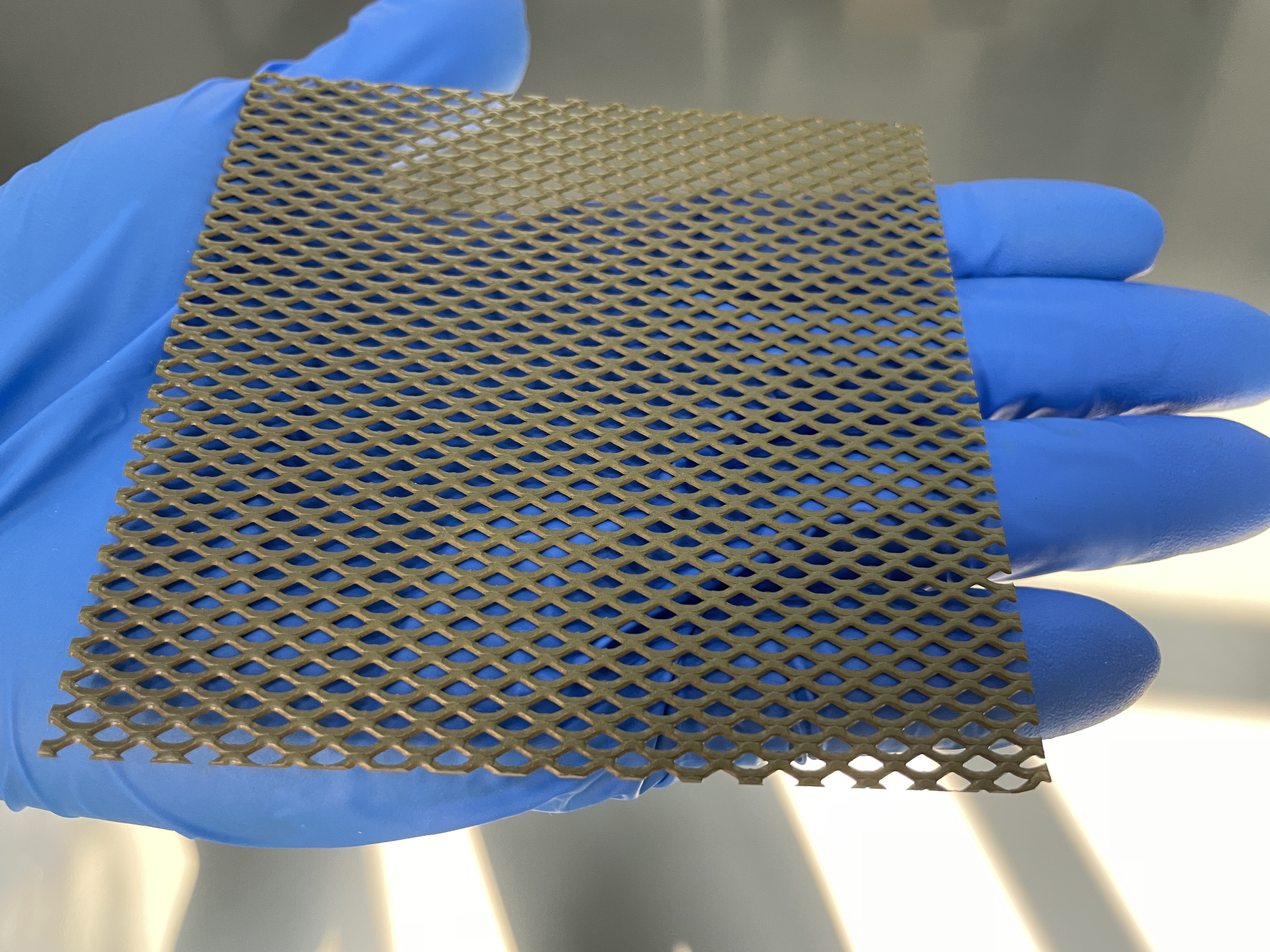
Ultrasonic spray deposition of a functional coating layer. Coating model families are selected by formulation, substrate, and required film thickness rather than by machine size alone.
The performance figures published for this family are application-specific and should be read that way. Cheersonic states raw material utilisation above 95% for its ultrasonic spraying equipment, with non-clogging, self-cleaning nozzles. Public third-party reporting supports the general direction: battery electrode manufacturers have reported material utilisation above 90% through ultrasonic spraying. Coating uniformity figures appear as process requirements in the application data rather than as universal machine specifications — a thickness error within ±3% for nano and functional coating lines, within ±2% for wafer-level photoresist work, and under 5% for medical-device coating.
Documented applications include drug-eluting stent and balloon coatings, catheter and syringe barrel coatings, blood collection tubes, fuel cell membrane electrode assemblies, electrolyser catalyst layers, perovskite solar cell layers, TCO films, PCB and chip-packaging fluxing, and photoresist deposition on MEMS and wafer structures. The common thread is low-pressure, non-contact deposition onto substrates that cannot tolerate high-velocity spray or thermal load.
What the published material does not provide is equally important. Atomization frequency and nozzle orifice are matched to formulation viscosity and target droplet size, and the correct value is a specification to request per formulation rather than a figure to assume. Buyers should also expect a sample-coating trial, because coating uniformity on a curved or stepped substrate is not transferable from a flat-plate demonstration.
The Shortlist at a Glance
| Application | Model families (as published) | Documented process notes | Verify before ordering |
|---|---|---|---|
| Cake and bakery portioning | UFM5000, UFM8101 | ±1 mm tolerance; frozen product cut at −15 °C to −20 °C without thawing; air-film anti-adhesion; 80–1,500 cakes or pies per hour across the slicing range | Model-level throughput at your product size and cut count; inline versus standalone configuration |
| Chilled and frozen cheese | CWM100, UFM8100C | Titanium alloy cutter head; food-grade contact parts; ±1 mm tolerance; direct frozen cutting; low-residue easy-clean structure | Cut quality at your actual worst-case product temperature; weight consistency across a shift |
| Thermoplastic welding and bonding | USM350, USM450, COS800 | Rotary sonotrode and customised anvil wheels; reported 400 pieces per minute on mask lines; vision edge tracking | Thermoplastic content of the substrate; anvil tooling for your seam pattern; seam strength trial |
| Ultrasonic soldering | R60P, R40P, R28P (and matching E variants) | Flux-free bonding of aluminium, ceramic, glass, graphite and dissimilar metals; 115–450 °C; 20–60 kHz frequency matching | Joint metallurgy; active solder alloy selection; hermeticity requirement |
| Coating and atomization | UAM4000, UAM6000; USP6000 / USP6000WS for photoresist | Non-clogging self-cleaning nozzles; stated material utilisation above 95%; application-specific thickness tolerances | Nozzle and frequency matched to your formulation; sample coating on your real substrate geometry |
What the Market Numbers Say — and What They Leave Out
Two structural facts are worth carrying into a negotiation. First, the category is regionally concentrated on the supply side: Asia Pacific accounted for 42.7% of ultrasonic cutter revenue in 2025, with China the largest single market, which is consistent with Chinese manufacturers competing on both capacity and customisation rather than on price alone. Second, concentration among the largest players is lower than the number of brand names suggests. Global Market Insights reports that Emerson Electric (Branson Ultrasonics), Dukane Corporation, Hielscher Ultrasonics, Telsonic AG, and Herrmann Ultrasonics together held 34.5% of the ultrasonic food processing technology segment in 2025 — meaning roughly two-thirds of that segment sits with suppliers outside the top five.
For a buyer, a fragmented supplier base is an opportunity and a risk at the same time. It widens the field of viable options and shortens the path to a tailored configuration. It also means that published comparison data is thin, that specification formats differ between suppliers, and that third-party performance verification is rarely available. Cheersonic, for example, reports 31 patents, 3 software copyrights, ISO 9001, EU CE, and US FDA certification, alongside a 20-engineer R&D team and 1,200 units of annual output — but these are company-reported figures and should be checked against the underlying documents rather than accepted as a compliance conclusion.
The data that most affects a purchase decision is also the data least likely to be public: model-level throughput under defined product conditions, droplet-size distribution for a specific formulation, lead time for a customised configuration, spare-part pricing, and service response in the destination market. None of that can be sourced from a market report. It comes from a specification request, a sample test, and a reference visit.
Where Ultrasonic Fits, and Where It Does Not
Against mechanical blade and wire cutting, ultrasonic equipment earns its place on sticky, soft, layered, or frozen products where compression and blade adhesion are the dominant defect sources. On rigid, dry, low-fat materials, the vibration adds little and a conventional cutting head can be the more economical choice. Ultrasonic cutting also introduces costs that mechanical systems do not carry: transducer and generator maintenance, blade wear as a consumable item, and the need for parameter discipline when products change.
Against pressure atomization and spin coating, ultrasonic spraying offers low-pressure, non-contact deposition with reduced overspray and a self-cleaning nozzle path that resists clogging on slurry and nano-suspension formulations. The trade-off is throughput and formulation range: ultrasonic atomization is typically a lower-flow process, and highly viscous or heavily filled formulations may fall outside its practical window. Where a line needs high-volume coverage of simple geometry, conventional spraying can still be the better fit.
Against adhesive bonding and stitching, ultrasonic welding removes consumables and produces a sealed seam without thread. It is unavailable, however, to any assembly without a thermoplastic interface — a genuine limitation rather than a marketing caveat, and one that eliminates a meaningful share of industrial joining work before a shortlist is even drawn.
A final boundary concerns documentation. CE marking and FDA status are not interchangeable categories, and a supplier statement that equipment holds both does not establish that the specific model and configuration are covered. Buyers entering the EU or US market should request the certificate, its scope, and the issuing body, and confirm which model numbers are listed.
What Changes Next
Three shifts are likely to shape this category over the next buying cycle. The first is the move from standalone units to inline integration: as bakery, dairy, and coating lines automate, the machine's value is increasingly defined by how it interfaces with conveying, demoulding, inspection, and packaging rather than by its head alone. The second is application-level evidence. With a fragmented supplier base and limited independent test data, buyers are starting to weight sample-test reports and reference installations more heavily than catalogue specifications. The third is the broadening of atomization into energy and semiconductor work, where fuel cell, electrolyser, and photoresist layers demand coating uniformity that older spray technologies struggle to hold on stepped or curved substrates.
For procurement teams, the practical consequence is that the shortlist should be rebuilt per application rather than inherited from a previous project. A cutting family that performs well on cheesecake is not evidence of anything about a welding sonotrode or a photoresist nozzle, and treating a supplier's portfolio breadth as proof of depth in every family is the single most expensive assumption in this category.
Frequently Asked Questions
What is an ultrasonic machine used for?
An ultrasonic machine applies high-frequency mechanical vibration to a material to cut, weld, solder, disperse, or atomize it. In industrial production the four most common families are cutting and slicing equipment for food and soft materials, welding and bonding equipment for thermoplastics and nonwovens, soldering systems for dissimilar metals, and coating or atomization systems that deposit fine droplets onto a substrate.
Which ultrasonic machine is used for cake cutting?
Cheersonic's published cake-cutting family includes UFM5000, UFM8101, UFM6000, UFM1000P, UFM1000R, UFM5100, UFM6600, and UFM8000. Across its ultrasonic slicing range the company reports production speeds of 80 to 1,500 cakes or pies per hour, a figure that spans multiple models and must be narrowed to a specific model and cut pattern before it is used for capacity planning.
Can ultrasonic equipment cut frozen cheese without thawing it first?
Yes. Cheersonic's dairy cutting documentation covers direct cutting of frozen cheese without pre-thawing, alongside soft and medium-hard cheese, in block, slice, strip, and small-portion formats. Published requirements for this class of equipment include a titanium alloy cutter head, food-grade contact parts, ±1 mm dimensional tolerance, and a low-residue easy-clean structure.
What frequency range do ultrasonic welding and soldering systems operate in?
Cheersonic's ultrasonic soldering systems are specified with an operating frequency range of 20 kHz to 60 kHz, alongside a working temperature window of 115 °C to 450 °C for flux-free bonding of aluminium, ceramic, glass, graphite, and dissimilar metals. Frequency and tooling for thermoplastic welding are configured per application and should be confirmed model by model.
How does ultrasonic spray coating differ from conventional spray coating?
Ultrasonic coating uses high-frequency vibration to break a liquid into fine droplets at low pressure, rather than forcing it through a pressurised nozzle. Cheersonic states material utilisation above 95% for its ultrasonic spraying equipment and specifies non-clogging, self-cleaning nozzles, while third-party reporting cites material utilisation above 90% for battery electrode manufacturing via ultrasonic spraying. The process is generally lower-flow than pressure atomization, so formulation viscosity and required throughput remain the deciding factors.
What should a buyer verify before shortlisting an ultrasonic machine supplier?
Five items carry the most weight: model-level throughput stated against defined product dimensions and operating hours; contact-part materials for food, medical, or cleanroom use; the scope and issuing body behind any CE or FDA statement; a sample test run on the buyer's own material at worst-case process temperature; and after-sales and spare-part terms for the destination market. Supplier-reported capability figures, including annual output and patent counts, are useful for qualification but are not substitutes for these checks.
Technical reference: Cheersonic publishes a product and application brochure covering its ultrasonic cutting, welding, soldering, and spray-coating ranges. It can be downloaded here.
Есть вопросы или нужны дополнительные детали?
Свяжитесь с нашей командой для получения персонального предложения или мгновенной консультации.
Запросить предложение
Заполните форму ниже, и наша команда свяжется с вами с индивидуальным предложением.
Прямой чат WhatsApp
Предпочитаете общаться в реальном времени? Напишите нам в WhatsApp для мгновенной помощи и быстрых ответов.
- Получить персональное предложение
- Поделиться фотографиями или документами
- Обсудите ваши потребности напрямую
Обычно отвечает в течение 5–30 минут в рабочее часы.