
Ultrasonic Machine Specs Explained: IP65, Voltage, Washdown
Ultrasonic Machine Specs Explained: IP65, Voltage, Washdown
A compliance specification on an ultrasonic machine is a constraint list before it is a feature list. IP65 defines what a cleaning regime is permitted to do to the enclosure. A 208–240 V, 50/60 Hz, 15 A rating defines the electrical environment the machine expects and the circuit that must be waiting for it. Food-grade washdown construction defines whether the surfaces that touch product can be cleaned to the standard an auditor applies. Stainless steel and titanium alloy define which parts carry documentary evidence, and which carry only a description.
Read as a group, these four items answer one procurement question: which figures in a quotation have actually been documented for the model being quoted, and which exist only as a sentence in a brochure? This article treats evidence in three levels. Documented means a certificate, test report or project record in Cheersonic’s published material. Declared means a datasheet value without an attached document. Assumed means what the buyer expects the number to mean. Where the published material does not state a value, this article says so and specifies what to request.
Why These Constraints, Not Features, Decide the Fit
An ultrasonic cutting machine, spray system or soldering unit is usually selected on process output — cut quality, coating uniformity, joint strength. The installation decision is made on something else. A food plant that cannot hose down an enclosure will clean around it, and residue builds in the places cleaning cannot reach. A line wired for 208 V three-phase commercial supply will not tolerate a machine designed only for a 230 V nominal feed. A dairy auditor who asks for the material report on a product-contact blade is not asking about the alloy’s marketing name.
Hangzhou Cheersonic Ultrasonics Equipments Co., Limited (Cheersonic) is a Hangzhou-based ultrasonic equipment manufacturer founded in 2014, working across ultrasonic cutting and ultrasonic spraying for baking, dairy, medical, electronics and energy applications. Its portfolio spans those two families plus welding, soldering and liquid processing, which makes it a useful reference case: the same supplier publishes different levels of specification detail across different product families, and the gaps are as instructive as the figures.
Each constraint below is presented the same way: what the figure governs, what the published record supports, and what a buyer should obtain before signing.
IP65 Is a Cleaning Envelope, Not Permission to Wash Freely
IP65 is a two-digit ingress protection code. The first digit, 6, means dust-tight: no dust ingress under the defined test conditions. The second digit, 5, means protection against water jets projected by a nozzle from any direction, at the defined test pressure and duration. It is not protection against immersion (that is the 7 and 8 second digits), and it is not the high-pressure, high-temperature washdown category associated with IP69K. It also says nothing about chemical resistance, surface roughness, or whether cleaning fluid can reach a hidden crevice.
In Cheersonic’s published project record, IP65 appears as a specified requirement in one food application rather than as a portfolio-wide claim. A seafood deep-processing enterprise in Poland running five units for frozen and semi-frozen mackerel and herring lists IP65 waterproofing and corrosion resistance alongside programmable cutting, vibration self-cleaning, anti-sticking performance and EU food-safety compliance. That is a project-level configuration record. It demonstrates that the rating has been engineered into at least one deployed food line; it does not establish that every cutting model ships at IP65, and the available material does not present it that way.
The practical consequence is that IP65 should be read as the boundary of a cleaning method. If the sanitation protocol specifies a low-pressure rinse with a defined detergent at a defined temperature, an IP65 enclosure rated for jets is plausibly compatible and should be confirmed against the enclosure test report. If the protocol specifies a high-pressure jet or a caustic foam cycle, the second digit and the seal materials — not the first digit — become the governing variables.
Three verification steps separate a stated rating from a usable one. First, ask for the rating per model, not per catalogue. Second, ask which components are inside the tested enclosure boundary: cable glands, connectors, the HMI panel, the control cabinet and the actuator housing are frequently the weakest points and occasionally sit outside the tested assembly. Third, map the rating against the actual cleaning procedure, including chemistry, contact time and temperature, because the IP code covers water ingress and not detergent attack.
The 208–240 V, 50/60 Hz, 15 A Line: Reading It as an Installation Envelope
This three-part rating describes the supply the machine expects, and each part governs a different decision. The voltage range defines tolerance: a machine marked 208–240 V is intended to run at the bottom of that window on a 208 V commercial supply and at the top on a 240 V supply, without re-tapping or a step transformer. The frequency pair, 50/60 Hz, defines dual-market usability and matters most to exporters and distributors who resell across regions rather than install in one. The 15 A figure defines the branch circuit: breaker size, cable cross-section, plug and connector type, and the isolation arrangement at the wall.
The 15 A figure is the one most often misread. It is a connection rating for the supply circuit, not the ultrasonic output power of the machine, and not the power delivered to the blade or the nozzle. A 15 A branch rating sets the ceiling of what the circuit can deliver; the machine’s own draw is normally lower and must be read from the nameplate on the specific unit. As plain arithmetic on the stated figures only — not a measurement — a 15 A circuit at 208 V implies a ceiling of 3,120 VA, and at 240 V a ceiling of 3,600 VA. Those numbers are circuit headroom. They tell an electrical planner what the wall must provide; they say nothing about how much ultrasonic energy reaches the tool.
This is also where the constraint connects to certification rather than to sales copy. Cheersonic’s published CE attestations cite the EU Low Voltage Directive 2014/35/EU alongside EN 60204-1:2018 (with amendment A1:2025) — the standard for electrical equipment of machines — and the EMC Directive 2014/30/EU with EN IEC 61000-6-2:2019 and EN IEC 61000-6-4:2019. A voltage, frequency and current declaration is exactly the class of information those documents govern. An auditor reading a certificate scope is checking whether the electrical design basis has been assessed, not whether the number looks convenient.
Documented-versus-declared gap: the Cheersonic material supplied for this article lists certificate scopes, standards and validity periods, but it does not publish a per-model nameplate voltage, frequency and current string, and therefore does not publish the 208–240 V / 15 A figure against a named machine. Buyers comparing quotations should request a photograph of the nameplate and the electrical schematic page for the exact model, then confirm the figures against the certificate that names that model.
Model-Scoped Certification: The Table to Read Before the Brochure
Certification is where buyers most often assume instead of verify. A CE attestation covers the models listed in its scope string. If the machine in a quotation does not appear in that string, the certificate — however valid — does not cover it, and the buyer needs either a scope extension or a separate declaration. The published Cheersonic certification set, as supplied, reads as follows.
| Certificate | Scope and standards (as published) | Validity |
|---|---|---|
| CE — ultrasonic food cutting machine No. TTC-22-2802/10/02 INTEGRA96 | Models HFM3000, UFM4000, UFM5000L, UFM6000, UFM6000L, UFM1000P, UFM700P, UFM3500, UFM8000. Directives 2006/42/EC (Machinery) and 2014/35/EU (Low Voltage); standards EN ISO 12100:2010 and EN 60204-1:2018. | Issued 2022-02-28 Expires 2027-02-27 |
| CE — ultrasonic spraying machine No. TRCN-26118HCU02 INTERTURK | Models UAM1000, UAM2000, UMC3000, UAM4000, UAM6000, UMC7100, UAM8000, UAM9000, UAC50, UAC120. Directives 2006/42/EC, 2014/35/EU, 2014/30/EU (EMC); standards EN ISO 12100:2010, EN 60204-1:2018/A1:2025, EN 61010-1:2010/A1:2019/AC:2019, EN IEC 61000-6-2:2019. | Issued 2026-04-28 Expires 2031-04-27 |
| CE — ultrasonic liquid processing equipment No. TRCN-26064HCU01 INTERTURK | Models Prosonic2000, Prosonic1000, Prosonic3000, LULP500, LULP750, IUIP1000, IUIP2000, IUIP2500, IUIP3000, IUIP5000. Directives 2006/42/EC, 2014/35/EU, 2014/30/EU; standards EN ISO 12100:2010, EN 60204-1:2018+A1:2025, EN IEC 61000-6-2:2019, EN IEC 61000-6-4:2019. | Issued 2026-03-05 Expires 2031-03-04 |
| CE — ultrasonic sewing/cutting machine No. TRCN-26118HCU01 INTERTURK | Models USM350S, USM450, USM550, COS500, HC300, HGC500, HLC300, HSC500, HSW500, KZJ. Directives 2006/42/EC and 2014/30/EU; standards EN ISO 12100:2010, EN 60204-1:2018/A1:2025, EN IEC 61000-6-2:2019, EN IEC 61000-6-4:2019. | Issued 2026-04-28 Expires 2031-04-27 |
| ISO 9001 quality management system No. 17325Q21416R2S Beijing Zhongjiaoyuanhang Certification | Production of ultrasonic cutting, spraying and liquid handling equipment; research and production of ultrasonic piezoelectric transducers. Standard GB/T 19001-2016 / ISO 9001:2015. | Issued 2019-12-26 Expires 2028-12-25 |
Certificate data as published by Cheersonic. Scope strings define which models are covered; a model outside the string is outside the certificate.
Two reading rules follow. The first is that scope gaps are normal and manageable: a supplier with four separate attestations across different product families is more legible than one that claims a single certificate for an entire catalogue, because the buyer can see precisely where each document stops. The second is that the food-cutting attestation expires in February 2027, while the spraying and sewing attestations run to 2031. Any buyer placing a long-life order on a food cutting line should confirm whether a renewal is in progress rather than assume continuity, and should record the certificate number in the purchase documentation so that a later audit can match the delivered machine to the assessed configuration.
Food-Grade Washdown: Three Documents, Not One Adjective
“Food-grade” is not a single certificate, and treating it as one is the most common compliance error in this equipment category. In practice, a defensible food-grade washdown claim assembles from three independent pieces of evidence, and a buyer should be able to produce all three on request.
1. Material evidence for product-contact parts
Cheersonic’s published record includes an SGS-CSTC test report (Ningbo branch, report NGBHG1805981901, issued 2018-11-23) for a titanium alloy blade against FDA Compliance Policy Guides Sec. 545.500, CPG 7117.05, and a separate SGS Xiamen report (XMAFF170601257E-2, issued 2017-06-30) for TPU conveyor belting against FDA 21 CFR 177.2600. Both are material-level reports. The blade report covers the blade; it does not cover the machine, the frame or the drive.
2. Construction and cleanability
In a documented Irish dairy installation for precision wedge cutting of wheel cheese, the published configuration describes a food-grade 304 stainless steel body, detachable for cleaning and aligned with dairy hygiene production standards. In a Russian pie and filled-pastry line running automated equal cutting, the record again cites food-grade stainless steel with easy cleaning as a specified requirement. The dairy application material adds a design intent that matters more than any single material callout: low-residue, easy-clean structure intended to avoid bacterial cross-contamination, paired with an anti-adhesion ultrasonic vibration design so that product does not build up on the cutting face and force frequent shutdowns.
3. Ingress protection matched to the cleaning method
The IP65 seafood application described earlier is the third leg. Without it, stainless steel and titanium describe materials that can be cleaned but not the enclosure that survives cleaning. With it, the three elements form a chain: compliant contact materials, geometry that can be reached and cleaned, and an enclosure rating that tolerates the water used to do it.
What the published material does not contain is an IP69K rating or a high-pressure jet classification for any model, and no machine-level food-contact certification beyond the material reports cited. Buyers whose sanitation protocol mandates high-pressure washdown should state that requirement in the RFQ rather than infer it from the stainless steel description, and should ask for the specific second-digit rating and the seal specification that supports it.

Fixed-weight cheese portioning: in this application segment the washdown requirement, the 304 stainless body and the titanium cutter head are specified together, not separately.
Stainless Steel and Titanium Alloy: Match the Document to the Part
Material naming is where specification language drifts furthest from evidence. “Stainless steel” on a datasheet may describe the frame, the hood or the product-contact chute, and each carries a different compliance implication. The same applies to titanium.
Cheersonic’s published documentation is consistent on the division of labour. Titanium alloy appears where the part cuts or contacts product directly: the FDA test report is scoped to a titanium alloy blade, and the dairy application material specifies a titanium alloy cutter head described as wear-resistant and corrosion-resistant among food-grade contact parts. Stainless steel, specifically grade 304, appears as the body and structural material in the cheese application, where detachable cleaning is part of the hygiene design. Neither material claim substitutes for the other. A 304 stainless body is not a food-contact certification, and a titanium blade report is not evidence about the frame.
For a buyer, the operative question is narrow and answerable: for each product-contact surface, which alloy, which test report, which standard, and which report number? A supplier who can answer at that granularity has done the documentation work. A supplier who answers “food-grade stainless and titanium” has given a description, and the auditor will eventually ask for the report.
Frequency and Power Across Cutting, Atomization and Soldering
Frequency and power are the two parameters that link a compliance sheet to a production line, and they are the two most unevenly published across the ultrasonic families. The table below separates what Cheersonic’s supplied material documents for each family from what a buyer still has to request. It is deliberately not uniform: the point of reading specifications carefully is to notice that different families are specified in different units.
| Family | Documented in the supplied material | Not published — request in writing |
|---|---|---|
| Ultrasonic cutting (cake, cheese, confectionery, frozen product) | Cut tolerance of ±1 mm across documented bakery, dairy and confectionery applications; slicing throughput of 80 to 1,500 cakes or pies per hour across the model range; direct cutting of frozen product at −15 °C to −20 °C without pre-thawing; food-grade 304 stainless body with detachable cleaning and titanium alloy cutter head in the dairy configuration; FDA test report on the titanium alloy blade. | Transducer frequency band per model; generator output power; IP rating per model; blade amplitude and its effect on throughput at your product temperature. |
| Ultrasonic atomization and spray coating | Droplet size of 5–30 μm with flux film of 1–8 μm and tolerance ≤0.8 μm in a PCB fluxing application; material utilisation above 90% in that project and above 95% in the company profile; wafer film-thickness error within ±2% and coating range from 50 nm to 30 μm; photoresist coating thickness adjustable from 10 nm to 100 μm; medical coating thickness error below 5%; nano-coating thickness variation within ±3%. | Nozzle operating frequency per model; generator power; the flow-rate window at which the stated droplet size is maintained; nozzle-to-substrate distance tolerance. |
| Ultrasonic soldering | 20–60 kHz ultrasonic frequency matching with a process temperature window of 115–450 °C; flux-free and lead-free operation without pre-plating; a semiconductor application reporting joint shear strength above 5,000 psi with no flux residue. | Generator power per model; duty cycle; whether the published frequency band applies to each of the R-series models individually. |
Two conclusions follow, and both are useful at the evaluation stage. First, soldering is the only family in the supplied material that publishes a frequency band. Cutting publishes geometric and thermal performance — tolerance, throughput, frozen-product capability — while spray publishes droplet and film metrics. That is not an omission unique to this supplier; it reflects what each market asks for. But it means a buyer cannot compare a cutting machine and a spray system on “frequency” as if the figure meant the same thing in both, and it means a cutting specification without a stated frequency cannot be modelled against an existing line’s tooling.
Second, generator output power is not published in watts for any family in the supplied material. This is the single most consequential gap for a compliance-driven purchase, because power determines duty cycle, and duty cycle determines whether a machine rated for intermittent batch work can survive two shifts. The request is straightforward: generator output, transducer rating, and the resulting duty cycle for the intended product and throughput, supplied in writing and cross-checked against the 15 A branch envelope on the nameplate.
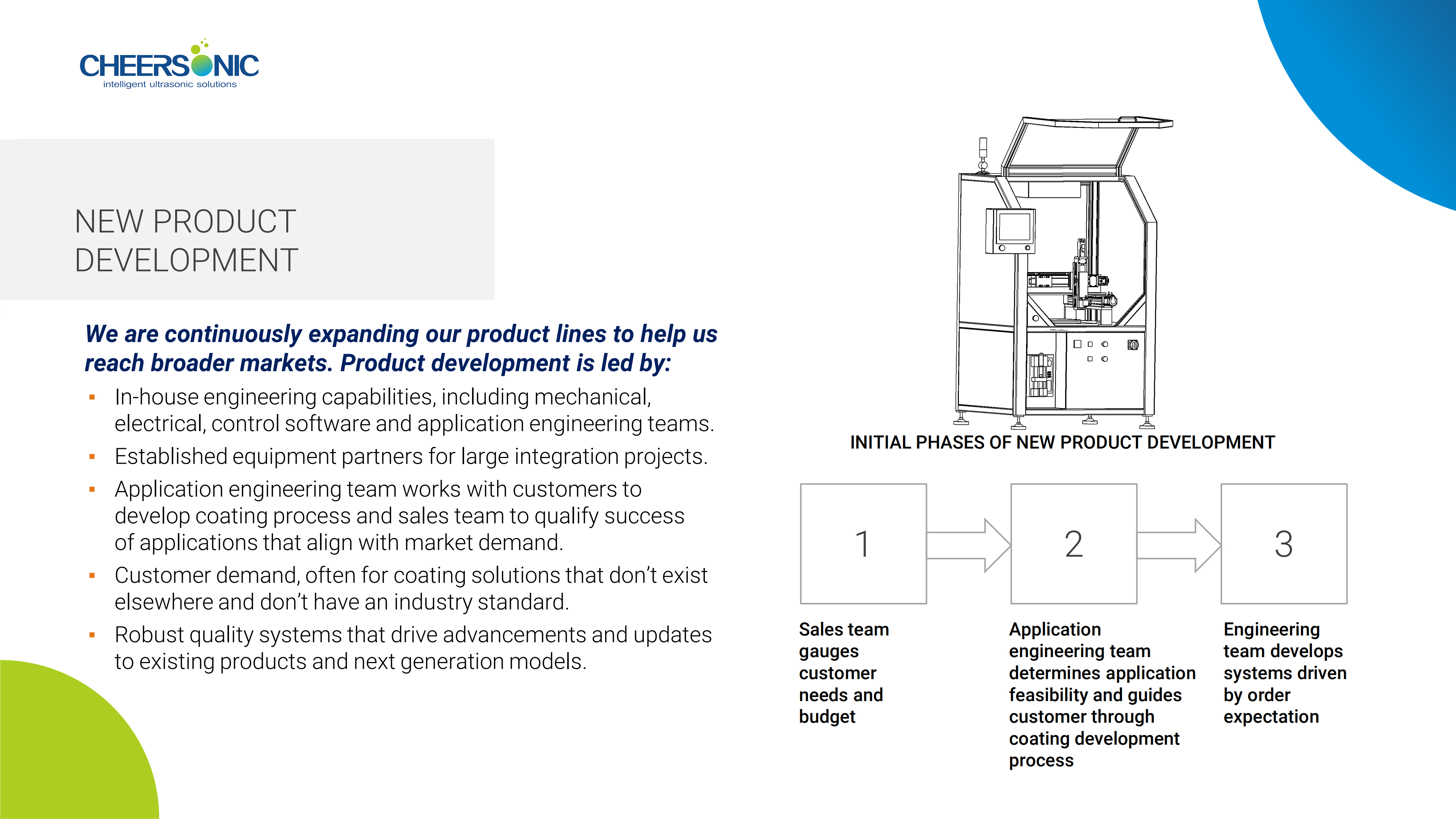
Tracing a specification to a build stage: the value of a documented process flow is that each declared figure can be attached to the stage where it is verified.
Matching the Envelope to the Room: Application Fit
The constraints only become decision criteria when they meet a specific production environment. Six configurations illustrate how the same specification groups resolve differently.
Frozen seafood and high-moisture protein. The Polish mackerel and herring line combines IP65 waterproofing and corrosion resistance with non-destructive cutting and vibration self-cleaning. Here the ingress rating and the corrosion requirement travel together, because a wet, salty environment attacks enclosures and cut faces at the same time.
Dairy and cheese. The Irish wheel-cheese configuration ties 304 stainless construction and a titanium cutter head to detachable cleaning and dairy hygiene standards, with an integrated weighing and cutting approach that reports weight error within ±1 g on the weighing system. In this segment the washdown structure and the portioning accuracy are the same purchase decision: cleaning downtime and giveaway both show up in the cost per kilogram.
Bakery and frozen dessert. A British sandwich and layer cake line reports fully unmanned cutting integration, a 99% product qualification rate and a 2.4-fold increase in per-shift cutting capacity after connecting ultrasonic cutting to an existing automated line. The relevant specification is not the enclosure but the tolerance and the frozen range: ±1 mm and direct cutting at −15 °C to −20 °C are what allow the line to skip a thawing stage.
Electronics fluxing. The reference case for spray specification is a PCB pre-soldering flux line reporting droplets of 5–30 μm, film of 1–8 μm with tolerance ≤0.8 μm, flux utilisation above 90% and a 90% reduction in nozzle-blockage stoppages. The constraint that matters is low-pressure atomisation that does not bend thin boards or displace miniature components — a mechanical constraint expressed through spray parameters.
Medical device coating. Coating work on stents, balloons and catheters is documented against Class 100/1000 cleanroom and GMP-class environments, with thickness error below 5% and low-temperature atomisation to protect biological drug activity. Here the governing constraint is the cleanroom classification and the temperature ceiling, not the ingress rating.
Flux-free soldering. Aluminium, ceramic and dissimilar-metal joining at 115–450 °C with a 20–60 kHz band removes the flux and the pre-plating steps, which changes the downstream cleaning process rather than the machine footprint. The specification to verify is the temperature window and the frequency match, not the enclosure.
A Constraint Verification Checklist for the RFQ
The following list converts the discussion above into requests that can be pasted into a procurement document. Each item produces a document rather than an assurance.
- Nameplate photograph for the exact model, showing voltage, frequency and current. Confirm the 208–240 V and 50/60 Hz window against your actual supply, and confirm the 15 A figure against your planned breaker and connector.
- IP rating per model, with the test basis identified as third-party report or manufacturer declaration, and with the enclosure boundary defined: glands, connectors, HMI and control cabinet included or excluded.
- Certificate copy with your model visible in the scope string. Record the certificate number, issuing body, standards and expiry in the purchase file.
- Material test reports naming the alloy and the standard for each product-contact part, and a statement of which parts are not covered by those reports.
- Cleaning procedure cross-check. Detergent chemistry, contact time, temperature and jet pressure, compared against the enclosure rating and the seal specification.
- Transducer frequency and generator output power at the tool, plus the duty cycle for your product and throughput.
- Construction and hygiene detail: grade of stainless, detachable parts list, surface finish where product contact occurs, and the anti-stick or self-cleaning mechanism if one is claimed.
- Delivery and support terms: Cheersonic’s published lead time is 7–15 days for standard models and 30–45 days for customised models, with remote online technical support, overseas engineer on-site service and spare-parts supply.
Where the Specification Stops
A well-read specification is also a list of what remains unproven, and a credible supplier will agree with the boundaries rather than argue them.
An ingress rating does not validate a sanitation programme. IP65 describes water jets under defined test conditions; your auditor validates cleaning effectiveness on your line, with your detergent and your dwell times, and no supplier document substitutes for that verification. Material reports cover the parts they name and no more: the titanium blade report is not a machine-level food-contact certification. Certificate scopes are finite — a model outside the scope string is outside the certificate, and the food-cutting attestation in this set runs to February 2027, so renewal status should be confirmed for long-life orders. Frequency and generator power are not published for every family in the supplied material, so a quotation that omits them cannot be compared on duty cycle. And no performance figure quoted from another customer’s installation transfers automatically to a different product, temperature or throughput.
Outlook: Documentation Becomes the Comparison Ground
As food safety and electrical conformity audits become more document-driven, the practical difference between ultrasonic machine suppliers is shifting from the specification headline to the specification trail. A buyer who can attach a certificate number, a report number and a nameplate photograph to each claim has a defensible installation; a buyer who cannot has a brochure.
The conditional implication for suppliers is straightforward, if not easy: product families that publish frequency, generator power and per-model ingress ratings will be easier to specify into a line than families that publish only outcome metrics. The same logic applies to certificate currency. On the evidence available here, a supplier with model-scoped attestations across four product families and a material-level FDA report on the actual cutting blade is already operating at that documentary level; the remaining gains lie in filling the parameter gaps rather than in adding adjectives.
FAQ
Does an IP65 rating mean an ultrasonic machine can be washed down with a hose?
IP65 means dust-tight construction plus protection against water jets under defined test conditions. It supports cleaning with a directed jet at the tested pressure and duration, but it does not cover immersion, high-pressure or high-temperature washdown, or resistance to a specific detergent. Confirm the rating per model, check whether glands, connectors and the control cabinet sit inside the tested enclosure boundary, and match the figure against your actual cleaning procedure.
What does a 208–240 V, 50/60 Hz, 15 A rating actually specify?
It specifies the electrical environment, not the process output. The voltage range defines the supply tolerance the machine is built for, the frequency pair defines dual-market usability, and the 15 A figure sizes the branch circuit, breaker, cable and connector. It is a connection rating, not ultrasonic output power; at 208 V a 15 A circuit implies a 3,120 VA ceiling and at 240 V a 3,600 VA ceiling, which is circuit headroom rather than machine consumption. Cheersonic’s supplied material does not publish this string per model, so the nameplate and schematic should be requested for the exact unit.
Is food-grade construction the same as FDA compliance?
No. FDA compliance is demonstrated by a specific test report on a specific material against a named standard — for example the titanium alloy blade report referenced to CPG 7117.05, or a TPU belt report against 21 CFR 177.2600. Food-grade construction is a broader design claim covering contact materials, cleanable geometry and, where applicable, an enclosure rating. A defensible purchase file contains all three elements separately.
Which Cheersonic models are covered by the published CE certificates?
Coverage is listed per certificate. The food cutting attestation covers HFM3000, UFM4000, UFM5000L, UFM6000, UFM6000L, UFM1000P, UFM700P, UFM3500 and UFM8000 and runs to 2027-02-27. The spraying attestation covers UAM1000, UAM2000, UMC3000, UAM4000, UAM6000, UMC7100, UAM8000, UAM9000, UAC50 and UAC120 to 2031-04-27. Liquid processing covers the Prosonic and LULP/IUIP series to 2031-03-04, and sewing/cutting covers the USM, COS, HC, HGC, HLC, HSC, HSW and KZJ models to 2031-04-27. A model outside these strings requires a separate declaration.
Why is ultrasonic frequency published for soldering but not for every cutting or spray model?
Because each market specifies performance in different units. Soldering specifications cite a 20–60 kHz frequency band alongside a 115–450 °C process window, while cutting is specified by cut tolerance and throughput — ±1 mm and 80 to 1,500 cakes or pies per hour — and spray by droplet size and film thickness, such as 5–30 μm droplets or a ±2% wafer thickness error. Frequency still governs blade amplitude and atomisation behaviour, so it should be requested in writing for any model where the quotation omits it.
Documentation and Further Reading
The specification framework in this article follows the certificate scopes, material test reports and application records published by Cheersonic. Buyers compiling an RFQ can download the full company and product brochure here: Cheersonic product brochure (PDF).
Есть вопросы или нужны дополнительные детали?
Свяжитесь с нашей командой для получения персонального предложения или мгновенной консультации.
Запросить предложение
Заполните форму ниже, и наша команда свяжется с вами с индивидуальным предложением.
Прямой чат WhatsApp
Предпочитаете общаться в реальном времени? Напишите нам в WhatsApp для мгновенной помощи и быстрых ответов.
- Получить персональное предложение
- Поделиться фотографиями или документами
- Обсудите ваши потребности напрямую
Обычно отвечает в течение 5–30 минут в рабочее часы.