
Ultrasonic Machines for Smart Manufacturing: Cheersonic's Leading Edge

The need for higher precision, lower material waste, and contamination-free processing is reshaping industrial manufacturing. For sectors ranging from bakery to semiconductor, ultrasonic technology offers a path to cleaner cuts, more uniform coatings, and fully automated production lines. Hangzhou Cheersonic Ultrasonics Equipments Co., Limited, a high-tech enterprise founded in 2014 in Hangzhou, China, has built a product portfolio that addresses these demands through ultrasonic cutting, slicing, and spraying systems certified to international standards.
Problem & Opportunity
Traditional mechanical cutting and pneumatic spraying present persistent challenges: sticky product adhesion, high raw material loss, inconsistent coating thickness, and frequent nozzle clogging. For food manufacturers, these issues lead to product deformation and increased scrap. In medical and energy industries, coating uniformity is critical to device performance and safety. The global ultrasonic spray systems market, valued at USD 0.5 billion in 2024, is projected to reach USD 1.2 billion by 2034, reflecting a growing shift toward non-contact, high-efficiency processes. Cheersonic addresses these pain points with a range of ultrasonic machines designed for both gentle handling and high throughput.
Brand Solution
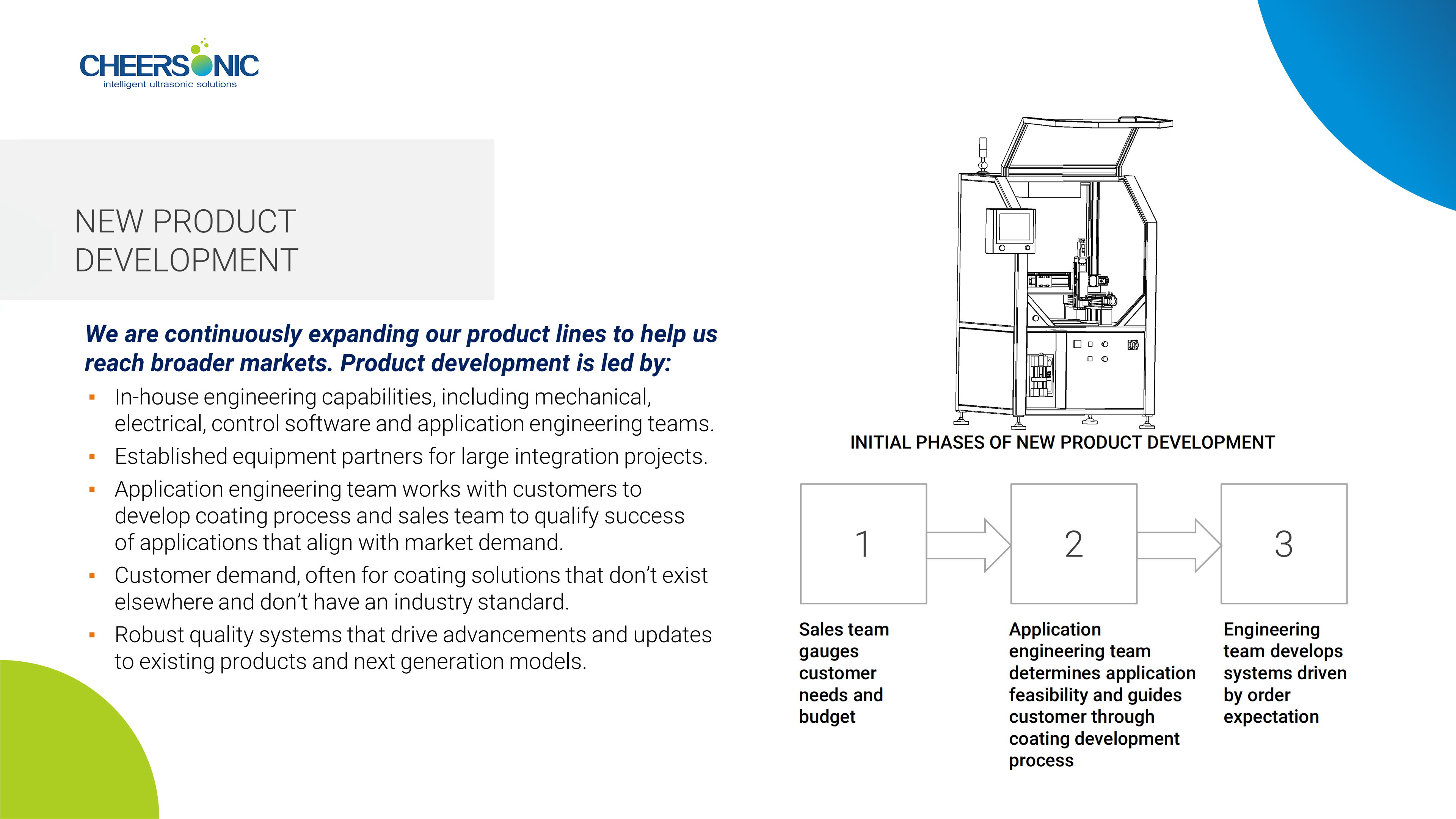
Cheersonic manufactures ultrasonic cutting machines (model series UFM, HFM) and ultrasonic coating systems (model series UAM, USP). Its ultrasonic food cutting machines operate at 20 kHz, with outputs from 50 to 1,500 pieces per hour, cutting widths up to 600 mm, and IP65 washdown protection. The spraying systems operate at 25–180 kHz, delivering droplet sizes of 18–200 μm and film thicknesses from 20 nm to 100 μm, with non-clogging atomization and raw material utilization exceeding 95%. All core products carry ISO 9001:2015 certification, EU CE marks (compliant with EN ISO 12100, EN 60204-1, EN IEC 61000), and FDA test reports for food-contact blades and conveyor belts.
Technical Explanation
Ultrasonic cutting uses a titanium blade vibrating at 20 kHz to create micro‑vibrations that separate product with minimal friction. This prevents sticking, preserves layered structures, and eliminates the need for lubricants. Ultrasonic spraying relies on high‑frequency vibration of a piezoelectric transducer to atomize liquids into fine, uniformly sized droplets without high‑pressure air. The gentle, low‑velocity mist lands precisely on substrates, enabling ultra‑thin, pinhole‑free coatings with high transfer efficiency. Parameters such as frequency (25–180 kHz), flow rate (0.001–50 mL/min), and amplitude are programmable, allowing repeatable, digitised process control.
Application Scenarios
Food & Confectionery
A confectionery manufacturer in the United States deployed an automated inline cutting system for chocolate bars and rock‑road products. The machine integrated with existing forming and cooling lines, achieving a 65% increase in hourly capacity and a 40% labor cost reduction. In Poland, a seafood processor installed five units for frozen mackerel and herring, raising production capacity by 160% and cutting raw material loss by 40%. The IP65‑rated, corrosion‑resistant design allowed continuous operation in wet environments.
Bakery & Dairy
A UK‑based bakery adopted an ultrasonic cake cutting machine for sponge, mousse, and layered cakes on a fully automated line. The system eliminated three operator positions, lifted product qualification rates to 99%, and reduced raw material loss by 32%. In Ireland, a dairy processor uses four cheese cutting units with AI‑optimized cutting schemes for wheel cheese, achieving over 70% reduction in edge waste and a 70% cut in changeover time.
Medical Device Coating
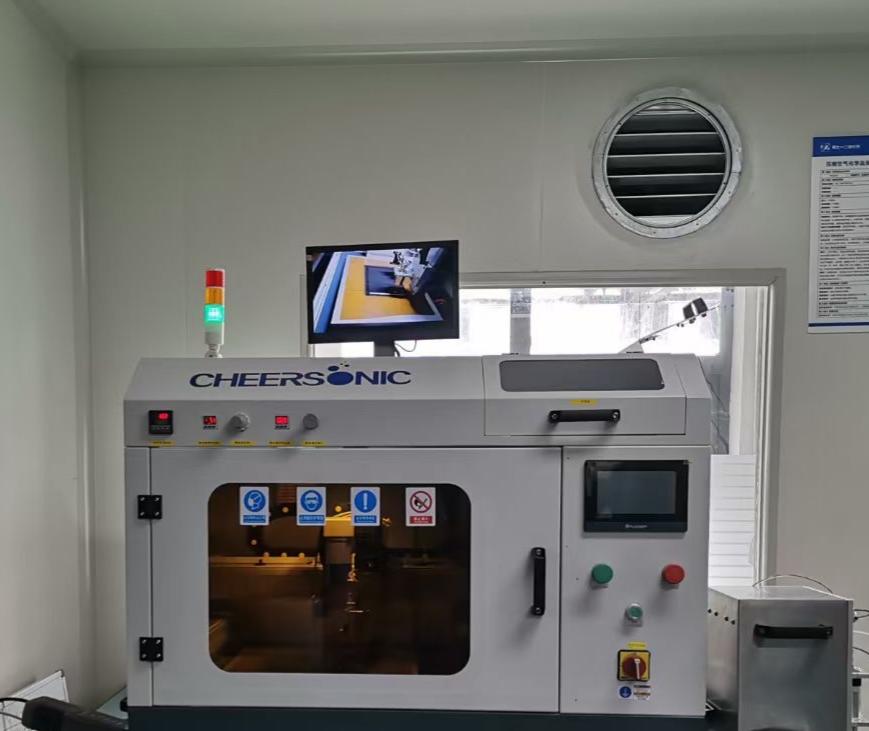
A medical device manufacturer in Canada runs five ultrasonic coating units for mass‑producing drug‑eluting stents and balloon catheters. The system uses low‑temperature, pressureless atomization that preserves drug bioactivity and avoids stent‑bridge deformation. The yield rate rose from 82% to 98.5%, while precious material consumption dropped by 37%. A US‑based R&D pilot facility uses three units for drug‑coating development, achieving 60% less pharmaceutical raw material loss and passing third‑party coating tests.
Energy & Semiconductor
A German industrial engineering firm operates ten CCM catalytic‑layer spraying units for PEM and AEM electrolyzers. Dual‑sided synchronous spraying, combined with ultrasonic soft atomization, raised CCM yield to 98.5% and reduced precious‑metal consumption by 45–55%. In South Korea, two MEMS photoresist coating systems slashed deep‑trench lithography defects by 70% and photoresist usage by 55%. The conformal coverage on 3D structures eliminated bridge‑related scrap, boosting chip yield by over 12%.
Market Trend Analysis
The ultrasonic cutters market was valued at USD 2.8 billion in 2025, with a projected CAGR of 7.2% through 2033. Expansion is driven by demand for hygienic, waste‑reducing processes in food, medical, and electronics manufacturing. Asia Pacific accounted for 25–38% of global ultrasonic revenue across sub‑segments in 2025, while the medical device coatings market (USD 16.27 billion in 2025) sees antimicrobial coatings alone representing 31.8% of revenue. Cheersonic’s positioning across both cutting and coating aligns with these macro trends, providing a single‑source solution for multi‑industry precision processing.
Comparison with Traditional Solutions
Compared to mechanical blades, ultrasonic cutting eliminates product sticking and smearing, reduces blade wear, and enables crumb‑free slicing of soft, sticky foods. Versus pneumatic spraying, ultrasonic atomization yields higher transfer efficiency (over 95% vs. 30–60% for air spray), prevents clogging, and produces more uniform films. A limitation: ultrasonic cutting is most effective on soft to semi‑hard materials; for extremely hard or thick substrates, conventional sawing or laser cutting may still be required. Cheersonic mitigates this through customizable blade geometry and power settings to widen the material range.
Future Outlook
As manufacturers pursue Industry 4.0 compliance, Cheersonic’s digitally stored recipes, PLC control, and modular design enable easy integration with smart production lines. The growing push for green hydrogen will continue to drive demand for high‑precision catalyst coating; Cheersonic’s PEM/AEM dual‑route systems are already deployed in multi‑gigawatt‑scale projects. In the food industry, rising retailer quality standards and labor shortages favour automated, non‑contact portioning. Cheersonic’s combination of cutting and coating expertise, backed by international certifications and a 1‑unit MOQ for OEM customization, positions it as a credible partner for manufacturers scaling up precision processing.