
Ultrasonic Smart Water Meter Procurement: Certifications and Connectivity Explained
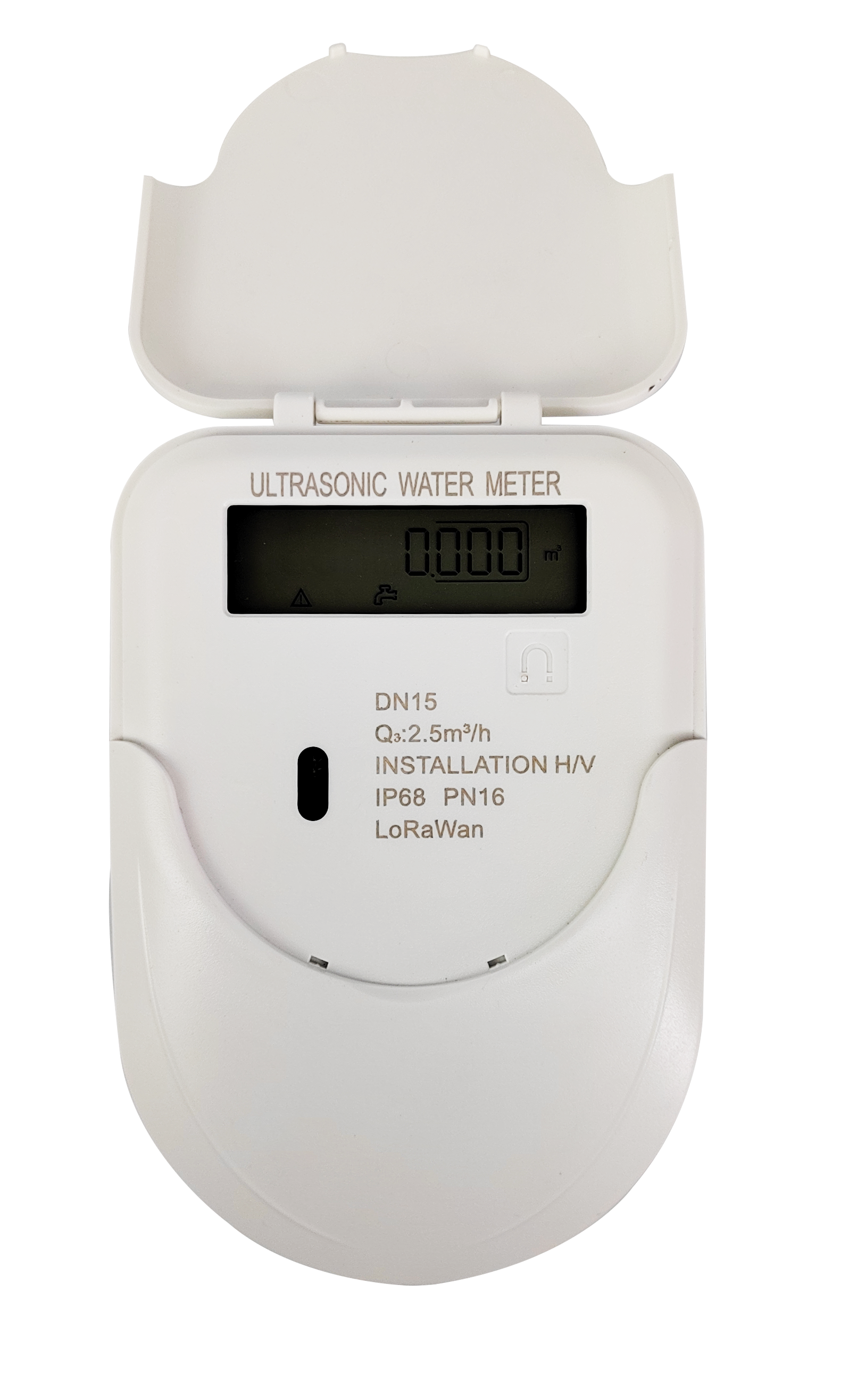
LoRaWAN ultrasonic water meter (model LXSC) for remote-reading smart water projects.
Ultrasonic smart water meters are increasingly specified in municipal, residential, and industrial metering projects because they combine no-moving-part measurement with wireless remote reading. For buyers moving from research to evaluation, the practical question is no longer whether ultrasonic technology works, but which certification, communication, and specification combinations are verifiable and fit the target market.
Why certification and specifications decide smart water meter purchases
Procurement teams evaluating smart water meters often face a fragmented set of claims about accuracy, connectivity, and compliance. A meter can display a high R-value on the datasheet, yet lack the MID or CE certification required for regulated European markets. Another may support LoRaWAN but not the regional frequency plan in the buyer's country. The result is project delays, rejected bids, or costly retrofits.
For the Research and Evaluation stages, the decision framework should center on three constraints:
- Metrological compliance — whether the meter meets ISO 4064, MID 2014/32/EU, or other standards required in the destination market.
- Communication compatibility — whether the module matches the operator's existing AMR/AMI infrastructure, network coverage, or gateway deployment.
- Verified parameters — R-value, nominal diameter, battery life, protection class, and installation options that align with the actual project environment.
The certification baseline for ultrasonic smart water meters
In the European market, the MID directive 2014/32/EU is the primary legal metrology framework for water meters. For ultrasonic meters, buyers should verify both the type examination certificate and the applicable product standard, typically EN ISO 4064-1 and EN ISO 4064-2.
An example is the LXC / LXC-V IoT ultrasonic water meter series produced by Shengda Water Meter Co., Ltd (SDWM). This series is covered by an MID Type Examination Certificate (Module B), number M4 69267376 0001, issued by TÜV Rheinland in compliance with the 2014/32/EU MID Directive, EN ISO 4064-1:2017+A11:2022, and EN ISO 4064-2:2017+A11:2022. The certificate is valid from 2024-10-14 to 2034-10-13 and applies to the global market.
In addition, the LXC ultrasonic water meter holds a CE Declaration of Conformity (certificate number HK2405221265S, issued by HUAK under EN 60529:1991+A1:2000+A2:2013), which covers the meter's IP68 ingress protection rating. The same product family is also covered by a RoHS certificate (number KTi260528R1441C) for the LXC series full specifications.
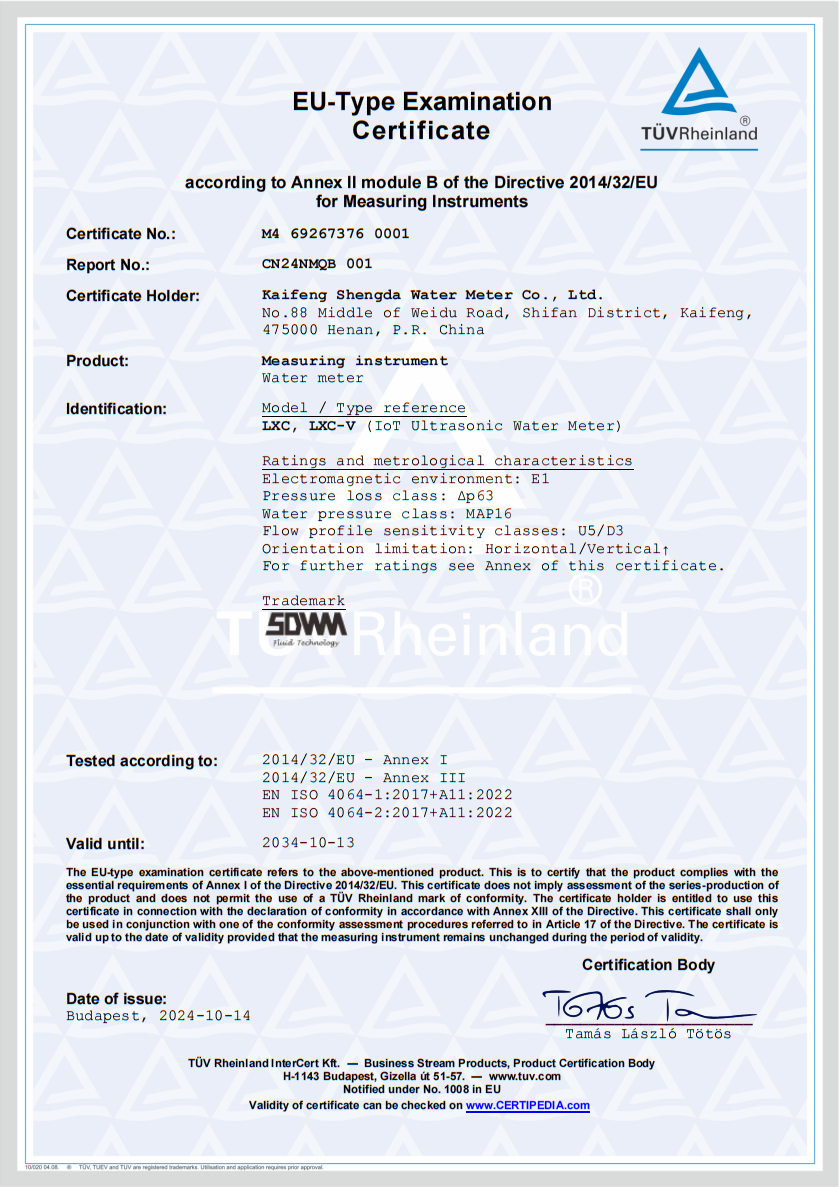
MID Type Examination Certificate for the LXC / LXC-V ultrasonic water meter covers EN ISO 4064-1:2017+A11:2022 and EN ISO 4064-2:2017+A11:2022.
Beyond product-level certificates, supplier-level management system certifications provide additional assurance. SDWM is certified to ISO 9001:2015 for quality management, ISO 14001:2015 for environmental management, and ISO 45001:2018 for occupational health and safety, all issued by CEOC Testing & Certification Center (Beijing) Co., Ltd.
Reading the specification sheet: R-value, size, temperature, and protection
Ultrasonic water meters are defined by several parameters that directly affect procurement decisions.
R-value (flow ratio)
The R-value expresses the ratio between the maximum and minimum flow rates at which the meter maintains its accuracy. A higher R-value means better sensitivity at low flows. SDWM's ultrasonic water meters are available with R250, R400, and R500 options, depending on the model. For comparison, traditional mechanical residential meters commonly deliver R80 to R160.
Nominal diameter and body material
The LXC ultrasonic water meter covers DN15–DN500, while the LXSC LoRaWAN ultrasonic version extends to DN15–DN600. The LXSY smart ultrasonic version also covers DN15–DN600. Body material can be brass, stainless steel, or composite material, allowing buyers to align the meter with local water quality and installation requirements.
Temperature and pressure
The LXSC operates in a working temperature range of -20°C to +60°C and a water temperature range of 0°C to +50°C. The LXSY smart ultrasonic version supports water temperatures up to +90°C. Standard pressure ratings are PN10 and PN16.
Protection class and battery life
All three ultrasonic series are designed with IP68 waterproof protection, making them suitable for underground meter boxes and outdoor installation. Battery life reaches up to 10 years for the LXC (DN15–DN40), LXSC, and LXSY configurations; larger diameters such as DN50–DN500 in the LXC series are rated for 6–8 years.
Communication options: matching connectivity with the project
Wireless connectivity is the most important differentiator in smart water meter procurement. The ultrasonic meter family from SDWM supports several communication methods, including LoRaWAN, NB-IoT, 4G, M-Bus, and RS485.
| Communication | Typical use case | Key specification from the product series |
|---|---|---|
| LoRaWAN | City-wide AMI, districts with own gateway network | EU868 / US915 / AS923 / AU915 frequency plans |
| NB-IoT | Areas with existing cellular IoT coverage | Narrowband LTE Cat.NB, B3/B5/B8 |
| 4G Cat.1 | Large-diameter meters and high-upload frequency needs | TD-LTE / FDD-LTE, GSM fallback |
| RS485 / M-Bus | Building management systems (BMS), wired AMR networks | Modbus RTU / M-Bus EN 13757 protocol |
The LXSC LoRaWAN ultrasonic meter is offered with communication options for EU868, US915, AS923, and AU915 bands, providing flexibility for utilities deploying LoRaWAN networks across different regions. For projects requiring wired integration, LXSY models support RS485 Modbus RTU and M-Bus, and can communicate with PLC, SCADA, AMR/AMI systems, and water management platforms.
Application evidence from actual projects
Procurement decisions improve when the specification sheet is supported by field evidence. SDWM has published several project references relevant to ultrasonic, NB-IoT, LoRaWAN, and prepaid smart metering:
- A municipal water department in Kenya deployed more than 20,000 NB-IoT smart water meters over 8+ years, improving automatic meter reading efficiency and reducing manual maintenance costs.
- A government water utility in Mongolia procured 15,000 LoRaWAN water meters through a government tender, using an OEM solution with LoRaWAN communication for smart city deployment.
- A water utility in Sudan awarded more than 10,000 ultrasonic water meters through a government tender for residential water metering, with OEM branding and long service life as key criteria.
- An HVAC contractor in Costa Rica used battery-powered, IP68-protected ultrasonic meters with wireless communication in a project-based installation, reducing maintenance costs.
- A municipal water supply project in Zimbabwe deployed over 4,000 STS prepaid water meters, supporting 20-digit STS tokens, remote valve control, remote recharge, and automatic billing.
Market direction: from automatic reading to intelligent water management
The shift from manual reading to AMR, and further to AMI, is visible in the product structure of major meter manufacturers. Across SDWM's ultrasonic and IoT water meter lines, remote automatic meter reading, historical consumption data storage, leakage alarms, reverse flow alarms, tamper alarms, and empty pipe alarms are increasingly standard. Remote shut-off valve control is offered as an option across LoRaWAN, NB-IoT, and 4G versions, enabling utilities to move from simple reading to active network control.
For emerging markets, the combination of STS prepayment with LoRa-RF communication is gaining traction because it supports third-party payment systems and reduces collection costs. In parallel, OEM customization—logo, housing design, communication module, software platform, protocol, packaging, and product specifications—has become a normal requirement in government tenders and utility projects.
Ultrasonic versus traditional mechanical water meters
A direct comparison helps buyers define when ultrasonic metering is justified and where mechanical meters remain a reasonable choice.
| Dimension | Ultrasonic smart water meter | Mechanical multijet water meter |
|---|---|---|
| Measurement principle | Ultrasonic transit-time, no moving parts | Impeller / turbine driven by water flow |
| Typical R-value | R250 / R400 / R500 | R80 / R100 / R160 / R200 |
| Remote reading | Integrated LoRaWAN, NB-IoT, 4G, M-Bus, RS485 | Optional pulse output or add-on communication module |
| Maintenance | No mechanical wear, lower long-term maintenance | Moving parts wear over time; may require recalibration or replacement |
| Power dependency | Battery-powered, up to 10 years | None in purely mechanical version |
| Relative cost | Typically higher initial cost | Lower initial cost |
One important boundary should be acknowledged. Ultrasonic meters rely on electronics and a battery, so total cost of ownership depends on battery life and module reliability. In extremely hot, aggressive water conditions, or in applications where no remote reading is required, a mechanical meter may still be the more practical and cost-effective choice. The evaluation should therefore be application-driven rather than technology-driven.
Future outlook
Three signals point toward the next phase of smart water metering. First, the integration of meters with IoT platforms and cloud-based monitoring will become the default expectation in urban projects. Second, prepaid models using STS standards will continue to expand in markets with collection challenges, supported by mobile payment and third-party payment systems. Third, as utilities build long-term AMI strategies, they are more likely to select suppliers that offer a full ecosystem—meter, gateway, data collector, communication protocol, and software platform—rather than a standalone device.
For manufacturers such as SDWM, the combination of observable production capability and documented certification is the main evidence buyers need. SDWM operates a 66,000 m² factory with a monthly capacity of 100,000+ units for water meters and flow meters, and reports that more than 65% of its business comes from repeat customers. Standard products are typically delivered in 15–20 days, while customized OEM products require 30–40 days depending on project requirements.
Frequently asked questions
What certifications are available for the LXC ultrasonic water meter?
The LXC / LXC-V ultrasonic water meter is covered by an MID Type Examination Certificate (Module B), number M4 69267376 0001, issued by TÜV Rheinland under the 2014/32/EU MID Directive and EN ISO 4064-1:2017+A11:2022 / EN ISO 4064-2:2017+A11:2022. It also holds a CE Declaration of Conformity (HK2405221265S, issued by HUAK) and a RoHS certificate (KTi260528R1441C) covering the LXC series.
Is the LXSY smart ultrasonic water meter MID certified?
The LXSY series is available with MID certification. Within the LXSY family, models such as the IoT water meter, wireless remote reading water meter, digital water meter, smart ultrasonic water meter, and LoRaWAN water meter are covered by MID certification, depending on configuration and target market.
Which communication protocols do these ultrasonic water meters support?
Depending on the model, communication options include LoRaWAN (EU868, US915, AS923, AU915), NB-IoT, 4G Cat.1, M-Bus, and RS485 Modbus RTU. The meters can be integrated with PLC, SCADA, AMR/AMI systems, and various water management platforms.
How long does the battery last on an ultrasonic smart water meter?
The LXC model provides up to 10 years of battery life for DN15–DN40 sizes, and 6–8 years for DN50–DN500. The LXSC LoRaWAN ultrasonic water meter and the LXSY smart ultrasonic water meter are both rated with battery life up to 10 years.
What is the measuring range of SDWM ultrasonic water meters?
The LXC ultrasonic water meter covers DN15–DN500. The LXSC LoRaWAN ultrasonic version and the LXSY smart ultrasonic version extend to DN15–DN600. Flow ratio options include R250, R400, and R500.