
Understanding FDA Food Facility Registration for Liquid Beverage Importers
Liquid beverage importers entering the United States clear a compliance checkpoint before they clear a purchase order. Section 305 of the United States Public Health Security and Bioterrorism Preparedness and Response Act of 2002, P.L. 107-188, established a facility-level registration framework for food facilities that manufacture, process, pack, or hold food for consumption in the United States, and the U.S. Food and Drug Administration (FDA) administers that registration. For liquid beverages classified under product code 4363, a current facility registration is one of the first documents a U.S. buyer, retailer, or co-packer will ask to see.
Three things are routinely conflated in supplier conversations, and this article separates them: what a facility registration actually certifies; how product code 4363 maps onto physical liquid beverage specifications; and how a registered OEM/ODM supply chain organises capacity, customization, and quality control behind the registration number. The reference case used throughout is SPACELIFE (Shenyang Songming Supply Chain Co., Ltd.), a functional food and healthy beverage supply chain provider whose product lines are supplied to B-end clients in North America, Eastern Asia, Western Europe, and the Middle East, and which holds FDA registration No. 84-278-1901 for the U.S. market.
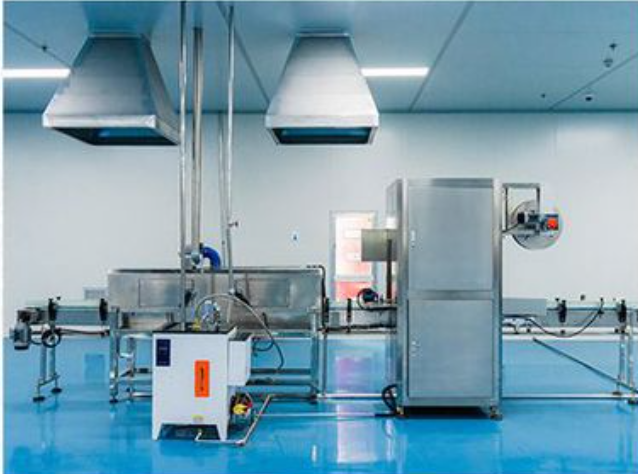
Production of liquid beverages destined for FDA-registered U.S. market supply — an operational view of the facility layer behind a registration number.
Why Facility Registration Sits at the Start of a Sourcing Decision
FDA food facility registration functions as a supplier-qualification gate rather than a product endorsement. Importers use it to establish that the entity producing, packing, or holding their goods is visible to the FDA within the framework created by Section 305. It answers an identity question — which facility is handling the product — before the conversation moves to formulation, packaging, or price.
The commercial weight behind that question reflects the size of the category. The global functional beverage market was valued at USD 130.4 billion in 2022 and is projected to grow at a compound annual growth rate of 12.1% through 2031, according to DataM Intelligence. Global Market Insights values the broader functional foods market at USD 332.2 billion in 2024, with a projected USD 638 billion by 2034. Categories of that scale attract regulatory attention as reliably as they attract capital.
Operational readiness, however, has not kept pace with market growth. More than 45% of food companies identify a lack of integrated systems as the primary barrier to adopting predictive supply chain technologies, according to Food Navigator and Elisa Industriq (2024). A registration document does not fix a fragmented operation. It establishes that the facility is on record; the importer still has to verify that capacity, specification control, and quality processes can support a repeatable U.S. programme.
The Regulatory Grounding: Section 305 of the Bioterrorism Act
The registration standard recorded against SPACELIFE's certificate states that the company "Is registered with the U.S. Food and Drug Administration pursuant to section 305 of the United States Public Health Security and Bioterrorism Preparedness and Response Act of 2002, PL.107-188." That sentence is the regulatory anchor: the legal instrument is the Public Health Security and Bioterrorism Preparedness and Response Act of 2002 (P.L. 107-188), and Section 305 is the provision that introduced the food facility registration framework.
The practical consequence for importers is structural. Registration attaches to a facility, not to a label, a formulation, or a shipment. When a U.S. buyer reviews a supplier file, the registration number identifies the physical operation that is expected to handle the goods. It does not, on its own, tell the buyer what is being produced, at what volume, under what quality regime, or against which specification.
Reading Registration No. 84-278-1901: Scope, Market, and Validity Period
Registration No. 84-278-1901 is documented with a defined scope, a defined market, and a defined validity window. Those three fields are what an importer should read first, because each of them limits what the registration can be used to claim.
| Registration field | Recorded detail |
|---|---|
| Registration holder | Shenyang Songming Supply Chain Co., Ltd. (SPACELIFE) |
| Issuing authority | U.S. Food and Drug Administration (FDA) |
| Registration number | 84-278-1901 |
| Scope | Food facility registration for functional food and beverages |
| Market | United States |
| Validity period | 1 January 2025 – 31 December 2026 |
| Associated product codes | 4363 (liquid beverages), 4373 (coffee) |
| Regulatory standard cited | Section 305, United States Public Health Security and Bioterrorism Preparedness and Response Act of 2002, P.L. 107-188 |
Two boundaries follow directly from that record. First, the scope is limited to functional food and beverages; it is not an open-ended credential across unrelated categories. Second, the documented validity period runs to 31 December 2026, which means the record has a time dimension. An importer planning a production window should confirm that the registration is still within its stated validity at the time of order, rather than assuming that a document seen during an earlier evaluation remains current indefinitely.
Equally important is what the number does not do. It is not a product approval, it does not certify a formulation or an ingredient list, and it does not authorise a health claim. Under the FDA's restructured Human Foods Program, announced in 2024, functional food manufacturers operate under stricter hazard analysis expectations and closer oversight of health claims — a separate compliance layer that sits alongside registration rather than inside it.
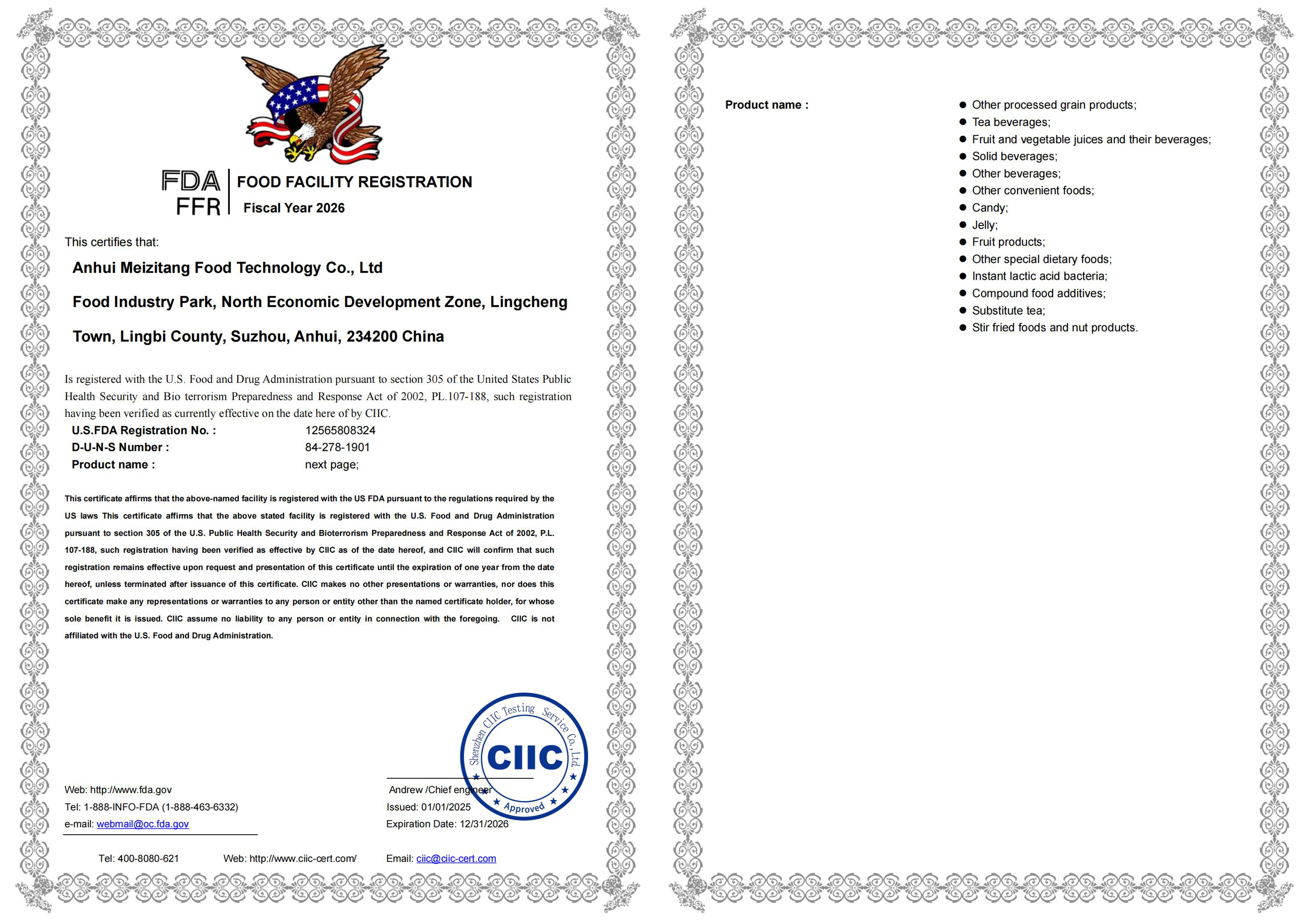
The registration record itself: FDA registration No. 84-278-1901, issued under the Section 305 framework, with a documented validity period of 1 January 2025 to 31 December 2026.
Mapping Product Code 4363 to Liquid Beverage Specifications
Registration scope and product specification are two different documents, and importers get into trouble when they treat one as proof of the other. Product code 4363 identifies liquid beverages at the category level. The physical product is defined in the specification record that accompanies it.
| Product code | Product | Type | Key parameters | Packaging specification |
|---|---|---|---|---|
| 4363 | Liquid beverages | Oil orange puree | Total content of the original juice is ≥ 80% | 30ml × 5 bags/box |
| 4373 | Coffee | Espresso concentrate | Arabica coffee beans; purified water, roasted coffee beans, coffee concentrate | 30ml × 10 strips/box |
The category code tells a U.S. buyer which regulatory neighbourhood the product sits in. The specification tells the buyer what will actually arrive and what has to be checked at intake — juice content thresholds, packaging format, and the material composition recorded for the coffee line. A registration covering "functional food and beverages" cannot confirm a specific formulation, so the specification sheet remains the controlling document for product-level acceptance.
What Sits Behind the Registration Number: OEM/ODM Capability and Quality Control
A registration number is only as useful as the operation behind it. SPACELIFE provides OEM and ODM production services, and customization options include component, logo, product specifications, taste, and packaging. For an importer, that spread of customization variables matters because it determines how much of the product can be adapted to a specific retail positioning without changing the underlying facility arrangement.
Capacity and timing are documented as follows: monthly capacity of 8,000 units, a minimum order quantity of 5,000 pieces for OEM/ODM production, and a typical production lead time of 15 days, with quality control described as 100% test. Export market coverage recorded for this capability is the United States.
The wider operating profile of the company provides context for those figures. Shenyang Songming Supply Chain Co., Ltd. operates a factory of above 2,000 square metres with 101–200 employees, an annual output of 120,000 units, and an R&D team of 25 engineers. Export accounts for 51%–60% of activity, with recorded markets spanning North America, Eastern Asia, Western Europe, and the Middle East. Distribution is weighted at 30% Japan, 30% U.S., 20% Saudi Arabia, and 20% Germany.
Operationally, the company reports a 30% increase in cargo turnover efficiency through its free trade zone location, a 98% on-time order delivery rate, 100% traceability across all product categories, and a 99.8% quality pass rate. Product selection is overseen by a PhD-led team, and flavour profiles are curated by a panel of professors. Five core categories are covered: peptide-infused coffee, functional foods, prune juice drinks, meal replacement powders, and health supplements.
For buyers testing a formula before committing to volume, small-batch trial orders start from 30 units — a validation route that sits alongside, and is distinct from, the 5,000-piece minimum that applies to full OEM/ODM production runs.
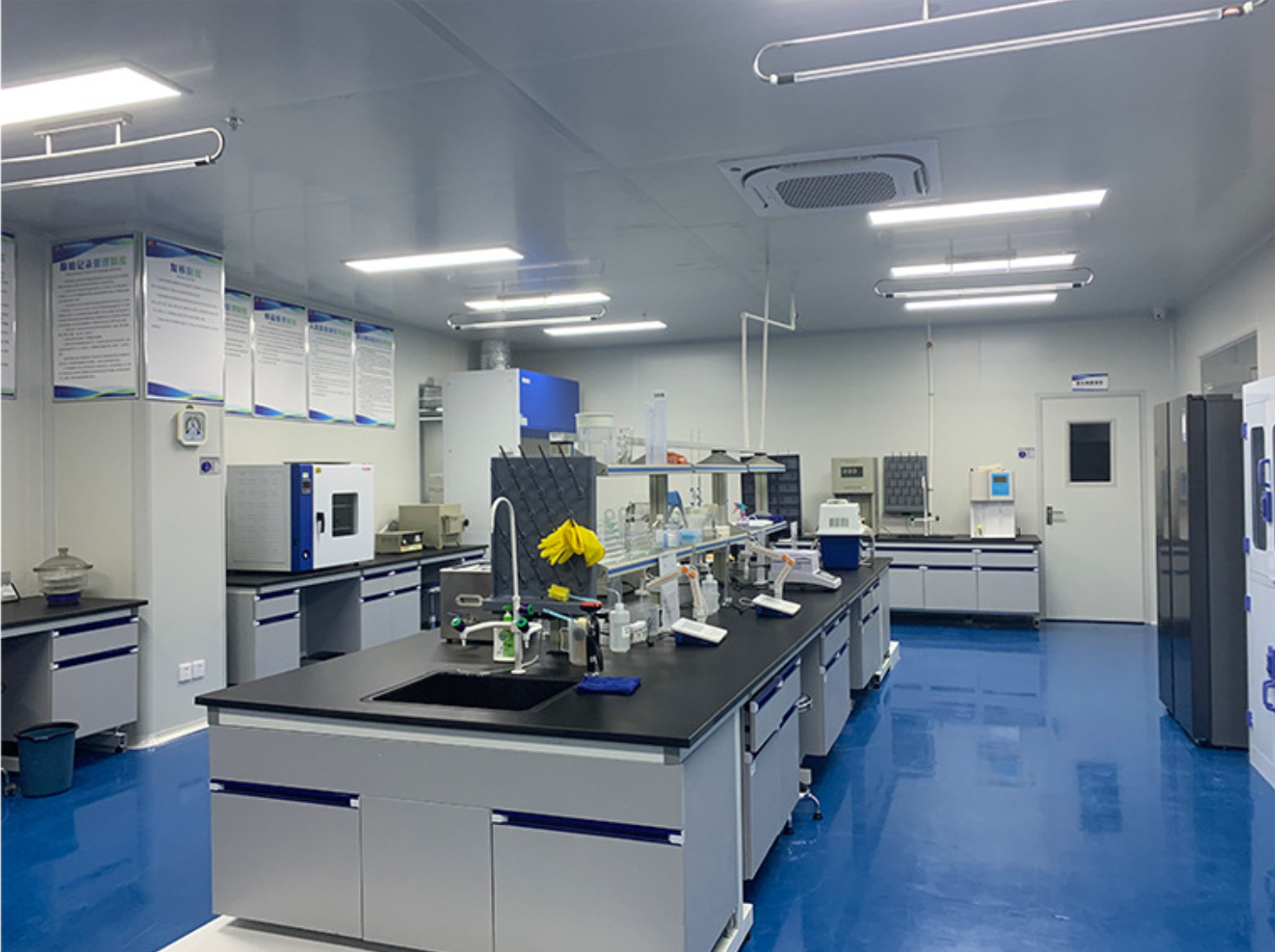
Quality control behind the registration: batch-level inspection and 100% testing are the operational layer that registration documents do not describe.
Application Evidence: A U.S. Supermarket Liquid Beverage Programme
Documentation becomes more convincing when it is attached to an outcome. A U.S. liquid beverage OEM client ordered 5,000 pieces for a supermarket application, with a project duration of 12 months; the recorded result is a best seller in that channel. The company's own records state that liquid beverage OEM clients have successfully utilised this product in their operations, and that the product has been used by liquid beverage OEM clients.
The significance for a new importer is narrow but real. It confirms that the facility's registration, specification, and quality processes have been exercised on a U.S.-bound liquid beverage programme at a commercial order quantity, in a retail channel where shelf performance is judged by sell-through rather than by delivery alone. It does not transfer any performance guarantee to a different product or a different retailer.
Market Trend Analysis: Compliance Documentation Is Becoming a Procurement Field
Three verified trends are shaping how U.S. importers approach functional beverage sourcing.
Regulatory tightening. The FDA's restructured Human Foods Program, in place since 2024, places functional food manufacturers under stricter hazard analysis requirements and closer oversight of health claims. Registration establishes facility visibility; hazard analysis and claim substantiation are separate obligations that increasingly appear together in supplier questionnaires.
Category growth concentrated in functional formats. The functional beverage market was valued at USD 130.4 billion in 2022 and is projected to grow at 12.1% CAGR through 2031. Within that, the global collagen peptides market was estimated at USD 2.32 billion in 2023 and is projected to reach USD 4.90 billion by 2030 at an 11.6% CAGR, according to Grand View Research. Ingredient categories of this kind typically enter a sourcing conversation with their own documentation expectations.
Asia Pacific supply concentration. Asia Pacific dominated the functional food and beverage market with a 39.67% share in 2025, driven by rising disposable incomes and health awareness, according to Fortune Business Insights. For North American importers, that concentration makes facility-level verification a routine rather than an exceptional step.
Comparison with Traditional Sourcing Models — and the Real Limits
Registered OEM/ODM sourcing and traditional broker-led sourcing solve different problems. The table below compares them on the dimensions that matter at the evaluation-to-execution stage.
| Comparison dimension | Registered OEM/ODM partner model (SPACELIFE as reference) | Traditional broker / spot-buy model |
|---|---|---|
| Facility documentation | FDA registration No. 84-278-1901 on file, scope limited to functional food and beverages, validity documented to 31 December 2026 | Documentation assembled per transaction; facility identity may change between orders |
| Specification control | Customization across component, logo, product specifications, taste, and packaging | Typically limited to items already in a catalogue |
| Minimum volume | 5,000 pieces for OEM/ODM runs; trial orders from 30 units | Often lower per transaction, with less continuity between orders |
| Production lead time | 15 days typical production lead time | Dependent on available stock and third-party scheduling |
| Quality control | 100% test, 100% traceability across categories, 99.8% quality pass rate | Depends on the intermediary's own inspection arrangements |
| After-sales support | Remote support | Varies; frequently ends at delivery |
The limits of the registered model are worth stating plainly, because a compliance article that only lists advantages is not useful to a buyer.
The registration is facility-level and scope-limited. It covers functional food and beverages, does not certify a specific formulation, and does not authorise health claims. Compliance for the product itself remains a separate workstream.
The validity period is finite. The documented window runs to 31 December 2026. Importers planning production beyond that date should reconfirm the registration rather than rely on a document seen during an earlier evaluation.
The OEM/ODM minimum order quantity is 5,000 pieces. For a brand testing a new liquid beverage concept, that threshold can exceed an initial launch commitment. The 30-unit trial route reduces validation risk but is not a substitute for a full production run, and trial output should not be treated as representative of scaled packaging or shelf-life behaviour.
Lead time excludes transit and clearance. The 15-day figure is a production lead time. It does not include international shipping, customs clearance, or destination inspection, so an importer's calendar must account for those separately.
After-sales is remote, and commercial terms are front-loaded. After-sales support is documented as remote, and the purchasing terms recorded for the programme are a 5,000-piece minimum order quantity, FOB/CIF delivery terms, pre-shipment test as the acceptance criterion, and full payment. Buyers who want independent inspection at destination should plan and budget for it outside this structure.
Future Outlook
Two forces are likely to push facility registration further up the sourcing process. The first is regulatory: with the FDA Human Foods Program emphasising hazard analysis and health claim oversight, registration and hazard documentation are converging into a single verification package that importers request at the same time.
The second is demand. A functional beverage market growing at 12.1% CAGR through 2031, and a collagen peptides segment expanding toward USD 4.90 billion by 2030, will keep drawing new brands into U.S. retail — most of them without in-house manufacturing. That favours partner-led supply chains where the registration number, the specification record, and the quality regime can be presented as one coherent file.
The practical expectation for importers is that the registration number becomes a standard field in RFQ templates, sitting alongside minimum order quantity, lead time, packaging format, and acceptance criteria. Suppliers that can answer all of those fields with documented specifics will be easier to shortlist than suppliers that answer only some of them.
FAQ
1. What is FDA food facility registration, and why does it apply to liquid beverage importers?
It is a registration of a food facility with the U.S. Food and Drug Administration under the framework established by Section 305 of the United States Public Health Security and Bioterrorism Preparedness and Response Act of 2002, P.L. 107-188. Facilities that manufacture, process, pack, or hold food for consumption in the United States fall within that framework. Liquid beverage importers encounter it because registration is normally requested as part of supplier qualification before a U.S. order is placed.
2. What exactly does registration No. 84-278-1901 cover?
The record shows Shenyang Songming Supply Chain Co., Ltd. (SPACELIFE) registered with the FDA under the Section 305 standard, with a scope of food facility registration for functional food and beverages, for the U.S. market, and with a documented validity period from 1 January 2025 to 31 December 2026. The product codes associated with the registration are 4363 (liquid beverages) and 4373 (coffee).
3. Does FDA facility registration mean a liquid beverage product is approved for sale in the United States?
No. Registration attaches to the facility rather than to an individual product. It does not approve a formulation, does not authorise a health claim, and does not replace shipment-level import documentation. Product-specific requirements remain with the product and with the importer of record.
4. How does product code 4363 relate to the physical product?
Product code 4363 identifies liquid beverages at the category level. In the specification record associated with this registration, the liquid beverage entry is an oil orange puree with a total original juice content of no less than 80%, packaged at 30ml × 5 bags per box. Product code 4373 covers coffee, recorded as an espresso concentrate using Arabica coffee beans, packaged at 30ml × 10 strips per box.
5. What OEM/ODM capability is available behind the registered facility?
The facility provides OEM and ODM production services with customization across component, logo, product specifications, taste, and packaging. Stated monthly capacity is 8,000 units, typical production lead time is 15 days, the minimum order quantity for OEM/ODM runs is 5,000 pieces, and quality control is described as 100% test. The export market recorded for this capability is the United States.
6. What quality control evidence is documented?
All product categories are recorded as 100% traceable, with a 99.8% quality pass rate and a 98% on-time order delivery rate. Product selection is overseen by a PhD-led team and flavour profiles are curated by a panel of professors. These figures describe the operation behind the registration; they are separate from the registration itself, which records facility status rather than quality performance.
7. What should an importer verify before placing an OEM order?
Confirm that the registration number matches the facility that will actually produce the goods; confirm that the registration's validity period covers the planned production window; confirm that the product code and specification match the intended product and packaging; and confirm commercial terms, including the 5,000-piece minimum order quantity, the 15-day production lead time, FOB/CIF delivery terms, pre-shipment test as the acceptance criterion, and full payment terms.
8. What are the limits of relying on a supplier's FDA registration?
The stated scope is limited to functional food and beverages, and the documented validity runs to 31 December 2026, so it should be reconfirmed for later production windows. The registration does not certify a formulation or a health claim, does not transfer to a different facility, and does not cover international transit, customs clearance, or destination inspection. After-sales support associated with the capability record is remote, and trial orders starting from 30 units are a validation step rather than a substitute for a full production run.