
Understanding FSC Certification for Custom Rigid Boxes: A Compliance Guide
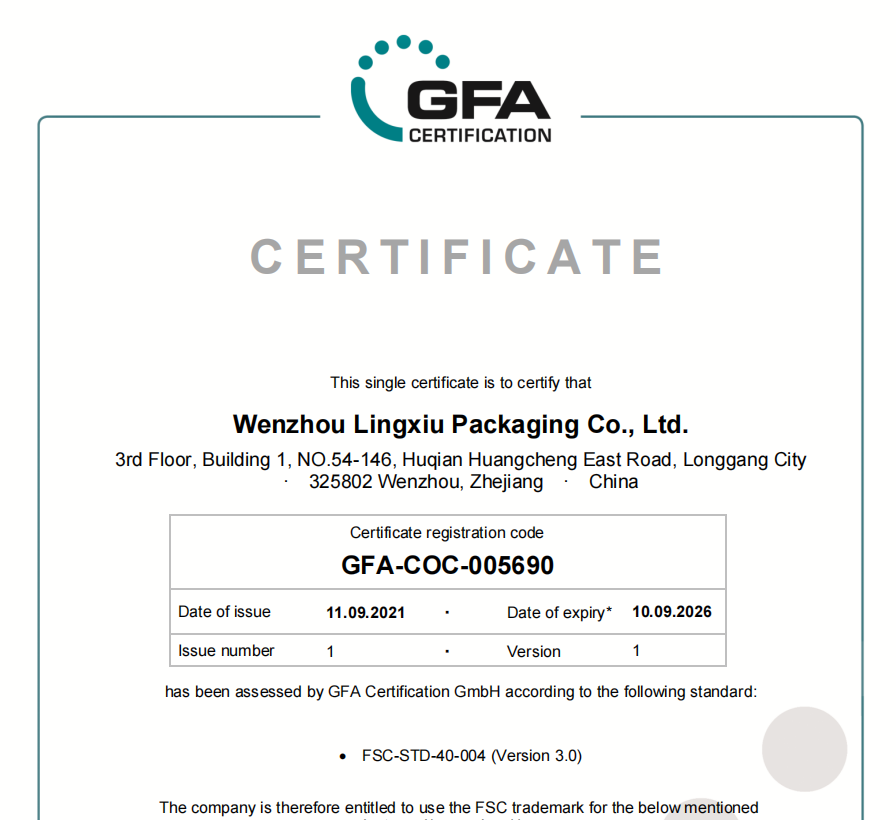
FSC Chain of Custody certificate GFA-COC-005690, issued by GFA Certification GmbH under FSC-STD-40-004 (Version 3.0), applies to Opack custom rigid boxes and custom shopping bags in Europe, North America, Australia & New Zealand, and the Middle East.
Custom rigid boxes are now specified as much for what they can document as for how they look. A rigid box with lid for a perfume launch, a collapsible rigid box for apparel, or a printed rigid gift box for an electronics accessory can all be produced to a comparable visual standard by many suppliers. What separates those suppliers in a procurement review is whether the paper inside the box can be traced through a certified chain of custody, and whether that traceability is backed by a certificate a buyer can check independently.
Opack is a custom packaging manufacturer based in Longgang, Wenzhou, Zhejiang Province, China, producing custom rigid boxes, custom shopping bags, custom folding cartons, custom mailer boxes, and custom packaging since 2010. Its custom rigid box line and custom shopping bag line hold FSC Chain of Custody certification GFA-COC-005690, issued by GFA Certification GmbH under the standard FSC-STD-40-004 (Version 3.0), with applicability in Europe, North America, Australia & New Zealand, and the Middle East.
This guide explains what that certificate actually confirms, how the number GFA-COC-005690 and the standard FSC-STD-40-004 are read by non-specialist buyers, where the boundary of a paper-based certification sits in a rigid box bill of materials, and how sourcing teams in the EU, North America, Australia/New Zealand and the Middle East can use certification as a verification tool rather than a logo on a quotation.
Why Rigid Box Sourcing Now Begins With Documentation
For most of the last decade, custom rigid boxes were bought on three variables: structure, print quality, and unit price. Compliance has since become a fourth. The EU Packaging and Packaging Waste Regulation (PPWR), Regulation (EU) 2025/40, became mandatory on 12 August 2026, requiring packaging placed on the EU market to be recyclable and properly labelled. For brand owners and importers, that turns a material question — is the board paper-based and recoverable? — into a documented one.
The commercial weight behind that shift is visible in the category data. The global rigid boxes market was valued at USD 31.2 billion in 2025 and is projected to reach USD 48.9 billion by 2035, according to Global Market Insights. Grand View Research estimates the rigid box segment within the broader corrugated market will expand at a 9.2% CAGR from 2026 to 2033, driven by e-commerce and premium packaging demand. Paper and paperboard already account for approximately 55.4% of rigid box material revenue, based on Future Market Insights data for 2026, reflecting the migration toward recyclable substrates.
Capacity and compliance demand are not located in the same place. Asia Pacific dominated the rigid packaging market with a revenue share of 48.2% in 2023, per Grand View Research and Global Market Insights, while Europe remains the largest specific market for luxury rigid boxes. That geographic split is the practical reason documentation travels with the shipment: a European or North American brand specifying a converter in Asia needs evidence that is recognised in its own market, not a verbal assurance. Chinese production is central to this trade — custom rigid and non-corrugated boxes under HS Code 481920 are a major export category, with China a primary global supplier according to UN Comtrade data.
What FSC Chain of Custody Certification Confirms
FSC Chain of Custody (COC) certification is a supply-chain certification, not a product-quality certification. It confirms that a company operates systems able to track FSC-certified material through purchasing, handling, production, and sale, and to support claims about that material on the finished product. It says nothing about print registration, structural strength, or the aesthetic standard of a rigid box — those remain separate manufacturing questions.
The standard that governs this type of certification is FSC-STD-40-004 (Version 3.0). Opack's certificate was issued by GFA Certification GmbH on 9 November 2021 and is stated as valid until 9 October 2026. The certificate covers two product families that matter to packaging buyers: custom rigid boxes and custom shopping bags.
| Certificate field | Value |
|---|---|
| Certificate holder | Opack |
| Certification type | FSC Chain of Custody (COC) Certification |
| Certificate number | GFA-COC-005690 |
| Certifying body | GFA Certification GmbH |
| Applicable standard | FSC-STD-40-004 (Version 3.0) |
| Scope | Cardboard packaging, sacks and bags of paper, adhesive labels, other pulp and paper products |
| Related products | Custom rigid boxes (models RB-C01, RB-G02, RB-M03, RB-L04, RB-B05, RB-O06, RB-T07, RB-D08, RB-W09); custom shopping bags (PSB) |
| Market applicability | Europe; North America; Australia & New Zealand; Middle East |
| Issue date | 9 November 2021 |
| Expiry date | 9 October 2026 |
For a buyer, the practical value of this structure is that every element is checkable. The certificate is not a general statement about a company being environmentally responsible; it is a defined claim about defined products in defined markets over a defined period.
Decoding the Certificate Number GFA-COC-005690
A certificate number is a short-form identity record, and reading it correctly is part of verifying a supplier. In FSC chain-of-custody numbering, the leading block normally identifies the certification body that issued the certificate — in this case GFA Certification GmbH — the COC segment identifies the certification type as Chain of Custody, and the trailing digits are the registration number assigned to the certificate holder. Two suppliers certified by different bodies therefore cannot hold the same number, and a number that does not match a recognisable certification body prefix is a warning sign rather than a detail.
The verification behaviour that follows from this is straightforward. Buyers should quote the full number in the request for quotation and in the purchase order, request the current certificate document rather than a logo file, and check the document against the issuing body rather than against the supplier's own marketing material. Verification should be repeated at the point of reorder, because certificate numbers persist while certificate validity does not.
What the number does not establish is equally important. It does not prove that a specific order was produced within the certified scope. It does not prove that a finished rigid box is recyclable or compostable. And it does not remain valid indefinitely — the certificate covering Opack's rigid box and shopping bag lines runs to 9 October 2026, after which validity depends on the outcome of the certification body's process.
Scope Boundaries: What a Paper Certificate Does Not Cover
The scope statement on a chain-of-custody certificate is the part buyers most often skim and most often need. Opack's certificate scope reads: cardboard packaging, sacks and bags of paper, adhesive labels, other pulp and paper products. Two product families are named against that scope — custom rigid boxes in models RB-C01, RB-G02, RB-M03, RB-L04, RB-B05, RB-O06, RB-T07, RB-D08 and RB-W09, and custom shopping bags in the PSB model.
A rigid box, however, is rarely a paper-only product. The primary structural materials used in this product line are Grey Board, Greyboard, Chipboard, or MDF (Medium-density fibreboard), wrapped in coated paper, kraft paper, specialty paper, textured paper, or white paperboard. Interior inserts can be foam, paperboard, EVA, plastic tray, corrugated cardboard, or silk, and closures may use magnets or ribbon.
Two further distinctions prevent over-claiming. First, FSC Chain of Custody certification is not a compostability certification and is not a recyclability assessment; it documents fibre origin and traceability. Second, it is not a substitute for the recyclability and labelling obligations introduced by the EU PPWR. A rigid box programme can be certified for chain of custody and still require a separate recyclability assessment for the market it is sold into.
Verifying an FSC Certificate: A Practical Checklist
The checklist below can be applied to any supplier, not only to Opack. Its purpose is to convert a certification claim into a set of documents and cross-checks that survive an internal audit or a customer compliance review.
| Check | What to look for | Why it matters |
|---|---|---|
| Certificate number | GFA-COC-005690 quoted consistently on certificate, quotation, and invoice | Prevents substitution of an unrelated certificate or a recycled marketing claim |
| Standard | FSC-STD-40-004 (Version 3.0) | Identifies the scheme and version the certification was granted under |
| Certifying body | GFA Certification GmbH | Establishes which organisation holds the record to verify against |
| Scope | Cardboard packaging; sacks and bags of paper; adhesive labels; other pulp and paper products | Confirms your product category is inside the certified scope |
| Products named | Custom rigid boxes (RB-C01 to RB-W09); custom shopping bags (PSB) | Links the certificate to the actual items being purchased |
| Market applicability | Europe; North America; Australia & New Zealand; Middle East | Confirms relevance to the destination market of the shipment |
| Validity window | Issued 9 November 2021; valid until 9 October 2026 | Ensures the certificate covers the production and shipping period |
| Component mapping | Paper versus non-paper components in the bill of materials | Prevents claims being extended to inserts, magnets, or ribbons |
Buyers who run this checklist consistently tend to find that the difficult part is not obtaining the certificate but mapping it to a specific box specification. A rigid gift box with a magnetic closure, a foam insert, and a ribbon pull is a multi-material assembly; the certified portion is the paper-based portion.
Regional Compliance Context: EU, North America, Australia & New Zealand, Middle East
European Union. The PPWR, Regulation (EU) 2025/40, became mandatory on 12 August 2026, with requirements that packaging be recyclable and properly labelled. Fibre-sourcing evidence such as FSC Chain of Custody supports the traceability side of a compliance file, but recyclability and labelling must be assessed on the packaging design itself. For EU-facing brands, the certificate is one input into a wider dossier.
North America. There is no single equivalent federal packaging regulation imposing the same recyclability mandate, so pressure arrives through retailer and brand procurement policies instead. In practice, North American buyers request chain-of-custody documentation alongside on-product claim wording, because their own sustainability reporting depends on supplier evidence they can retain.
Australia & New Zealand. Both are named as applicable markets on Opack's certificate. Importers in this region frequently align their paperwork with EU-style expectations, since many of their brand customers sell across multiple regions and prefer one documentation standard across a product range.
Middle East. Also named as an applicable market, and one of Opack's main export regions alongside the EU and the United States. Compliance requests here typically originate from international retail groups, hospitality and gifting programmes, and regional brands manufacturing for export, where the certificate acts as evidence for downstream customers rather than for a local regulator.
The common thread across all four regions is that certification is used as a filter. Opack produces for export markets with roughly 80% of output exported, which means its documentation is built for cross-border review — a structural reason why the certificate names markets explicitly rather than treating certification as a domestic formality.
From Certification to Finished Box: Materials, Structures, and Production

Custom rigid box construction: a rigid board core wrapped in printed paper, the format most commonly requested in FSC-certified premium packaging programmes.
Certification does not change how a rigid box is engineered, but it does change which parts of the specification need documentary support. The custom rigid box line is built on Grey Board or MDF cores with customisable thickness, wrapped in coated paper, kraft paper, specialty paper, textured paper, or white paperboard. Printing options include CMYK, Pantone, UV, offset, and screen printing, with finishing options covering hot stamping, spot glossy UV, soft touch lamination, holographic foiling, embossing, debossing, and matte or gloss lamination.
Structure choices are relevant to both compliance and freight. Foldable, magnetic closure, and ribbon closure formats are available, and collapsible rigid box construction reduces shipped volume for brands distributing to multiple markets — a practical consideration when certified material and packaging volume are both being reviewed. Sizes are fully customisable based on product requirements, and insert options include foam, paperboard, EVA, plastic tray, corrugated cardboard, and silk. The minimum order quantity for custom rigid boxes is 500 pcs, and for custom shopping bags it is 1,000 pcs.
Application coverage for this product line includes jewelry, watches, perfumes, cosmetics and beauty, apparel, gift packaging, electronics, PR boxes, and corporate and promotional packaging. Production specified for these applications uses eco-friendly water-based printing inks and low-VOC adhesive materials, in line with FSC standards. Storage guidance for finished boxes is a dry, low-humidity environment at a stable moderate temperature, away from direct sunlight and chemicals — a useful constraint for brands warehousing rigid packaging ahead of a seasonal launch.
Manufacturing context matters when a compliance audit extends into a factory review. Opack operates a 10,000 m² facility with 160 employees, a 5-person R&D team, and a stated annual output of 10,000,000 units. Monthly capacity is stated at 1,000,000 units with a lead time of 12–18 days, a 100% quality check process, and after-sales support through real-time online chat, WhatsApp, telephone, and official email.

Printed custom rigid box: decorative wrapping paper and finishing options are specified separately from the certified paper-based components inside the scope.
Certified Supply Chains Compared With Alternative Sourcing Approaches
Buyers evaluating rigid box suppliers usually compare four documentation positions rather than four companies. The table below sets out what each position establishes and where it stops.
| Approach | Evidence the buyer receives | What it establishes | Principal limitation |
|---|---|---|---|
| FSC Chain of Custody certified supplier, in-scope products | Certificate number GFA-COC-005690, standard, scope, validity dates, market applicability | Certified chain of custody for in-scope paper-based components | Does not extend to non-paper components; is not a recyclability or compostability statement; is bound to a validity window |
| General eco-friendly supplier claim | Usually none beyond marketing wording | Nothing verifiable or repeatable across shipments | Cannot be audited, mapped to a bill of materials, or cited in a compliance file |
| Recycled-content claim without chain of custody | Material composition statement | A material input claim at most | No fibre-origin traceability and no third-party verification path |
| In-house conversion from unspecified board stock | Internal purchasing records only | Only what the buyer documents itself | No independent verification of fibre origin or handling |
The rigid box market includes integrated packaging groups such as Smurfit Westrock, Mondi Group, and Sonoco, alongside specialised converters including PakFactory and BorhenPack. These names are referenced here as market context for sourcing comparisons; certification status, scope, and specifications vary by entity and product line, and no claim about any of these companies is made in this article.
Limits and Trade-offs Buyers Should Plan For
Documented limitations are more useful than reassurance, because they define what must be managed internally.
- The certificate has an expiry date. Opack's FSC certificate is stated as valid until 9 October 2026. For any programme, repeat order, or framework agreement extending beyond that date, buyers should confirm the current validity status before committing. Renewal is a process outcome, not an automatic extension.
- Scope, not blanket coverage. The certification applies to defined paper-based products: cardboard packaging, sacks and bags of paper, adhesive labels, and other pulp and paper products. A magnetic closure, EVA insert, plastic tray, or textile ribbon is outside that scope.
- Certification is not a quality standard. FSC Chain of Custody says nothing about board thickness tolerance, print accuracy, or structural strength. Quality assurance is a separate discipline; Opack's published process is a 100% quality check, and buyers should still define their own inspection criteria or acceptance protocol.
- Minimum order quantities still apply. Certification runs alongside commercial thresholds — 500 pcs for custom rigid boxes and 1,000 pcs for custom shopping bags. Buyers with smaller or test-run volumes may not be served by the same documentation path as a full production order.
- Certified material can change a production schedule. A stated lead time of 12–18 days applies to normal orders. Certified fibre typically involves separate purchasing, handling, and record-keeping steps, so buyers should confirm the schedule for a certified order explicitly rather than assume it matches an earlier quotation.
- Documentation carries an operational cost. Segregation of certified material, record-keeping, and correct claim wording on finished packaging are administrative obligations. They should be treated as a specification line item during cost review rather than an assumed free addition.
- Certification is not a PPWR substitute. FSC Chain of Custody supports fibre traceability. It does not by itself demonstrate that a rigid box meets the recyclability and labelling requirements of the EU PPWR, which must be assessed on the packaging design.
Market Outlook: Compliance as a Procurement Gate
The direction of travel is that fibre-sourcing documentation is moving from differentiator to entry requirement. The rigid boxes market is projected to grow from USD 31.2 billion in 2025 to USD 48.9 billion by 2035, with a 9.2% CAGR for the rigid box segment from 2026 to 2033, and paper and paperboard already representing roughly 55.4% of rigid box material revenue as of 2026. When paper-based substrates dominate a category, the traceability of those substrates becomes a category-level question rather than a niche claim.
Three developments are likely to shape how buyers use certification over the next few years. First, certificate renewal cycles will become visible procurement events, as programmes spanning multiple years encounter expiry dates and need a documented transition. Second, verification will become more routine, with certificate numbers checked against issuing body records rather than accepted from supplier documents. Third, the gap between fibre certification and recyclability regulation will narrow in buyer expectations even though the two remain technically distinct — teams will increasingly be asked to produce both, and suppliers that can supply both lines of evidence will be easier to qualify.
For now, the practical standard is narrow and achievable: know which products are in scope, know which markets the certificate applies to, know when it expires, and check the number against the issuing body. Those four checks separate a verifiable sourcing claim from a claim that merely sounds compliant.
Frequently Asked Questions
What is the difference between FSC Chain of Custody certification and FSC forest management certification?
FSC forest management certification applies to the forest operations that manage land to FSC standards. FSC Chain of Custody certification applies to organisations that purchase, process, manufacture, or trade FSC-certified material and need to track it through their own operations and onto product claims. A rigid box manufacturer such as Opack holds Chain of Custody certification — certificate GFA-COC-005690, issued under FSC-STD-40-004 (Version 3.0) — rather than forest management certification, because its role in the chain is conversion and supply, not forestry.
What does the certificate number GFA-COC-005690 actually verify?
The number identifies a specific, traceable certificate record. The leading block identifies the certification body, GFA Certification GmbH; the COC segment identifies the certification type as Chain of Custody; and the trailing digits are the registration number held by the certificate holder, Opack. It allows a buyer to confirm that the certificate exists, who issued it, which standard it was granted under, and what products and markets it covers — rather than relying on a supplier statement that a product is certified.
What does the standard FSC-STD-40-004 (Version 3.0) cover?
FSC-STD-40-004 is the standard against which Chain of Custody certification is granted. It sets out the requirements a company must meet to track certified material through purchasing, handling, production, and sale, and to make supportable claims about that material on the products it supplies. It is the standard cited on Opack's certificate for both its custom rigid box and custom shopping bag products.
Which products and markets does Opack's FSC certification apply to?
The certificate names custom rigid boxes, including models RB-C01, RB-G02, RB-M03, RB-L04, RB-B05, RB-O06, RB-T07, RB-D08, and RB-W09, and custom shopping bags in the PSB model. The declared market applicability covers Europe, North America, Australia & New Zealand, and the Middle East. The certificate scope is cardboard packaging, sacks and bags of paper, adhesive labels, and other pulp and paper products.
Do inserts, magnets, and ribbons inside a rigid box fall under FSC certification?
Generally no. Chain of custody certification for a paper-based scope covers the paper components. Options used inside custom rigid boxes include foam, paperboard, EVA, plastic tray, corrugated cardboard, and silk inserts, and closures may use magnets or ribbon. Foam, EVA, plastic, metal, and textile elements sit outside a pulp-and-paper scope, and MDF, a wood-based board, should be confirmed with the supplier rather than assumed to be included. Buyers should map each component in the bill of materials to the certificate scope.
Does FSC certification mean a custom rigid box complies with the EU PPWR?
No. The EU Packaging and Packaging Waste Regulation, Regulation (EU) 2025/40, became mandatory on 12 August 2026 and requires packaging placed on the EU market to be recyclable and properly labelled. FSC Chain of Custody certification addresses fibre origin and traceability through the supply chain. It is not a recyclability assessment, so a rigid box programme still needs a separate evaluation of material composition, labelling, and end-of-life performance for the EU market.
What should a buyer do when a supplier's certificate is close to its expiry date?
Certificate validity is time-bound, and Opack's certificate is stated as valid until 9 October 2026. For orders, repeat runs, or framework agreements that extend beyond the stated expiry, buyers should request written confirmation of the current certificate status before placing the order, and re-verify the certificate number against the issuing body record at the point of reorder. Planning verification as a scheduled step rather than a one-off check during supplier onboarding keeps the compliance file accurate.
Reference material: Opack publishes a company profile covering its facilities, product ranges, and documentation at opack.com, with a downloadable profile at Opack company profile (PDF).