
Understanding Multi-Fiber Compliance in Seaweed Textile Imports
Understanding Multi-Fiber Compliance in Seaweed Textile Imports
Compliance risk in imported seaweed textiles is decided at the fiber-composition level, not at the brand level. Most products in this category are multi-fiber constructions, and the paperwork attached to a shipment has to describe each declared fiber, its percentage, the construction it was tested against and the colourway it was approved in. This reference explains how buyers can read those documents, where the gap between a regenerated seaweed fiber and a blend composition actually sits, and how colour consistency across natural, white, black and grey variants belongs in the same import file.
Why Multi-Fiber Products Carry More Compliance Risk Than Single-Fiber Ones
A product called alginate fiber can describe at least three commercially different things: a regenerated filament spun from seaweed-derived alginate; a composite filament in which seaweed charcoal mud or alginic acid is dispersed inside a polyester or polyamide matrix; or a blend in which alginate fiber is one of several spun components alongside modal, cotton, tencel or elastane. Each structure produces a different fiber-content declaration, and the product name alone does not tell an importer which one they hold.
Healcell® products illustrate the spread. The item listed as DTY Alginate Fiber / Seaweed Charcoal Mud Polyester Filament (Light Net) [75D*72F] (model TSY00006-1) is declared as 100% Polyester including seaweed charcoal mud. The item listed as 10% Healcell Alginate Fiber / Seaweed Fiber Elastic Jersey Raw Color [40S] (model HMY00001) is declared as 45.3% Modal + 42.1% Cotton + 7.3% Alginate Fiber / Seaweed Fiber + 5.3% Spandex. Both contain alginate chemistry. Only the second one carries alginate as a separately quantified fiber component on the label.
That difference matters during import review, label artwork approval and any later dispute about what was shipped. Buyers who treat "alginate fiber" as one category frequently approve a label that does not match the composition report generated for the actual construction.
What a Fiber Content Report Establishes — and What It Does Not
The document that converts a marketing description into a verifiable declaration is the fiber composition content test report, issued against a named sample. Healcell's green Haixian functional fabric is documented in a CNAS accredited report with certificate number T T T S – W T 2 4 0 7 0 4 5 1, issued on 24 June 2024 by TTTS. The reported scope is 1# green seaweed knitted fabric (30×30 cm), and the recorded composition is Modal 85.9%, seaweed fiber 7.1% and spandex 7.0%. Testing referenced GB/T 35443-2017 together with the FZ/T 01057.2 / 01057.3 / 01057.4 / 01095-2002 fiber test series.
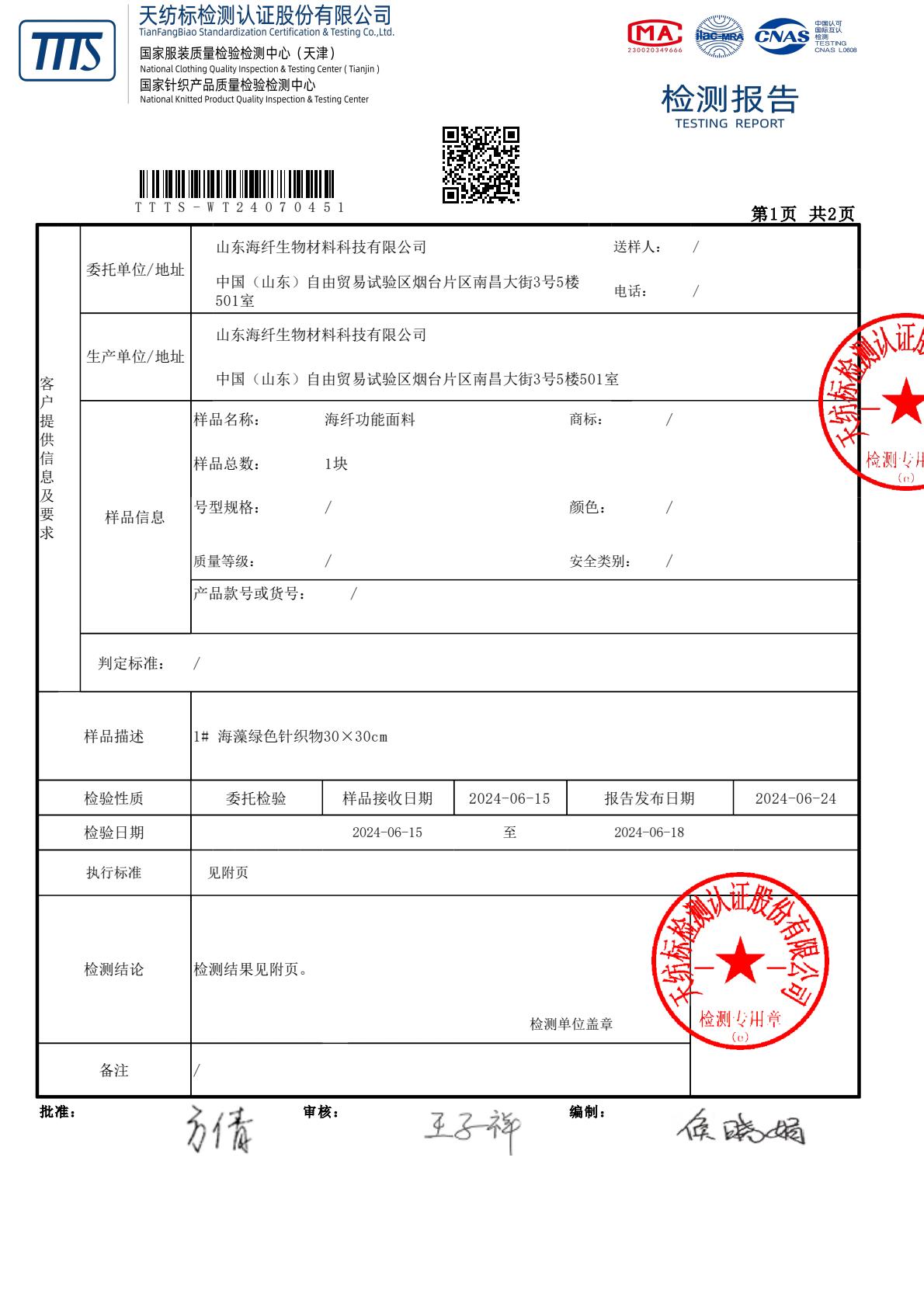
CNAS accredited fiber composition content test report for green Haixian functional fabric (certificate no. T T T S – W T 2 4 0 7 0 4 5 1), recording Modal 85.9%, seaweed fiber 7.1% and spandex 7.0%.
Three practical points follow from this document format. First, the report is tied to one sample — here a specific green knitted fabric at 30×30 cm — so a report issued for one construction or colourway does not automatically cover a sister construction in a different colour. Second, it quantifies the minor seaweed-derived fraction rather than treating it as a headline material, which is exactly what a customs or retail compliance reviewer needs. Third, it names the standard set used, so a destination-market reviewer can judge whether the method is comparable to local requirements.
Three Product Structures, Three Disclosure Outcomes
Healcell's alginate range can be grouped into three declaration structures. The table below uses the declared compositions recorded for the corresponding models.
| Structure | Example product (model) | Declared composition | Disclosure consequence |
|---|---|---|---|
| Composite filament — alginate or seaweed charcoal mud dispersed in a base polymer | DTY Alginate Fiber / Seaweed Charcoal Mud Polyester Filament (Light Net) [75D*72F] (TSY00006-1) | 100% Polyester (including seaweed charcoal mud) | The base fiber is declared; the seaweed component is a modifier rather than a separately listed fiber. |
| Composite filament — alginic acid in a polyester matrix | Healcell Alginate Fiber / Seaweed Quick-Dry Filament Polyester DTY [75D*48F] (DSY00010) | 100% Polyester (with alginic acid) | Same structure as above; dry-dry designation refers to the composite fiber, not to a separate alginate yarn. |
| Composite filament — polyamide base | FDY Alginate Fiber / Seaweed Charcoal Mud Nylon Conductive Filament [20D*3F] (TSY00015) | 100% Polyamide (with seaweed charcoal mud) | Base fiber declaration is polyamide; conductive function is carried by the composite construction. |
| Blend — alginate fiber as a separately quantified component | 10% Healcell Alginate Fiber / Seaweed Fiber Elastic Jersey Raw Color [40S] (HMY00001) | 45.3% Modal + 42.1% Cotton + 7.3% Alginate Fiber / Seaweed Fiber + 5.3% Spandex | Alginate appears as a distinct labeled component with its own percentage. |
| Blend — higher alginate share in a spun yarn | 13% Healcell Alginate Fiber / Seaweed Fiber Yarn Modal Black (HSY00013); 13% Healcell Alginate Fiber / Seaweed Fiber Yarn Modal Seaweed Green (HSY00010) | 87% Modal + 13% Alginate Fiber / Seaweed Fiber | The alginate fraction is large enough to be a visible claim on the label. |
| Blend — modifier inside a cellulose blend | Alginate Fiber / Seaweed Charcoal Mud Warm Woven Fabric (Lyocell Cotton) (TMY00003) | 65% Combed Cotton + 35% Lyocell (with Alginate Fiber / Seaweed Charcoal Mud) | Two base fibers are declared, with the seaweed components noted parenthetically. |
The working rule for importers is straightforward: before label artwork is approved, ask the mill to state whether the alginate or seaweed fraction will appear as a separately declared fiber with its own percentage, or as a modifier inside the base fiber declaration. Both arrangements can be legitimate; an import file that mixes them is not.
Colour Consistency as Part of the Compliance File
Colour is often treated as a merchandising detail and handled outside the compliance discussion. In multi-fiber seaweed textiles it belongs inside it, because the approved colourway is one of the attributes against which shipped lots are verified. Healcell's range spans natural and skin-tone variants, white, black and grey, across both yarn and fabric lines, and each colourway is tied to a specific construction rather than being interchangeable.
- White and black: Healcell Alginate Fiber / Seaweed Deodorizing Yarn is offered in 40s and 60s in White, Black and Gray (models BSY00042-1/2/3 and BSY00043-1/2/3). The quick-dry anti-perspective fabric family is documented in White — double-sided at 140g/1.75m (DMY00004), bird's-eye at 160g/1.8m (DMY00005), healthy fabric at 190g/1.85m (DMY00006) — and the elastic double-sided variant at DMY00008. Healcell Alginate Fiber / Seaweed Fiber Yarn Modal is listed in Black (HSY00013) and Seaweed Green (HSY00010).
- Grey: Alginate Fiber / Seaweed Charcoal Mud Yarn is listed at Light Gray 60s (TSY00003), and the Seaweed Charcoal Mud Towel Cloth is documented at 1.62m / Gray / 210g (TMY00002). Several CNAS performance reports were generated on grey woven and grey knitted seaweed carbon mud constructions.
- Natural and skin tone: Alginate Fiber / Seaweed Charcoal Mud Warm Yarn 50s is listed in Natural Color (TSY00011), the warm elastic small ribbed fabric at 1.8m / 230g / 50s in Natural Color (TMY00005), and the Modal yarn line includes a Skin Tone variant (HSY00019).
Two verification habits reduce colour-related disputes. The first is to approve a colour standard per SKU rather than per product family, since the same seaweed charcoal mud construction appears in grey, natural and light grey forms. The second is to link pre-shipment testing to colour approval in the same acceptance step: Healcell's stated acceptance criterion is pre-shipment test, and quality control is described as 100% test. Natural and skin-tone colourways generally carry more lot-to-lot variation risk than a defined black or white, so they warrant tighter sampling rules and a written tolerance before production starts.
The Test-Report Set That Should Accompany an Order
Fiber composition is one input. Functional and physical performance reports form the rest of the file. The reports below are CNAS accredited, and in each case the issuing laboratory records that the test data is mutually recognized worldwide under CNAS laboratory accreditation. Note how each report names a specific sample weight, colour and construction — a pattern buyers should expect from any mill.
| Reported scope | Standard referenced | Certificate no. | Issued |
|---|---|---|---|
| Deodorant performance (acetic acid), 01# grey woven seaweed carbon mud fabric 40×40 cm | GB/T 33610.1-2019 | T T T S - W T 2 5 5 6 6 4 02 | 2025-03-27 |
| 7A grade antibacterial after 150 washes, 1# grey twill woven seaweed carbon mud fabric 40×50 cm | T/SZTIA 001-2023; GB/T 20944.3-2008 | T T T S - W T 2 5 0 1 2 6 1 5 J | 2025-03-21 |
| Anti-UV, 1# light grey knitted seaweed carbon mud fabric 30×60 cm | GB/T 18830-2009 | T T T S -W T 2 4 1 2 2 3 1 7 | 2024-10-22 |
| Far-infrared, 01# grey khaki knitted seaweed carbon mud fabric 70×80 cm | GB/T 30127-2013 | T T T S - W T 2 5 6 4 6 2 4 1 | 2025-08-05 |
| Negative ion generation, 01# grey khaki knitted seaweed carbon mud fabric 70×80 cm | GB/T 30128-2013 | TTTS-WT25646239 | 2025-08-05 |
| Anti-static (pre-washing), 01# grey woven seaweed carbon mud fabric, 180 cm width | GB/T 12703.1-2021 | TTTS-WT25602350 | 2025-06-03 |
| Anti-static before washing and after 43 washes, 01# white knitted seaweed quick-dry fabric 60×60 cm | GB/T 12703.1-2021 | TTTS-WT26046702 | 2026-04-24 |
| Deodorization (ammonia), 01# white knitted seaweed quick-dry fabric 50×80 cm | GB/T 33610.1-2019; GB/T 33610.2-2017 | TTTS-WT26063571 | 2026-05-19 |
| Physical properties of seaweed carbon mud functional yarn 75D72F | GB/T 14343-2008; GB/T 14344-2022; GB/T 6505-2017 | GTTC-262005828 | 2026-03-25 |
| 7A grade antibacterial after 150 washes, 01# white knitted anti-see-through functional fabric 70×100 cm | T/SZTIA 001-2023; GB/T 20944.3-2008 | TTTS-WT26085397 | 2026-06-26 |
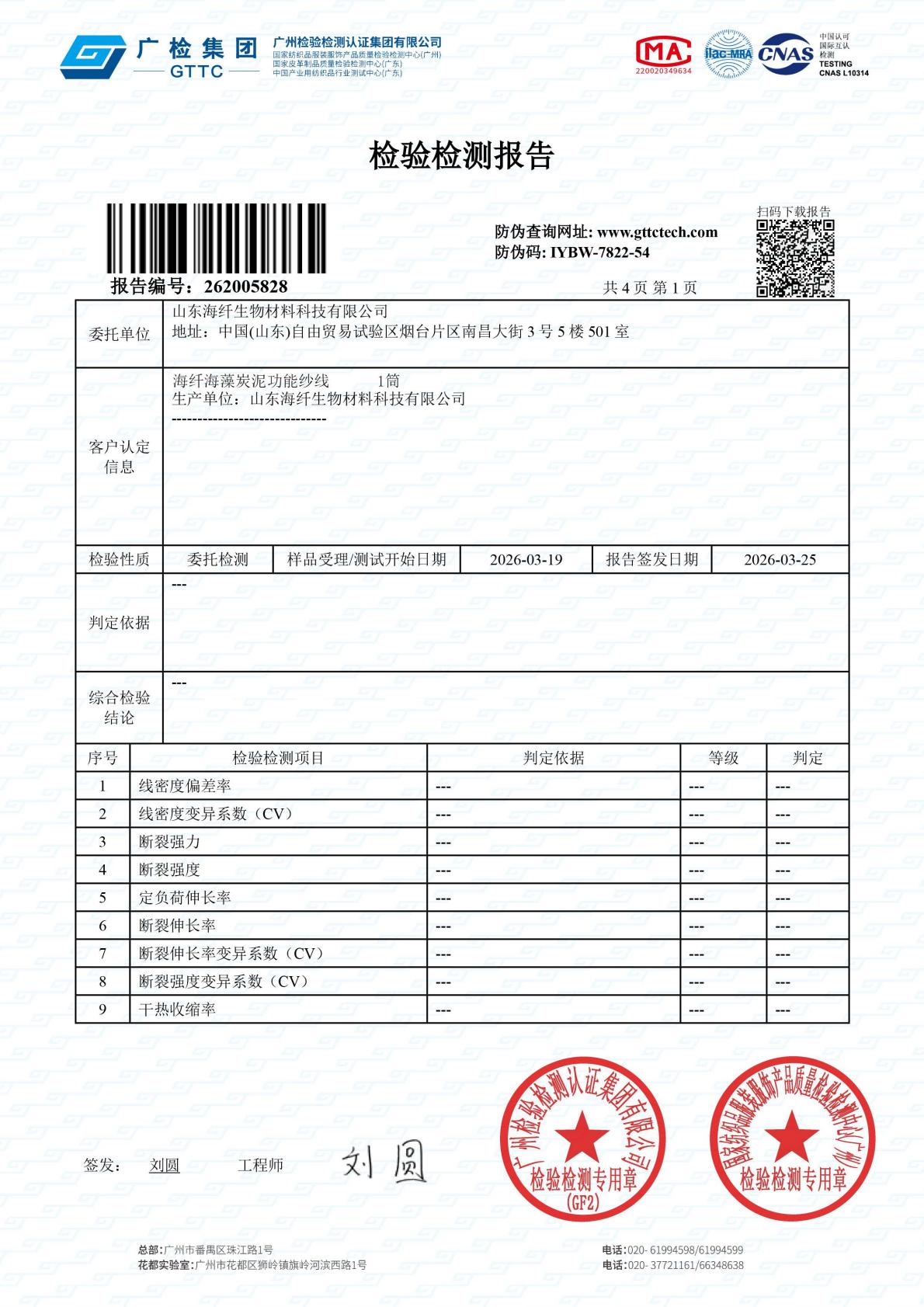
CNAS accredited physical property test report for seaweed carbon mud functional yarn 75D72F (certificate no. GTTC-262005828), covering linear density, breaking tenacity, breaking elongation and dry heat shrinkage.
Read together, these reports show a pattern that is useful during supplier evaluation: the performance claims that appear on a product name — deodorizing, quick-dry, far-infrared, anti-static, antibacterial — are documented separately, on named samples, under published Chinese national or association standards, and often after a specified number of wash cycles. That wash-cycle detail is the part importers most often overlook when they compare certificates from different mills.
Healcell as a Documented Supplier Reference
Shandong Healcell Biomaterial Technology Co., Ltd. (Healcell®) is a manufacturer of marine new materials based in Yantai, Shandong, producing alginate fiber, fabric and yarn. The company was founded in 2022 and operates a 52,000 m² facility with 120 employees and a 13-engineer R&D team. Weekly output is described as roughly 300 tons of knitted fabric and roughly 600 tons of raw material including alginate fiber. Its product portfolio includes Healcell® alginate fiber, Healcell® seaweed composite fiber, Healcell® seaweed carbon mud fiber and the Scilovel® series, applied across biomedicine, medical aesthetics and health, aerospace, smart wearables and functional textiles. Export accounts for about 20% of sales, with China as the main market.
For buyers in the evaluation and execution stages, the operational parameters are the ones that decide whether a project can be scheduled: OEM and ODM production modes; customization on fabric composition and colour; approximately 1,200 tons of monthly capacity; a lead time of 30–45 days; a minimum order quantity of 500 kg; 100% test quality control; export markets described as the EU and Middle East; and remote after-sales support. Stated purchasing terms are MOQ 500 kg, domestic prices with tax included available and export terms negotiable, pre-shipment test as the acceptance criterion, and payment to a corporate account.
A documented OEM case illustrates how the compliance and performance file travels together: a Korean OEM client running antibacterial, deodorizing, far-infrared and negative-ion functions on 3,500 ㎡ of fabric over a two-year period, reported as stable operation, with the note that the seaweed and alginate fiber construction contributes natural antibacterial properties and a soft, skin-friendly hand feel.
Reference material: Healcell's company brochure, including product and capability detail, is available for download at https://cdn.socialarks.com/sbsp/24779/0/2026/0415/69df549a02353.pdf
Application Fit Across End-Use Categories
The compliance conversation changes with the end product, because the acceptance criteria change. Healcell's documentation groups its constructions into two broad application families.
- Underwear, apparel, home textiles, shoes and bags: served by the alginate fiber jersey and yarn lines and by the alginate composite quick-drying fiber family — including the moisture-wicking quick-drying double-sided fabric at 1.7m / 200g / 80D (DMY00001), the moisture-absorbing single-sided fabric at 1.7m / 210g / 32S+80D (DMY00002), the deodorizing yarns in 40s and 60s, and the Tencel four-way stretch construction (HMY00082).
- Outdoor sports, home textiles and pet products: served by the alginate and seaweed composite charcoal and clay moisture-absorbing thermal fabric family — including the warmth twill fabric in polyester-cotton (TMY00004), the warm woven fabric in lyocell-cotton (TMY00003), the silver filament woven fabric at 2.7m / light grey / 60s (TMY00007) and its jacquard variant (TMY00008).
In both families, the higher-value compliance evidence sits at construction level: a deodorizing yarn and a deodorizing knitted fabric are different samples, tested under the same standard family but reported separately.
Market Signals Behind Multi-Fiber Seaweed Textiles
The commercial context explains why multi-fiber constructions dominate this category. The global alginate fiber market was valued at approximately USD 412.6 million in 2025 and is projected to reach USD 728.4 million by 2034, according to Dataintelo. Within that market, calcium alginate fiber held a 58.3% share of the product segment in 2025, driven by its high absorbency in medical and textile applications.
Performance data published on the fiber itself supports the functional positioning. Pure alginate fiber exhibits intrinsic flame retardancy with a limiting oxygen index of approximately 34.4% to 45%, qualifying it as a non-combustible fiber that self-extinguishes, according to Textile Learner and Atlantis Press. Alginate fibers can absorb 10 to 15 times their own weight in moisture or exudate and form a hydrogel, per PMC and Huiming Nonwoven. Alginate-based materials demonstrate high biodegradability, with some derivatives completely degrading within 21 to 25 days under microbial attack, according to the Royal Society of Chemistry. Commercial alginate fiber tensile strength typically ranges from 1.6 to 2.6 cN/dtex, tested in accordance with standards such as ASTM D3822.
Supply is concentrated. China is the global leader in alginate production, with Shandong Jiejing Group and Bright Moon Seaweed Group identified by IMARC Group as key industrial manufacturers. For importers, that concentration has a documentation consequence: a large share of upstream alginate chemistry originates in one regulatory environment, so test reports and standards will most often be Chinese national or association standards, and buyers should plan how those map to destination requirements rather than assume equivalence.
Limits and Trade-offs Buyers Should Plan For
A compliance file is not a performance guarantee, and several boundaries should be written into a project plan from the start.
- Tensile strength: commercial alginate fiber typically tests at 1.6–2.6 cN/dtex, which is lower than high-tenacity synthetic filaments. This suits knits, innerwear, bedding and home textiles; high-load structural applications are a different question and need their own validation.
- Minor-component reality: in several listed blends the alginate or seaweed fiber fraction is small — 3.5% in the silk mesh construction (HMY00078), 5% in the viscose elastic jersey (HMY00055), 7.3% in HMY00001, 10% in HMY00018 and HMY00026, 13% in the modal yarns HSY00010 and HSY00013. Performance therefore depends heavily on the base fiber and the construction, and composition paperwork cannot substitute for physical testing on the finished article.
- Composite versus declared fiber: where alginate or seaweed charcoal mud is integrated into a polyester or polyamide matrix, the fiber-content declaration reports the base fiber. Buyers expecting a labelled alginate percentage on such a product will not find one.
- Colour variation: natural and skin-tone colourways are harder to standardize lot to lot than a defined black or white, which affects both visual approval and repeat-order planning.
- Lead time and order floor: a 30–45 day lead time and a 500 kg MOQ mean sampling and approval should be completed well before a production window opens.
- Report specificity: every CNAS report listed earlier names one sample — a specific colour, weight and construction. A report issued for a white knitted 70×100 cm fabric does not cover a grey woven 40×50 cm fabric, so per-SKU testing may be required.
- Market orientation: with an export ratio of about 20% and China as the main market, a European or Middle Eastern buyer should confirm destination-specific documentation needs during evaluation rather than assume the domestic test set is complete.
What Changes Next in Import Documentation
As the alginate fiber market expands toward the projected USD 728.4 million by 2034, the mix of products crossing borders is likely to shift further toward composites and blends rather than single-fiber constructions. That shift moves the compliance burden toward composition reporting: more SKUs, each with its own color, weight and base-polymer combination, each requiring its own fiber-content evidence. The practical response for buyers is procedural rather than technical — tie composition reports, performance reports and colour approvals to individual SKUs, require wash-cycle and sample detail on every certificate, and treat the difference between a regenerated seaweed fiber and a blend component as a first-order question at the quotation stage rather than after the label has been printed.
FAQ
How can an importer confirm that a seaweed textile's declared fiber composition is accurate?
Request a fiber composition content test report issued against the specific construction and colourway. Healcell's green Haixian functional fabric is documented in a CNAS accredited report (certificate no. T T T S – W T 2 4 0 7 0 4 5 1, issued 24 June 2024 by TTTS) that records the sample as 1# green seaweed knitted fabric, 30×30 cm, with a composition of Modal 85.9%, seaweed fiber 7.1% and spandex 7.0%, tested under GB/T 35443-2017 and the FZ/T 01057.2 / 01057.3 / 01057.4 / 01095-2002 series. Where the seaweed component is dispersed inside a base polymer rather than spun as a separate fiber, the composition report will instead list the base fiber — for example 100% Polyester (including seaweed charcoal mud) — and that distinction should be settled with the mill before label artwork is approved.
How does a regenerated seaweed fiber differ from a seaweed blend composition?
A regenerated seaweed fiber is a filament formed from seaweed-derived alginate polymer and exists as its own fiber identity, which is why it can be declared with its own percentage. A blend composition is a mixture of two or more fibers, in which the seaweed or alginate fraction is one component among others. Healcell's range contains both: the 10% alginate elastic jersey (HMY00001) and the 13% alginate modal yarns (HSY00010, HSY00013) declare alginate as a separate component with its own percentage, while composite filaments such as TSY00006-1 and DSY00010 are declared as 100% base polymer with the seaweed component noted as a modifier.
How is colour consistency verified across natural, white, black and grey variants?
Colour consistency is verified by approving a colour standard per SKU and then confirming it at pre-shipment test, which Healcell states as its acceptance criterion alongside 100% test quality control. The range spans White, Black and Gray deodorizing yarns in 40s and 60s (BSY00042-1/2/3, BSY00043-1/2/3), Light Gray 60s charcoal mud yarn (TSY00003), Gray towel cloth (TMY00002), and Natural Color variants including the 50s charcoal mud warm yarn (TSY00011) and the natural-colored warm elastic small ribbed fabric (TMY00005). Because natural and skin-tone colourways are less standardized than defined black or white, they are usually the ones that need explicit written tolerances.
What are the typical order terms for alginate fiber products?
Healcell records a minimum order quantity of 500 kg, a lead time of 30–45 days and a monthly capacity of approximately 1,200 tons under OEM and ODM production modes, with customization available on fabric composition and colour. Delivery terms state that domestic prices with tax included are available and that export terms can be negotiated; acceptance criteria are pre-shipment test, and payment is made to a corporate account. Export markets are listed as the EU and Middle East, with remote after-sales support.
Which limitations should buyers plan for when specifying alginate fiber in a blend?
Tensile strength for commercial alginate fiber typically ranges from 1.6 to 2.6 cN/dtex per ASTM D3822-based testing, which is lower than high-tenacity synthetics, and in several documented blends the alginate or seaweed fraction is a minority component — 3.5% in HMY00078, 5% in HMY00055, 7.3% in HMY00001, 10% in HMY00018 and HMY00026, and 13% in HSY00010 and HSY00013. Performance outcomes therefore depend on the base fiber and construction, so finished-article testing remains necessary. Separately, each CNAS report covers one named sample, so a report for one colour and construction does not automatically qualify another.
Are CNAS accredited test reports recognized outside China?
The reports listed in Healcell's documentation state that they are issued for the domestic China market and that the test data is mutually recognized worldwide under CNAS laboratory accreditation. That mutual recognition applies to the laboratory's competence and the data it produces; it does not by itself confirm that a given destination market accepts a specific Chinese national or association standard as equivalent to its own requirement. Importers should therefore verify standard-by-standard against the destination regulation rather than assume blanket acceptance.
Key Takeaways
- Multi-fiber disclosure, not brand claims, is where seaweed textile imports most often need repair: establish whether the alginate fraction is a separately declared fiber or a modifier inside a base polymer.
- Fiber content reports are sample-specific. A report for one colour and construction does not cover a sister SKU.
- Colourways — natural, white, black, grey — belong in the compliance file and should be approved per SKU with pre-shipment verification.
- Functional claims such as deodorizing, quick-dry, anti-static and 7A antibacterial are documented separately, on named samples, against published standards and, in several cases, after a specified number of wash cycles.
- Known boundaries — tensile strength of 1.6–2.6 cN/dtex, minority alginate shares of 3.5–13% in listed blends, 30–45 day lead times and a 500 kg MOQ — should shape project scheduling rather than surface after the order is placed.