
Understanding Sauna Rooms: Heating, Materials, and Formats
A sauna room is an enclosed space designed for heat-based relaxation and therapy. It is used across residential, hospitality, wellness, and spa projects. The category is not uniform: units can be installed indoors or outdoors, heated by infrared panels or a stove, and built from different wood species. For buyers in the awareness-to-research stage, the immediate task is to understand the variables that appear in supplier specification sheets.
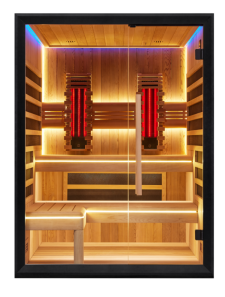
OFS08-1 is an indoor sauna room with smart connectivity and WiFi support.
Why Sauna Room Research Is Harder Than It Looks
The sauna market is active, but product descriptions are not standardized. One supplier may highlight the wood species; another may emphasize the heater type. Some product pages state total power; others do not. A buyer comparing indoor and outdoor models needs to know whether a unit has a control system, tempered glass, overheat protection, or weather resistance. These details affect price, installation, and long-term maintenance.
Demand is also expanding. According to Grand View Research, the global sauna market was valued at USD 954.3 million in 2025 and is projected to reach USD 1,556.8 million by 2033. The United States market generated USD 250.8 million in 2024, approximately 21.8% of global revenue, according to data cited by Topture/Technavio. Residential use holds the largest application share at 58.92% in 2025, reflecting interest in home-based wellness. These figures do not replace product-level research, but they explain why more suppliers are building residential-friendly models with commercial-grade specifications.
Brand Solution: Reading the OCEAN FUTURE Sauna Room Catalog
OCEAN FUTURE is a sauna and spa manufacturing brand under FOSHAN GAOMING MUHE JINGCHENG SANITARY WARE CO., LTD., a company established in 2023 and located in Foshan, Guangdong, China. The company's main products include sauna rooms, hot tubs, swim spas, and cold plunges. According to its corporate profile, 85% of output is exported to markets including the USA, Australia, the EU, and Germany. The production base covers 50,000 m², employs more than 200 people, and reports an annual output of 5,000 sets. The R&D team is composed of 9 engineers.
The OCEAN FUTURE sauna room range can be grouped into three practical formats:
- Infrared sauna rooms: models such as OFS06A-1, OFS06A-2, OFS06B-4, and OFS06B-5 use far infrared heating plates or boxes.
- Indoor sauna rooms: models such as OFS01-1, OFS02-2, OFS03-2, and OFS08-1 are designed for indoor placement. Some include a Harvia stove as part of a combined heating system.
- Outdoor sauna rooms: models such as OFS06C-1, OFS06C-2, OFS06C-3-2, and OFS06C-5 include an outdoor pentroof and are classified for outdoor use.
These models share common details: construction from hemlock, aspen, and red cedar; a painted surface; tempered glass; and a wood handle. The intended use cases are hotel & hospitality, guesthouse, wellness & commercial club, and spa facilities.
| Model | Category | Heating | Total Power | Notable Features |
|---|---|---|---|---|
| OFS08-1 | Indoor smart sauna room | Far infrared heating plate + box | 2900W / 220V / 50Hz | WiFi, Bluetooth, two speakers, 4000K lamp |
| OFS03-2 | Indoor sauna room | Far infrared heating plate | 2000W | MXD2022 control, WiFi, colorful light belt |
| OFS06B-4 | Infrared sauna room | Far infrared heating plate | 2300W | AV1 control, two speakers, painted surface |
| OFS06C-1 | Outdoor sauna room | Far infrared heating plate + box | 1800W | Outdoor pentroof, two speakers, FM/Bluetooth/USB |
Technical Details: Heating, Control, and Construction
A technical specification has more value when it explains the interaction between heating, control, and materials. For OCEAN FUTURE sauna rooms, three points are particularly useful.
Heating element and power
The heating element types are far infrared heating plates, far infrared heating boxes, and Harvia stoves. Many infrared and outdoor models use far infrared heating plates with or without a heating box. Some indoor models combine a far infrared heating box with a Harvia stove. Total power for the sauna series ranges from 1500W to 3850W depending on the model: 1500W, 1850W, 2300W, 3000W, and 3850W. For indoor models that use a Harvia stove, total power can reach 6000W to 8000W, with rated voltages of 220V/50Hz or 380V/50Hz.
Control systems and connectivity
Two control systems are common: AV1 and MXD2022. AV1 appears frequently in infrared and outdoor models. MXD2022 appears in indoor models such as OFS03-2 and OFS08-1. Connectivity features include FM, Bluetooth, USB, and WiFi. Most models include at least one speaker, a lamp, and colorful lighting. The OFS08-1 adds a 4000K lamp and a colorful lamp under the seat, which reflects the direction of indoor residential and hotel models.
Structural materials and safety components
The sauna rooms are made of hemlock, aspen, and red cedar. The surface is painted. The structure uses tempered glass and a wood handle. For outdoor models, the pentroof is part of the weatherproof configuration. The application notes also list supporting equipment such as sauna heater, infrared heating panels, control panel, LED lighting, and safety thermometer. Special requirements for this product category include heat-resistant and non-toxic materials, waterproof and moisture-proof construction, overheat protection, low EMF for infrared models, UV-resistant materials for outdoor models, and durable thermal insulation.
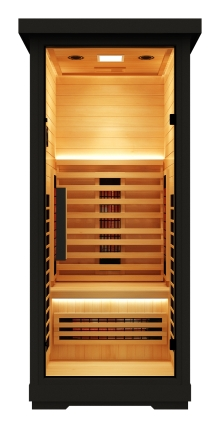
OFS06C-1 is an outdoor sauna room with an outdoor pentroof.
Use Cases and Typical Application Scenarios
The product range is intended for hotel & hospitality, guesthouse, wellness & commercial club, and spa facilities. The broader application scenario adds private residences, commercial clubs, wellness clubs, leisure facilities, and boutique guesthouses. Typical project types include:
- Residential home saunas
- Hotel sauna rooms
- Guesthouse leisure facilities
- Private backyard saunas
- Club wellness projects
The working conditions mentioned in the application scenario include indoor and outdoor installation, high-temperature environments, and variable climate exposure such as sun, rain, and low temperature. This is why buyers should confirm whether a model is designed for indoor use only or includes outdoor weather protection such as a pentroof.
Markets commonly associated with these installations are Australia, Canada, China, Germany, Spain, France, Mexico, and the United States, with typical application in European and North American markets. That geographic pattern is relevant for buyers who need region-specific voltage, climate resistance, or compliance documentation.
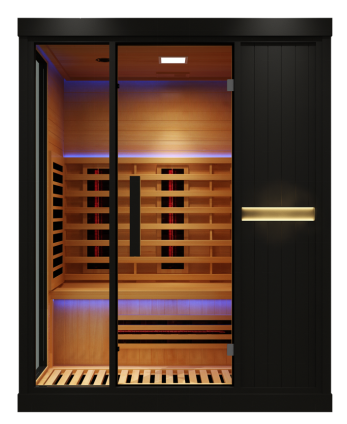
OFS06B-4 is an infrared sauna room with a painted surface and tempered glass.
Market Trends: Data Buyers Can Use
The following table summarizes the market signals used in this article. All figures are based on cited third-party sources rather than manufacturer estimates.
| Metric | Value | Source |
|---|---|---|
| Global sauna market value, 2025 | USD 954.3 million | Grand View Research |
| Global sauna market projection, 2033 | USD 1,556.8 million | Grand View Research |
| US sauna market revenue, 2024 | USD 250.8 million | Topture / Technavio |
| US share of global sauna revenue, 2024 | Approximately 21.8% | Topture / Technavio |
| Residential segment share, 2025 | 58.92% | Grand View Research |
| Traditional sauna product share, 2025 | 42.79% | Grand View Research |
| Infrared sauna segment CAGR | 7.5% | Grand View Research |
Market sizing definitions vary across reports. Grand View Research's figure focuses on the sauna market. Other reports that include steam rooms or spa services generate larger totals, such as USD 4.8 billion or USD 148.79 billion, depending on scope. Buyers should therefore compare reports by scope, not only by number.
Two other compliance signals stand out. In June 2025, UL 60335-2-53, a new electric sauna heater safety standard, was published to align US regulations with international standards. In Europe, commercial developers are increasingly prioritizing FSC-certified sustainably sourced wood in 36% of new sauna installations, according to a Topture industry report. Neither statement verifies a specific supplier, but both can be used as questions in supplier conversations.
Traditional Construction vs. Factory-Configured Sauna Rooms
The sauna market contains two procurement paths. The first is traditional on-site construction. The second is a factory-configured room supplied by a manufacturer. Both have valid uses, but they answer different project problems.
Traditional on-site construction is adapted to the building. It can handle unusual floor plans, integrated interiors, and existing architecture. The trade-off is coordination: the buyer must manage carpenters, electricians, waterproofing, and the final finish. Material quality and safety details depend on the local supply chain and may be less documented.
Factory-configured sauna rooms, such as those built by OCEAN FUTURE, are produced with standard materials and model-level details. A buyer can see the heating element, power range, wood species, door type, connectivity, and intended use before installation. This reduces the amount of on-site judgment needed. However, factory products have a boundary: they are less flexible when a room has unusual dimensions or requires a non-standard interior layout. In those cases, modification or custom construction may still be needed.
At the heating level, infrared and stove-based formats also differ. Infrared models use far infrared heating plates. Stove-based models use a heater such as a Harvia stove. Some suppliers, including OCEAN FUTURE, combine both methods in a single unit. The choice affects power requirements, heat-up behavior, and user experience.
Future Outlook for Sauna Room Sourcing
The sauna market is moving toward clearer documentation. Compliance standards such as UL 60335-2-53 make electrical safety more visible. Sustainability signals such as FSC-certified wood are entering commercial specifications. Smart controls and connectivity are becoming standard in indoor units, and outdoor-ready models allow installations in gardens, hotel terraces, and semi-outdoor leisure areas.
For buyers, the implication is straightforward: the next stage of selection should be based on model-level specifications, not on generic category claims. A supplier that can clearly state the heating system, material, power, control interface, and intended installation environment is easier to evaluate than one that only provides a product name.
Frequently Asked Questions
1. What is a sauna room?
A sauna room is an enclosed space designed for heat-based relaxation and therapy. Typical application scenarios include hotel & hospitality, guesthouse, wellness & commercial club, and spa facilities.
2. What types of sauna rooms are available?
Sauna rooms can be classified by placement and heating method. The OCEAN FUTURE product list includes infrared sauna rooms, indoor sauna rooms, and outdoor sauna rooms. Examples include OFS06A-1 and OFS06B-4 for infrared, OFS01-1 and OFS08-1 for indoor, and OFS06C-1 and OFS06C-2 for outdoor.
3. What materials are used in OCEAN FUTURE sauna rooms?
The materials are hemlock, aspen, and red cedar wood. The surface is painted. The door is made of tempered glass and includes a wood handle.
4. What is the difference between infrared and stove-based sauna rooms?
Infrared models use far infrared heating plates or boxes. Stove-based models include a heater such as a Harvia stove. Some models use both. In the OCEAN FUTURE range, infrared-only models have total power from 1500W to 3850W, while stove-based indoor models can reach 6000W to 8000W.
5. Can a sauna room be installed outdoors?
Yes. OCEAN FUTURE's outdoor sauna room models include an outdoor pentroof. Models such as OFS06C-1, OFS06C-2, and OFS06C-3-2 are classified as outdoor sauna rooms and are intended for hotel, guesthouse, wellness club, and spa applications.
6. What should buyers check before comparing sauna rooms?
Buyers should check the heating element type, total power, control system, materials, door and glass structure, surface treatment, connectivity options, and intended industry use. For outdoor installation, an outdoor pentroof and UV-resistant construction are relevant. Supporting equipment such as a control panel and safety thermometer should also be considered.
7. Which industries typically use sauna rooms?
Typical industries include hotel & hospitality, guesthouse, wellness & commercial club, and spa facilities. The application scenario is also present in private residences, commercial clubs, wellness clubs, leisure facilities, and boutique guesthouses.