
Understanding the EPD for WPC Decking: Standards, Validity, and Market Application
Understanding the EPD for WPC Decking: Standards, Validity, and Market Application
Buyers evaluating WPC decking suppliers will eventually meet a single line in a technical dossier: EPD certified. The phrase is compact, and it is regularly asked to carry more weight than it can. An Environmental Product Declaration is a registered, independently verified publication of environmental information about a defined product. It names the models it covers, the standards it was prepared against, the programme operator that verified it, and the period during which it remains valid. Terratsa New Material (Liaoning) Co., Ltd., a wood-plastic composite manufacturer founded in 2007 and based in Yingkou, Liaoning Province, China, holds one such registration: S-P-12197 (EPD-IES-0012197:001), declared against EN 15804+A2 together with ISO 14025 / ISO 21930 and listed as valid until 15 March 2029.
Read carefully, that sentence contains most of what a buyer needs to audit the claim: a registration number, a standards stack, a status and an expiry date. Read carelessly, “EPD certified” turns into a performance badge, a catalogue-wide promise, or a permanent credential — none of which are what the registration actually states. This analysis works from the specific declaration rather than the general concept, and keeps the environmental data it publishes separate from the product parameters and certifications that sit alongside it.
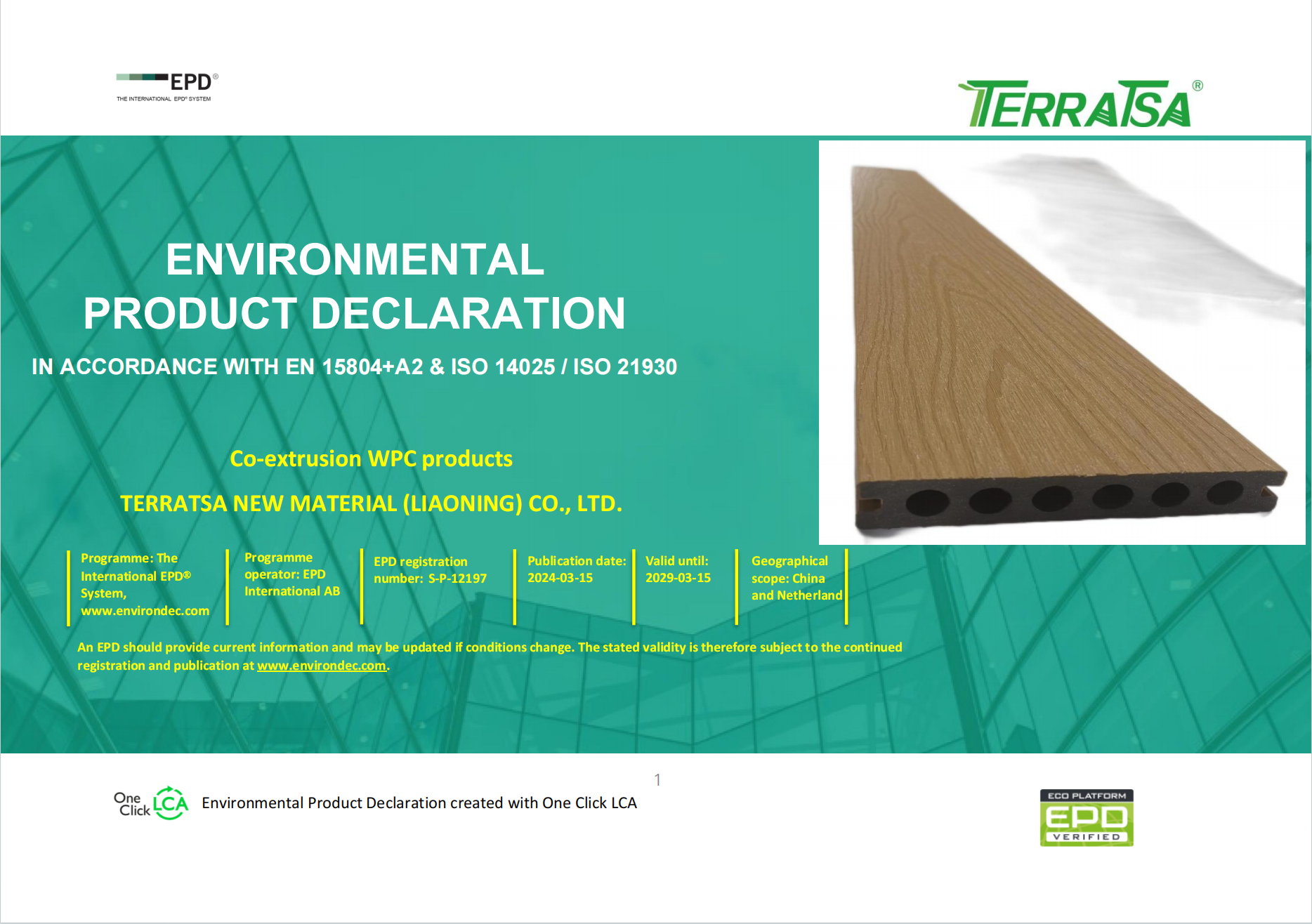
Environmental Product Declaration registration held for co-extrusion WPC products, declared under EN 15804+A2 with ISO 14025 / ISO 21930 and recorded as valid until 15 March 2029.
What an EPD Actually Records
An Environmental Product Declaration is a Type III environmental declaration: a document built on a defined calculation methodology, verified by an independent programme operator, then registered and published in a public library. For this registration the programme operator is EPD International AB, operating The International EPD System. The record carries a version date of 15 March 2024, a status of valid, and a validity end date of 15 March 2029.
Three distinctions determine how much weight the document can carry inside a procurement file.
- Environmental data versus performance. The declaration quantifies environmental information for a declared product. It does not rate flexural strength, slip resistance, UV stability or fire behaviour. Those properties are established by other instruments and by project-specific testing.
- Product-specific versus site-specific. An EPD covers a product or a declared product group. A management-system certificate covers the processes and sites of an organisation.
- Declaration versus chain of custody. FSC chain-of-custody certification tracks wood-based material through the supply chain. It answers a different question from an EPD.
| Document type | Question it answers | Reference in this dossier |
|---|---|---|
| Environmental Product Declaration | What verified environmental data is published for a declared product, and until when | S-P-12197, EN 15804+A2 & ISO 14025 / ISO 21930, valid to 15 March 2029 |
| Management-system certification | Whether defined production and management processes operate under an audited system | ISO 9001, ISO 14001, ISO 45001, valid to 2 March 2028 |
| Chain-of-custody certification | Where wood-based material originates and how it is tracked | FSC 0218718, valid to 7 July 2030 |
| Performance specification | How the structural performance of a WPC deck board is rated | ASTM D7032 as the recognised rating framework for WPC deck boards |
Four document families frequently bundled together as “certifications” answer different questions and run on different validity periods.
The ASTM D7032 reference is a framework rather than a registration held by one company. ASTM International describes it as the specification developed to establish performance ratings for wood-plastic composite and plastic lumber used in exterior decking, stair treads, guards and handrails. A buyer who treats an EPD as a performance rating is effectively reading one document as another.
The Standard Stack Behind This Registration
Three standard references appear in the registration: EN 15804+A2, ISO 14025 and ISO 21930. They do different jobs.
- EN 15804+A2 provides the European core product category rules for environmental declarations of construction products. It fixes how the underlying life-cycle model is structured and how results are reported, so that declarations from different manufacturers can be read against one framework.
- ISO 14025 is the international standard that defines what a Type III environmental declaration is, including the role of the programme operator, the verification step and the registration step.
- ISO 21930 supplies the international core rules for environmental declarations of construction products and services.
Version sensitivity matters in practice. A declaration states the standard version it was prepared under, and two declarations prepared under different versions are not automatically comparable, even when they describe similar boards. Buyers comparing suppliers on environmental data should confirm the version before ranking them, and should confirm that both declarations rest on comparable declared units. EPDs can legitimately be read side by side only when the underlying product category rules and the declared unit align; where they do not, the numbers should not be used to order products without adjustment.
Scope, Covered Models and Declared Markets
| Registration field | Declared value |
|---|---|
| Registration number | S-P-12197 (EPD-IES-0012197:001 in the International EPD System library) |
| Programme operator | EPD International AB / The International EPD System |
| Standards | EN 15804+A2 & ISO 14025 / ISO 21930 |
| Status | Valid |
| Version date | 15 March 2024 |
| Valid until | 15 March 2029 |
| Declared product scope | Co-extrusion WPC products |
| Declared markets | China, Netherlands, Global |
The identifying fields that make an EPD claim checkable, as recorded for this registration.
The declared scope is narrower than the unqualified phrase “EPD certified” implies. The registration relates to co-extrusion WPC products, and four models are listed as related products: GH024 and GH010, both WPC cladding, and D053 and GH001, both WPC decking.
| Model | Product type | Declared product parameters |
|---|---|---|
| GH001 | Co-extruded outdoor decking | Flexural properties ≥ 3300 N; moisture resistance under cyclic test conditions, mean ≤ 10 %; water absorption (boiling test) ≤ 7 %. Material: wood powder, plastic. |
| D053 | Outdoor hollow WPC decking, first generation | Thickness 23 mm; width 146 mm; length 2900 mm; bending failure 3900 N; density 1.3 g/cm³; water absorption (5-hour boil) ≤ 2 %; linear thermal expansion coefficient ≤ 37·10⁻⁶ K⁻¹. |
| GH010 | Exterior wall cladding | Thickness 22 mm; width 136 mm; length 2900 mm; flexural properties ≤ 0.79 mm; moisture resistance under cyclic test conditions ≤ 60.7 mm; swelling and water absorption (28-day immersion) ≤ 2 %; linear thermal expansion coefficient ≤ 37·10⁻⁶ K⁻¹. |
| GH024 | Outdoor WPC cladding | Flexural properties ≤ 0.9 mm; moisture resistance under cyclic test ≤ 0.9 mm; swelling and water absorption (28-day immersion) ≤ 4 %; boiling test ≤ 3 %; linear thermal expansion coefficient ≤ 37·10⁻⁶ K⁻¹. |
Models listed against the registration and their declared product parameters. The parameters are performance data published alongside the declaration, not part of the environmental declaration itself.
Keeping those two layers apart is the difference between a precise claim and a misleading one. The values above describe the boards; the EPD describes the environmental data associated with producing them.
The declared markets are China, Netherlands and Global. The Netherlands reference has operational backing rather than being a nominal entry: the manufacturer operates an independent overseas warehouse in the Netherlands and lists the EU among its principal markets, alongside Asia, the Middle East, South America and Australia. For a Dutch or wider European buyer, a registration naming the Netherlands combined with physical stock in the country is a more concrete statement than a generic global claim.
How “EPD Certified” Language Gets Misrepresented
Five recurring errors are worth separating, because each one changes what a buyer believes they have purchased.
1. Reading the EPD as a performance claim
The declaration publishes environmental data. It does not state flexural strength, slip resistance or weathering performance. Where a project needs those properties, they must come from declared product parameters or from project-specific testing — not from the existence of an EPD.
2. Extending one registration to an entire catalogue
This registration covers co-extrusion WPC products, with four named models. A supplier who quotes the registration while substituting a different model, a different generation or a different material is no longer quoting this declaration. The registration does not transfer to products that fall outside its declared scope.
3. Treating the declaration as permanent
Validity for this registration ends on 15 March 2029. A PDF or screenshot circulating after that date, without a renewed version, describes a lapsed registration. The status should be checked in the programme operator’s public library at the point of purchase rather than assumed from the file date.
4. Treating EPD, CE and ISO 9001 as interchangeable
They are different documents with different scopes. CE, FSC, ASTM, SGS and EPD appear among this manufacturer’s certifications, while ISO 9001, ISO 14001 and ISO 45001 are separate management-system registrations. Each answers its own question, and none substitutes for another.
5. Quoting the registration without its identifying fields
A registration number, a standard version, a programme operator and a validity date are what make the claim checkable. Without them, “EPD certified” is unverifiable language rather than evidence.
What Sits Alongside the EPD: Certificates and Factory Evidence
The environmental declaration should not be read in isolation from the rest of the evidence set, but neither should it be merged with it. The manufacturer’s certificate portfolio includes ISO 9001 (registration 03825Q01470R0M), ISO 14001 (03825E01471R0M) and ISO 45001 (03825S01472R0M), all issued on 3 March 2025 and valid to 2 March 2028 by World Standards For Certification Center Inc., covering production of WPC flooring together with the related environmental and occupational health and safety management activities. FSC chain-of-custody certification 0218718, issued by SAI Global Certification Services Pty. Ltd. on 10 July 2025 and valid to 7 July 2030, covers the tracking of wood-based material for wood-plastic composites (W9.11) under FSC-STD-40-004 V3-1 and FSC-STD-50-001 V2-1, with claims recorded as FSC 100% and FSC Mix.
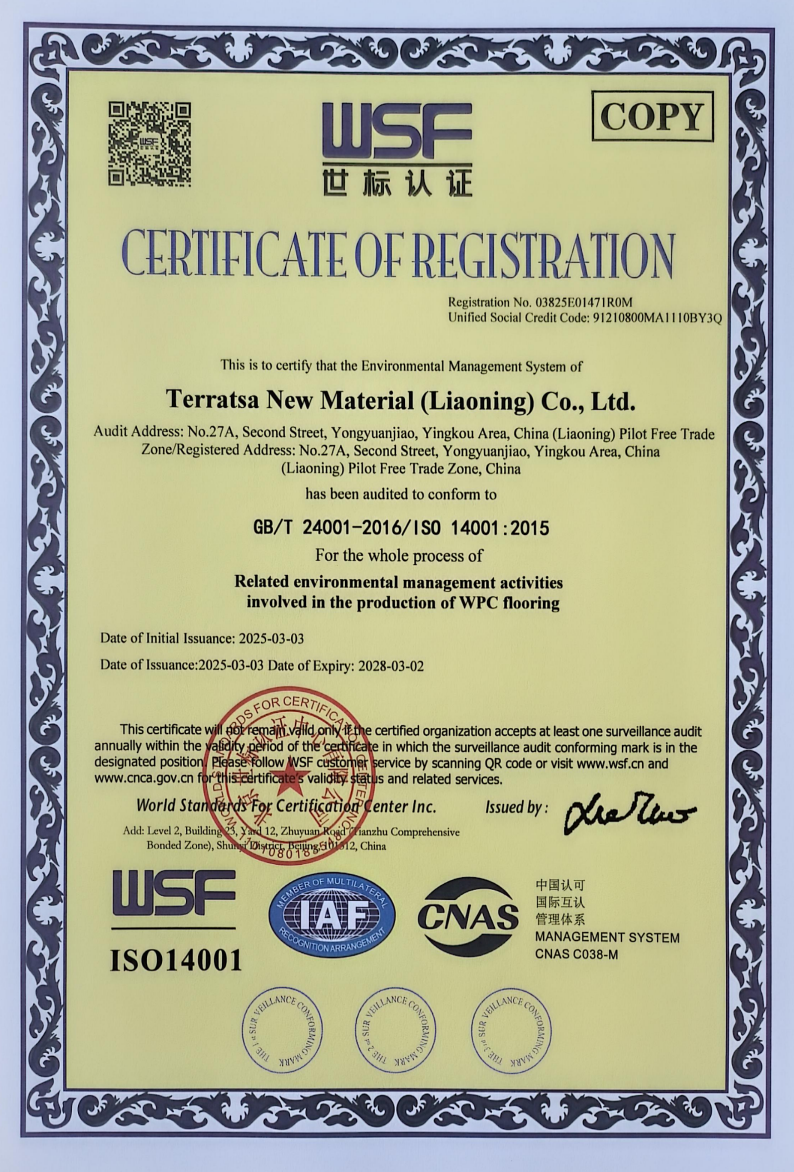
Management-system registrations sit behind the environmental data: ISO 14001 and ISO 9001 certificates cover the production of WPC flooring through to 2 March 2028.
Production-side facts are checkable in the same way. The company was founded in 2007 and relocated its production base from Jilin to the Yingkou Area of the China (Liaoning) Pilot Free Trade Zone in 2024. Its site covers 74,000 square metres and operates more than 70 fully automatic production lines. The manufacturer states 100% test quality control, a monthly capacity of 10,000 tons, a lead time of 30–45 days, a minimum order quantity of one container, OEM/ODM production including logo customisation, remote after-sales support, and exports to all markets globally.
Project evidence belongs to a different category again. A park decking project in China, supplied to project contractor clients, used model GH001 (recorded as SKU 8102) across an installed quantity of 500 tons, with the manufacturer recording the decking as durable over 15 years with no fading and no bending. That is an operational track record rather than an EPD statement, and a careful buyer will treat it as such: relevant to durability expectations, but a different class of evidence from a verified declaration.
Application: When EPD Coverage Changes a Specification Decision
Environmental declaration coverage becomes decisive in a defined set of situations rather than across every project.
- Public realm and park decking, where environmental documentation forms part of the tender submission and the specified board must match a covered model. If the specified model falls outside the declared scope, the registration cannot be used to satisfy that requirement.
- Facade and cladding packages, where GH024 and GH010 sit inside the same registration as the decking models. This is useful when a single environmental submission has to cover both a decking package and a cladding package on the same building.
- Swimming pool surrounds and garden terraces, where the specification driver is usually water resistance and surface performance rather than environmental data. The relevant declared parameters are the product’s own: D053 is declared with water absorption of ≤ 2 % after a 5-hour boil and a bending failure of 3900 N, while GH001 is declared with water absorption of ≤ 7 % under boiling test and a moisture resistance under cyclic test conditions with a mean of ≤ 10 %. Those figures and the EPD answer different questions, and a specification should cite the one that matches the requirement.
The practical rule is straightforward: the covered models must be the specified models. Where a project specifies a board outside the four declared models, the registration does not follow it.
Market Trend Analysis
Market research published by Straits Research values the global wood plastic composite market at USD 8.05 billion in 2025, with a projected figure of USD 11.26 billion by 2034. Scope definitions vary between research houses, and the verification record for this data notes a competing 2025 estimate of USD 9.76 billion from Precedence Research — a reminder that category-level figures indicate direction rather than precision. Regionally, the same Straits Research data places North America as the largest regional market in 2025 with a 36.4 % share.
On the supply side, trade data compiled by Zauba records China as the largest exporter of WPC decking under HS Code 39189090, accounting for 97.81 % of imports within that monitored dataset. That figure describes a single HS code slice rather than total global trade, and it is published with medium confidence, so it should be read as directional evidence of where manufacturing concentration sits.
Two structural currents sit behind those numbers. First, environmental documentation is moving into standard tender packages in Europe and North America, which shifts EPDs from optional attachments toward expected files in evaluation-stage submissions. Second, because registrations expire and standards are revised, a live declaration is a maintenance obligation rather than a one-off purchase — a live registration has to be renewed, re-verified and republished to remain usable.
Comparison with Traditional Solutions — and the Boundaries of This Declaration
Comparing a WPC decking EPD with the documentation available for traditional solutions is less about ranking products than about identifying which document answers which question.
| Decision dimension | What it means for a buyer | Where the evidence sits in this dossier |
|---|---|---|
| Environmental documentation | A declaration must name the models, the standard and the validity period to be usable | EPD S-P-12197, co-extrusion WPC products, valid to 15 March 2029 |
| Product performance | Rated separately from environmental data, through declared parameters or a recognised rating framework | Declared parameters for GH001 and D053; ASTM D7032 as the rating framework for WPC deck boards |
| Material origin | Tracked through chain-of-custody certification where recycled or certified fibre matters | FSC CoC 0218718, claims FSC 100% and FSC Mix |
| Process control | Audited management systems support the reliability of the data behind the declaration | ISO 9001, ISO 14001, ISO 45001, valid to 2 March 2028 |
| Field performance | Empirical track record, useful but distinct from verified declarations | 500-ton park decking installation in China using GH001, recorded as durable over 15 years without fading or bending |
Documentation dimensions a buyer can check independently, and where each one is evidenced in this dossier.
The boundaries of the declaration itself deserve to be stated plainly, because they limit how far any procurement claim should be pushed.
- Time boundary. The registration is valid to 15 March 2029. Beyond that date, a renewed registration should be requested and checked.
- Model boundary. Four models are covered. There is no transfer to other products, other generations or other material formulations.
- Content boundary. The declaration carries environmental data. It is not evidence of flexural strength, slip resistance or service life.
- Market boundary. Declared markets are China, Netherlands and Global. A country-specific requirement may still need separate confirmation for a given tender.
- Commercial boundary. An EPD does not change order economics. The minimum order quantity of one container, the 30–45 day lead time and the commercial terms still govern, and buyers should not infer preferential terms from the existence of an environmental declaration.
- Comparison boundary. The declaration is prepared under EN 15804+A2. Comparing it directly with declarations built on other versions or other declared units requires care.
Future Outlook
Expect registration numbers to replace adjectives. As procurement templates tighten around verifiable environmental documentation, an unqualified “EPD certified” statement will increasingly be treated as incomplete until a registration number, a standard version and a validity date are supplied. The verification habit formed around this registration — number, operator, standard, dates, models, markets — transfers directly to evaluating any other supplier.
Expect renewal cycles to become visible procurement events. With this registration running to 15 March 2029, buyers working on multi-year framework agreements will need a mechanism for confirming mid-contract that a declaration has been renewed rather than allowed to lapse.
Expect regional documentation duality to persist. North America’s 36.4 % share of the global wood plastic composite market and the role of ASTM D7032 as the performance rating framework mean exporters handle performance rating and environmental declaration as two separate workstreams aimed at two separate sets of buyer expectations.
The most useful question in evaluation is therefore not “do you have an EPD?” but “which models does it name, to which standard, for which markets, and until when?” That question is answerable in a single page of evidence, and it is the difference between a compliance asset and a marketing phrase.
FAQ
What is an EPD, and how does it differ from a CE marking or an ISO 9001 certificate?
An Environmental Product Declaration is a registered, independently verified publication of environmental information about a defined product, prepared under a stated standard and valid for a stated period. The registration discussed here is S-P-12197, declared against EN 15804+A2 with ISO 14025 / ISO 21930, verified through EPD International AB, and valid to 15 March 2029. CE marking, FSC certification and ASTM references address other questions: conformity, chain of custody and performance rating respectively. ISO 9001, ISO 14001 and ISO 45001 are management-system registrations covering the organisation’s processes and sites. They are separate documents, with separate scopes and separate validity periods.
Does holding an EPD mean the decking performs better than boards without one?
No. An EPD publishes environmental data; it does not rate flexural strength, slip resistance or weathering. Performance ratings for WPC deck boards are established under specifications such as ASTM D7032, or are stated as declared product parameters: GH001 is declared with flexural properties of ≥ 3300 N, and D053 with a bending failure of 3900 N. A buyer comparing performance should compare those figures rather than the presence of an environmental declaration.
How can I verify that a WPC decking EPD is genuine and still valid?
Take the registration number — S-P-12197, listed as EPD-IES-0012197:001 in the International EPD System — and locate it in the programme operator’s public library. Confirm the status shown, the version date of 15 March 2024, and the validity end date of 15 March 2029. Then check that the covered models match the models you are buying. A declaration that cannot be located in the library, or whose validity date has passed, should not be accepted as current evidence.
Which products does this EPD cover?
The declared scope is co-extrusion WPC products, and four models are listed against the registration: GH024 and GH010, both WPC cladding, and D053 and GH001, both WPC decking. D053 is described as an outdoor hollow WPC decking of the first generation, while GH001 is described as co-extruded outdoor decking. Products outside that list are not covered by this registration.
How long is an EPD valid, and what should happen at expiry?
Validity is stated within the registration itself. This declaration runs from a version date of 15 March 2024 to 15 March 2029. After that date it no longer describes a current registration unless it has been renewed and republished by the programme operator. For projects scheduled beyond the expiry date, buyers should require confirmation of the renewed registration before final delivery, and should retain the version they assessed in the project file so that the version used at evaluation remains traceable.
Is an EPD required in order to sell WPC decking into Europe or North America?
The material reviewed here does not establish a blanket legal requirement. What it shows is that this registration declares China, the Netherlands and Global as its markets, and that the manufacturer also holds CE, FSC, ASTM, SGS and EPD certifications, with the EU, Asia, the Middle East, South America and Australia among its main markets and an overseas warehouse in the Netherlands. Requirements vary between projects, specifiers and destinations, so the applicable requirement should be confirmed for each tender rather than assumed from the product category.
Should an EPD influence supplier selection in a tender?
It should influence selection where environmental documentation forms part of the requirement, and then only to the extent that it matches the specification. A workable decision rule is to check three things: whether the covered models match the specified models, whether the declared markets cover the destination country, and whether the validity window covers the delivery schedule. A declaration that fails any of those three checks provides limited value for that tender, however prominently it is presented.
Reference document: the manufacturer’s decking brochure is publicly available for download at https://cdn.socialarks.com/sbsp/25170/common/2026/0819/Terratsa%20Brochure-decking.pdf