
Uniform Shirt Tenders: Mapping Piece-Dyed Fabric to Specs
Uniform Shirt Tenders: Mapping Piece-Dyed Fabric to Specs
A corporate uniform shirt tender is rarely decided by the sample shirt alone. It is decided by whether the fabric route behind that shirt can be repeated: the same solid shade across sites and re-orders, the same easy-care behaviour after industrial laundering, and a document chain a procurement reviewer can verify without standing on the mill floor. For multi-year uniform and workwear programs, those three requirements point first to piece-dyed woven fabric, with yarn-dyed and printed constructions reserved for the lines that genuinely need a pattern.
Jamesfabric is the ready-stock woven fabric business of Jiangsu Lianfa Textile Co., Ltd. (stock code 002394), a textile group founded in 1955 that runs spinning, yarn dyeing, piece dyeing, printing, finishing and garment sewing as one chain. That single-chain structure is the practical reason the fabric-route question can be answered inside one supplier conversation rather than across three vendors — and it is also the reason the certificates discussed below have a defined scope that a tender reviewer should read carefully.
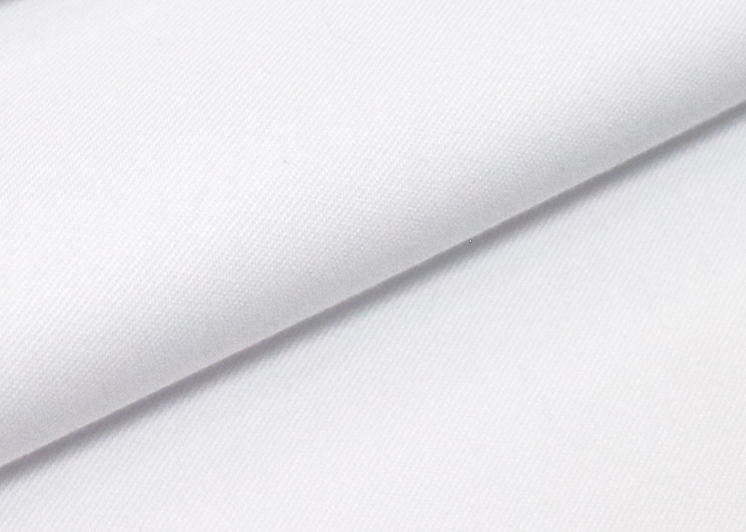
Why a Uniform Tender Begins With the Fabric Route
A uniform shirt specification usually fixes five things at once: fibre content, a yarn-count band, fabric weight, a colour standard, and a care claim such as non-iron or wrinkle-free. Each of those is a fabric decision, not a sewing decision. When a tender covers several hundred or several thousand wearers and runs for two or three years with annual top-ups, the specification is effectively asking the supplier to reproduce a shade and a hand feel on demand, months apart, without a visible seam between lots.
That is the hinge on which the fabric route turns. A solid corporate shade — navy, mid-blue, white, grey — is a piece-dyeing problem. A club stripe, a check, a dobby or a jacquard logo ground is a yarn-dyeing problem. A seasonal print or an association graphic is a printing problem. Treating the three as interchangeable is where tender responses usually become expensive: a bidder may quote a patterned fabric where the wearer base needed one flat colour, adding approval steps and cost with no benefit to the program.
Piece dyeing also carries the easier administrative path for repeat orders. The shade is matched at lab-dip stage against the buyer's standard, approved once, and then re-produced on the same dyeing line — a workflow that fits tenders where the colour itself is the contract.
What Piece Dyeing Actually Guarantees for Repeat Orders
Piece-dyed fabric is woven first and dyed afterwards in full width. The colour is applied to the finished greige, which makes the route efficient for solid shades and quick to match; the mill dyes to a lab dip prepared against the customer's colour standard rather than against a mill-owned shade card. In a uniform program this matters at the point of re-order: the approved dip becomes the reference, and the bulk is judged against it.
The documented range available for this route covers solid-colour poplin, oxford, twill and sateen, in yarn counts from 10s to 200s and fabric weights from 60 to 300 g/m². Fibre options include cotton, cotton/polyester blends, cotton/spandex stretch, linen and linen blends, and viscose or modal blends. Finishing can be specified as non-iron, wrinkle-free or soft-touch, which is what allows a single fabric family to serve a boardroom dress shirt and a factory-floor workwear shirt without splitting the tender across two suppliers.
What piece dyeing does not do is guarantee shade continuity by itself. Continuity depends on how dye lots are recorded, whether a retained approved swatch is kept against each program, and whether the mill re-approves the dip when a new production run starts. A tender reviewer should ask for that lot-tracking procedure in writing and treat it as part of the technical response, not as an afterthought. A supplier that can describe its dip approval and swatch retention process is giving a more useful answer than one that simply states that shades are consistent.
Where Yarn-Dyed and Printed Wovens Earn Their Place
Yarn-dyed fabric is woven from yarns dyed before weaving, so the pattern is built into the cloth rather than applied to it. Colour runs through both faces, and the structure carries the design: stripes, checks, gingham, chambray, dobby and jacquard. Lianfa's yarn-dyed capacity is reported at 84 million metres a year, with finishing options that include liquid ammonia non-iron, resin finishing and garment dipping.
This is the correct route when the uniform itself depends on a pattern — a house check for a retail floor team, a stripe for a hospitality or transport identity, a dobby texture for a premium corporate line. The trade-off is that pattern matching becomes a tender variable: alignment at the placket, pocket and yoke has to be specified, and visual approval is repeated per lot rather than approved once as a flat shade.
Printed woven fabric covers printed shirting, printed flannel and printed home textile fabric, using reactive and pigment printing on woven bases, with an in-house design studio and an annual printing capacity reported at 85 million metres. Prints suit seasonal or campaign-driven lines and low-volume association patterns. They are usually the wrong instrument for a five-year corporate uniform where one solid shade must hold across all sites, because print repeat, colour registration and per-lot visual approval add control points that a flat shade does not need.
How Ready-Stock Fabric Shortens the First Delivery
Ready-stock fabric is already woven, dyed and finished, and held in inventory for immediate shipment; the buyer is choosing from existing production rather than waiting for a dyeing slot. Jamesfabric lists roughly 4,000 ready-stock styles online, adds more than 400 new styles a year, and keeps ten million metres of fabric available year-round in a 12,000 m² warehouse. No minimum order quantity applies to the ready-stock program, and the sales network runs through showrooms in 36 core textile markets.
Inside a tender, ready stock does two specific jobs. First, it removes the fabric minimum from the sampling stage: pre-production samples can be cut from stock rather than from a made-to-order loom allocation, which compresses the interval between technical clarification and a submitted sample. Second, it supports a pilot or phased rollout — a first tranche of shirts for one site, one region or one department can be delivered before the bulk dyeing schedule is finalised.
The boundary is colour. Ready stock is a catalogue of shades the mill has already produced; a tender that names a specific colour standard usually needs a lab dip and a made-to-order run. Made-to-order fabric starts at 2,000 yards per colourway and made-to-order shirts at 1,500 pieces per colourway. Buyers should therefore decide early which lines can accept a stock shade and which require an exact match, and should confirm the per-pattern packing minimum of the stock program in writing at quotation stage rather than assuming it.
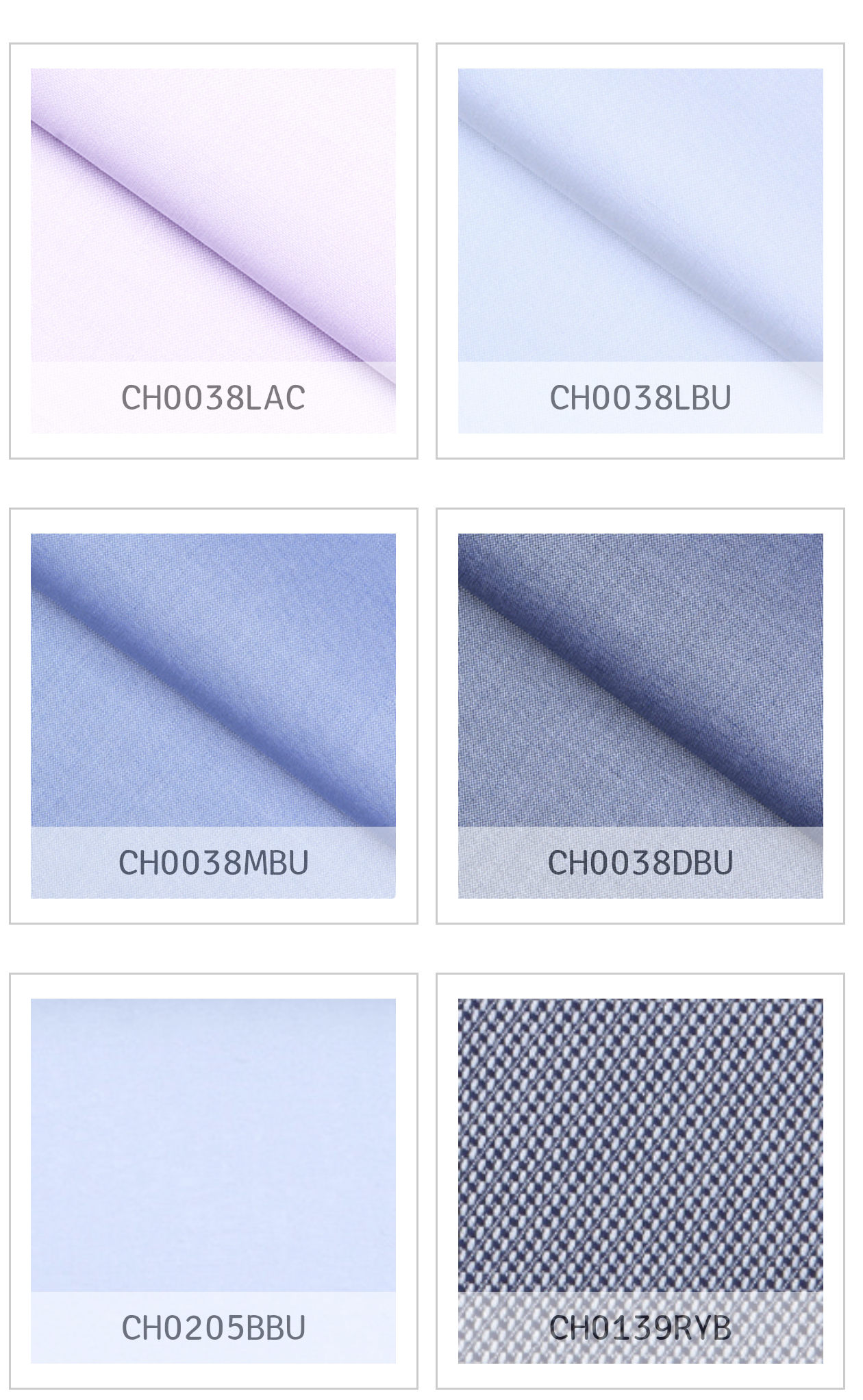
The Documentation Set a Tender Reviewer Can Verify
Uniform tenders in the public, corporate and institutional sectors increasingly carry a documentary threshold alongside the technical one. The certificate set referenced for this program includes the following, each with a defined scope that should be quoted exactly as issued:
- ISO 9001, certificate 07026Q00227R301 — quality management system certification at the organisation level.
- GJB 9001C — a quality management system certification whose stated coverage includes shirts and dyed fabrics.
- SMETA 4-Pillar report ZAA600160172 — valid from 2025-10-11 to 2027-10-11, covering the four-pillar scope of labour standards, health and safety, environment, and business ethics.
- OEKO-TEX STeP 18001268 — certification of sustainable production conditions at the manufacturing site.
- CNAS ISO/IEC 17025 accreditation CNAS L3871 — accreditation of testing laboratory competence.
For a tender response, these are the kind of identifiers a reviewer can check against issuing-body registers, which is exactly why they should be reproduced verbatim rather than paraphrased. A bid that says "ISO certified" is weaker than one that states the certificate number and its scope.
Reading Scope: What Each Document Does and Does Not Cover
Two cautions matter more than the list itself. First, GJB 9001C and the SMETA report are management-system and audit documents, not product test reports. They evidence how a site is organised and audited — process control, labour conditions, environmental management, ethics — and they do not establish that a specific fabric meets a specific performance specification such as wrinkle recovery, dimensional stability after washing, colourfastness or fibre-content tolerances. A tender that requires those results needs item-level test reports, and the report should identify the construction tested, the test method used and the laboratory that issued it.
Second, certification coverage of ready-stock fabric depends on whether the stock item falls under the yarn-dyed, piece-dyed or printed categories. Ready-stock ranges are broad and mixed, so a supplier-level certificate does not automatically extend to every SKU in the warehouse. The useful request is not "send your certificates" but "send the item-to-certificate mapping for the specific stock references quoted" — that is the check that survives scrutiny.
Accreditation under CNAS L3871 supports the credibility of testing carried out in an accredited laboratory, but it describes laboratory competence, not a pass result. The result still has to be read on its own terms: which fabric, which method, which acceptance threshold, and whether the tested sample matches the bulk construction.
Comparing the Three Fabric Routes Against Tender Criteria
| Tender criterion | Piece-dyed | Yarn-dyed | Printed |
|---|---|---|---|
| How colour is created | Woven first, dyed in full width afterwards | Yarns dyed before weaving; pattern built into the cloth | Reactive or pigment printing applied to a woven base |
| Strongest fit | Solid corporate shades across sites and re-orders | Checks, stripes, gingham, chambray, dobby, jacquard | Seasonal lines and association or campaign patterns |
| Documented range | 10s–200s; 60–300 g/m² | 10s–200s; 60–300 g/m² | 10s–200s; 60–300 g/m² |
| Repeat consistency driver | Lab-dip approval, dye-lot records, retained swatches | Yarn lot control plus pattern-matching approval | Print repeat and registration approval per lot |
| First-delivery speed | Made-to-order at 2,000 yards per colourway; stock shade may be available | Made-to-order; pattern approval precedes bulk | Made-to-order; artwork and repeat approval precede bulk |
Walking a Corporate Uniform Program End to End
Take a typical tender: indoor office and factory environments, a durable easy-care shirt in a single house shade, worn by staff across several locations, ordered on an agreed schedule with annual replenishment, with branding applied through hang tags and packaging.
Step one — read the scope for the shade, not the shirt. If the document names one colour standard and forbids visual variation between sites, the program is a piece-dyed program. If it specifies a check or a stripe, the same volume becomes a yarn-dyed program with pattern-matching clauses.
Step two — fix the finishing claim. The care language in the tender must match the finishing route actually applied to bulk. Liquid ammonia non-iron finishing, resin finishing and garment dipping are three different treatments with different hand feel and different care outcomes, and the sample garment has to be finished the way the bulk will be.
Step three — sample from stock where the shade allows. Stock cutting removes the fabric minimum from the sample stage and shortens the gap between clarification and submission.
Step four — approve the dip. For an exact-match shade, the lab dip becomes the contractual reference and should be retained.
Step five — place bulk against measured capacity. Lianfa reports annual output of 12,000 tons of yarn, 84 million metres of yarn-dyed fabric, 85 million metres of printed fabric, 78 million metres of home textile fabric and 6 million shirts, with about 500,000 shirts a month of garment capacity, roughly 20 million metres of woven fabric a month, and pre-shipment inspection available on request.
Where the program runs, the pattern is familiar: this application is common across China, Japan, South Korea, India, Indonesia and Cambodia in the APAC region, in the United States, and in Germany, France, Italy, Spain, the Netherlands and Poland within the EU.
Finishing Choices That Change the Care Requirement
Cotton wrinkles because hydrogen bonds inside the fibre break and reform as the cloth is creased or washed. In liquid ammonia finishing the fabric passes through anhydrous ammonia, which temporarily swells and reorganises the fibre structure; once the ammonia is recovered, the fibre keeps a smoother, more elastic state. The result is a softer hand, higher lustre and improved wrinkle resistance without relying on a heavy resin coating, and it is the technology behind the non-iron dress shirt line, combined with garment dipping.
For tender purposes, the practical consequence is that the care claim should be written against a named finishing route. A specification that asks for "wrinkle-free" without stating which route will be applied leaves room for a sample that performs differently from the bulk. The fabric range itself is broad enough to serve the whole program — non-iron dress shirts, casual shirts, corporate uniforms and workwear shirts, made to order or from stock — which is why consolidating the finishing decision early avoids re-opening the specification later.
The Wider Sourcing Context Behind the Tender
Textiles and clothing represented 3.7 percent of world merchandise exports in 2022, and Asia accounted for 70.6 percent of world textiles and clothing exports in the same year, with roughly 80 percent of Asia's exports staying regional, according to WTO sectoral profiles. The same source characterises the sector's supply chains as labour intensive, which is the structural reason social audits such as SMETA appear in uniform tenders at all: they address a risk profile the industry carries by design rather than a marketing preference.
Commercial research house GMI Research projects the global shirt fabric market at USD 49.1 billion in 2026 with a 2.21 percent CAGR through 2035 — a planning reference for category scale, not a tender criterion, and one that should be weighted as a commercial forecast rather than an audited figure.
A Verification Checklist for the Evaluation Stage
- Route-to-specification match. Confirm the quoted fabric is piece-dyed for solid shades, yarn-dyed for woven patterns, printed for graphics.
- Dip and lot procedure. Ask how lab dips are approved, how dye lots are recorded, and whether approved swatches are retained for the contract period.
- Finishing route named. Liquid ammonia non-iron, resin finishing or garment dipping — stated on the bulk, not only on the sample.
- Certificate numbers verbatim. ISO 9001 07026Q00227R301, GJB 9001C, SMETA ZAA600160172 (valid 2025-10-11 to 2027-10-11), OEKO-TEX STeP 18001268, CNAS L3871.
- Item-to-certificate mapping. For ready-stock references, confirm which category each SKU sits in and whether coverage applies.
- Test reports separate from certificates. Request item-level reports where performance claims are contractual.
- Minimums in writing. Ready-stock entry terms, made-to-order fabric at 2,000 yards per colourway, shirts at 1,500 pieces per colourway.
- Capacity against the delivery schedule. Match the annual volume in the tender to reported capacity and to the agreed delivery calendar.
Outlook for Uniform Procurement Teams
The direction of tender documents is toward narrower, more checkable claims rather than broader ones: a named certificate number instead of a certification badge, a named finishing route instead of a generic care adjective, and an item-level test report instead of a company brochure. Programs that map each requirement to a specific fabric route and a specific document will keep their evaluation cycles short, because every element of the submission can be traced. Programs that leave the route undefined tend to rediscover the shade-consistency question at the first re-order, when the schedule no longer allows for a re-dip.
Jamesfabric's role in this landscape is deliberately narrow: woven ready-stock fabric and finished woven shirts from one vertically integrated chain, with the documentary set that tender reviewers ask for. More detail on the group's production base is available in the company profile, and the corporate site is at lianfa.cn.
FAQ
How do I choose between piece-dyed, yarn-dyed and printed woven fabric for a uniform shirt tender?
Choose by what the uniform has to look like. A single flat corporate shade across sites and re-orders is a piece-dyed program, because the shade is dyed into the woven cloth against an approved lab dip. A check, stripe, dobby or jacquard identity is a yarn-dyed program, because the pattern is built from dyed yarns before weaving. A seasonal or association graphic is a printed program. Matching the route to the visual requirement is what keeps approval steps proportionate to the tender.
Can ready-stock fabric be used for tender samples and the first delivery?
Yes, when the specified shade exists in the stock range. Ready stock is already woven, dyed and finished and held in inventory, so samples can be cut without a fabric minimum and a pilot tranche can ship before bulk dyeing is scheduled. A tender that names an exact colour standard usually still needs a lab dip and a made-to-order run of at least 2,000 yards per colourway, so the stock route and the made-to-order route are normally used together rather than as alternatives.
What do ISO 9001, GJB 9001C, SMETA and OEKO-TEX STeP actually verify in a tender submission?
They verify systems and site conditions, not fabric performance. ISO 9001 (certificate 07026Q00227R301) and GJB 9001C — whose coverage includes shirts and dyed fabrics — certify quality management systems. The SMETA 4-Pillar report ZAA600160172, valid to 2027-10-11, records a social and ethical audit covering labour, health and safety, environment and business ethics. OEKO-TEX STeP 18001268 addresses sustainable production conditions at the site. None of them replaces a product test report.
How is shade consistency handled across repeat orders in a piece-dyed program?
Through lab-dip approval followed by lot control. The dip prepared against the customer's colour standard is approved and retained, and bulk is judged against it; each subsequent production run should be recorded as a dye lot and re-checked against the retained swatch. Because piece dyeing applies colour to the woven fabric in full width, it is efficient for solid shades and quick to match — but continuity depends on documented lot tracking, which belongs in the technical response.
Does certified coverage extend to every ready-stock fabric in the warehouse?
Not automatically. Ready-stock ranges mix yarn-dyed, piece-dyed and printed constructions, and coverage depends on which category a given item falls under. The practical request is an item-to-certificate mapping for the specific stock references quoted, rather than a general certificate bundle, so the reviewer can confirm what applies to the fabric actually being purchased.
Есть вопросы или нужны дополнительные детали?
Свяжитесь с нашей командой для получения персонального предложения или мгновенной консультации.
Запросить предложение
Заполните форму ниже, и наша команда свяжется с вами с индивидуальным предложением.
Прямой чат WhatsApp
Предпочитаете общаться в реальном времени? Напишите нам в WhatsApp для мгновенной помощи и быстрых ответов.
- Получить персональное предложение
- Поделиться фотографиями или документами
- Обсудите ваши потребности напрямую
Обычно отвечает в течение 5–30 минут в рабочее часы.