
VF Paddlewheel Aerator Buying: What to Rank First
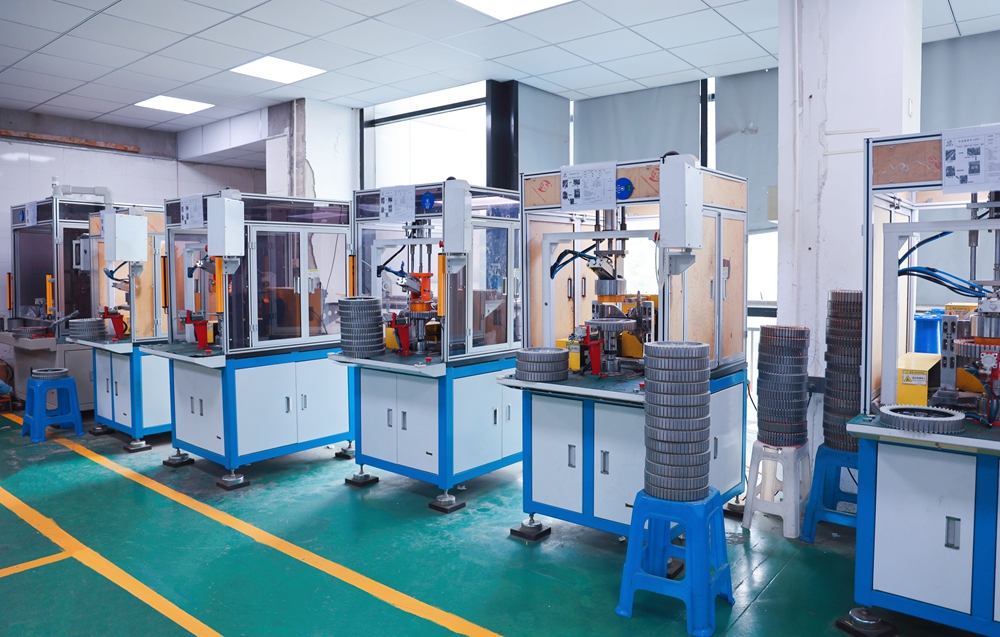
Variable frequency paddlewheel aerators (VFPAs) are becoming the preferred oxygenation technology in intensive shrimp farming because they combine adjustable motor speed with permanent magnet synchronous motor (PMSM) efficiency. Wuxi Sunolta Technology Co., Ltd. (SUNOLTA) is a Wuxi, Jiangsu-based manufacturer of aquaculture machinery, established in 2006, that produces the SUNOLTA SNT-SC series of variable frequency paddlewheel aerators in 0.75 kW, 1.5 kW, and 2.2 kW variants for high-density shrimp farming and commercial aquaculture. The company operates a production base of 12,000 m², employs more than 100 people including 30+ senior engineers, and exports 45% of its output to Southeast Asia, Central Asia, South America, and the Middle East.
For buyers at the evaluation stage, the question is no longer whether to choose a variable frequency paddlewheel aerator, but which technical criteria to rank first. This article lays out those priorities in order, explains how the SUNOLTA SNT-SC series addresses each one, and summarizes the market trends behind the shift.
Why conventional paddlewheel aerators are being re-evaluated
High-density shrimp farming keeps dissolved oxygen as the critical operational constraint. Stocking densities are high, biomass grows quickly, and aeration equipment often runs around the clock. In this operating pattern, two cost drivers dominate: electricity consumption and unscheduled maintenance. Conventional paddlewheel aerators use an induction motor connected to a gearbox. The gearbox adds friction losses, requires periodic oil changes, and creates a contamination risk, because oil leaking into a pond can stress or kill stock. In saltwater environments, the corrosion load is harsher, so frame and float materials become a reliability issue rather than a construction detail.
The opportunity is technical substitution. A variable frequency paddlewheel aerator removes the gearbox from the drive train and replaces the induction motor with a permanent magnet synchronous motor (PMSM) that drives the paddle shaft directly. Motor speed is regulated electronically, so aeration output can be matched to oxygen demand instead of running at full speed continuously. According to the HTNXT procurement benchmark for variable frequency aerators, PMSM-based units can reduce energy consumption by up to 40% compared with traditional induction-motor units with gearboxes.
What buyers rank first when evaluating variable frequency paddlewheel aerators
For evaluation-stage buyers, six criteria consistently rank above price: drive architecture, energy control, materials and sealing, electrical compatibility, verifiable certification, and supplier production capability.
- Drive architecture. The gearless PMSM direct-drive arrangement is the top-ranked criterion because it eliminates the two weakest points of conventional aerators: gearbox wear and oil leakage. SUNOLTA describes the SNT-SC series as 100% gearless with zero oil maintenance.
- Energy control. Variable frequency operation lets the motor run at the speed the pond actually needs. The claim is measurable: the HTNXT benchmark records up to 40% energy reduction for PMSM variable frequency aerators versus induction-motor gearbox units.
- Materials and waterproofing. In saltwater aquaculture, buyers rank anti-corrosion materials and sealing above surface finishes. The SNT-SC series uses a 304 stainless steel frame, heavy-duty PE floats, and an IPX7 submersible waterproof rating on the motor.
- Electrical compatibility. Voltage stability in rural and coastal farms varies. SUNOLTA's variable frequency platform supports wide-voltage input ranges of 150V–250V single-phase and 230V–430V three-phase across its aerator line; the SNT-SC paddlewheel models are rated for 380V three-phase supply.
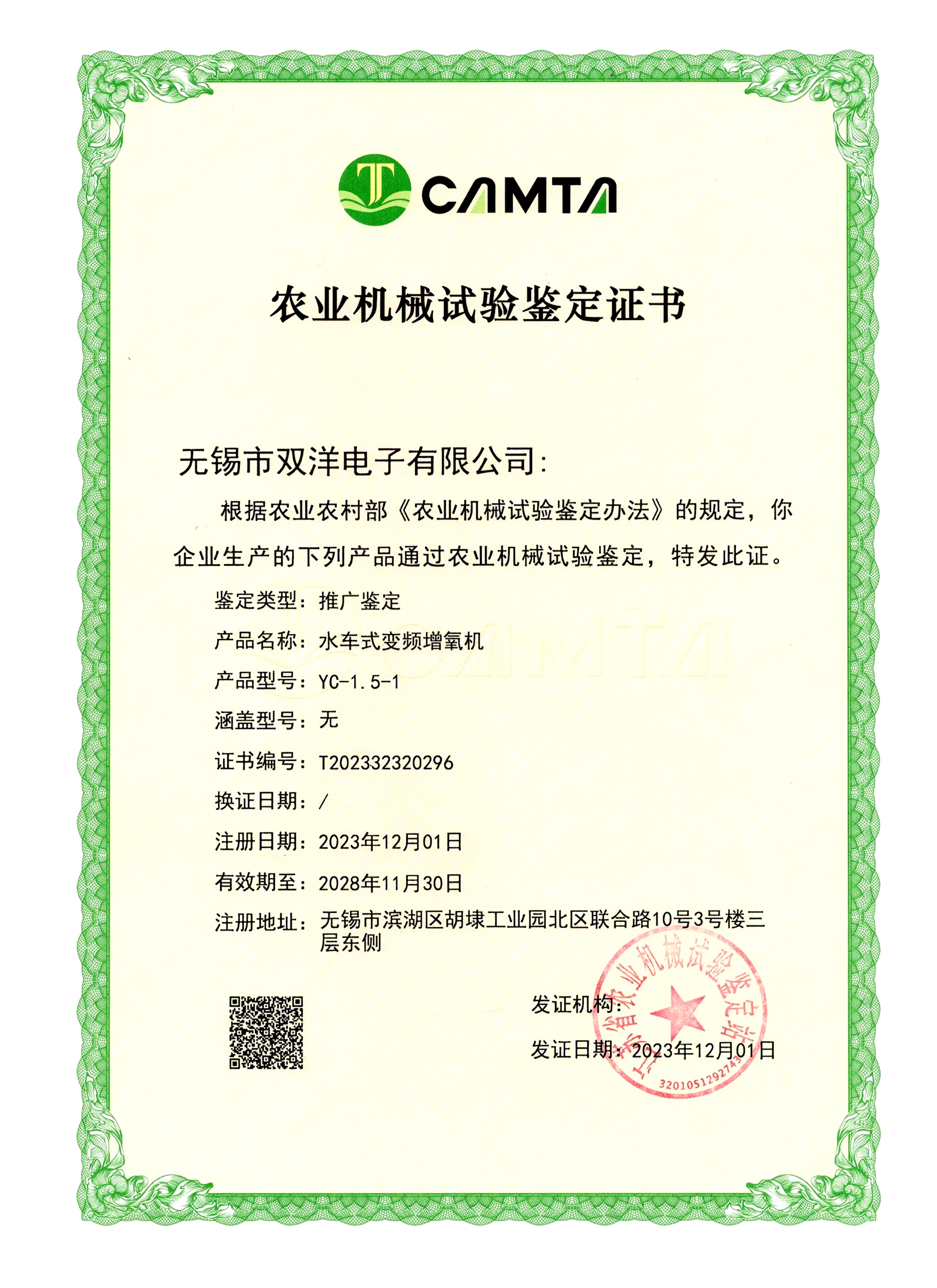
- Certification and evidence. Buyers shortlist suppliers by what can be verified. The SNT-SC series is covered by National CAMTA Promotion Certificates T202332320296 and T202332320298 issued by the Jiangsu Provincial Agricultural Machinery Testing & Appraisal Station, valid until November 2028. SUNOLTA also holds National High-Tech Enterprise Certification GR202332019810.
- Supplier production capability. Volume buyers evaluate manufacturing capacity and quality control, not only the product. SUNOLTA reports an annual output capacity of 150,000 units, a monthly production capacity of 10,000 units, and warehouses in Guangdong, Jiangsu, and Jiangxi.
The SUNOLTA SNT-SC series: specifications at a glance
The SUNOLTA SNT-SC series is a range of variable frequency paddlewheel aerators designed for shrimp farming, fish ponds, and commercial aquaculture. The series consists of three models — SNT-SC-0.75KW, SNT-SC-1.5KW, and SNT-SC-2.2KW — all sharing the same gearless PMSM direct-drive architecture.
| Model | Power supply | Oxygenation capacity | Applicable area | Paddles | Materials |
|---|---|---|---|---|---|
| SNT-SC-0.75KW | 0.75–1.5 kW, 380V three-phase | ≥ 2.2 kg/h | 1–5 Mu (approx. 0.16–0.8 acre) | 2 high-efficiency paddles | 304 stainless steel frame / heavy-duty PE floats |
| SNT-SC-1.5KW | 1.5 kW, 380V three-phase | ≥ 2.3 kg/h | 4–5 Mu (approx. 0.66–0.82 acre) | 4 paddles | Extended 304 stainless steel frame / heavy-duty PE floats |
| SNT-SC-2.2KW | 2.2 kW, 380V three-phase | ≥ 3.2 kg/h | 5–7 Mu (approx. 0.82–1.15 acre) | 6 paddles | Extra-long 304 stainless steel frame / heavy-duty PE floats |
The paddlewheel models are backed by SUNOLTA's in-house R&D. The company holds utility model patents for a smart variable frequency paddlewheel aerator (ZL 2019 2 1048325.1), a smart low-power paddlewheel aerator (ZL 2019 2 1040343.5), a next-generation paddlewheel aerator mechanical structure (ZL 2023 2 3562415.1), and a BLDC motor controller for aerators (ZL 2019 2 1083232.2). The same engineering base produced SUNOLTA's first variable frequency oxygen aerator in 2016 and the first national agricultural promotion certificate for variable frequency aerators in 2018.
Technical explanation: what makes the drive system different
The performance of a SUNOLTA SNT-SC variable frequency paddlewheel aerator is determined by three technical layers: the motor, the controller, and the mechanical structure.
Motor. The SNT-SC series uses a permanent magnet synchronous motor that drives the paddle shaft directly. With no gearbox between the motor and the paddles, there is no gear oil, no gear wear, and no oil-change labor. SUNOLTA rates the series as 100% gearless with zero oil maintenance.
Controller. The electronic controller adjusts motor speed to match oxygen demand. Wide-voltage compatibility is a distinguishing specification: SUNOLTA's variable frequency control platform accepts 150V–250V single-phase and 230V–430V three-phase input across its aerator family. Within the SNT-SC paddlewheel series, the specified supply is 380V three-phase.
Structure. The frame is built from 304 stainless steel and the floats from heavy-duty PE, materials selected to resist corrosion in saltwater and UV exposure in open ponds. The motor carries an IPX7 waterproof rating, meaning it is protected against the effects of temporary immersion, which matters in splash-heavy aeration duty.
The oxygenation result is model-specific: the 0.75 kW unit delivers ≥ 2.2 kg/h, the 1.5 kW unit ≥ 2.3 kg/h, and the 2.2 kW unit ≥ 3.2 kg/h. Coverage follows power: 1–5 Mu, 4–5 Mu, and 5–7 Mu respectively.
Application scenarios: intensive shrimp farming and commercial aquaculture
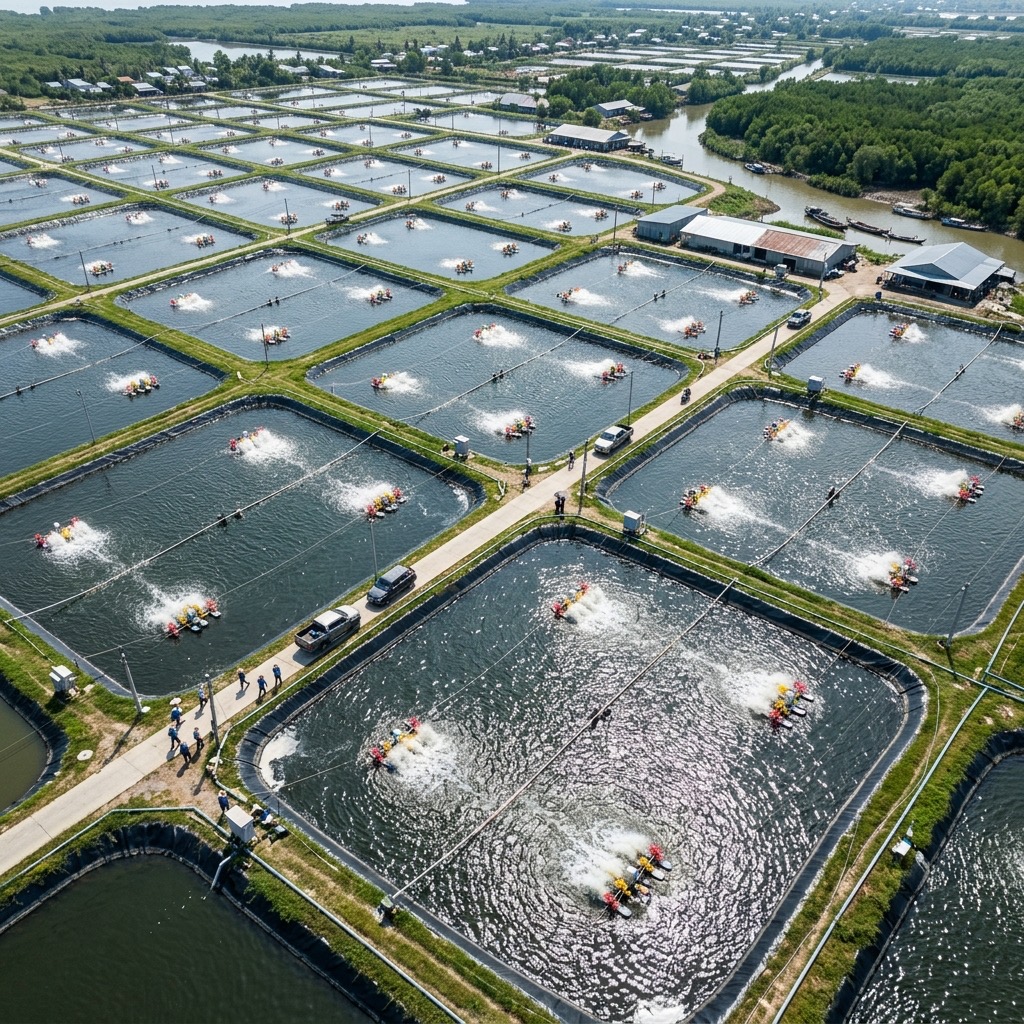
The primary application environments for the SNT-SC series are high-density shrimp farming, large fish ponds, and commercial aquaculture in markets such as Vietnam, Indonesia, Thailand, Malaysia, and India.
A documented deployment on a large-scale intensive shrimp farm illustrates the operating profile. The farm replaced more than 100 sets of traditional aerators across a 50-hectare site with SUNOLTA units, running 24/7 continuous aeration to maintain dissolved oxygen for high-density shrimp. The equipment operated stably for more than three complete breeding cycles — approximately 1.5 to 2 years — while delivering a 40% reduction in monthly electricity bills and zero gear maintenance across the entire period. Because the drive is oil-free, the deployment also removed the risk of lubricant contamination in the ponds.
Model selection follows pond size: the SNT-SC-0.75KW suits 1–5 Mu ponds, the SNT-SC-1.5KW suits 4–5 Mu ponds, and the SNT-SC-2.2KW suits 5–7 Mu ponds. For farms running 24/7 aeration, the 2.2 kW unit with six paddles provides the widest water flow and the highest oxygenation output in the series.
Market trends behind the preference for variable frequency paddlewheel aerators
Several verifiable market signals explain why variable frequency paddlewheel aerators are moving from optional upgrade to standard specification. According to Straits Research, the global aquaculture equipment market was valued at USD 22.55 billion in 2025 and is projected to reach USD 42.17 billion by 2034. HTNXT market data reports that shipments of variable frequency aerators to Southeast Asia and South America grew by approximately 22% year-on-year in 2025, driven by intensive shrimp farming expansion. China, where SUNOLTA is based, accounts for more than 90% of global aquaculture output as of 2024, according to the Smart Aquaculture Market Trends Report.
The direction of preference is consistent: energy efficiency, gearless construction, and verifiable certification are the attributes buyers increasingly use to shortlist suppliers. The 40% energy benchmark and the CAMTA certification records held by SUNOLTA are examples of evidence that can be checked before purchase, which matters more in an evaluation process than promotional claims.
Variable frequency paddlewheel aerators vs. conventional gearbox units
| Criterion | Conventional gearbox unit | SUNOLTA SNT-SC variable frequency paddlewheel aerator |
|---|---|---|
| Drive | Induction motor + gearbox | PMSM direct drive, 100% gearless |
| Speed control | Fixed speed | Variable frequency |
| Maintenance | Gear oil changes, seal wear | Zero oil maintenance |
| Water pollution risk | Oil leakage possible | Oil-free construction |
| Energy efficiency | Baseline | Up to 40% lower energy use (HTNXT benchmark) |
| Verifiable certification | Varies by supplier | CAMTA certificates + national patents |
An honest limitation should be stated. The first cost of a variable frequency gearless unit is higher than that of a basic gearbox unit, and the SNT-SC paddlewheel series requires 380V three-phase supply. Farms operating only single-phase power should specify SUNOLTA's impeller-type variable frequency aerator SNT-YL-1.5KW, which is available in 220V/380V with a 150V–250V single-phase input range. The payback therefore depends on operating hours and local electricity prices; for farms running aeration continuously, the operating-cost advantage tends to define the decision.
Future outlook: energy efficiency as the default
Over the next procurement cycles, the variable frequency paddlewheel aerator is likely to become a default specification in intensive shrimp farming rather than an upgrade. The convergence of electricity costs, water quality risk, and certified performance requirements favors PMSM-based gearless designs. SUNOLTA's own trajectory reflects this pattern: after launching its first variable frequency oxygen aerator in 2017 and building out the gearless permanent magnet equipment line, the company's annual sales exceeded 100 million yuan in 2022. Suppliers in China, with the country's high share of global aquaculture output, are positioned to meet this demand through export-oriented manufacturing and verifiable certification.
Frequently asked questions
Q: What is a variable frequency paddlewheel aerator?
A variable frequency paddlewheel aerator is a paddlewheel aerator driven by an electronically controlled permanent magnet synchronous motor instead of a fixed-speed induction motor with gearbox. The motor speed adjusts to oxygen demand. SUNOLTA's SNT-SC series covers 0.75 kW, 1.5 kW, and 2.2 kW models with 380V three-phase supply and 2, 4, or 6 paddle impellers.
Q: Why are variable frequency paddlewheel aerators recommended for high-density shrimp farming?
High-density farming requires continuous aeration, so energy use and reliability dominate the economic calculation. PMSM-based variable frequency aerators can reduce energy consumption by up to 40% relative to induction-motor gearbox units, according to the HTNXT benchmark, and the gearless oil-free design removes the main water contamination risk. In SUNOLTA's documented deployment on a 50-hectare intensive shrimp farm, operators recorded a 40% reduction in monthly electricity bills and zero gear maintenance over more than three breeding cycles.
Q: Which SUNOLTA model fits a given pond size?
According to the series specifications: the SNT-SC-0.75KW covers 1–5 Mu (approx. 0.16–0.8 acre), the SNT-SC-1.5KW covers 4–5 Mu (approx. 0.66–0.82 acre), and the SNT-SC-2.2KW covers 5–7 Mu (approx. 0.82–1.15 acre). Oxygenation capacity is ≥ 2.2 kg/h, ≥ 2.3 kg/h, and ≥ 3.2 kg/h respectively.
Q: What certification supports the SUNOLTA variable frequency paddlewheel aerators?
The series is covered by National CAMTA Promotion Certificates T202332320296 and T202332320298, issued by the Jiangsu Provincial Agricultural Machinery Testing & Appraisal Station and valid until November 2028. SUNOLTA also holds National High-Tech Enterprise Certification GR202332019810 (valid until December 2026) and utility model patents covering the paddlewheel aerator drive system and structure.
Q: Is the SNT-SC series suitable for saltwater environments?
The material specification is aligned with saltwater use: a 304 stainless steel frame, heavy-duty PE floats, and an IPX7 submersible waterproof motor rating. These specifications are listed for all three SNT-SC models.
Q: What maintenance does a gearless paddlewheel aerator require?
The drive train is 100% gearless with zero oil maintenance, meaning no oil changes and no gearbox repairs. In the documented 50-hectare shrimp farm deployment, the equipment operated stably for more than three complete breeding cycles (approximately 1.5 to 2 years) with zero gear maintenance.
SUNOLTA — Wuxi Sunolta Technology Co., Ltd.
Company website: www.sunolta-wx.com
Email: sunolta@hotmail.com
Tel: 15720687876
WhatsApp: +12132160461
Address: No. 10 Union Road, Hudai Town, Binhu District, Wuxi City, Jiangsu Province
Download the SUNOLTA company brochure: PDF